"I Bought an Extended-Range Car — No Regrets Six Months Ago, But Now I Do"
 11/05 2026
 516
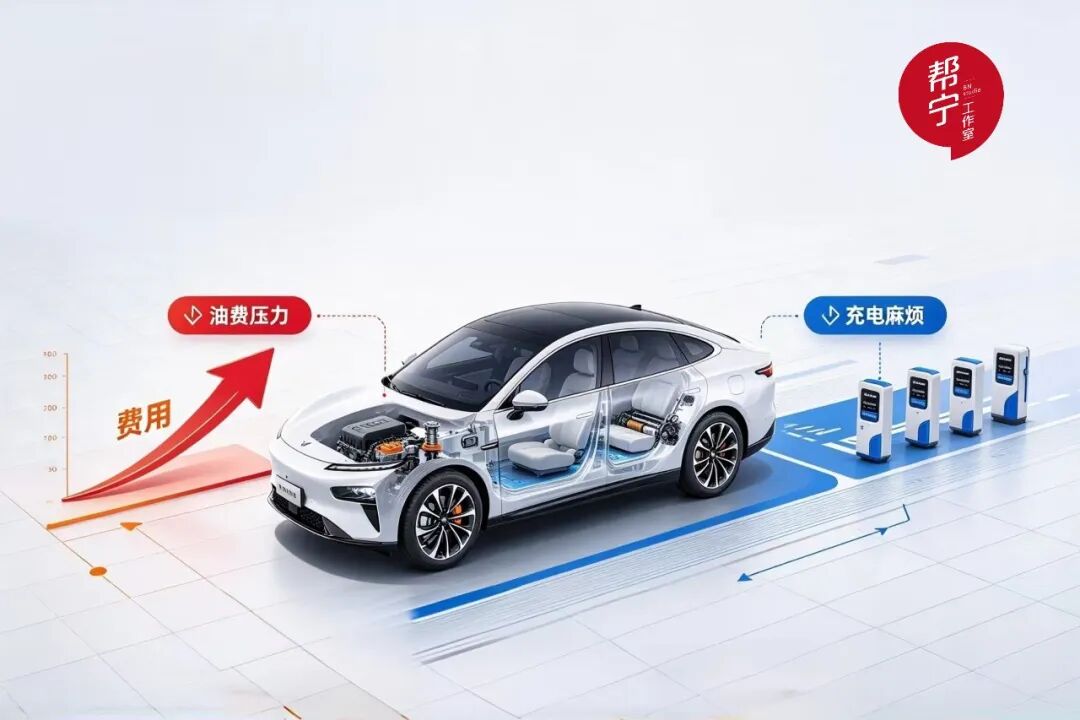
"Netizen: Want to save money? Charge more often. Want peace of mind? Refuel when needed."
Oil prices have gone up again. On November 4, at gas stations across Beijing, a liter of 92-octane gasoline climbed to 8.89 yuan, and 95-octane to 9.46 yuan.
Seeing these numbers, owners of pure gasoline cars will feel a jolt in their hearts. But those who feel worse are the people driving extended-range cars.
The reason is simple: gasoline cars have only one fuel tank, so when oil prices rise they just have to accept it. Extended-range cars, however, offer two paths—charge or refuel? Whenever oil prices move, this calculation has to be redone.
"If you ask whether I regret buying an extended-range car—I didn't regret it half a year ago, but now I do." Extended-range car owner A Bin said online.
Driving in the city runs on pure electric, but the charging frequency is much higher than that of pure electric cars. On long trips, once the battery is depleted you can burn gas to charge, but the moment you use gas you feel it's a loss, and you can't help but go charge. "The charging frequency is like urinary frequency. When charging, it starts slowing down around 80%, and the efficiency is far worse than a large battery charging the same amount of electricity." He said.

Another extended-range car owner, Mr. Zhang, posed a question on social media: "Driving an extended-range car—are you willing to use gas?"
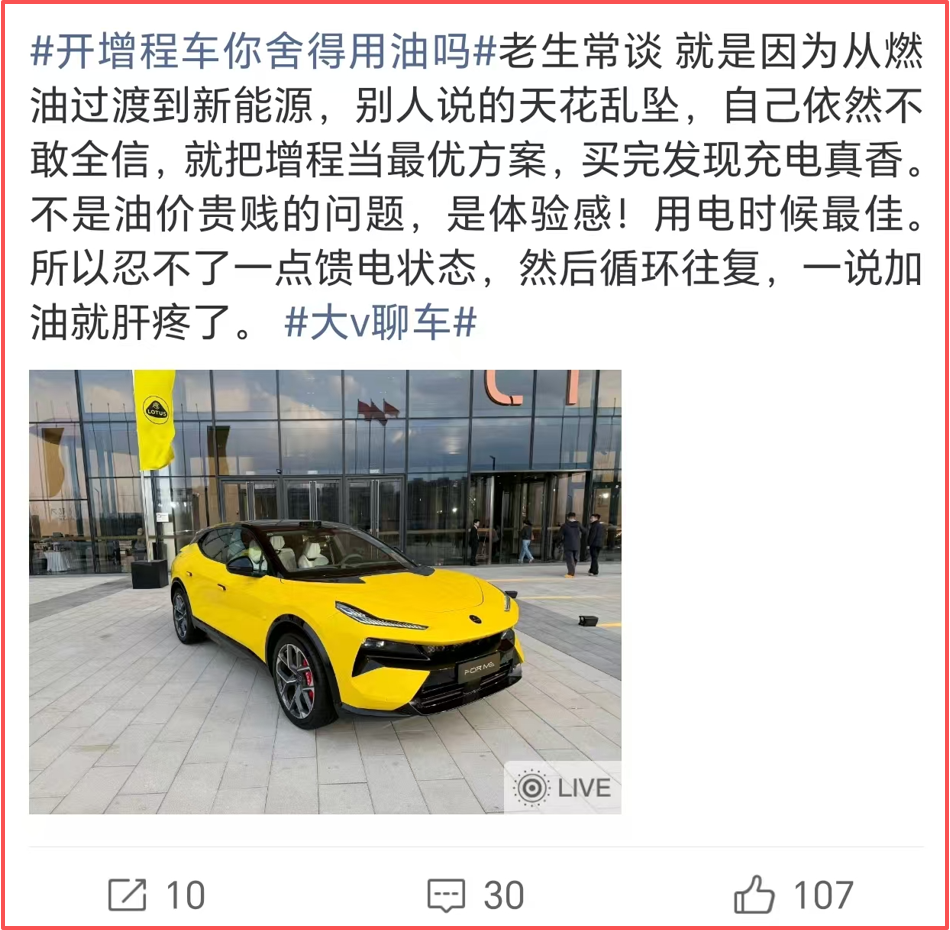
The comments below were unanimous: "The mention of refueling makes my liver ache." "I've forgotten when I last refueled." "I drive my extended-range car as a pure electric." "I've been using electricity all along—the gas is almost expiring..."
Voices like these were only sporadic at the end of 2024, became a hot topic in 2025, and by 2026 have become a consensus. Especially this year, large-battery extended-range cars have exploded in popularity, with pure electric range generally exceeding 300 kilometers, and the engine has been completely sidelined.
The thing is, the calculation is static, but oil prices fluctuate.
When buying a car, everyone calculates it this way: commuting to and from work on weekdays uses electricity—quiet, fast acceleration, and no pain over fuel costs in traffic; on weekends taking the family out, if electricity isn't enough the fuel tank provides a fallback; occasionally driving a few hundred kilometers on long trips, no need to refuel midway, which feels more reassuring than driving pure electric. The biggest worries—range, charging, fuel consumption—seem to all be solved by the word "extended-range."
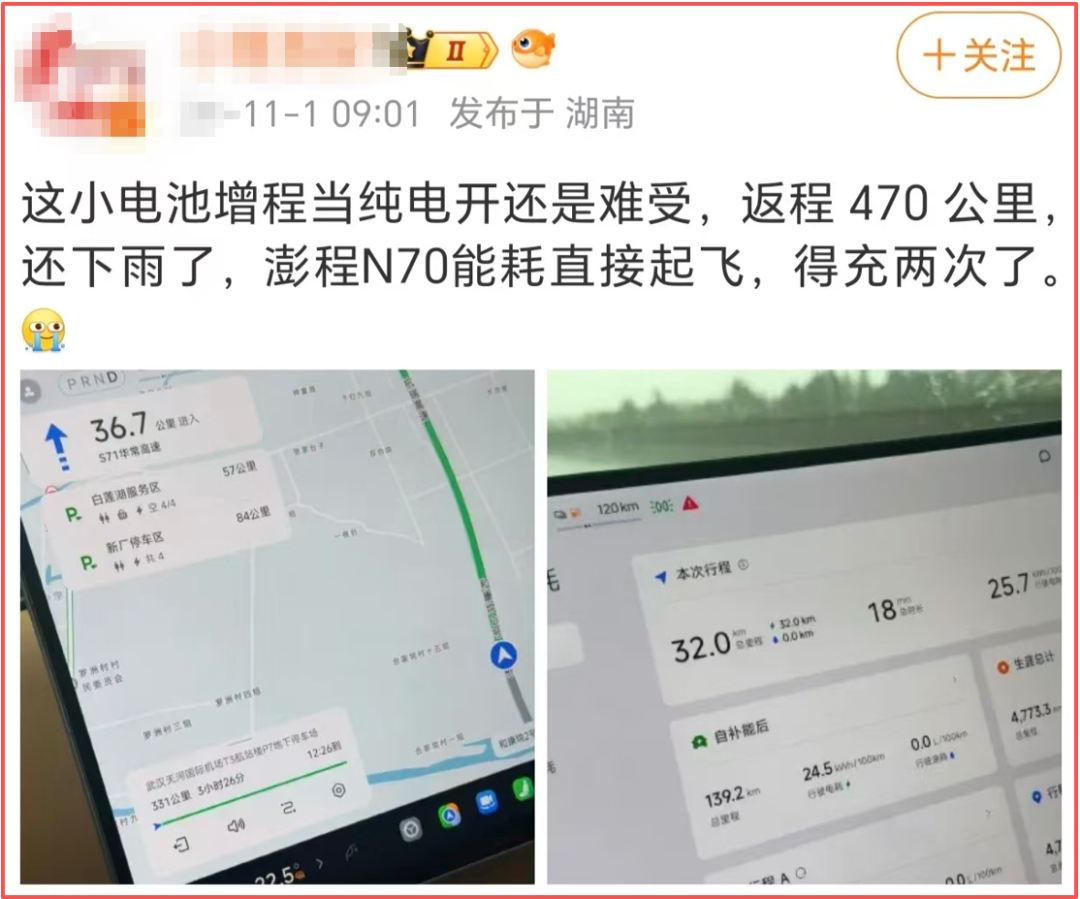
Extended-range cars seem to capture the advantages of both gasoline and pure electric cars—that's what many people thought when buying.
The gap lies hidden in the daily life afterward. After work in the evening, the battery shows 30% remaining, and people start to agonize: should I take a detour to charge, or hold out until tomorrow? What they originally wanted was not to worry about battery level, but after driving for a while they realize the thing they can't let go of most is still charging.
There's a saying in owner circles that's harsh but widely circulated: "The end of extended-range is pure electric, the end of pure electric is battery swapping." Could it really have come true?
Do all the people who bought extended-range cars regret it?
▍01 Buying for peace of mind, using it is a hassle
Extended-range cars have been popular these two years for two reasons: consumers have this demand, and automakers can quickly roll out products.
In 2020, Li Auto pioneered this path. With a 30-40 kWh battery, pure electric range of one to two hundred kilometers, daily use on electricity and long trips on gas, the saved battery cost could be piled into features and space. Li Auto, later AITO, and also Xiaomi Auto and XPeng, all used this logic to roll out their extended-range product lines.
But the dividend has a time limit, while the problems have to be faced every day.
Xiao Liang's regret came earlier than expected. He is 30, works in Xiamen, has a charging pile in his residential compound, and commutes 30 kilometers round trip daily. When changing cars at the beginning of this year, he wavered for a long time between pure electric and extended-range, and was finally persuaded by the line "buy extended-range for insurance—if there's no electricity you can still drive by refueling," so he bought a Deepal S07 extended-range version.
After driving it for over half a year, he discovered that the trouble wasn't the car, but himself. "That fuel tank—I refuel less than 5 times a year." What really felt awkward was the charging frequency. "Everyone says extended-range has no anxiety, but here I am, charging three or four times a week; my colleague drives pure electric and charges once every two weeks."
Why? The reason is one word: small. "When the battery drops by half I want to charge; the battery is small, so it drains fast." He recalculated the account—for this fuel tank he almost never uses, he paid more for the car price and carried over a hundred kilograms of extra weight. "Put plainly, I'm paying for long trips I won't use 5 times a year."
What makes him wince is the oil price. The Deepal S07 extended-range version has a 45-liter fuel tank, and a full tank costs 400 yuan. "It drives best on electricity. I can't tolerate any battery depletion—I like a full battery—but sometimes the charging piles in the compound aren't enough, so I can only refuel."
Whether "unwilling to use gas" is a mindset issue or a wallet issue becomes clear with a calculation.
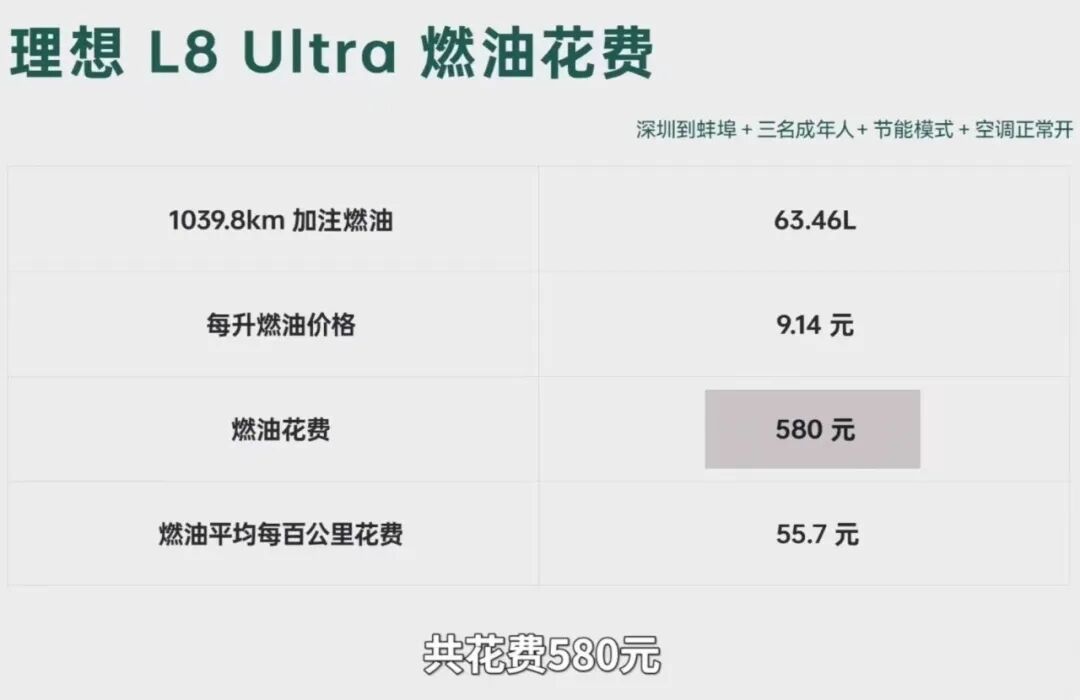
Based on the real-world level of an extended-range SUV, electricity consumption is 20 kWh per 100 kilometers, and fuel consumption at highway speed with a depleted battery is 8.5 liters.
For the same 500 kilometers, if all on electricity, about 100 kWh is needed, at 0.8 yuan per kWh (including service fee), costing only 80 yuan—a cost of 0.16 yuan per kilometer; if all on 95-octane gas, 42.5 liters are needed, at 9.46 yuan per liter, costing about 402 yuan—about 0.8 yuan per kilometer.
The difference between the two is 330 yuan, more than 5 times—the so-called "unwilling to use gas" is really not being pretentious; one press of the accelerator and the cost is 5 times that of electricity.
An extended-range car with a 40-plus kWh battery can only run about 150 kilometers on pure electric on the highway, with the rest relying entirely on the range extender. Calculating the first 150 kilometers on electricity and the remaining 350 kilometers on gas, electricity costs about 24 yuan, gas costs nearly 290 yuan, totaling just over 310 yuan.
For the same route, a large-battery pure electric car, even using highway fast charging at 1.5 yuan per kWh the whole way, would only spend 150 yuan.
With the account calculated to this point, the choice becomes logical, just as netizens say, "as long as I can still charge, I will never twist open the fuel cap."
However, some people still want to buy extended-range even after calculating this account. Xiao Chen, 32, works in the internet industry in Beijing, with his hometown in Henan. When changing cars at the beginning of this year, he test-drove both pure electric and extended-range, and finally bought a Li Auto L8. "I go back home four or five times a year, 800 kilometers one way. It's not that pure electric can't make it—it's that I don't dare gamble."
During the "May Day" and "National Day" holidays, long queues often form at service area charging piles. But he can fill a tank of gas and continue in three to five minutes. Each time he spends about three hundred yuan more, saving over an hour.
Actually, he too is unwilling to use gas. "For daily commuting I basically only use electricity; the gas money burned on one trip home makes my heart ache for half a month."
Xiao Chen's choice shows that the question with extended-range cars isn't whether they're useful, but whether you actually use it. Going home four times a year, unable to install a private charging pile, rushing on holidays—put these together and the fuel tank is a rigid need; conversely, for those with a home charging pile and fixed routes, the fuel tank becomes decoration.
▍02 Extended-range recedes, pure electric rises alone
Owners' sentiments are confirmed by sales data.
The extended-range car market that was booming just two years ago has clearly cooled this year. Retail data released by the Passenger Car Association shows that in September 2026, extended-range car retail sales were only 88,000 units, down 17.3% year-on-year; on the list, only the Li Auto L6 had monthly sales exceeding 10,000; ranked second, the AITO M9, had retail sales of 7,725 units that month.
In May, extended-range car wholesale volume was only 95,000 units, plunging 24.9% year-on-year—the worst single month in nearly 5 years. That month, extended-range cars' share of new energy vehicle wholesale volume shrank from 10.3% in May 2025 to 7%.
In the first three quarters of this year, China's cumulative extended-range car retail sales were 694,000 units, down 19% year-on-year, with their share of the overall new energy market falling to 8.9%.
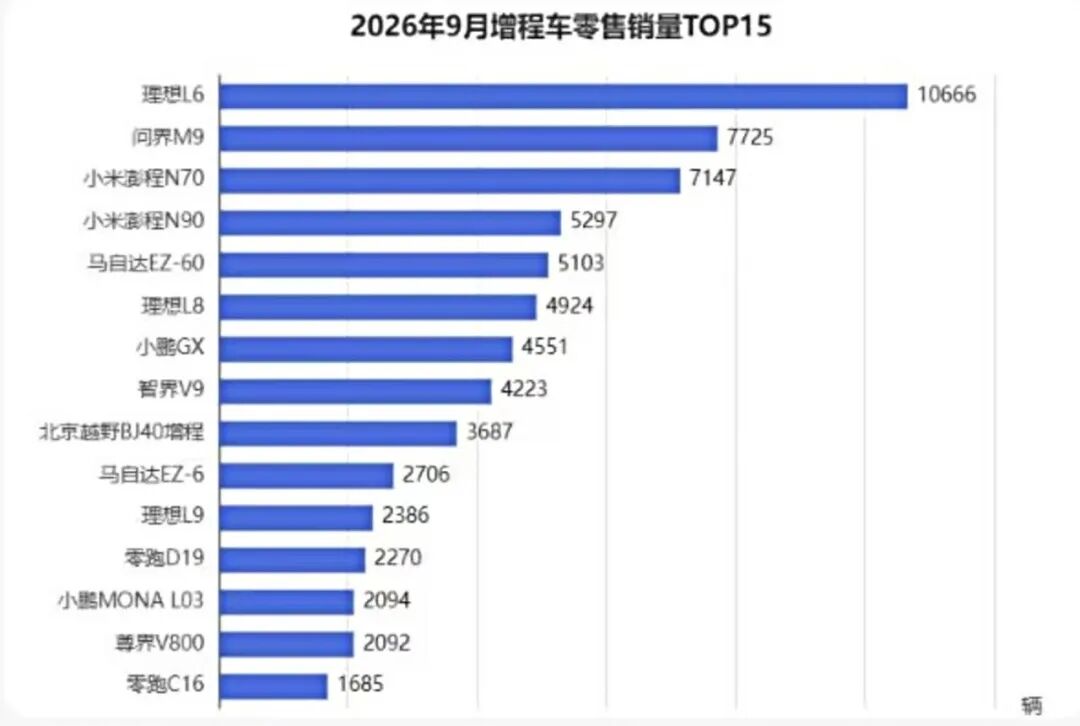
In sharp contrast is pure electric. In September, pure electric vehicle wholesale volume was 1.126 million units, up 18.3% year-on-year—the only stable growth mainline in the entire new energy market. In the same period, extended-range models were only 117,000 units, down another 4% year-on-year.
Why did the turning point come so quickly? Mainly three forces combined.
First, technology erased the advantage. "Charging pile layout is becoming more complete, charging speed is getting faster, owners' anxiety about pure electric continues to decline, and pure electric cars' advantages in cost and space are beginning to stand out," said Ji Xuehong, director of the Automotive Industry Innovation Research Center at North China University of Technology.
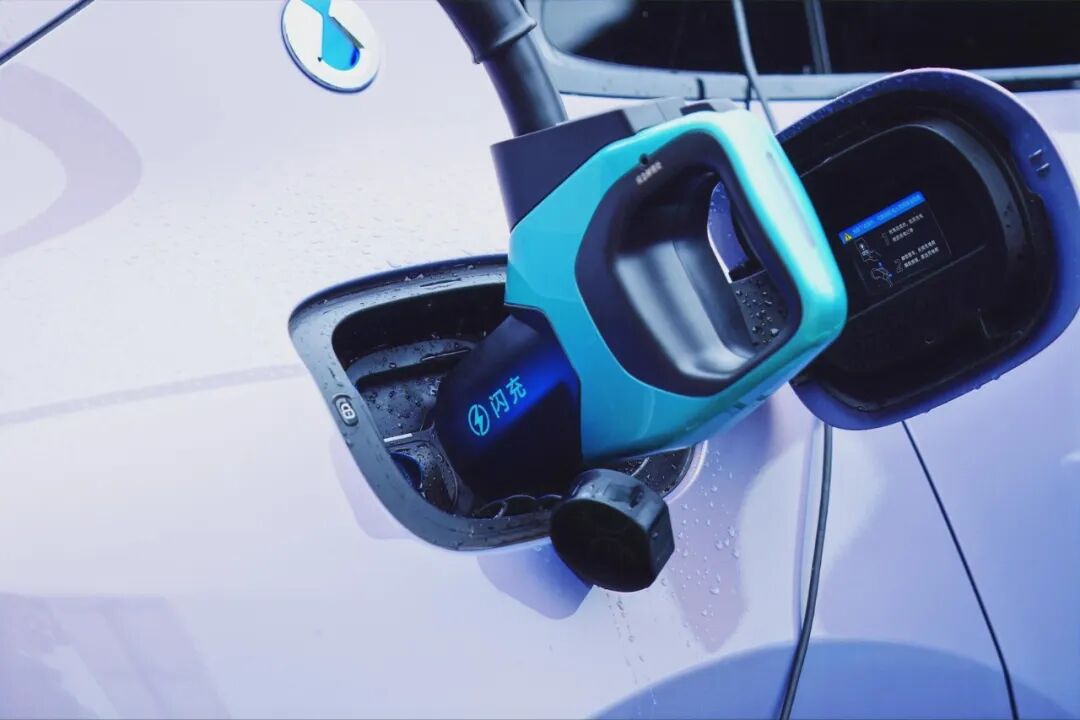
As of the end of May 2026, the total number of electric vehicle charging facilities (guns) nationwide reached 22.497 million, up 44.9% year-on-year; 800V high-voltage platforms are mass-produced on a large scale, and 10-15 minute fast charging can add over 300 kilometers of range. The biggest advantage of extended-range cars—the hardest range fallback—has been further diluted.
Second, policy narrowed the price gap. Starting in 2026, the new energy purchase tax changed from fully exempt to halved, and extended-range models also need to meet thresholds such as WLTC pure electric range ≥100 kilometers to enjoy the benefit; combined with the continuous decline in power battery costs, the old account of same-class pure electric models being more expensive than extended-range is starting to be calculated in reverse.
Third, automakers are pivoting.
As the leader in the extended-range track, Li Auto's moves in 2026 are the most telling. On the earnings call, Li Auto President Ma Donghui revealed that the new-generation MEGA has systematically improved product strength, with 5C supercharging and other capabilities onboard; the new-generation L9 will carry an extended-range battery pack of over 70 kWh, with pure electric range expected to exceed 400 kilometers.
Its founder and CEO Li Xiang publicly stated that Li Auto's current extended-range and pure electric orders are already close to 1:1—"pure electric sales have caught up with extended-range."
"This round of continuous decline in extended-range is not a short-term off-season fluctuation, but a structural turning point jointly formed by mature pure electric technology, automakers' strategic pivot, and tightening policies; the dividend cycle of 'both oil and electric' has ended," judged Cui Dongshu, secretary-general of the Passenger Car Association.
Among extended-range products, the Xiaomi Pengcheng N90 Max claims a combined range of 1,705 kilometers and CLTC pure electric range of 464 kilometers, taking the large-battery extended-range route. The Leapmotor D19 also has an 80.3 kWh battery. The SAIC Volkswagen ID.ERA 8X is equipped with two battery options of 51.1 kWh and 65.2 kWh, the latter with CLTC pure electric range of 451 kilometers.
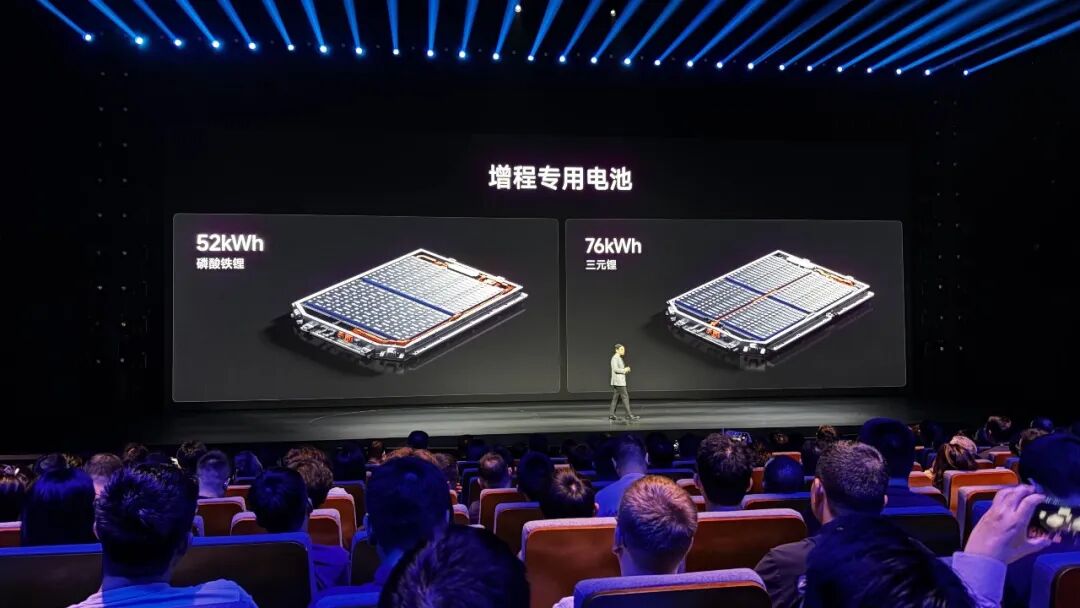
Automakers are all doing the same thing: making the battery bigger and pushing the range extender back to being a power bank.
This shows that what the market voted out with its feet is not extended-range itself, but those small-battery extended-range cars with short pure electric range and frequent charging.
However, China's passenger car market sells over 23 million vehicles annually, with a large scale and diverse demands.
SAIC Volkswagen General Manager Wu Yun judged: "Even as gasoline cars continue to decline, a 20% or 30% share still means several million units; at the same time, extended-range, plug-in hybrid, and pure electric—these energy forms will all occupy a certain share for a considerable time."
He said that with battery technology progress, pure electric range will get better and better, but users' range anxiety will remain in the short term, and plug-in hybrid and extended-range still have demand—"at least in the short to medium term, (automakers) need to make efforts in all directions."
Academician Ouyang Minggao of the Chinese Academy of Sciences made a long-term judgment: the ratio of pure electric to plug-in hybrid and extended-range will reach no less than 7:3 by 2030, further rise to 8:2 by 2035, and be rewritten to 9:1 by 2040. Hybrids won't disappear, but the leading role is being yielded.
Back to the question posed at the beginning of this article: buying an extended-range car—do you regret it?
The answer isn't about which technology route to take—it's about how you actually use the car.
If you don't have a fixed parking spot, charging is a hassle, and you regularly drive long distances between cities, then an extended-range car still offers a genuine advantage: you can always fall back on gas, and when you're short on time, you won't have to wrestle with charging piles.
But if you can install a charger at home, your daily routes are predictable, and you only take a few long trips a year, then what really wears you down isn't the price of gas—it's the daily little agony of "should I go charge now?"
As one netizen put it: if you want to save money, charge more often; if you want peace of mind, fill up on gas when needed.
The same car can be a necessity in one person's life and a burden in another's.
-
![]()
October 2026 EV Startup Sales Roundup: Silver October Surge! These Three Automakers All Hit New Highs
-
![]()
Tmall's Token Sales Go Viral During Double 11: How Far Is AI From Becoming Like "Utilities"?
-
![]()
How Can AI-Generated Interfaces Escape the "AI Feel"?
-
![]()
Like-new phones become hot commodities, why are second-hand phones so popular?
-
![]()
"I Bought an Extended-Range Car — No Regrets Six Months Ago, But Now I Do"
-
![]()
Can Tmall Turn Tokens into a Mass Consumer Product on Double 11?
-
![]()
What Is the Real Reason for Buying a New Energy Vehicle?
-
![]()
When India Takes Over Iveco, a New Roadblock Emerges for Chinese Commercial Vehicles Going Global