Does an "Intelligent Organization" Still Need Baidu?
 11/16 2026
 398

Chaoyong AI Editorial Team
Few industries are more prone to illusion than tech: whoever names the trend first is presumed qualified to lead it. On November 12, at Baidu World 2026, Robin Li dubbed the "intelligent organization" the next act of AI.
He offered an analogy with considerable staying power: AI is the new electricity, and the intelligent organization is the new factory of the AI era. An enterprise that merely swaps in AI tools is like replacing an old factory's motor—only by redesigning the organization can productivity truly be unleashed.
The judgment is sound; it may even be the most accurate summary of this year's organizational transformation at big tech companies. But the question Baidu must answer is not "will the intelligent organization arrive," but "on what grounds should Baidu define it."
Seeing the future and owning the future are two different things. Baidu has never lacked the former ability; what it has never fully proven is the latter.

Robin Li summarized a future that is already happening
Robin Li proposed three principles of evolution for the "intelligent organization": break down job boundaries, accumulate tacit knowledge, and design closed-loop processes. Jobs are the unit of the industrial age; tasks are the unit of the intelligent age.
As more and more execution work can be handed over to agents, the organization will no longer be merely a combination of people and reporting lines, but a network that operates around tasks.
He further judged that jobs will not disappear in the future but will converge into two categories: Builders, responsible for creating new things, and Sellers, responsible for communication, connection, and building trust.
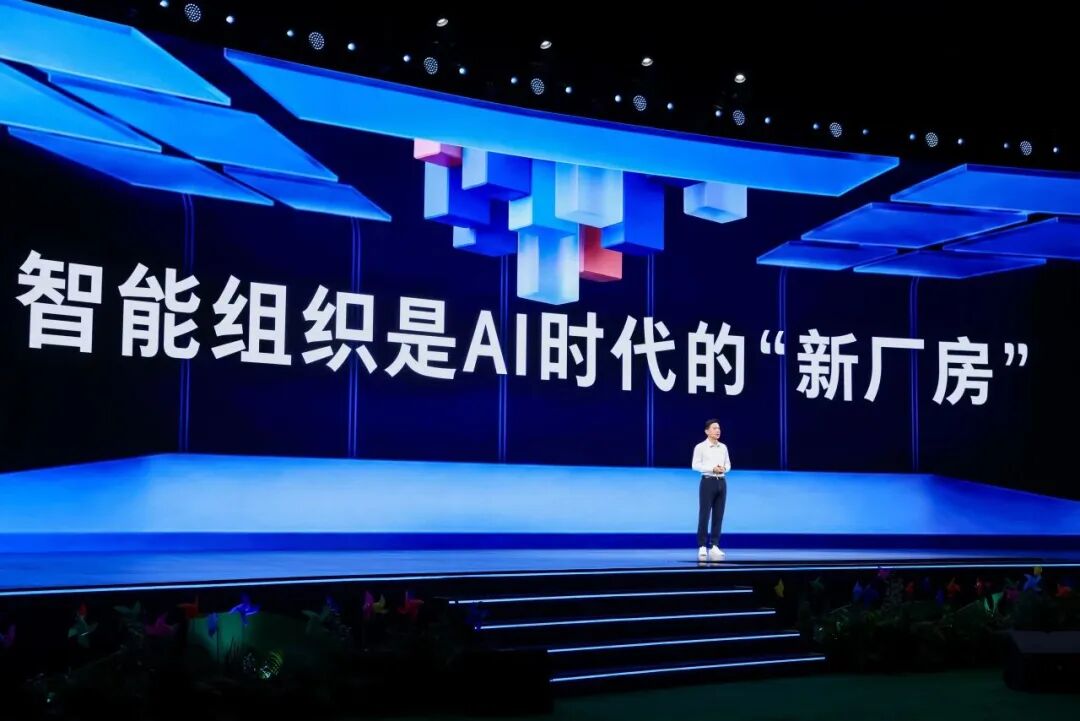
Baidu World Conference 2026
This dichotomy may not cover all occupations, but it captures how AI is re-screening the value of jobs: work that can be encoded, broken down, and repeatedly executed is accelerated toward machines, while creation and trust are closer to the long-term value of humans. Baidu also presented internal practices.
Robin Li disclosed that over the past year, Baidu's average daily active agents grew from 5,000 to 37,000, and the effective tasks completed by agents each week grew from 84,000 to more than 1 million; Baidu has built 4,300 Workspaces and accumulated more than 20,000 organizational Skills.
So the "intelligent organization" is not an empty slogan. Baidu is indeed trying to turn employee experience into reusable organizational assets, bring agents into workflows, and continuously optimize through feedback. The problem is that none of this is a new continent that Baidu discovered first.
In its annual Work Trend Index report released in April 2025, Microsoft already proposed the "Frontier Firm," discussing hybrid teams of human employees and agents, agents entering business processes, and how enterprises can turn AI usage experience into organizational capability.
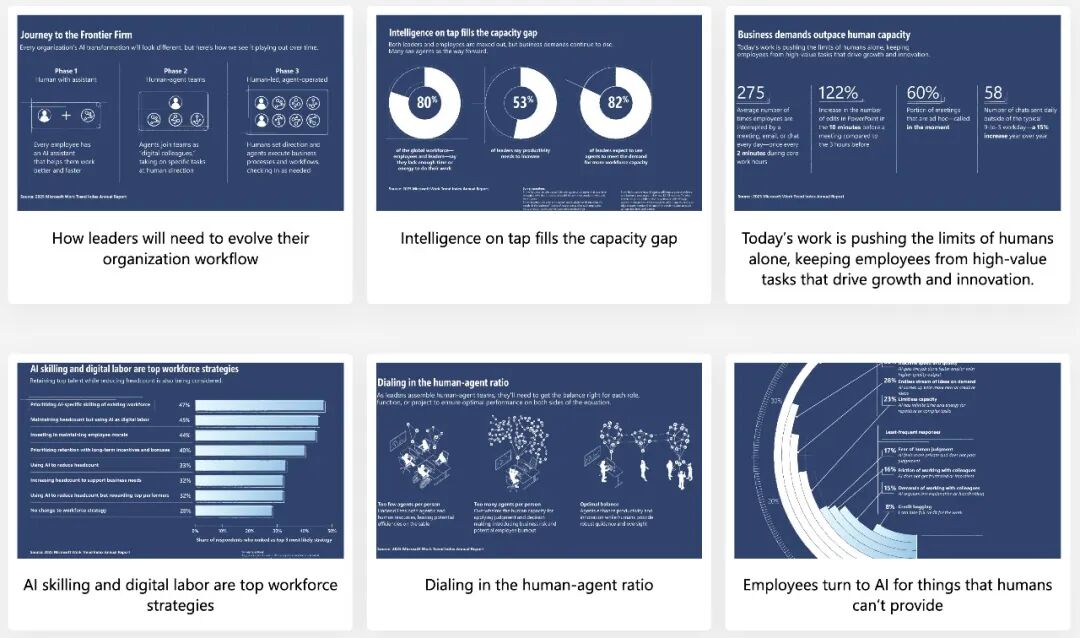
Microsoft Work Trend Index 2025
Domestic big tech companies and AI-native companies have been even more direct: cutting product lines, changing reporting relationships, and rearranging data and tool permissions so that organizations can operate around AI. Robin Li's contribution is to summarize these ongoing changes into a complete proposition, not to redefine productivity. Changes in productivity happen in the daily work where tasks are rewritten, knowledge is accumulated, and processes begin to close the loop, not at the moment a concept is named. Calling what is happening in the industry the "next act" does not mean one has already gained the leading role in that act.

Baidu has a full-stack system, but lacks a main axis that runs through the market
In terms of system completeness, Baidu remains a rare player among domestic big tech companies. From Kunlun chips, Baidu AI Cloud, and the ERNIE model to Baidu Dazi, Kuku, Baidu Yijing, and Famou, Baidu has built a four-layer architecture of "chips, cloud, models, and agents."
At this conference, the ERNIE 5.5 Flash preview, the Tianchi 1024-card super node, and upgrades to four agents pushed this system one step further.
The newly launched "Ciyuansuo" attempts to build a large-model trading platform, using verification and credit reporting to solve issues of model provenance, service quality, and invocation stability.
Baidu disclosed that within one month of launch, it had more than 100 supplier resources onboarded, with average daily token invocations exceeding 700 billion.

Baidu World Conference 2026
These products at least show that Baidu is not using an architecture diagram to talk about the intelligent organization. It has a technology foundation, internal scenarios, and a batch of applications that are looking for markets.
But full-stack answers "what can I provide," while a market entry point answers "why must customers work through me every day." These are two different questions. It is not that Baidu has no strong businesses.
Baidu's Q2 2026 financial report shows that AI cloud infrastructure revenue grew 50% year over year, and GPU cloud revenue grew 283% year over year; Apollo Go, digital humans, and other segmented businesses also have their own accumulated strengths... It cannot simply be said that Baidu "has nothing it can put on the table."
Its real problem is that these businesses have not yet formed a main axis that pulls the "intelligent organization." The cloud provides computing power, Ciyuansuo connects models, Dazi targets office work, Kuku handles documents and content, Yijing does digital humans, and Famou targets industrial decision-making.
Each piece has value, but there is not yet a sufficiently strong product that continuously draws users, data, tasks, and workflows into the same closed loop.
Tencent has WeChat and WeCom, Alibaba has DingTalk and Alibaba Cloud, and ByteDance has Doubao, Feishu, and Douyin.
They may not have formed the final intelligent organization, but they all have high-frequency scenarios to which AI capabilities can be continuously added. What Baidu lacks most is precisely this axis.
The outside world often describes Baidu as "rising early but arriving late at the market." Applied to the "intelligent organization," this does not mean Baidu fails to understand the trend, but points to the gap between its technology system and market results: early layout, many products, but ultimately no sufficiently strong entry point.
An architecture can be drawn in one go at a conference, but an entry point can only be won inch by inch with hit products.
Without an entry point, full-stack capability is just a set of parts waiting for customers to assemble themselves; with an entry point, it can become an organizational system that others find hard to replace.

Rivals have reorganized around entry points, while Baidu is still looking for a flagship product
From July to August 2026, Tencent, Alibaba, and ByteDance successively adjusted their AI office businesses. Tencent merged QClaw into the department where WorkBuddy is based;
Alibaba merged and reorganized three product lines—QoderWork, Wukong, and MuleRun—into the Qwen Office business unit; ByteDance merged the Feishu product team into the Doubao system, brought TRAE and Coze into Doubao, and then released "Doubao Work."
These adjustments may not all be correct, but they send a common signal: competition in the intelligent organization is no longer just about how many Agents are released, but about who dares to end internal horse racing and concentrate resources on a main entry point validated by the market.
Baidu Dazi is also doing similar integration and has achieved real growth; it should not be written off as "not in the top ranks."
According to QuestMobile data, in September 2026, Baidu Dazi had about 9.77 million monthly active users, ranking second among domestic AI office agents; but the first place, Tencent WorkBuddy, had 32.353 million, and the third place, Qwen Office, had 7.905 million.
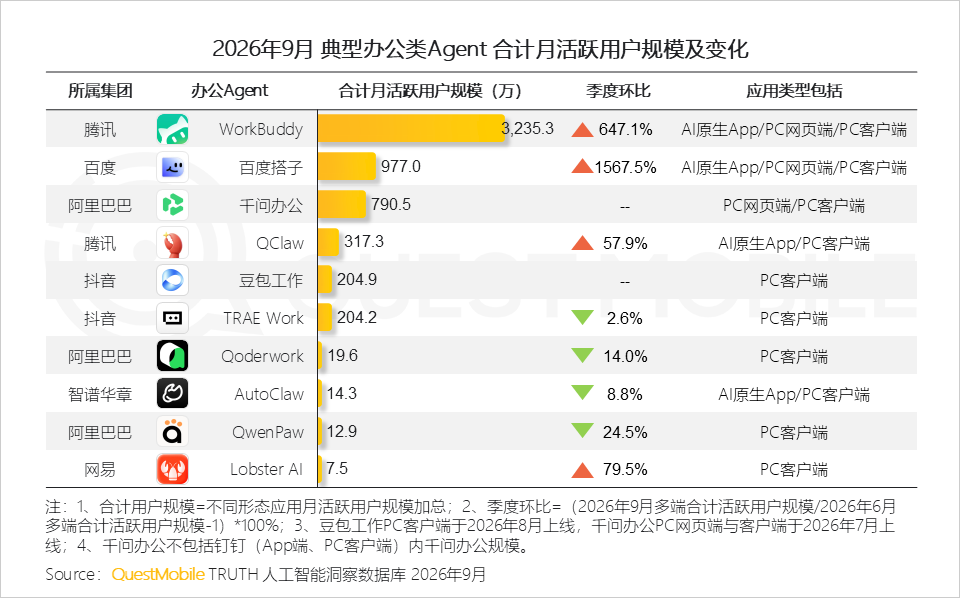
This ranking precisely reveals Baidu's current position: it is already qualified to sit at the table, but does not yet control the game.
There is still a distance between second place and an entry point. Dazi's monthly active users are less than one-third of WorkBuddy's, while Tencent can connect office agents to WeCom and WeChat relationship chains, and Alibaba and ByteDance are also concentrating their respective products, data, and organizational processes toward main entry points.
The situation in video and content production illustrates the problem even more clearly. Baidu Yijing has its own position in the digital human segment and cannot simply be conflated with general video generation products.
But if we look at the content production entry point, the market has continuously voted for Jimeng and Kling with users and revenue. Kuaishou disclosed that Kling AI's revenue in Q2 2026 exceeded 850 million yuan, a year-over-year increase of more than 200%.

Baidu Yijing generates digital humans
At least judging from public data, Yijing has not yet produced proof of users or revenue on the same scale. This is Baidu's most realistic shortcoming: it is not that it has made no effort, nor that no products have made the list, but that it lacks a flagship product capable of pulling the full-stack capabilities and establishing market mindshare.
The intelligent organization needs a high-frequency, trustworthy entry point that can continuously accumulate organizational knowledge. What Baidu has now is still a set of products, not this definite answer.

Chaoyong AI View
Of course the intelligent organization needs Baidu. It needs Baidu's chips, cloud, models, agents, and internal practices, and it also needs a veteran technology company to participate in exploration.
But participating in a productivity revolution and becoming the flag-bearer of that revolution are two completely different market positions. For Baidu to carry the flag, it cannot rely on "I was the first to propose this concept," but on "the largest number of enterprises are willing to entrust real work to my products."
It is not that Robin Li does not know where the problem lies. In 2025, in an internal Baidu speech, he directly asked "why can't Baidu win battles," and attributed the reason to "lack of focus." Looking at the "intelligent organization" today, this sentence still applies.
It is not that Baidu has no money. According to Baidu's Q2 2026 financial report, as of the end of June 2026, its total cash and investments were 283.1 billion yuan.
But in the same quarter, Baidu's capital expenditure reached 11.39 billion yuan, operating cash flow was 3.436 billion yuan, and free cash flow was approximately negative 7.95 billion yuan; R&D expenses were 4.607 billion yuan, down about 10% year over year.
Online marketing revenue fell 19% year over year, and the traditional cash cow continues to come under pressure.
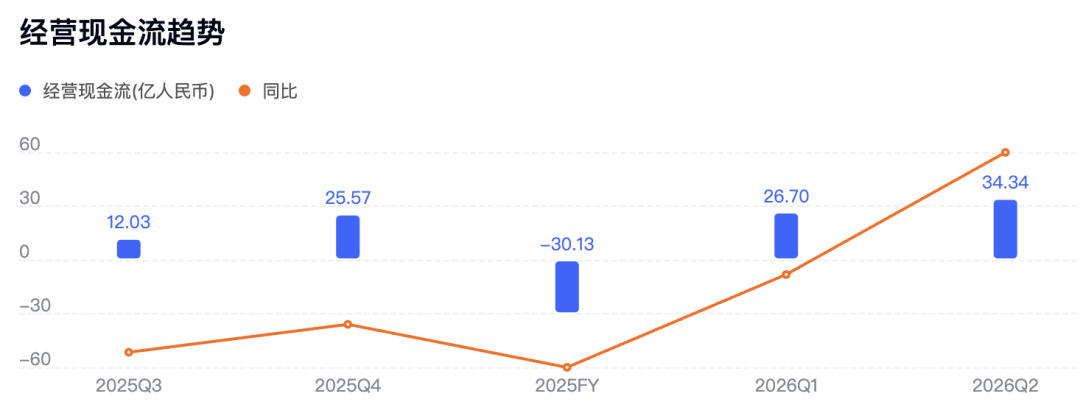
Baidu Q2 2026 Financial Report
So the problem is not simply "insufficient financial resources," but that old businesses are contracting and new businesses are more capital-intensive, and Baidu can no longer afford to continue spreading its efforts evenly.
The more this is the case, the more it needs one product to concentrate resources and break through the market, rather than adding another layer of grand conceptual packaging. On November 11, in an internal livestream for Tencent's 28th anniversary, Pony Ma called AI transformation a "life-and-death transformation to adapt to new battlefields and new ways of fighting."
He emphasized that this is no longer simply cost reduction, but that both people and organizations must adjust, core businesses must improve efficiency, and at the same time forces must be split to explore new AI Native battlefields. This sense of urgency applies equally to Baidu, perhaps even more so.
Tencent has already been concentrating resources around WorkBuddy, and ByteDance and Alibaba have also each found their own product main axis.
If Baidu still focuses mainly on defining the next act, rather than winning the most specific users and scenarios in this act, it will be difficult for it to change the outside world's judgment of itself.
The way to tear off the label is not to rush to propose another new concept, but to make one product that others cannot avoid. If a flagship product and market entry point are still absent, the more correct the judgment of the "intelligent organization" is, the more likely it will once again prove: Baidu saw the era, but the era handed the entry point to others.
-
![]()
The AI Search Wars Begin: What the Giants Are Really Fighting For Goes Beyond Answers
-
![]()
Hardcore Science Popularization | Chinese Smart Cars Going Global in Europe: Nine Types of Data, Seven Rules, Four Misconceptions
-
![]()
Musk and Jensen Huang: A Bromance Worth Shipping
-
![]()
Breaking News! Musk Rushes to Jensen Huang's Rescue, and Asia's Richest Man Zhang Yiming Joins In
-
![]()
Exposed! The Mastermind Behind the "Hunt for Jensen Huang"—All Clues Point to Him
-
![]()
Zhang Yiming Speaks Out: Catching Up with OpenAI and Anthropic Within 4 Years
-
![]()
Does an "Intelligent Organization" Still Need Baidu?
-
![]()
One Car, Two Smart Driving Systems: Are Automakers Developing In-House Technology or Keeping Their Options Open?