The AI Search Wars Begin: What the Giants Are Really Fighting For Goes Beyond Answers
 11/16 2026
 559
By Haotian
In the AI era, the search business has once again become a battleground.

Image source: Yuanbao Search
On November 11, 2026, coinciding with the company's 28th anniversary, Tencent launched a new search product called "Yuanbao Search," complete with its own standalone webpage. Users can also upgrade QQ Browser to the latest version and select "Yuanbao Search" from the engine settings menu.
Tencent is not alone. Internet companies such as Alibaba and ByteDance, along with AI firms like DeepSeek and Moonshot AI, are all racing to advance their AI search businesses.
As one of the earliest product forms in the internet industry, search has undergone years of development and long ago settled into an oligopolistic era with a relatively stable landscape. Now, a host of tech companies are once again reaching into the search market—largely because AI technology has introduced new variables. Under AI's influence, both the competitive landscape and the business model of the search industry may be in for tremendous change.
01 In the AI Era, Search Once Again Takes Center Stage
This is a far cry from the PC internet era, when search served as the core strategic gateway. After the rise of the mobile internet, specific needs were absorbed by closed platforms, and recommendation mechanisms could precisely deliver information that had once required active retrieval. General-purpose search engines began to decline.
On this point, then-Sogou CEO Wang Xiaochuan said in an April 2017 media interview: "On PC, search is the center—the gateway for traffic, the core of all applications. On wireless, it is indeed no longer the most central position; it is just one of several applications and services. This is reality, and you accept this reality."
Precisely because search began to lose its central position, mobile internet companies stopped fighting over the search gateway and stopped building products around search. Instead, they pursued vertical exploration based on user needs. Users, in turn, adapted to the isolated-island ecosystem of the mobile internet, satisfying their shopping, entertainment, video and other needs through separate apps.
Now, as AI technology gradually matures, search has once again become a focal point for tech companies. This round of competition includes upgrades to traditional search products, improvements to the retrieval capabilities of AI assistants, and further extension into search services for developers.
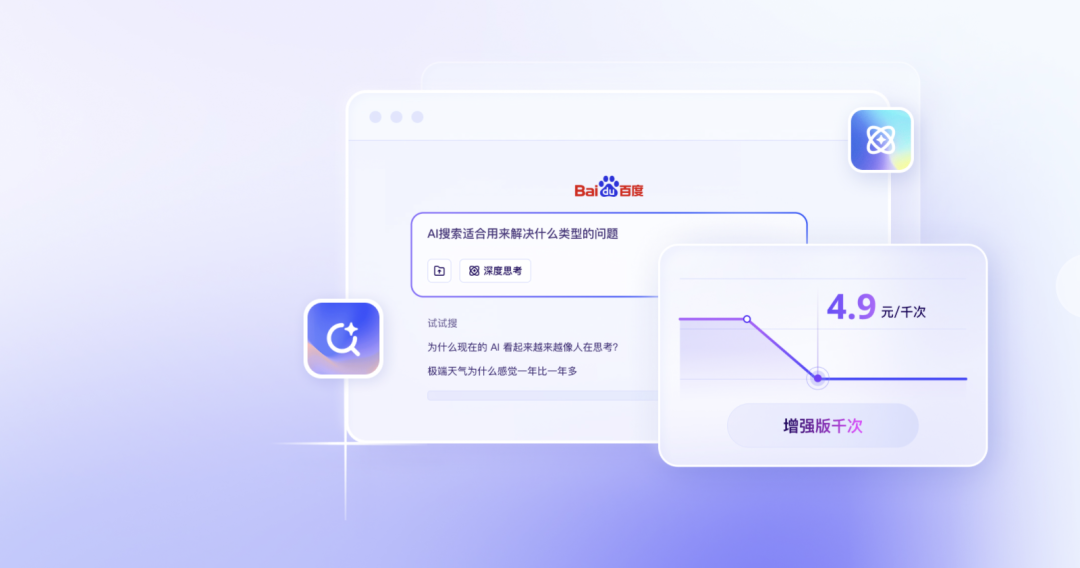
Image source: Baidu
Traditional search companies such as Baidu are committed to reconstructing existing search businesses on top of their established retrieval and distribution systems. AI assistants such as Yuanbao, Qianwen and Doubao rely on large models to organize content and services. Companies such as Tencent, DeepSeek and ByteDance are opening retrieval capabilities to developers to serve more AI applications. These initiatives often unfold simultaneously, and search is further transforming from a product for C-end users into a foundational capability that connects AI products to external information.
Overall, although tech companies' approaches differ, their strategic orientation all points to the same goal: winning the battle for the information gateway in the AI era. AI enables search to extend from presenting information to understanding needs and organizing answers, and it also makes it possible to rewrite search habits that users have formed over many years.
For traditional search companies, AI search is a defensive battle to protect their user and distribution advantages. For new players, it is an opportunity to redefine where users start when seeking information. The key to competition is beginning to shift from who can provide more results to who can make users think of them first when they want to ask a question.
02 AI Targets the New Generation Gateway, but Reliability Needs Urgent Improvement
The reason tech companies are deploying AI search one after another is largely that AI tools have the potential to become the new generation gateway.
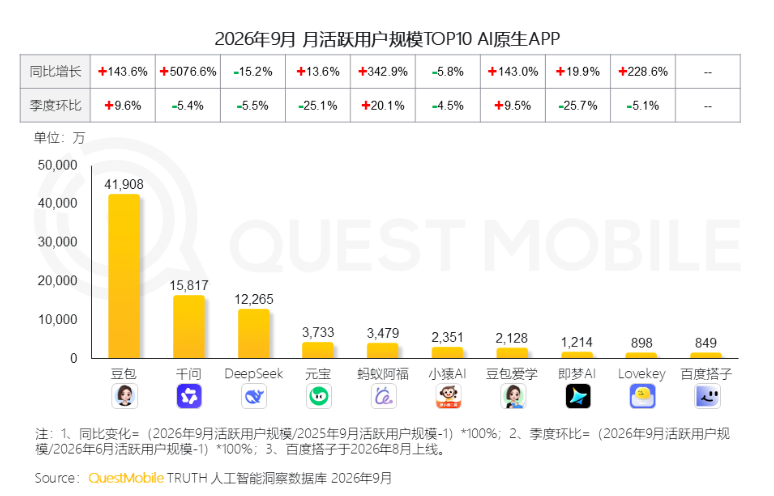
Image source: QuestMobile
Data disclosed by QuestMobile shows that in September 2026, the top three AI-native apps by monthly active users were Doubao, Qianwen and DeepSeek, with MAUs of 419 million, 158 million and 123 million, respectively—year-on-year growth of 143.6%, 5,076.6% and a decline of 15.2%.
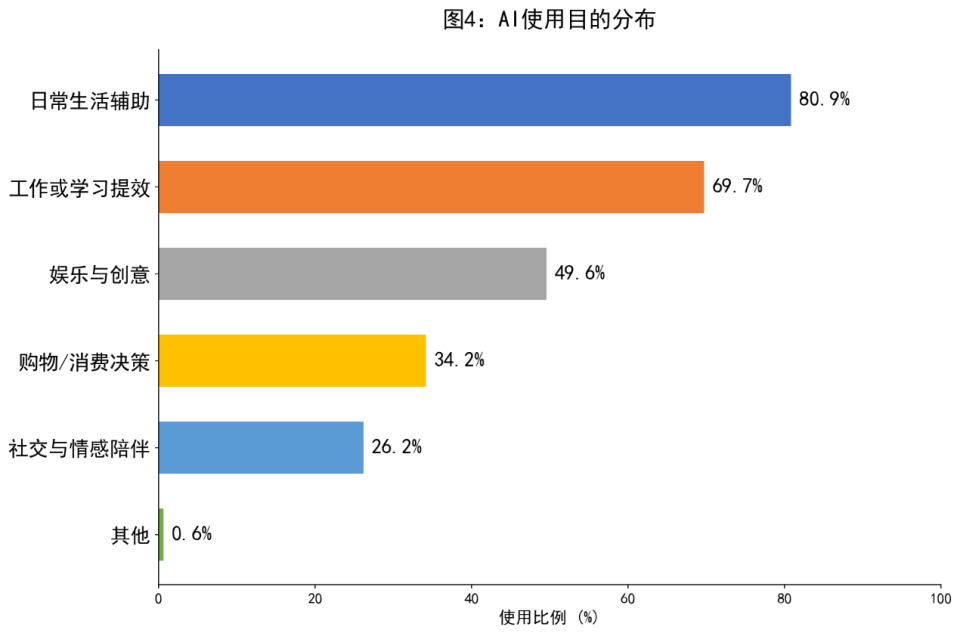
Image source: Tencent Research Institute
Because large models have strong task-understanding and feedback capabilities, more and more users regard AI assistants as "intelligent secretaries" for solving everyday problems. Survey data from Tencent Research Institute shows that 95.6% of respondents had used AI large models in the past three months, and among them, 80.9% regarded AI as their preferred tool for solving daily problems—using services such as information queries, itinerary planning and question answering.
As more and more users' retrieval needs shift to AI tools, the knowledge lag and hallucination problems of large models have also begun to surface. A large model's knowledge comes from training data; once training is complete, its weights are fixed, making it difficult to provide the latest information. In addition, guessing answers based on the vague memory encoded in model weights can also cause large models to hallucinate.
Tech companies' recent rush to deploy AI search is precisely aimed at solving these problems. After introducing internet search functionality, large models can retrieve information across the web in real time, compensating for lagging knowledge and reducing hallucinations by grounding responses in external reference texts.
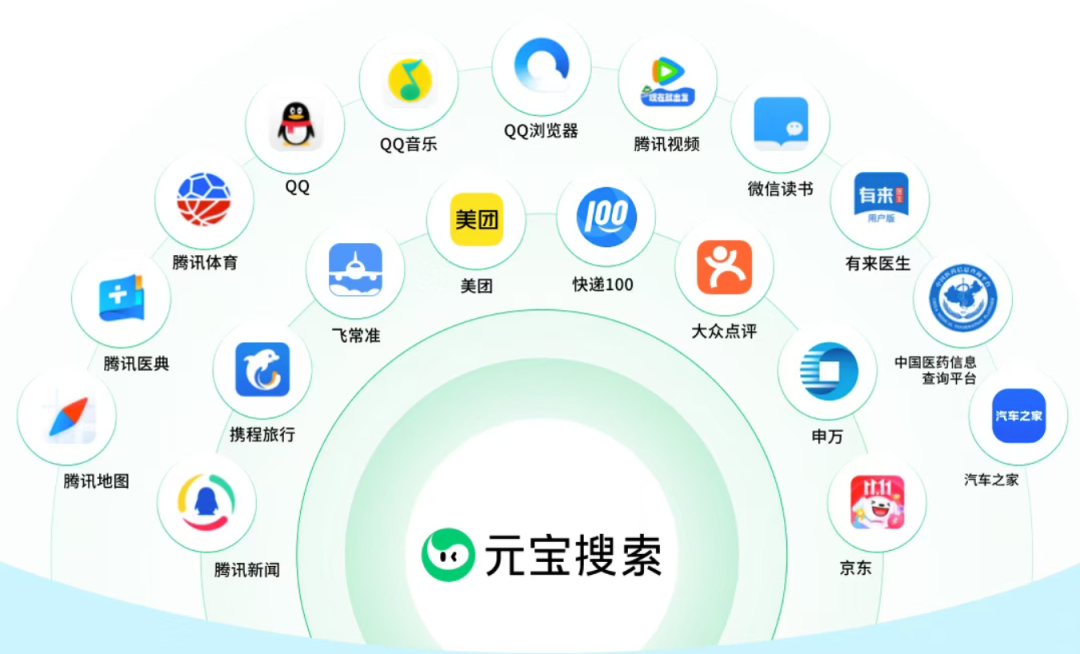
Image source: Tencent
Take Yuanbao Search as an example. It supports retrieval of highly time-sensitive content and can obtain the latest information in real time—such as policy updates, breaking news, weather changes and stock market quotations. In addition, the product connects with Tencent's high-quality content ecosystem, covering content resources such as Tencent News, Sogou Baike and Penguin Accounts.
Search helps AI move from a tool you can talk to toward an information service gateway that can be used repeatedly. But gateway status does not depend on whether it can answer a single question; rather, it depends on how to continuously reduce the cost for users to obtain and judge information. When all AI tools have internet access capabilities, competition will further extend to content coverage, source quality, answer credibility and other aspects.
It is foreseeable that AI products that can significantly reduce user screening costs and provide reliable feedback will be more likely to emerge as the winners of this round of search competition.
03 After Finding the Answer, How to Achieve Commercialization?
Once revolutionary AI technology matures, it not only brings a brand-new search experience but will also overturn the existing business model of search engines.
An important source of revenue for traditional search engines is search advertising. After users enter keywords, the platform displays commercial results based on factors such as advertising bids and relevance, and charges advertisers by click and other methods. Clear search intent makes search an important channel connecting users and merchants.
When AI begins to directly organize information and give answers, users no longer need to click on specific webpages and advertising links, and the display positions and conversion links of traditional advertising face the challenge of becoming ineffective.
On this point, 360 Group founder Zhou Hongyi said at the end of 2024: "Actually, we are also in pain doing AI search. We are disrupting ourselves; for now, we can't find a place to put ads."
Therefore, for AI search players, efficiently satisfying users' needs is only the first step; the bigger challenge lies in how to achieve commercialization after providing answers.
At the current stage, AI assistant products are exploring revenue sources such as membership subscriptions, transaction channel fees and providing retrieval services to developers. Among these, connecting transactions and offering open retrieval capabilities represent two different monetization approaches for AI search.
Take Doubao as an example. It is trying to direct users' life service needs toward transactions and then take a commission from them.
In August 2026, some hotel orders completed through the Doubao channel began to implement independent rates, with a software service fee of 11.4% and an additional 0.6% payment processing fee, for a combined rate of 12%. Doubao responded that merchants only pay the channel service fee after an order is completed and cannot influence recommendations or rankings by paying.
However, whether user scale can be converted into revenue sufficient to cover costs is still a question AI assistants need to answer. According to calculations by LatePost based on publicly disclosed API prices from Volcano Engine, in May 2026, Doubao consumed tens of millions of yuan per day, while in the first half of the year, the product's daily revenue was less than one million yuan, mainly from e-commerce commissions.
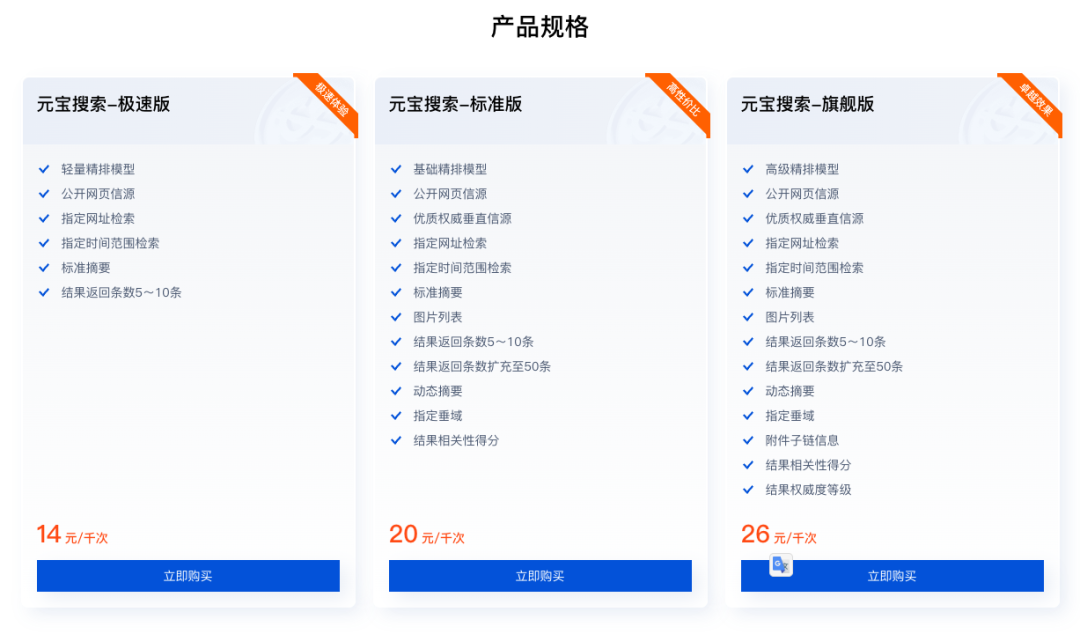
Image source: Tencent Cloud
In parallel with the commercialization of consumer-facing products, Tencent is also selling search capabilities as a developer service. In October 2026, Yuanbao Search began to open externally through Tencent Cloud. Currently, the prices listed on the Tencent Cloud product page for the Express, Standard and Flagship editions are 14 yuan, 20 yuan and 26 yuan per thousand calls, respectively. For Tencent, search can both directly serve users and become a foundational capability called upon by other AI applications.
From transaction channel fees to open retrieval services, the value of search is extending in different directions: toward users, it has the opportunity to participate in consumption decisions and connect information needs to actual transactions; toward developers, it is committed to becoming a foundational capability called on demand by AI applications. These two paths mean that search's revenue sources are expected to be further broadened.
But an increase in revenue sources does not mean the profitability problem has been solved. Transactions need to prove that they can bring incremental orders to merchants, and retrieval services need to find a balance among quality, response speed and cost. Competition in the next stage of AI search will place more emphasis on whether each demand can bring sustainable returns, rather than simply expanding users and call volume.
For internet giants such as Tencent, Alibaba and ByteDance, AI search has a deeper meaning: whoever understands users' needs first has a better chance of allocating content, goods and services. Needs that were previously handled separately by different apps may in the future first be judged by AI, which then connects the corresponding services. Changes in the search gateway may therefore also bring about a redistribution of distribution power and transaction opportunities among platforms.
However, how many application boundaries AI can cross still depends on content authorization, service access and fulfillment capabilities. Giants have ecosystem resources but also need to face questions about whether recommendations are excessively biased toward their own businesses; new players can redo the interaction experience but still need to fill in content supply, transactions and after-sales links. Model capabilities affect answer quality, while whether reliable services can be connected determines how far one can go after the answer.
Compared with the winners, what is more noteworthy in this round of competition is how platforms maintain the balance between helping users make judgments and earning revenue from recommendations and transactions when AI does both. What users hand over is not only a search request but also trust in information screening and consumption advice.
Platforms that maintain user trust during commercialization are more likely to turn short-term usage heat into lasting gateway advantages.
Interactive Topic
What tools are you used to using to retrieve information? Is there any AI assistance?
This article is original content of Farsight. Unauthorized reproduction is prohibited.
-
![]()
The AI Search Wars Begin: What the Giants Are Really Fighting For Goes Beyond Answers
-
![]()
Hardcore Science Popularization | Chinese Smart Cars Going Global in Europe: Nine Types of Data, Seven Rules, Four Misconceptions
-
![]()
Musk and Jensen Huang: A Bromance Worth Shipping
-
![]()
Breaking News! Musk Rushes to Jensen Huang's Rescue, and Asia's Richest Man Zhang Yiming Joins In
-
![]()
Exposed! The Mastermind Behind the "Hunt for Jensen Huang"—All Clues Point to Him
-
![]()
Zhang Yiming Speaks Out: Catching Up with OpenAI and Anthropic Within 4 Years
-
![]()
Does an "Intelligent Organization" Still Need Baidu?
-
![]()
One Car, Two Smart Driving Systems: Are Automakers Developing In-House Technology or Keeping Their Options Open?