Musk and Jensen Huang: A Bromance Worth Shipping
 11/16 2026
 368
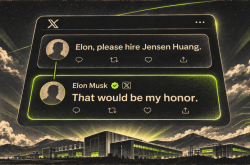
On November 12, NVIDIA announced that Jensen Huang is stepping down from his roles as CEO, president, and director. Before the news even broke, someone on X had already tagged Musk on Jensen's behalf: "Elon, please hire Jensen Huang."
Musk wasted no time replying: "That would be my honor."
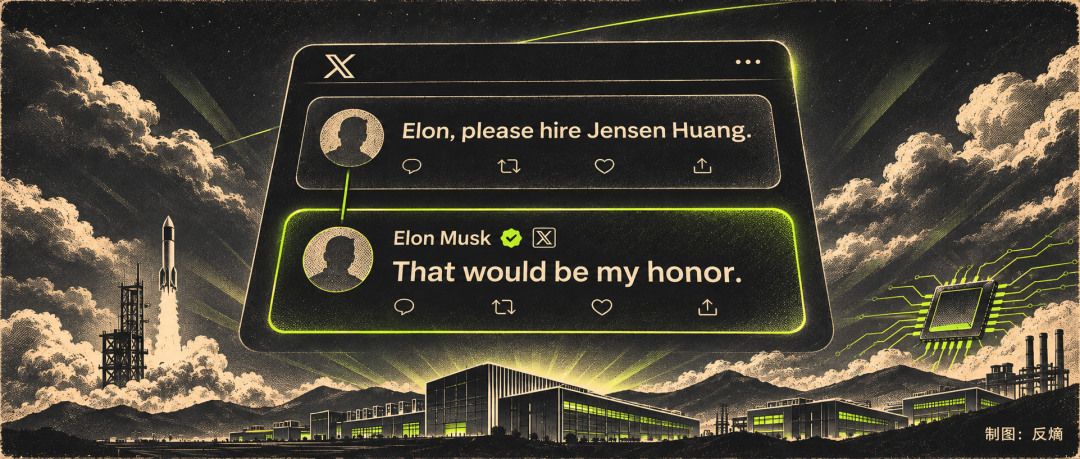
One turned GPUs into the lifeblood of the AI era; the other rewrote industrial rules through electric vehicles and reusable rockets. If these two really teamed up, it's hard not to ship them just a little.
What's more, they go way back — ten years, to be exact. Musk once tried to buy GPUs from Jensen Huang, and now SpaceX is building its own chip factory. Their collaboration is deepening by the day, and Musk is working hard to boost self-sufficient chip supply.
On November 13, Musk publicly stated that he had signed a petition supporting Jensen Huang's return to NVIDIA.
On one hand, he says having Jensen come aboard would be his honor; on the other, he's backing Jensen's return to NVIDIA. Musk certainly makes no secret of his admiration for this old friend.
It's just that the two have long been accustomed to steering their own ships while cooperating with each other. If they really were to end up in the same company, who would be willing to sit in the passenger seat?
01 A Friendship Ten Years in the Making
About one dinner, Ellison and Jensen Huang told two different versions.
In 2024, Oracle founder Larry Ellison recalled at a public event that he had dined with Musk and Jensen Huang at the Nobu restaurant in Palo Alto. At the time, NVIDIA GPUs were in short supply, and Ellison said that he and Musk were practically begging Jensen Huang to sell them more chips — even urging him to take the money already.
Jensen Huang later denied this account in an interview. He acknowledged that the three had dined together and that they had a great conversation, but insisted no one begged him to sell GPUs. According to him, customers only needed to submit purchase orders as usual.
One meal, two accounts. Ellison spun an amusing tale of billionaires begging for chips, while Jensen Huang described how NVIDIA does business.
During those years, Musk did indeed need a massive number of GPUs. Even if he was willing to pay enormous procurement sums, he might not immediately get the supply he wanted.
The friendship between the two goes back even further.
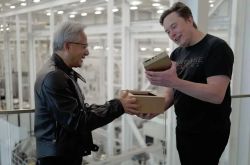
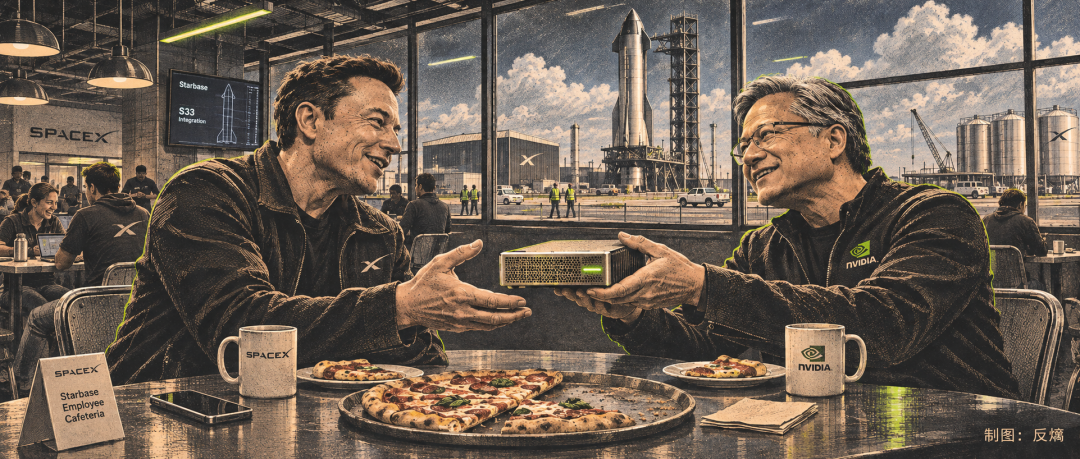
In August 2016, Jensen Huang delivered the first DGX-1 deep learning supercomputer to the then newly founded OpenAI — and Musk was one of its co-founders at the time. In October 2025, Jensen Huang visited SpaceX's Starbase in Texas and personally handed the DGX Spark to Musk.
NVIDIA's official website recorded the second meeting. The two ate pizza in the employee cafeteria and reminisced about the machine from nine years earlier.
Over the decade, GPUs evolved from deep learning research equipment into the computing infrastructure that tech companies scrambled to buy. Musk, too, went from an early backer of AI research to a large-scale computing power operator.
In February this year, SpaceX acquired xAI. In May, its business signed a cloud computing service agreement with Anthropic, involving about 325,000 NVIDIA GPUs. In a prospectus update on November 10, Anthropic disclosed that as computing resources are delivered, the related monthly service fee is expected to reach about 3.1 billion USD in December.
SpaceX reports that its "superintelligence" business revenue has reached 7.56 billion USD — more than half of its total revenue for the quarter — while capital expenditure for that business in the same period was as high as 16.444 billion USD.
The computing power business requires continuous investment. Once data centers are built, expensive GPUs still have to run customer workloads continuously over the coming years before procurement and operating costs can be gradually recovered.
On October 26, SpaceX reached a binding commitment with an entity under Apollo Global Management for about 40 billion USD in GPU equipment financing leases. The Apollo-managed entity will purchase NVIDIA Vera Rubin equipment and then lease it to SpaceX, with deliveries expected to begin in the first half of 2027, and each batch having a lease term of about five years.
In the existing computing power business, part of the service agreement with Anthropic — starting in early 2027 — allows both parties to terminate after 90 days' notice.
Musk is expanding computing power supply through multi-year financing. In the coming years, he will also need to keep winning customers so that the purchased computing equipment can generate revenue to its full potential.
Ten years ago, he wanted Jensen Huang to sell him more GPUs. Now, in addition to purchasing, he also wants to master more chip manufacturing capabilities.
02 The Time Gap in Ambition
Musk plans to send the first batch of AI computing equipment into space in 2027, but the chip factory he is building is not expected to achieve large-scale production until at least the second half of 2028.
In August this year, the terawatt-scale chip manufacturing project Terafab, jointly advanced by SpaceX and Tesla, landed in Grimes County, Texas, with first-phase investment exceeding 16.8 billion USD. Musk's long-term goal is for this factory to annually produce chip hardware capable of providing about one terawatt of computing power.
The Terafab R&D factory is aiming to manufacture its first test chip in May to June 2027, while the main plant area is planned for mass production in the second half of 2028.
On November 6, Musk said at the Baron Investment Conference that he expected to begin launching the first batch of Starmind orbital AI computing equipment in the third quarter of 2027.
By the time the first batch of Starmind goes into orbit, Terafab will probably still be gearing up for mass production.
The first generation of Starmind will adopt the Vera Rubin computing system developed by SpaceX and NVIDIA for the space environment. Musk even publicly stated that in his view, this was the best AI computing architecture at the time.
With NVIDIA's mature platform, SpaceX can begin deploying orbital computing systems without waiting for Terafab to complete process validation and production ramp-up.
On November 12, SpaceX also disclosed plans for two supercomputing parks, with total investment expected to exceed 74 billion USD. Among them, the Starbase project in Texas exceeds 24 billion USD and will also be supported by natural gas power generation facilities.
Power supply has become a real constraint on Musk's expansion of AI computing power. In July this year, a Reuters investigation found that xAI deployed 59 natural gas turbines to support the "Colossus 2" data center — 57 of which are located in Southaven, Mississippi — and the related facilities sparked controversy over air emission permit issues.
For data centers with tens of billions of dollars in investment, timely delivery of computing equipment is far from enough. Once power generation facilities and grid connections are delayed, expensive GPUs may sit idle, and the project's capital recovery will also be affected.
With Terafab, ground supercomputing, and Starmind advancing one after another, SpaceX needs to coordinate more and more engineering. Advanced processes require repeated trial production and yield improvement, data centers must wait for stable power supply, and orbital computing must also align with satellite development and launch schedules. Any delay in one place may affect procurement and funding arrangements for other projects.
Musk has already proven his industrial organization capability in reusable rockets and Starlink mass production. However, semiconductor manufacturing involves suppliers spread across the globe, and advanced processes, packaging, and memory capacity each have their own investment cycles, making it difficult to adjust entirely according to SpaceX's plans.
Even if Terafab is successfully put into operation in the future, SpaceX still expects to purchase a large amount of computing hardware from external suppliers.
Musk is investing heavily to increase self-sufficient chip supply on one hand, while expanding cooperation with NVIDIA on the other. At least in the next few years, NVIDIA will remain an important computing platform supplier for SpaceX.
This relationship is quite telling. Musk is investing heavily in a market where NVIDIA has long held an advantage, yet his own first-generation space computing system still uses NVIDIA technology.
And NVIDIA's business has already begun reaching into the computing systems of customers who are preparing to build their own chips.
03 Jensen Huang's Edge
South Korean AI chip company Rebellions is developing its own processor but plans to connect it to NVIDIA's computing system.
In early November, NVIDIA announced cooperation with Rebellions and SK Telecom. Under the plan, Rebellions' R200 processor will connect to NVIDIA's high-speed interconnect system through NVLink Fusion, and the related systems will also adopt NVIDIA's MGX rack design.
More and more cloud computing companies hope to reduce dependence on NVIDIA GPUs through self-developed chips, yet NVIDIA has begun opening its system technology to these processors.
For NVIDIA, customers choosing self-developed chips does not necessarily mean losing the entire computing system business.
Over the past two decades, Jensen Huang has already built a similar commercial advantage through the software ecosystem.
In 2006, NVIDIA launched CUDA, enabling developers to run general-purpose computing programs on GPUs. Since then, a large number of research institutions and enterprises have written software around CUDA, while NVIDIA has continuously improved computing libraries and development tools.
In the era of large models, these accumulations have created quite high migration costs. Even if enterprises find cheaper alternative chips, they still have to re-adapt programs, optimize operators, and verify computing results. The developer ecosystem accumulated over the long term gives customers reasons to stick with NVIDIA's computing platform.
In the second quarter of fiscal 2027 ended July 26, 2026, NVIDIA's revenue reached 96.2 billion USD, up 106% year on year, with a gross margin of 75%. Customer stickiness brought by the software ecosystem and the complete computing system is an important part of its long-term commercial advantage.
NVIDIA also needs to arrange supply in advance for growing demand. As of July 26, NVIDIA's supply and capacity commitments reached 279 billion USD, an increase of 160 billion USD from three months earlier. Advanced GPUs require the combined support of wafer foundry, advanced packaging, and high-bandwidth memory, and huge capacity must be arranged before products hit the market.
NVIDIA needs to convince suppliers that there is sufficient market demand for the next generation of products, and also convince customers that computing systems can be delivered on schedule, in order to push both sides to invest in advance.
Looking back at the meal Ellison described, it becomes easier to understand why Jensen Huang emphasized that customers only need to place orders as usual.
He once said in an interview that when NVIDIA allocates products, in addition to purchase orders, it also considers whether customers' data centers are ready to receive the equipment. Arranging manufacturing capacity in advance and coordinating delivery order concerns the operation of the entire supply system.
This system, accumulated over many years, has become NVIDIA's own competitive advantage.
Even if Terafab goes into operation as planned, SpaceX still needs to establish corresponding software tools, supplier relationships, and a customer usage base. Jensen Huang can help Musk judge the technological direction and reduce trial and error, but these industrial accumulations still take time.
For Musk, who is simultaneously advancing chip manufacturing, ground supercomputing, and orbital computing, Jensen Huang's experience is indeed very attractive.
However, this founder who has steered NVIDIA for 33 years may not necessarily still have the same decision-making space at SpaceX.
04 Who Calls the Shots
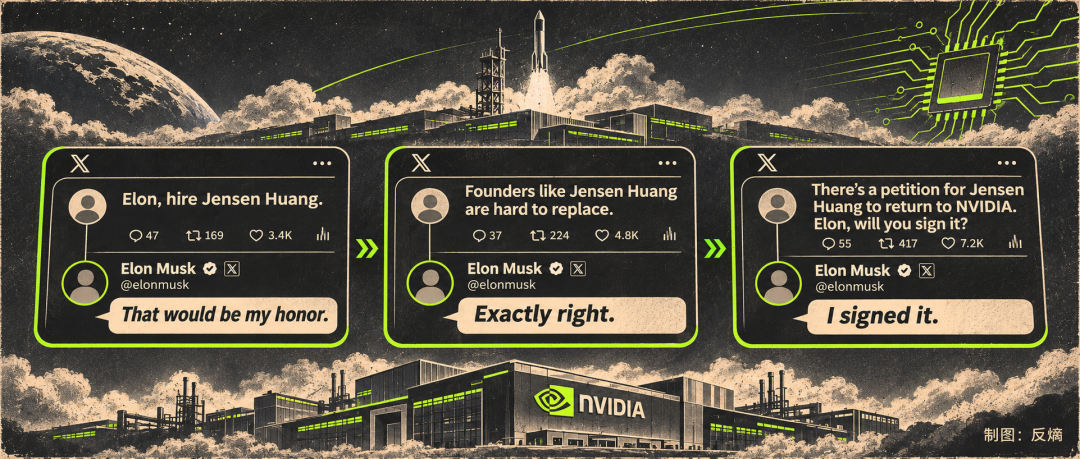
After Jensen Huang's departure, Silicon Valley investor Naval Ravikant lamented on X that from the experiences of Jobs and Apple, and Kalanick and Uber, people should have understood long ago that founders are hard to replace.
Musk replied: "Exactly."
On November 13, he also publicly stated that he had signed a petition supporting Jensen Huang's return to NVIDIA. Counting the earlier statement that "hiring Jensen Huang would be my honor," in just two days, Musk had already spoken out three times for this old friend.
This appreciation is not hard to understand. Both once changed industries through their own technological judgment, yet they have completely different levels of control over their companies.
Jensen Huang has led NVIDIA for 33 years, with beneficial ownership of about 3.58% as of March this year, and has long relied on operating performance and board support to lead the company's strategy. Musk, through a dual-class share structure, holds about 82.4% of voting rights after SpaceX's listing, while also serving as CEO, CTO, and chairman.
Now, Musk is also preparing to further expand his industrial map.
On November 12, Bloomberg reported that merger negotiations between SpaceX and Tesla are advancing and could be announced as early as December. The two sides have established independent special committees of directors to study transaction terms and governance arrangements.
Once the merger takes place, Musk's automotive, robotics, AI model, chip manufacturing, and aerospace businesses will have the opportunity to form closer ties, and capital allocation and technology resource sharing will also involve more complex corporate governance issues.
For now, Musk's phrase "my honor" remains merely a public response. Whether this appreciation will develop into real cooperation is, at present, only speculation.
If the two really do have the chance to work together, decision-making power may prove harder to arrange than job titles. Terafab and Starmind both concern SpaceX's investment direction for years to come, and if Jensen Huang is to leverage his long-accumulated industry experience, he will also need sufficient autonomy. And Musk is clearly not a founder accustomed to handing major decisions entirely to others.
What's more, the two already have a very solid foundation for cooperation. From Jensen Huang delivering the DGX-1 to OpenAI, co-founded by Musk, ten years ago, to today's NVIDIA and SpaceX collaborating on the Starmind computing architecture, their careers have always remained intertwined. Even as Musk begins building his own chip factory, SpaceX still needs NVIDIA's technology and products.
For ten years, they have each steered their own companies, and neither has had to compromise his own technological judgment to maintain cooperation. If one day Jensen Huang truly joins SpaceX, this relationship will change.
If Musk really invites Jensen Huang into SpaceX, what he needs to welcome is not only an old friend, but also someone who may say "no" to him at a critical moment.
-
![]()
The AI Search Wars Begin: What the Giants Are Really Fighting For Goes Beyond Answers
-
![]()
Hardcore Science Popularization | Chinese Smart Cars Going Global in Europe: Nine Types of Data, Seven Rules, Four Misconceptions
-
![]()
Musk and Jensen Huang: A Bromance Worth Shipping
-
![]()
Breaking News! Musk Rushes to Jensen Huang's Rescue, and Asia's Richest Man Zhang Yiming Joins In
-
![]()
Exposed! The Mastermind Behind the "Hunt for Jensen Huang"—All Clues Point to Him
-
![]()
Zhang Yiming Speaks Out: Catching Up with OpenAI and Anthropic Within 4 Years
-
![]()
Does an "Intelligent Organization" Still Need Baidu?
-
![]()
One Car, Two Smart Driving Systems: Are Automakers Developing In-House Technology or Keeping Their Options Open?