Jensen Huang: The Last Guarantor
 11/27 2026
 439
Produced by | Zhixie Island
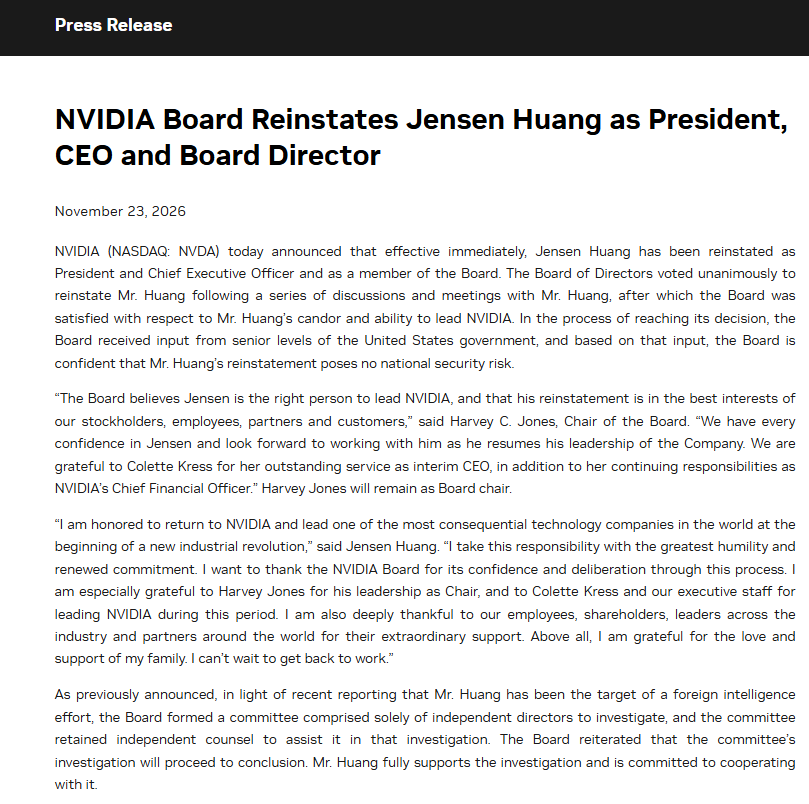
Not even a Hongguo short drama would dare script it this way: the day I was forced to resign, the whole world watched me become a laughingstock. Over the next two weeks, global investors took a collective bath, trillions in wealth evaporating. The President personally intervened, and the board had no choice but to ask me back to steady the ship.
Since then, the male lead of short dramas has taken the surname Huang. On social media, netizens queued up to "absorb some of Jensen Huang's career luck."
In just 11 days, the drama set off by Jensen Huang's scandal went through several reversals, pausing for now on the page where Jensen Huang is reinstated.
On his second day back as NVIDIA CEO, Jensen Huang stood before all employees, his tone as earnest as a newcomer on his first day: I made a terrible mistake, I was unfaithful to Lori, and I receive 90 minutes of psychotherapy every day.
A company had just proven it could survive without its founder—and then immediately proved, in the most dramatic way possible, that it could not.
But now that Jensen Huang is back, is NVIDIA really okay?
1. The Consort Returns to the Palace, But No Longer Wears Leather
On November 23 local time, at NVIDIA's headquarters in Santa Clara, California, the lobby, the staircases, and the railings along the second-floor corridor were packed. Hundreds of employees held up their phones and chanted in unison: "Jensen!"
Jensen Huang walked out from the crowd in a dark blue jacket and black trousers—only the iconic black leather jacket was missing. He placed his hand on his chest several times and bowed to the crowd: "Thank you for giving me a second chance. This time, I will be a better CEO."
A female employee rushed forward to hug him, and the crowd erupted in cheers again.
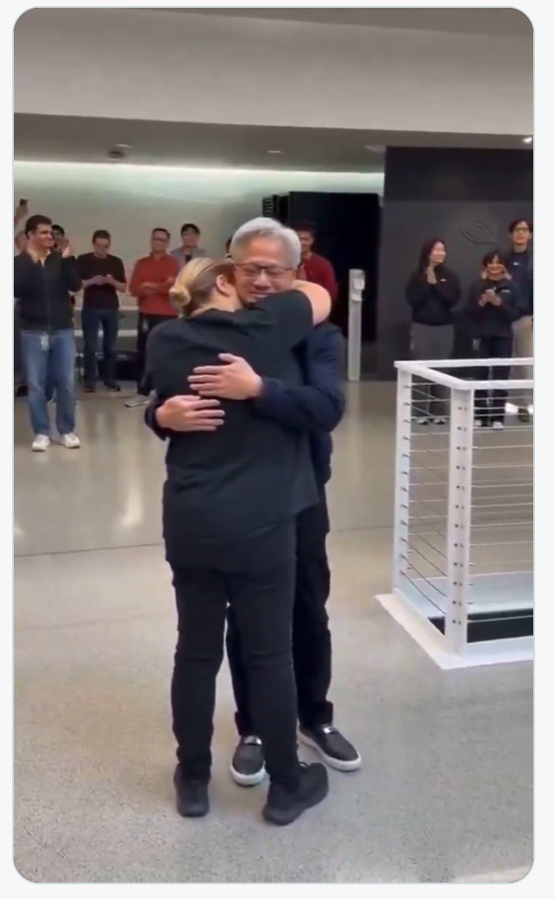
Image source: Screenshot from a video on Musk's X account
Old Huang is still Old Huang. He joked to the camera: "Today is my first day at work, and I don't even have a computer yet. I have to go to IT to get one." And so Jensen Huang ended his limited-edition annual leave.
An affair might not necessarily bring down a CEO of another listed company. Scandal is never more than the fuse; what really pushed Jensen Huang out was the gunpowder that had long been piled beneath it.
The most direct trigger was trust. Citing people familiar with the matter, Jensen Huang had been lying continuously about the matter for about a year, from October 2025 all the way until the scandal was exposed. For the board, an affair might be forgivable, but being deceived for a full year was not.
This is especially true for a company known for its strict code of conduct—some of whose provisions were written by Jensen Huang himself.
Even harder to handle than trust was national security. One of Jensen Huang's extramarital partners, Huang Le, had helmed the Singapore data center company Megaspeed. This company bought more than $4.8 billion worth of chips from NVIDIA in two years, and Huang Le herself was suspected by U.S. intelligence agencies of being a Chinese intelligence officer. Investigators suspected that these chips flowed to China via Singapore.
For a company that sells chips to the whole world, the words "the founder may be targeted by foreign intelligence operations" are themselves the biggest risk exposure.
The last straw was the equity structure. NVIDIA has no dual-class shares; it is one share, one vote. Jensen Huang holds only 3.58% of the shares, making him legally merely a professional manager hired by the board—a fiduciary who can be fired.
Generally speaking, in the history of corporate governance, super-voting rights have protected many founders who made mistakes, giving them time to buffer and chips to negotiate. But Jensen Huang did not have this card, so when the board decided to act, no mechanism could stop Jensen Huang's departure.
For the first time in NVIDIA's 33-year history, there was no Jensen Huang.
But at his first all-hands meeting after reinstatement, Jensen Huang threw out a surprising claim: NVIDIA does not need a traditional succession plan. His reasoning was that the company has more than 60 executives directly reporting to him, each managing their own area, and it is inherently a multi-leader structure. Designating a successor in advance would only create unnecessary hierarchy.
In a sense, NVIDIA did indeed outrun founder dependence, because the organizational machine did not stop. The company's financial reports were released as usual, and products shipped on schedule.
But the market voted against it with real money. The same company, the same chips, the same orders—only without Jensen Huang—saw its market value fall 47.5% in 45 days, with the stock price nearly halved.
In other words, Jensen Huang's value had long split into two halves: operating value and trust value. The former had already settled into the organization, and whoever became CEO could keep it running; the latter still hung on him personally—supply chain trust, employee loyalty, customers' confidence in the AI story, and so on. These guarantees cannot be written into a list, nor can they be handed over.
For example, Jensen Huang has done business with TSMC for about thirty years, at a scale of tens of billions of dollars, without signing a single formal contract. He himself said with a touch of pride on a podcast that after thirty years, I don't know whether we've done tens of billions or even hundreds of billions of dollars in business, but we have no contract.
On November 14, Musk also posted that Jensen Huang had run NVIDIA's supply chain exceptionally well, but many of those deals were handshakes between him and me, not written contracts. Without him, at least some key deals would be lost.
This shows that NVIDIA's relationships with its largest supplier and with customers are mostly built on personal relationships and verbal promises rather than formal contracts. In essence, NVIDIA is a risk guarantee company, bearing future uncertainty for the entire industrial chain, with chips merely the vehicle through which it charges.
Suppliers fear that expanded production won't sell, so NVIDIA backstops them with purchase commitments; customers fear they won't get goods, so NVIDIA backstops them with capacity locks; new cloud providers fear they can't repay loans, so NVIDIA can backstop them with guarantees and equity investments.
In one sentence: customers feel safe betting on AI, and NVIDIA carries the risk. Therefore, NVIDIA's true moat is a trust network guaranteed by Jensen Huang's personal credit and written into no contract.
But what was once regarded as a strength of Jensen Huang's leadership has now become the company's weakness.
Thus, what happened in 11 days has a completely new explanation: this was not a governance crisis, but a credit run. Jensen Huang's forced departure was equivalent to removing the sole guarantor of this network.
The White House's weekend intervention was essentially that of a lender of last resort, using national credit to temporarily endorse personal credit. On the day Jensen Huang returned, NVIDIA surged 31.48%, and the market likewise used real money to price this credit at roughly one trillion dollars.
2. The 11 Days Without Jensen Huang
NVIDIA's stock price traced a complete roller-coaster curve during the 11 days Jensen Huang was away.
On November 12, the resignation announcement was released, and NVIDIA fell more than 8% intraday, with its market value dropping below $4 trillion and briefly yielding the world's largest market cap to Microsoft; on November 20, the SEC audited its books, and NVIDIA plunged 14% in a single day and 23% in a week, posting its worst weekly performance since October 2008.
On November 23, the board unanimously approved his reinstatement, and the stock surged 31.48% in a single day, adding $952 billion in market value in one day and setting a record for the largest single-day market value increase for a global listed company. Short sellers suffered paper losses of about $12.2 billion in one day, and the Philadelphia Semiconductor Index jumped 14% in a single day; on November 24, the stock gave back 5.86%.
The moment the guarantor left, every handshake turned into an unsecured claim.
The White House's role at this point is called, in financial terms, the lender of last resort. When an institution's credit chain breaks at the final link, only national credit can catch it. The most typical case was the 2008 financial crisis.
So can a founder really be replaced? The past forty years of tech history have given three answers.
Jobs was ousted from Apple, the company he founded, in 1985. When he returned in 1997, Apple was on the brink of bankruptcy. His value had settled into product intuition, and the company could not do without that intuition, so the board invited back the man it had driven out.
Kalanick did not return after being expelled. Uber shifted to professional-manager governance, because in Uber's story the founder himself became a liability, and cutting him off was more valuable than keeping him.
Nadella represents the third path. Microsoft completed its transition in crisis, proving that succession at a mature company does not necessarily require the founder's return as a precondition.
Jensen Huang walked a fourth path. The first three faced companies with problems; Jensen Huang faced a company with no problems and a guarantor with problems. NVIDIA's performance was at its peak and its product lines were operating normally, yet the board's refusal lasted only six days.
The watershed lies in what the founder's value settles into.
Jobs settled into products, Kalanick settled into trouble, and what Jensen Huang settled into is more abstract: certainty. The supply chain believes in him, employees believe in him, customers believe in him, and even the market treats his very existence as collateral for the AI story.
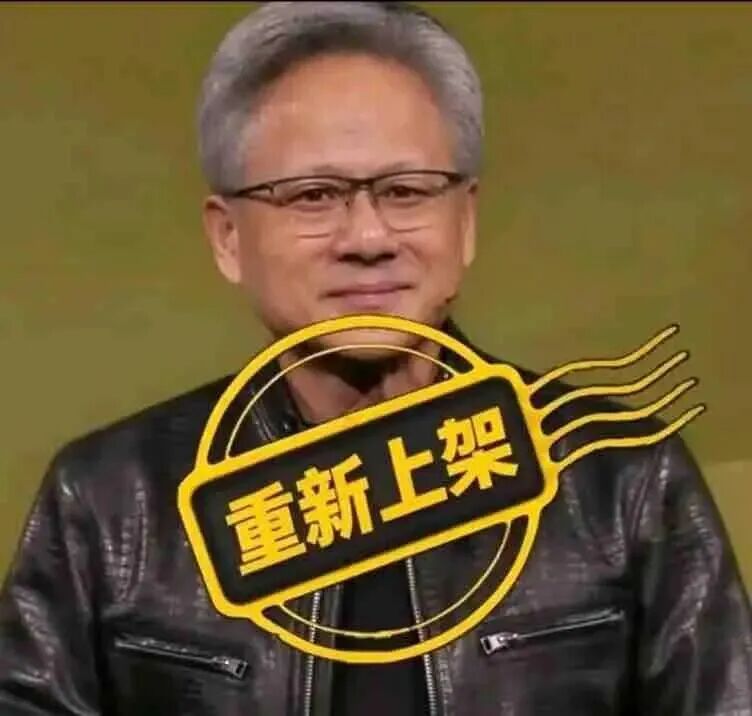
Image source: AI-generated
Certainty is NVIDIA's most expensive product. Stock price fluctuations are only the surface; the loss of certainty in the industrial chain is the substance.
Once a person becomes collateral, he cannot simply be replaced at will. Jensen Huang's reinstatement can solve the guarantor's absence, but not the flaws in the guarantee itself. NVIDIA's certainty is leaking in at least three places at the same time.
The first layer is certainty in the China business. Jensen Huang's reinstatement not only failed to soften Congress, but instead strengthened the political coalition behind control legislation. Multiple chip control proposals are advancing, and the probability of the Chip Security Act becoming law has been raised to 80%. In a key market, the rules are not set by NVIDIA.
The second layer is supply chain certainty. During his resignation, some Chinese customers had already canceled orders and suspended purchases. Customers did not know whether the hand they shook yesterday still counted today.
The third layer is governance certainty. Reinstatement is not a pass for exemption from inspection. Jensen Huang himself still faces a closed-door House inquiry on December 1 and a public Senate hearing on December 3, and the company's independent investigation is continuing. These are the real exams that will determine whether his "second term" can be secure.
Of the three leaks, the White House can plug only one. So reinstatement is not a victory for governance, but a victory for the guarantee. The board did the right thing according to corporate law, and the market punished it according to the logic of the guarantee. In the end, the guarantee won.
3. Who Is Dismantling NVIDIA's Moat?
The Chinese market is where NVIDIA's guarantee system fails.
In the Chinese market, NVIDIA's moat is being dismantled in a peculiar way.
IDC data shows that in the first half of 2026, NVIDIA's share of China's data center AI chip market fell to 34%, while Huawei rose to 28%. A year earlier, the gap between the two was 31 percentage points; a year later, only 6 percentage points remained.
At the shipment level it is even more intuitive: NVIDIA shipped 678,000 units in the first half, down 44% year on year; Huawei shipped 572,000 units, nearly doubling year on year.
Another noteworthy detail is on the supply-demand side. Huawei's Ascend 910C is in short supply, with cards hard to find on the spot market. ByteDance and Alibaba have already cleared out inventories, and Tencent and Baidu are queuing for goods. In other words, domestic substitution has reached the stage where demand is waiting for capacity. Morgan Stanley predicts that China's AI chip self-sufficiency rate will rise from 45% in 2026 to 68% in 2027.
More intriguingly, in the same financial report, NVIDIA's revenue from mainland China and Hong Kong had already reached $11.05 billion, more than triple the same period last year. This precisely shows that Chinese customers' attitude is to buy quickly while they can, using stockpiling to hedge against supply-cut risks. And the more frenzied the stockpiling, the more it proves that certainty has become a scarce commodity.
Demand migration occurred before performance caught up, showing that what customers really want is certainty that will not be cut off by a single government order; chip performance ranks behind that.
Therefore, NVIDIA's real competitor in China is the uncertainty it created itself. Huawei's share is rising fast, more because NVIDIA's "certainty discount" is transferring customers to it.
This certainty discount is even clearer in contract terms. With TSMC, NVIDIA has not signed a contract in thirty years; with Chinese customers, according to a Reuters report in January 2026, NVIDIA required full prepayment, with no order cancellation, no refunds, and no configuration changes.
Although NVIDIA later denied the "prepayment" claim, the terms "no cancellation, no refund" were repeatedly verified by multiple media outlets.
The same company signed two types of contracts, and the difference lies in the nature of the risk: commercial risk can be secured by personal credit, but political risk cannot. Handshakes happen only where trust exists; where trust is absent, contracts must be spelled out in sufficient detail.
China is not an exception for NVIDIA—only a preview, since Chinese customers have merely signed the contracts that the rest of the world will sooner or later have to sign.
Looking back at NVIDIA's guarantee system, the most extreme failure occurred at Megaspeed—the true starting point of Jensen Huang's scandal.
In March 2023, a Singapore company called 7 Road International changed its name to Megaspeed, and Huang Le joined that same month as managing director. The company was spun off from the Chinese gaming company 7th Road.
In December of the same year, at an Italian restaurant in Singapore, Huang Le stood beside Jensen Huang, beaming. Jensen Huang wore his iconic black leather jacket and held a glass of red wine. Several NVIDIA colleagues were also in the photo, and the scene looked like an ordinary business dinner.
Four days after the ownership change, Megaspeed was listed as an NVIDIA cloud partner—a status that meant priority access to the most sought-after chips. Over the next two years, through affiliates in Malaysia and Indonesia, it imported at least $4.6 billion worth of NVIDIA hardware, which ultimately surfaced in a U.S. Department of Justice export control investigation.
If the Chinese market is undermining NVIDIA's certainty, the global market is eroding its main battlefield.
The main front of the computing power war is shifting from training to inference. In the first half of 2026, inference chip shipments in the Chinese market surpassed GPUs for the first time. The Vera Rubin homepage no longer highlights training performance; instead, it promotes a 10x reduction in inference cost and the ability to train with only a quarter of the previous generation's GPUs.
For NVIDIA, this is a delicate situation. The CUDA ecosystem, ten-thousand-GPU training capability, and engineering experience—the deepest moat it has built—are all stacked on the training side.
The incremental battlefield is on the inference side, where competition revolves around cost per million tokens, deployment flexibility, and power consumption—precisely where domestic cards are most likely to win on economics rather than politics.
Goldman Sachs estimates that capital expenditure by the six major cloud providers will reach $890 billion in 2026 and continue to swell to $1.4 trillion in 2027. To digest these investments and achieve a 15% return, they will need to generate a cumulative $1.42 trillion in revenue from 2028 to 2030.
The more detailed the calculation of capital expenditure, the more important inference costs become. Training is a one-time investment, while inference is a bill that must be paid every day. Whoever is cheaper at inference holds the ticket to the next stage.
Looking one layer deeper, Jensen Huang's 11 days are actually a free short-sell report for the domestic GPU industry. Founder credibility collapses, supply chain trust loosens, engineers leave, and customers migrate—four windows open at the same time. Every time NVIDIA's uncertainty rises, the timetable for domestic substitution moves one step forward.
But Jensen Huang's reinstatement postponed the window. The mentality of "he's back, let's wait a bit longer" will slow some customers' migration decisions. Therefore, the key variable in the real timetable for domestic substitution is not the benchmark scores of domestic cards, but the speed at which NVIDIA's certainty premium collapses.
Of course, NVIDIA itself has corresponding strategies too, and three cards are already on the table. One is the cost war: a 10x reduction in inference costs. Another is to expand the board: the robotics platform Isaac and the Halos safety stack continue to grow; LG pairs its robots' "bodies" with NVIDIA's "brains"; the AI PC chip RTX Spark is being advanced together with Microsoft—all of these are new battlefields beyond the training market.
There is another card hidden deeper: a chief compliance officer, a national security and export control oversight committee, and the first board chair in the company's history. NVIDIA is turning certainty from Jensen Huang's personal asset into a corporate asset.
The industry is turning toward certainty, and NVIDIA itself is also pricing certainty.
Push the perspective up to the industry level, and the conclusion becomes clearer: in the inference era, products become standardized, and competition shifts from "who can secure capacity" (guaranteed by relationships) to "who can lower the cost per million tokens" (guaranteed by contracts and products). Vera Rubin's 10x cost reduction is NVIDIA converting its guarantee advantage into a product advantage.
The global AI industry is walking the road China has already traveled: from personalized guarantees to institutionalized guarantees.
IV. Conclusion
In the final analysis, NVIDIA has two sets of statements: financial and expectations.
During the turmoil, its third-quarter report hit a record high, and the financial set was barely damaged; the expectations set, however, collapsed.
Over the past few years, the market had always priced the two sets together. This was the first time it was forced to look at them separately. What rose back on the day of reinstatement was only the discount deducted from the expectations set; once the market calmed down, it found that the investigation, hearings, and legislation had solved not a single problem.
That is also the meaning of institutionalized catch-up. The chief compliance officer, the oversight committee, and the first chairman appear on the surface to constrain Jensen Huang, but in reality they are NVIDIA's first answer to the question: if expectations break again, what will the company use as a backstop?
The line in the reinstatement announcement—"having listened to the views of senior U.S. government officials"—follows the same logic: using external endorsement to hedge the fragility of internal guarantees.
Back in 1995, Jensen Huang, having taken the wrong technology route, flew to Japan and apologized to Sega in person, in exchange for a life-saving sum of money. That was the earliest and most important handshake of his life.
Thirty-one years later, the market used one trillion dollars to value the same kind of credit. Jensen Huang is the last person to use personal credit to guarantee a trillion-dollar industry.
NVIDIA's second chance is to turn certainty from one person's signature into a contract.
Cover image source: People on the Lost Road
Header image source: NVIDIA
Disclaimer: The content of this article is for reference only and does not constitute investment advice. Investors who act accordingly do so at their own risk.
Copyright Zhixie Island. Unauthorized reproduction is prohibited.
-
![]()
$55 Billion! Liang Wenfeng Becomes the World's Richest Large-Model Developer
-
![]()
Anthropic IPO Watch: A $1.5 Trillion Valuation and a Pricing Experiment in the AI Capital Era
-
![]()
What Are the Benefits of Becoming a DeepSeek Shareholder? | Juchao
-
![]()
The Wealth-Creation Myth Behind the Largest IPO in History
-
![]()
Chinese Brands Are Starting to Make Their Way into European Shopping Malls
-
![]()
China's Robotaxi Battle Heats Up in Dubai | Juchao
-
![]()
$952 Billion: Nvidia's Repurchase of a Guarantee Letter
-
![]()
A 50,000 Yuan C-Segment Car—Is Battery Swapping the Key to Stimulating Consumption?