The Wealth-Creation Myth Behind the Largest IPO in History
 11/27 2026
 418

Perhaps the most staggering wealth-creation story ever spun from a single IPO.
Anthropic rings the bell, and the equity held by roughly 2,800 employees is now worth more than $10 million each.
On the day of the Nasdaq bell-ringing, Anthropic priced its shares at $83, but the first public trade hit $111.50. By the close, the stock had settled back to $97.17. Some investors pocketed 17.1% in a single day; others lost 12.9% over the same session.
The former got in at the issue price; the latter bought at the opening price. But for a group of early employees, both prices sit far above their original exercise price. According to the prospectus, options still outstanding at the end of 2023 carried a weighted average exercise price of just $0.52.
On November 19, the company behind Claude listed on Nasdaq under the ticker ANT. On November 20, the company confirmed that the over-allotment option had been fully exercised, bringing total IPO issuance to approximately $93.5 billion. According to Reuters, this is the largest IPO in history.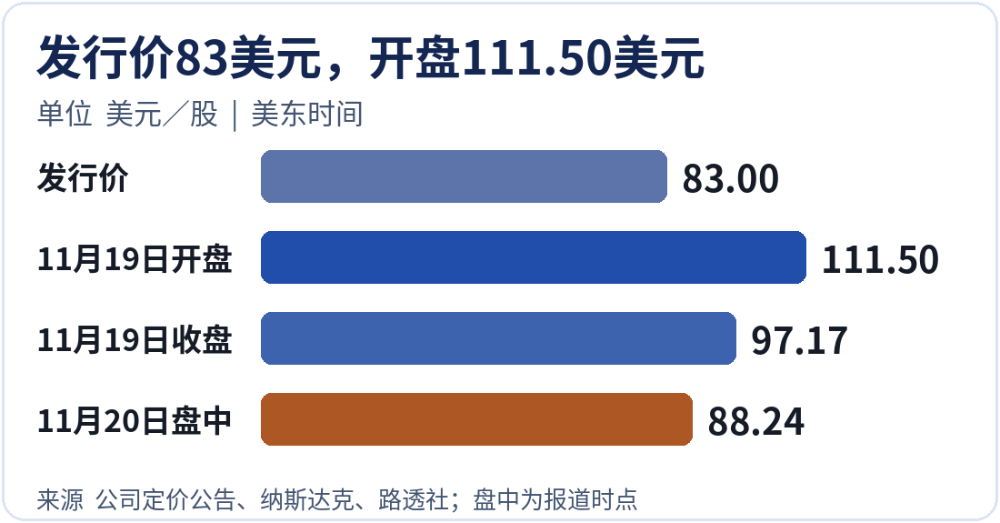
Of that $93.5 billion, about $91.6 billion came from new shares issued by the company, while roughly $1.963 billion came from existing shares sold by selling shareholders—all figures before fees.
There was also a concurrent $26 billion private placement. Combined, the public offering and private placement raised about $119.5 billion, a total that also includes proceeds going to selling shareholders.
From the confidential filing on June 1, to a roadshow range of $70 to $78 in November, and finally a price of $83, the fundraising target was raised along the way. Based on the issue price, Reuters reported a fully diluted valuation of about $1.5 trillion—a measure that also accounts for potential shares.
Trading enthusiasm soon gave way to price volatility. During U.S. trading hours on November 20, Reuters reported the stock was quoted at $88.24 at one point, about 9% below the first-day close. For anyone who bought at the first-day opening price, that intraday level represented a decline of roughly 21%.

Two estimates, both landing at roughly 2,800 people.
The Wall Street Journal, citing private trading platform HiII, estimated that the equity held by about 2,800 employees is worth at least $10 million each, with roughly 600 of them at the $100 million level. The latter figure the institution gave to Reuters was 598 people, excluding founders.
Another widely circulated figure is also "about 2,800 people." That one was calculated by private research firm Sacra based on a $1.35 trillion valuation, using a $1 million threshold. It covers current and former employees and counts vested equity on a pre-tax basis.
The 2,800 people in the two estimates happen to coincide, even though the thresholds differ tenfold. Hill's two tiers also overlap: anyone reaching $100 million has already crossed the $10 million line. Stacking these groups together only makes the same listing look more and more bustling.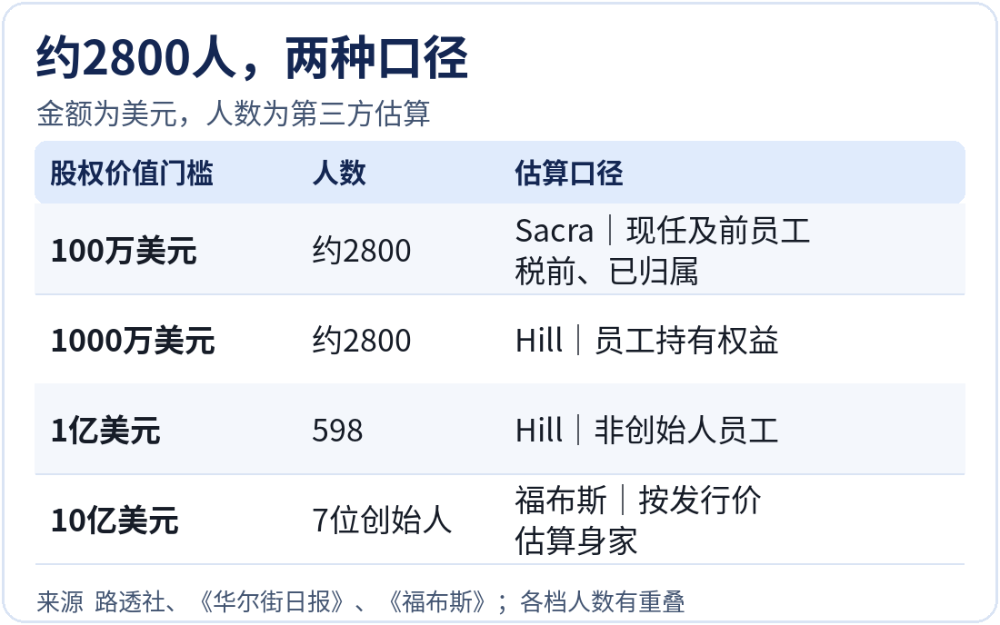
The seven co-founders are easier to verify. Forbes estimated, based on the $83 issue price, that the seven together are worth about $140 billion, or roughly $19.9 billion each. They were already dollar billionaires at the previous private valuation; the IPO merely marked up their paper fortunes.
What was actually cashed out is stated more clearly in the prospectus. Each of the seven founders sold about 3.3784 million shares in this offering, which at $83 amounts to about $280 million each—roughly $1.963 billion in total, still before fees and taxes.
For employees, only the total pool is visible. As of the end of September, the prospectus listed the total intrinsic value of unexercised options at about $119.1 billion, of which about $72.6 billion was vested and exercisable. This is a measurement as of the end of September, and it differs in basis from individual wealth estimated at the issue price.
The company did not disclose, on an individual basis, the number of grants, vesting progress, shares sold, or tax situation. Who crossed $10 million the moment the company listed, and how many had already cashed out through private transactions—public materials can answer only part of that. Image source: The Wolf of Wall Street
Buying five years ago versus buying on the bell-ringing day.
In 2021, Skype co-founder Jan Tallinn led a $124 million Series A. At the time, Claude had not yet been commercially released, and the bet was that the team could turn research into a product and that the company had the ability to keep raising money to train the next round of models.
In 2023, Claude launched, Google joined the May Series C, and Amazon announced in September a planned investment of up to $4 billion.
Cloud providers were simultaneously betting that models would bring new computing demand and allow them to collect an extra cloud service fee from enterprise procurement.
Money that entered later already faced a product that could be tried, procured, and billed—and the price went up accordingly. The post-money valuation of the February 2026 Series G was $380 billion, and the post-money valuation of the May Series H rose to $965 billion. Series H also brought in $65 billion in funding.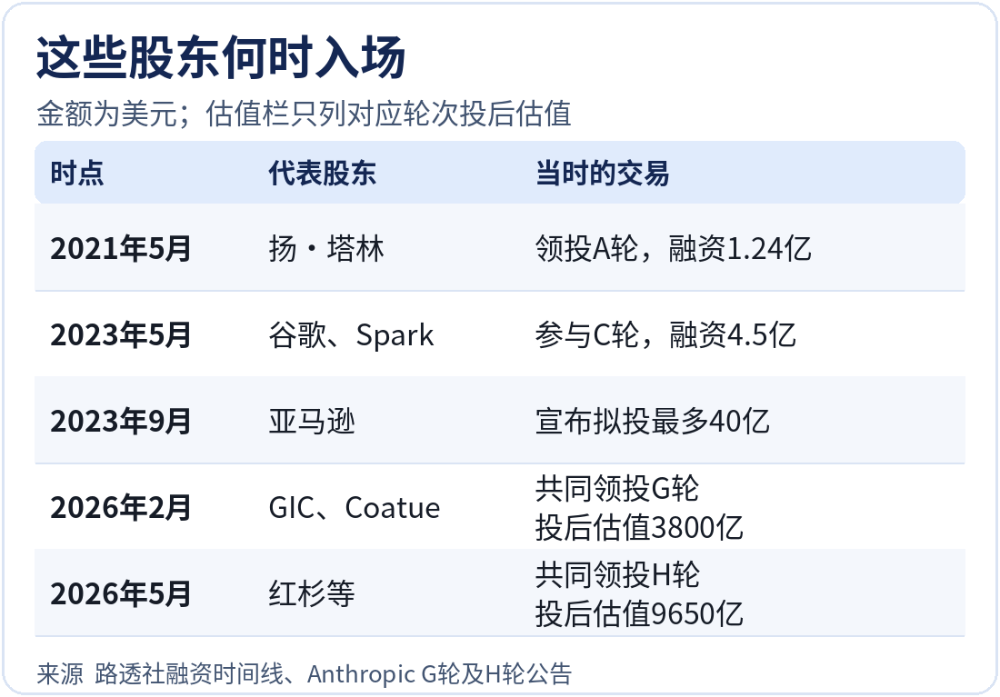
The split-adjusted Series H price given by Forbes is $58.90 per share. Compared with the $83 pricing, that is about 41% higher. Subtracting one quote from the other is easy, but calculating an institution's return depends on which rounds it bought into, how much it sold along the way, and what rights it still holds.
The same goes for employees. The weighted average exercise price of newly granted options in 2024 was $1.30. At that cost, 100,000 vested options at $83 have a pre-tax intrinsic value of $8.17 million. For every $10 lower the share price falls, that paper value drops by $1 million.
Claude makes money through channels such as subscriptions, direct API access, and cloud platforms. In the first nine months of 2026, Anthropic's revenue was $33.242 billion, about 13.1 times the same period a year earlier.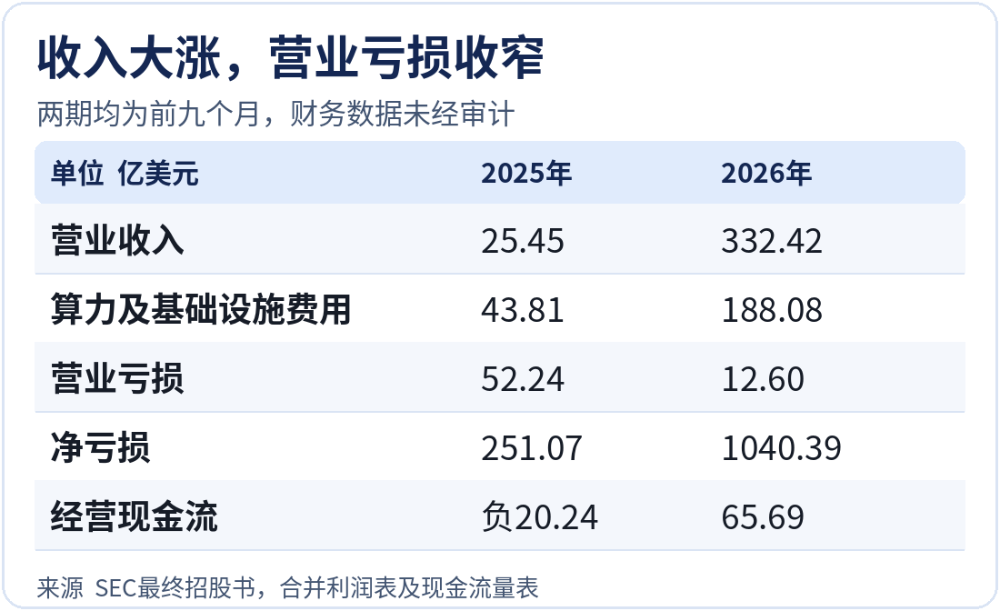
As scale increased, operating loss in the same period narrowed from $5.224 billion to $1.260 billion, and operating cash flow turned positive at $6.569 billion.
Over the same period, net loss reached $104.039 billion, of which $94.324 billion came from fair value changes in instruments such as convertible bonds.
Book revaluation dragged down net profit. In the first nine months of 2026, computing power and infrastructure expenses had already reached $18.808 billion. The faster inference demand grows, the more data centers and chips often need to be prepared in advance.
This fundraising leaves room for computing investment. Going forward, the question is whether the bills customers run up using Claude can cover training, inference, and related operating costs for several consecutive quarters.
Existing shareholders will be released in batches.
Nasdaq trades Class A shares, with regular trading hours from 9:30 to 16:00 Eastern Time. When existing shareholders can put their shares on the market still depends first on the lock-up terms of this IPO. Lock-ups come from underwriting or company agreements.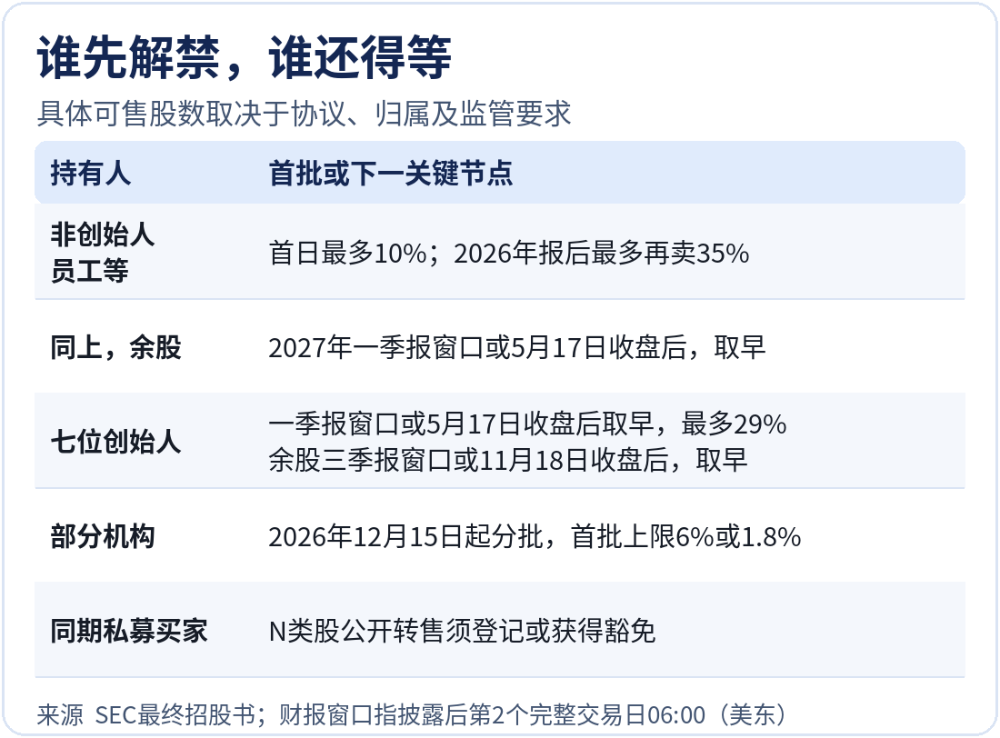
Non-founder directors, executives, and current and former employees and consultants may transfer up to 10% from the first day of listing. From 6 a.m. Eastern Time on the second full trading day after the official results for fiscal 2026 are released, they may transfer up to another 35%, both calculated based on locked-up securities as of the end of October.
The lock-up for the remaining portion takes effect at the earlier of 6 a.m. Eastern Time on the second full trading day after the release of the first-quarter 2027 report and after the close on May 17, 2027. May 17 is the 180th day after the prospectus date.
In addition to the shares already sold in the IPO, founders may transfer up to 29% under the agreement at the earlier of the above two time points. For the remaining portion, the earlier of 6 a.m. Eastern Time on the second full trading day after the release of the third-quarter 2027 report and after the close on the 365th day applies.
The 365th day is November 18, 2027. Some institutions may transfer as early as 6 a.m. Eastern Time on December 15 this year, divided into two tiers of up to 6% and 1.8% under the agreement.
The release of the remaining shares in the two tiers refers respectively to the first-quarter report or the 180th day, and the third-quarter report or the 365th day, whichever is earlier.
The concurrent private placements subscribed by Google, Nvidia, and others are Class N shares. These shares are unregistered and not directly listed, and public resale depends on registration or exemption and conversion terms. When using the SEC's Rule 144 exemption, eligible non-affiliates generally must hold for at least six months.
After the agreement allows it, it is still necessary to confirm that the options held have vested and the shares have been settled, and where applicable, to comply with insider trading windows and SEC resale requirements. How much can actually be obtained from a transaction still depends on how deep the bids are that day.
How many venture capital projects make it to the bell-ringing?
According to the third-quarter report by PitchBook and the National Venture Capital Association, in the first three quarters of 2026, U.S. venture capital deal value reached $515.8 billion, with AI accounting for 82.7%. Yet for the entire third quarter, the report counted only 18 venture-backed companies going public.
The same report also recorded two discounted exits. Airtable was sold for $1.3 billion, and Miro was acquired for $1.4 billion, both nearly 90% below previous valuations. These are the gaps between transaction prices and historical valuations; individual profit and loss still must be calculated from each person's entry price.
There is also a clear path for venture capital to lose everything. The company burns through cash, the next financing round cannot be secured, and it has to shut down. Liquidation pays debts first, then handles preferred rights according to agreement. By the time common shares are reached, there is often no money left to distribute.
Entering early looks glamorous, but in reality it means trading several years of liquidity for a probability. Even if the investment hits, subsequent financing may continue to dilute the stake. A fund has ten projects, nine have no exit, and the one most likely to remain in the news is the tenth.
Of course, another fast-rising company will appear in the market. The difficulty is that when it has not yet validated its product and is short of cash, investors must first recognize it, still have a chance to get it at a suitable price, and be able to wait through several financing rounds and a long exit cycle.
Onlookers easily remember the opening price of $111.50. The person who took that option five years ago had to first believe that a company which had not yet sold a product would survive. Equity can change a person's wealth, and it may also leave only a certificate for which no one quotes a price.
I would rather treat this IPO as a lesson in pricing. If a company truly has ability, the market truly is willing to give money. When it is your turn to invest in an unproven sci-tech innovation project, first calculate how long it can last and how much can be recovered in the worst case. That bit of calm is more valuable than copying down a list of rich people.
What do you think of this hot topic? We look forward to your civilized and rational comments in the comment section.
Disclaimer: This article is only a financial hotspot analysis from a professional perspective. Data and materials are cited from public queries, company announcements, and Tonghuashun iFinD. The views are for reference only and do not constitute any investment or consumption advice.
#FinancialHotspot #InDepthInterpretation #BusinessFinance #InvestmentBankingCircle #ListedCompanies #PrimaryMarket #IPO #AI
-
![]()
$55 Billion! Liang Wenfeng Becomes the World's Richest Large-Model Developer
-
![]()
Anthropic IPO Watch: A $1.5 Trillion Valuation and a Pricing Experiment in the AI Capital Era
-
![]()
What Are the Benefits of Becoming a DeepSeek Shareholder? | Juchao
-
![]()
The Wealth-Creation Myth Behind the Largest IPO in History
-
![]()
Chinese Brands Are Starting to Make Their Way into European Shopping Malls
-
![]()
China's Robotaxi Battle Heats Up in Dubai | Juchao
-
![]()
$952 Billion: Nvidia's Repurchase of a Guarantee Letter
-
![]()
A 50,000 Yuan C-Segment Car—Is Battery Swapping the Key to Stimulating Consumption?