Chinese Brands Are Starting to Make Their Way into European Shopping Malls
 11/27 2026
 425
Author | Yang Zi
Editor | Xiaotian
The brand landscape on European shelves is shifting.
Once, the most prominent spots in the hair dryer aisle typically belonged to international names like Dyson and Philips; in the robot vacuum displays, European, American, Japanese, and Korean brands long dominated the options familiar to consumers. But now, more and more Chinese brands are starting to appear in these same positions: Laifen's hair dryers and Dreame's and Roborock's robot vacuums are displayed alongside established international products; Hisense and TCL televisions have entered the core sales systems of mainstream European retailers; Xiaomi, through phones, smart wearables, and smart home products, has gradually become a name consumers recognize.
These changes are no longer confined to the shelves.
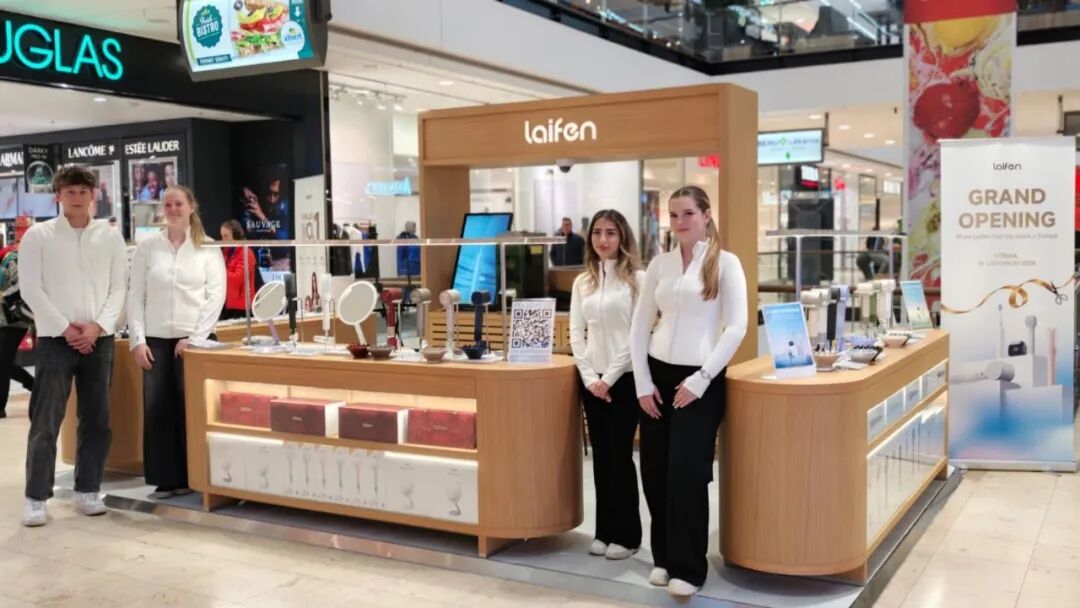
In European shopping malls, Chinese brands are beginning to open their own experience spaces. Laifen chose to open a brand experience store in Prague and entered mainstream consumer electronics retail systems such as Germany's MediaMarkt in the form of a flagship store, allowing consumers to directly experience Chinese-made high-speed hair dryers, electric toothbrushes, shavers, and more offline. In the past, such consumer scenarios were often the home turf of international brands like Dyson and Philips.
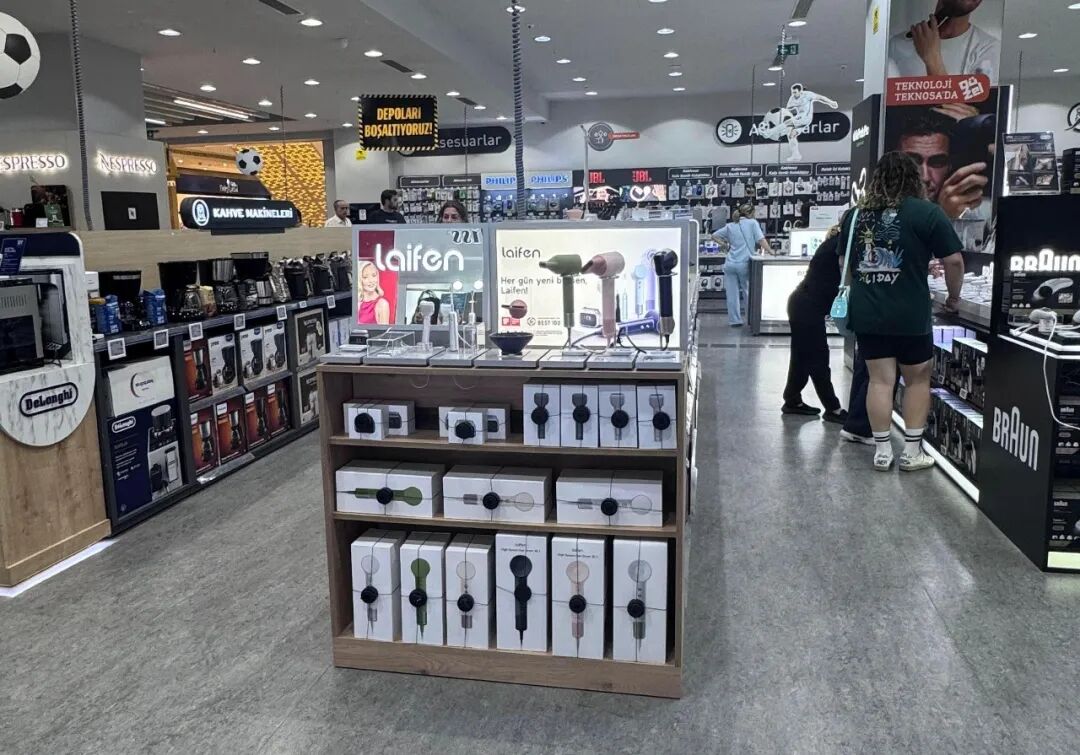
For European consumers, Chinese brands are transforming from unfamiliar options that need to be searched for and compared on e-commerce platforms into brands they can directly see, pick up, experience, and choose when shopping.
The role of Chinese brands in the European market is also changing. In the past, Chinese manufacturing entered Europe more by relying on supply chain advantages and product cost-effectiveness; today, more and more Chinese brands are beginning to enter local mature retail systems, competing for shelf space, stores, and consumer attention. They are no longer satisfied with simply selling products to Europe; they want to truly enter the daily lives of European consumers.
This may be precisely the signal of a new stage in the globalization of Chinese brands.

Why are European offline channels such a difficult hurdle for Chinese brands going global?
In Europe in November 2026, Laifen left nearly synchronized footprints across three countries.
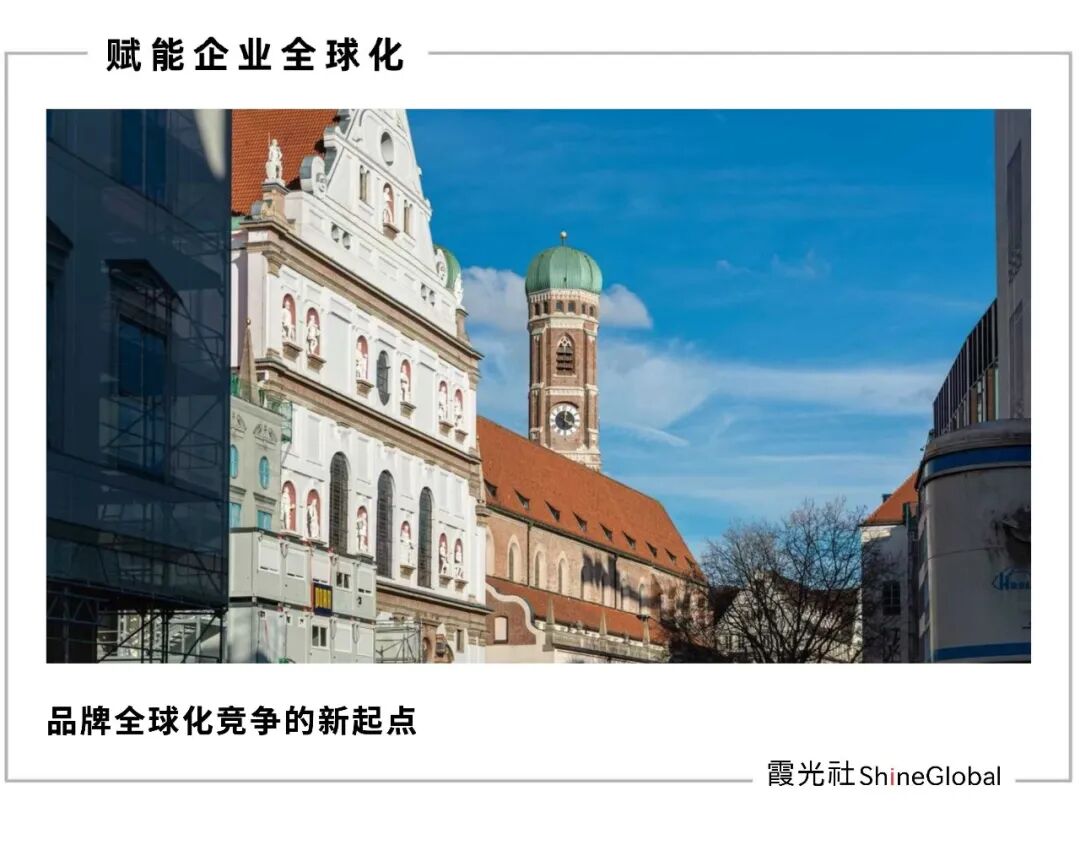
At the Beaugrenelle shopping center on the banks of the Seine in Paris, a tech day pop-up co-hosted with the leading French media outlet Le Journal du Numérique had just concluded. In the MediaMarkt at Stachus in Munich's old town, a shop-in-shop featuring Laifen's brand image was opening its doors to customers. Soon after, at the OC Arkády Pankrác shopping center in Prague, Laifen's first independently operated brand space in Europe officially opened. Laifen's moves in Europe are shifting from "getting products into channels" to "bringing the brand face to face with consumers."
In the words of Marek, sales director of Laifen's Czech partner distributor NEOX GROUP, in the past, consumers mainly came to know the brand through e-commerce and product reviews; "now, they can finally experience the products firsthand offline."
This path did not emerge overnight. Initially, Laifen's European market was basically driven online, gaining traction on Amazon, establishing itself through the momentum of its high-speed hair dryer as a single product, and then gradually entering local retail systems. Information disclosed during IFA 2026 indicated that its European offline presence had already entered mainstream channels such as Boots, Costco, and MediaMarkt.
How to make consumers stop, pick up, and try? This seems to be a question Chinese brands need to answer together when entering the European market.
The offline channel in the European market is a system with high thresholds, multiple layers, and trust as its currency. The online scaling logic that Chinese brands excel at cannot be directly transplanted here.
The first threshold is the concentration of channel entry points.
Shelf space in European consumer electronics offline retail has long been controlled by a small number of large retail groups. MediaMarktSaturn operates more than 1,000 stores in 12 countries; in Germany alone, its two brands MediaMarkt and Saturn hold more than 30% of the market, making it the largest consumer electronics retail network in Europe. The UK's Currys holds about a quarter of the domestic market share, while Fnac Darty constitutes another pole in France.
This is not a fragmented market that can be covered by adding a few more distributors; it is a structure with narrow entry points and inherently scarce shelf positions. Online sales are certainly important, but when a category involves personal care, feel, noise, airflow temperature, and fit—experiences that require actual handling to obtain—without entering physical channels, the brand remains stuck in "search results" and has no access to the space where consumers pass by, pick up, and judge.
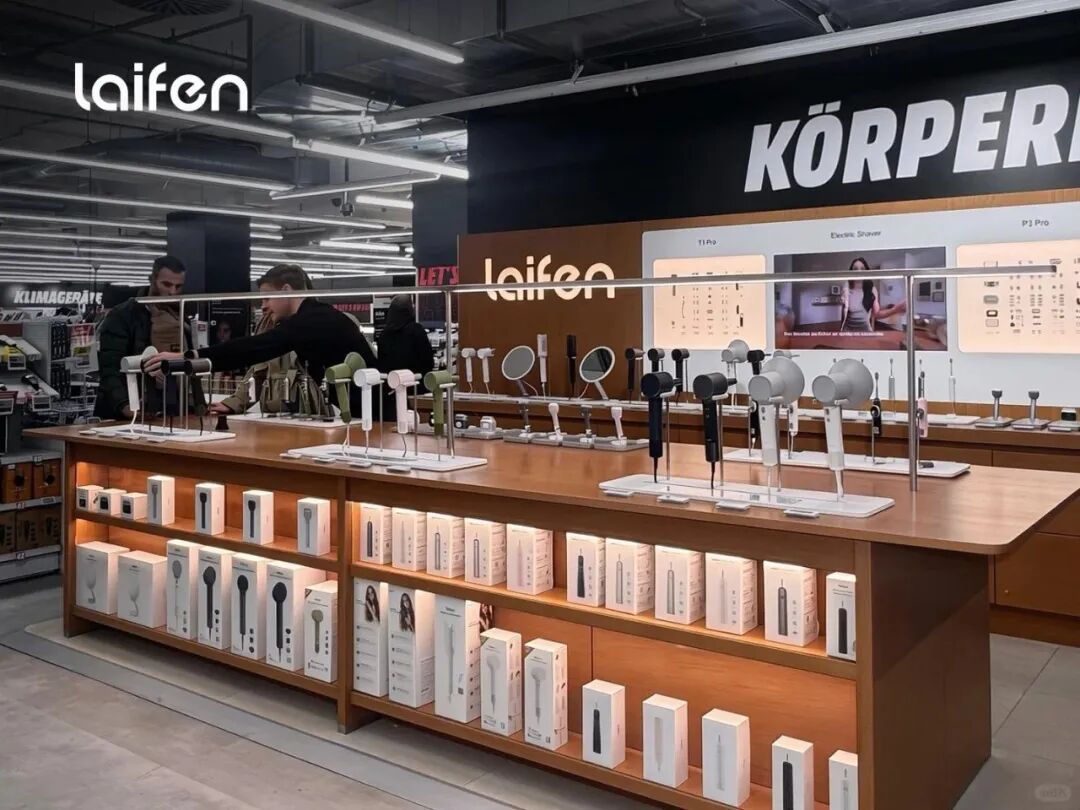
This is precisely why Laifen chose to do a shop-in-shop at the MediaMarkt in Munich's Stachus. It needs brand presence to "show its face," not merely exposure volume. MediaMarkt München-Stachus itself is one of Germany's most famous shopping districts, with a total store area of more than 5,000 square meters; what Laifen's brand space is embedded in is retail infrastructure whose foot traffic and trust have been repeatedly verified.
The second threshold is the lack of market uniformity.
The State of European Retail jointly published by McKinsey and EuroCommerce in 2024 shows that there are significant differences in the rhythm and structure of retail markets across European countries. For example, non-food spending accounts for more than half of the total in Germany and the UK, while French consumers' budgets are the opposite, highly concentrated on groceries.
This means there is no template strategy that can "cover Europe." Chinese brands entering Europe does not mean that securing one general agent will provide full coverage; rather, they need to establish channel partnerships, logistics, services, and brand operations capabilities market by market. Each market requires re-solving the adaptation of channel relationships, local content, after-sales networks, and consumer habits.
In Germany, Laifen chose to bind itself to the MediaMarktSaturn system, entering through shop-in-shops while expanding density with dedicated brand spaces. In the Czech Republic, it used an independent brand space together with local brand ambassador Terezie Kovalová and Czech VOGUE to build aesthetic recognition and brand image. In Turkey, it used the local chain market Teknosa as its gateway, tapping into the familiarity that local consumers have accumulated over time.
The third threshold is the way consumers gain trust.
Products such as hair dryers, electric toothbrushes, and shavers are used extremely frequently; every time they are picked up and put down, they are tested. Feel, noise, durability, and after-sales all enter into purchasing considerations.
As a foreign brand, the first question to answer is "why should I trust you," yet the "harder" the capability, the harder it is to land in the heart. Offline experience spaces are different; they allow consumers to judge for themselves.
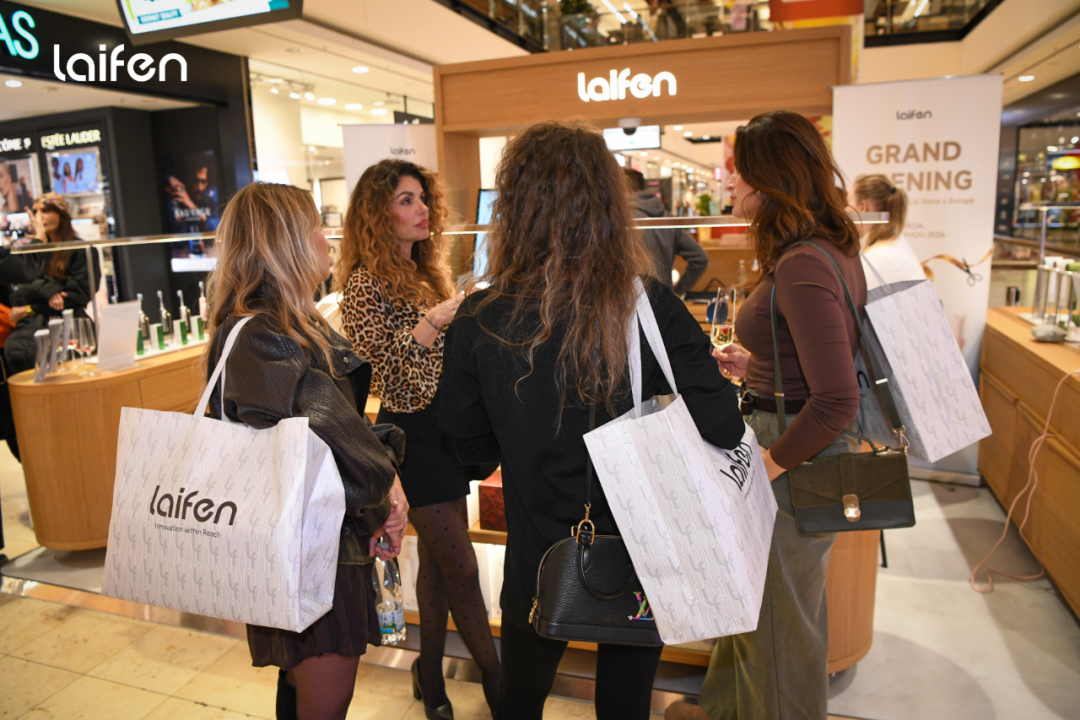
At the Prague opening, Laifen displayed its entire product line so that consumers could blow, brush, and hold products to feel their weight and materials. This order of "judge first, then trust" is exactly the opposite of the online shopping logic of "trust first, then order." It turns the brand from "an object that needs to be argued for" into "an object that can be tested." When products are placed next to shelves and on the floors of shopping malls, the initiative changes hands.
In the past, when Chinese brands entered Europe, they often first had to answer why consumers should trust a Chinese brand. Now, they are beginning to let consumers directly judge whether products are worth buying through offline stores.
Imagine this scene: on a weekend in Munich, a German consumer stands in a store, holding a Laifen hair dryer and turning it over and over. He does not look at the specs or check reviews on his phone. But he is listening to the sound, weighing it, and pointing the air outlet at the back of his hand to test the temperature.
This scene is precisely the value of offline channels: if this hair dryer appeared only on an Amazon search page, consumers would most likely not take the step of "walking to the checkout counter." The distance between the online shopping cart and the offline checkout counter is not about walking into a mall, but about how to build trust in the product.

Chinese brands are changing the way competition works in Europe's offline market
Laifen is not alone; the shift happening to it is also unfolding among more Chinese brands.
Chinese brands in the European market have different starting points, categories, and time windows for entry, but they all arrive at the same destination: they all place offline space at the core of their brand strategy. This is not a tactical choice of one company, but a logical turn for a generation of going-global brands.
In 2025, Dreame captured a 27.6% shipment share in the European robot vacuum market, becoming No. 1 in Europe according to IDC. Its overseas revenue accounts for about 65%, and its products have entered more than 100 countries and regions and more than 5,500 offline stores. For it, offline space is not about proving channel capability, but about allowing its already existing multi-category matrix to be perceived simultaneously in one physical scene.
Dreame explicitly defines its stores in Europe as experience centers. From MyZeil in Frankfurt to the Olympia shopping center in Munich, and then to Westfield Mall in The Hague, consumers who go in are not just buying a robot vacuum, but understanding the relationship between cleaning appliances and personal care products through demonstrations: someone who enters for a robot vacuum may take a liking to a hair dryer, and someone who stops for personal care products may casually learn about a wet-dry vacuum.
Xiaomi's offline path is a completely different one. It mainly relies on online sales and carrier channels, and its brand awareness in Europe is concentrated in cost-effective phones.
In September 2025, Xiaomi opened its first directly operated store in Germany at the Limbecker Platz shopping center in Essen, with an area of about 99 square meters. In addition to phones, the store displays wearable devices, TVs, robot vacuums, electric scooters, and home appliances. Xiaomi's intention is not to add another place to sell goods, but to turn "human x car x home full ecology" from a slogan into operations that can be remembered.
Lei Jun announced in early 2026 a plan to increase the number of stores in the UK to 150 within four years, expanding the business scope from phones to wearables, home appliances, and cars. Xiaomi Group defines this stage of globalization as a series of evolutions, from "product going global" and "brand going global" to "model going global."
Xiaomi's self-operated direct stores mean it is willing to trade higher rent and operating costs for control over narrative and experience, allowing consumers to form an overall judgment of the brand in a space fully controlled by the brand, rather than through fragmented information on e-commerce detail pages.

Compared with the previous two, BYD's expansion in the European market has been even faster. In 2021, it chose Norway for a trial, entering Germany, France, and other core countries of the automotive industry from a corner of Northern Europe, and within five years expanded its sales network to more than 30 European markets. By the end of 2025, its European sales points had reached about 1,000, covering nearly 30 markets, with plans to double to 2,000 by the end of 2026.
In the first nine months of 2026, BYD newly registered about 42,800 vehicles in Germany, 3.6 times the same period the previous year, with about 65% coming from individual customers. A salesperson who has worked in Germany's automotive industry for many years compared this momentum to the scaling stage of China's new energy vehicle market around 2021: "the momentum is about to take off." What cars need is not an experience store, but a complete network of showrooms, test drives, delivery, repair, and after-sales service. BYD is relying on the growth momentum of Chinese brands to activate local European dealer and service networks.
If Laifen and Dreame are fighting for brand space, and Xiaomi is fighting for ecological showrooms in shopping malls, then what BYD is fighting for is access to a complete set of local commercial infrastructure—dealer systems, repair capabilities, delivery processes, and long-term service relationships, none of which can be missing.
Online sales can prove that a product is needed, but only when consumers stop in physical space, pick it up, and judge with their bodies does the brand truly begin to accumulate.

From online hit products to offline stores, Chinese brands are beginning to enter the home turf of major European brands
What is more noteworthy is that what Chinese brands are truly entering is a competitive scene long occupied by European and American brands in the past.
Take personal care appliances as an example. Brands such as Dyson, Philips, and Braun have built up considerable brand recognition among European consumers over years of operation. When shoppers walk into a local electronics store looking for a premium hair dryer or electric shaver, the names that first come to mind are often these familiar ones. These brands have not only accumulated deep product and technological expertise, but have long been embedded in the region's mature retail system—from shelf placement and product demonstrations to sales recommendations and after-sales service, an entire commercial infrastructure continually reinforces consumer awareness of these brands.
This is also one of the least welcoming aspects of the European market for latecomers. Products can reach Europe through cross-border e-commerce, but brand awareness cannot be shipped along with the package. When consumers spot an unfamiliar Chinese brand on Amazon, versus encountering it firsthand in a shopping mall or electronics store they know well, these are two entirely different purchase decisions. This is especially true for products like hair dryers and shavers that are used over the long term and place a premium on experience: offline channels serve not only a sales function but also act as a key entry point for building brand trust.
And when Chinese brands begin opening brand experience spaces in European shopping malls and entering mainstream electronics retail systems like MediaMarkt, they are in effect stepping directly onto the home turf that international brands such as Dyson have spent years cultivating. Consumers no longer encounter Laifen only online through prices and specs; instead, in a familiar shopping environment, they can compare it side by side with established brands: whose product is easier to use, whose design better meets their needs, whose price is more worth paying.
What lies behind this shift is that competition between Chinese brands and established European companies is extending from online traffic and supply chain efficiency to a contest over offline consumer touchpoints and brand awareness. In the past, when Chinese brands entered Europe, they mostly brought products to consumers; now they are beginning to actively enter the commercial spaces consumers know well, striving to become the brand consumers will instinctively think of the next time they shop.
In this sense, what really matters about Laifen entering European offline channels is not how many stores it has opened, but that it is beginning to appear in the very positions once familiar to brands like Dyson and Philips. Chinese brands are transforming from external suppliers in the European market into competitors that local consumers can directly compare, experience, and choose.
This means Chinese brands need to rethink the relationship between products and channels. In the past, many Chinese brands entering overseas markets relied on a single hit product to break through. Laifen built brand awareness with high-speed hair dryers, Dreame opened the European market with robot vacuum cleaners, and Xiaomi gradually extended from smartphones to smart homes. But if a brand always depends on a single hit product, its bargaining power with retail channels, frequency of consumer reach, and long-term operating space will all be limited.
Behind offline sales lies a complete set of local operating capabilities: from warehousing and logistics, inventory management, to product repair, spare parts supply, returns and exchanges, and consumer services. This is another lesson Chinese brands need to catch up on. When a brand begins entering offline channels—especially when trying to establish its own stores—it can no longer see itself merely as an exporter but must become a long-term operator in the local market.
Europe is also not just a destination for product exports, but an important market for Chinese brands to build global awareness, test product competitiveness, and hone local operating capabilities. Of course, this road is not easy. Getting onto a retailer's shelf may require only one channel partnership; but for a brand to truly integrate into local consumers' lives requires long-term product investment, channel building, and service accumulation. The former solves how products are sold; the latter solves how a brand stays.
When Chinese brands begin opening stores in Europe, competing for core shelf space, and building local service networks, what they are truly striving for is no longer just a share of sales in the European market, but a long-term position in the minds of global consumers.
In this sense, entering European offline channels is not the endpoint of Chinese brands' globalization, but the starting point of the next stage of competition.
-
![]()
$55 Billion! Liang Wenfeng Becomes the World's Richest Large-Model Developer
-
![]()
Anthropic IPO Watch: A $1.5 Trillion Valuation and a Pricing Experiment in the AI Capital Era
-
![]()
What Are the Benefits of Becoming a DeepSeek Shareholder? | Juchao
-
![]()
The Wealth-Creation Myth Behind the Largest IPO in History
-
![]()
Chinese Brands Are Starting to Make Their Way into European Shopping Malls
-
![]()
China's Robotaxi Battle Heats Up in Dubai | Juchao
-
![]()
$952 Billion: Nvidia's Repurchase of a Guarantee Letter
-
![]()
A 50,000 Yuan C-Segment Car—Is Battery Swapping the Key to Stimulating Consumption?