$952 Billion: Nvidia's Repurchase of a Guarantee Letter
 11/27 2026
 414
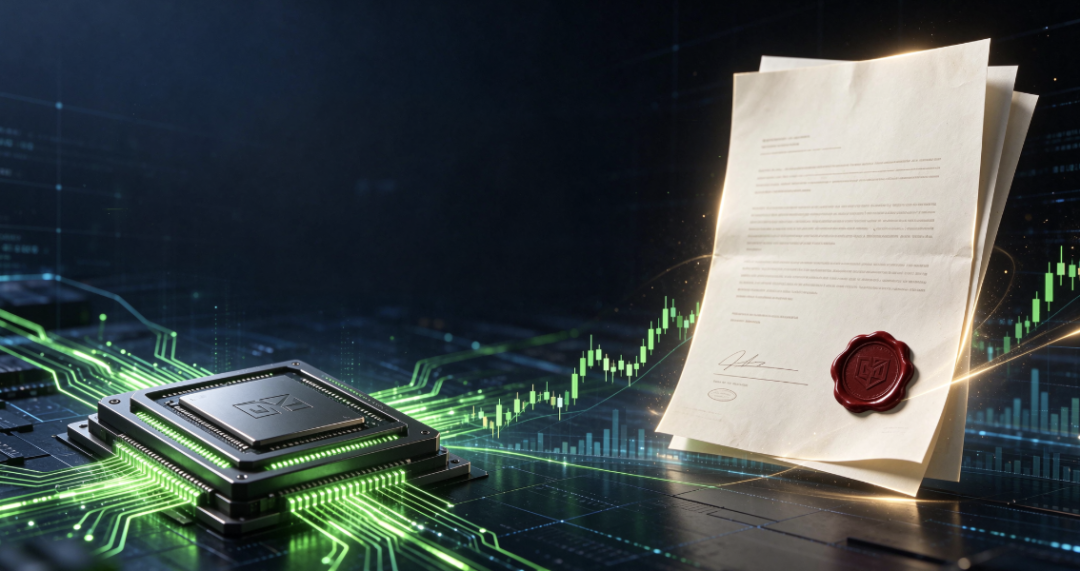
What the market has been pricing may never have been the AI bubble, but rather who signs for the bubble.
/
By He Lanyi | Edited by Yang Xiaoruo
On the morning of November 23, the atrium of Nvidia's headquarters in Santa Clara, California, was packed. Multiple employees captured the scene on their phones.
According to several on-site videos, hundreds of people crowded the first-floor lobby; some stood on the stairs, others leaned over the second-floor corridor railing holding up their phones. When Jensen Huang walked in, the crowd first applauded, then broke into a rhythmic chant: "Jensen! Jensen!" Someone shouted, "Love you, Jensen."
On-site video showed he was not wearing his signature black leather jacket, but a dark jacket. His right hand pressed to his chest, he looked around and bowed twice.
He said, "Today is my first day at work. I don't have a computer—IT needs to get me a new one." Then he added, "I'm very sorry for putting you all through this. I made some very serious mistakes. Thank you for giving me a second chance. The second time, I'll be a better CEO." In the video, an employee rushed forward and hugged him.
At almost the same moment, three thousand miles away in New York, the U.S. stock market opened.
CNBC's intraday data showed that within less than an hour of the open, Nvidia's gain was pushed from 14% all the way to 34%. It closed up 31.48% at $165.05, with a market capitalization of $3.98 trillion, adding $952 billion in a single day. This is also the historic record for single-day market cap increase by a global listed company.
A man who had just admitted to making serious mistakes made a company nearly a trillion dollars more valuable in one trading day. What exactly is the capital market paying for?
01 Eleven days: the market put a price on one man
According to Nvidia's November 12 announcement, Jensen Huang resigned as president, CEO, and director due to an extramarital affair scandal, and CFO Colette Kress became interim CEO.
On November 17, the first earnings report after his departure was released. The company's fiscal 2027 third-quarter results showed quarterly revenue of $115.8 billion, up 103% year-over-year; net profit of $65.3 billion, up 105%; data center revenue of $107.6 billion, up 110%, with next-quarter guidance of $130 billion.
By any standard, this was a flawless beat-and-raise.
According to the public record of the November 17 earnings call, Chairman Harvey Jones said that day that the board had unanimously accepted the resignation and "has no intention of having Jensen Huang return as CEO."
After that, the stock kept falling. On November 20, Reuters reported that the SEC was investigating Nvidia's accounting issues; according to a later Wall Street Journal account, the core of the investigation was whether the company's disclosures had misled investors.
That day, the stock fell another 14% to close at $125.53. By then, Nvidia had fallen for seven consecutive trading days and seven consecutive weeks, the largest weekly drop since October 2008.
According to Reuters statistics, market capitalization fell from the October 6 peak of $5.76 trillion to $3.03 trillion, a drawdown of about 47%, dropping behind Apple, Microsoft, and Alphabet.
By the evening of Sunday, November 22, Trump posted on Truth Social demanding that the board rehire Jensen Huang. On November 23, the board unanimously approved.
From resignation to reinstatement, seven trading days erased $1.16 trillion, and one day brought back $952 billion. These figures are often interpreted as a founder premium. But the unit of the premium should not be dollars; it should be multiples.
The last closing price before reinstatement was $125.53; after reinstatement it was $165.05, with a trailing P/E of 17.73 times. Back-calculating from these two public data points, Nvidia's P/E on November 20 was about 13.5 times.
It should be noted here that 13.5 times is the result calculated in this article based on the closing price and public P/E; using a different EPS base would produce slightly different figures.
The earnings report showed that a company with quarterly revenue growth of 103%, a gross margin of 74.8%, and data center revenue that had doubled was being priced by the market at 13.5 times. That multiple does not look like a bubble; a bubble should be 40 times, 60 times, or 100 times. And 13.5 times is roughly equivalent to the price of mature manufacturing, telecom operations, or cyclical stocks deemed to have peaked in growth.
There is a benign explanation for the low multiple: the market believes these are peak-cycle profits and that they will decline next year. That explanation is only half valid; it cannot explain why, within the same sector, only Nvidia was singled out and pushed down.
According to Reuters market statistics, from November 6 to the trading days after the resignation, Nvidia fell 16.3%, while the VanEck Semiconductor ETF fell only 0.4% over the same period. Of the roughly $735 billion in market value erased, almost all was attributed to Nvidia itself.
What the market is really selling may not be that AI is too expensive, but another question: of this company's revenue, how much is actually cash received, and how much is guaranteed by the company itself.
According to estimates by research firm SemiAnalysis, as of the end of the previous fiscal quarter, Nvidia's off-balance-sheet commitments and guarantees totaled about $530 billion, compared with about $184 billion a quarter earlier.
This estimate was cited by Tencent News in "Nvidia Proves in 11 Days That It Cannot Do Without Jensen Huang"; its scope may include both purchase commitments and guarantees. Among them, forward supply-chain purchase commitments were about $366 billion, maximum guarantee exposure about $108.5 billion, and another roughly $99 billion in ecosystem equity investments. The largest single item was a lease guarantee of about $105 billion for OpenAI's Ohio data center campus, in exchange for the campus purchasing only Nvidia equipment.
Under this structure, Jensen Huang's real second job over the past two years may have been to provide credit enhancement for customers who could not afford chips, so they could afford Nvidia's chips. Facing new cloud vendors, data center developers, and large-model companies, Nvidia used its own balance sheet to lever up customers' capital expenditure, and customers' capital expenditure then flowed back as Nvidia's current revenue.
How fast the flywheel spins may not depend on financial models, but on his personal judgment and courage. According to the Tencent News report mentioned above, Kress had cut the guarantee amount for the OpenAI project from $250 billion to $105 billion.
By this logic, when he left, what the market feared was the flywheel slowing down. And when he returned, what the market priced was the accelerator.
Of course, this day was not entirely a pricing of one man. ORTEX data cited by Reuters showed that Nvidia short sellers had unrealized losses of about $12.2 billion that day, and short covering and mechanical buying by passive funds both amplified the gain. But those can only explain the speed, not the structure.
The structure is hidden in the distribution of gains. Reuters closing data showed that the biggest gainers were not the users of AI, but the borrowers for AI. CoreWeave rose 23%, Nebius rose 20%, SK Hynix rose 20%, Micron rose 19%. The Wall Street Journal's McIntosh called CoreWeave one of the weakest new cloud vendors. On the same day, public market data showed that Anthropic, which had just set a global IPO fundraising record of $81.3 billion and rose 17.1% on its first day, fell 1.43%.
If the market were merely pricing the CEO vacancy, Nvidia itself should have risen the most. But the company that actually makes money from models did not rise, while companies that borrow to buy chips rose 20%. What the market bought may not be AI productivity, but the AI credit chain.
That $952 billion is perhaps more accurately described not as pricing a CEO, but as renewing a guarantee letter.
02 Is the one who returned a different Jensen Huang?
But according to Nvidia's November 23 announcement, reinstatement was more than just a sentence.
Broken down, the announcement contains four things. The board unanimously voted after "a series of discussions and meetings" with Jensen Huang; during the decision-making process it "sought the views of senior U.S. government officials" and on that basis was confident that reinstatement "does not constitute a national security risk"; a committee composed entirely of independent directors will continue investigating "until a conclusion is reached"; and a new National Security and Export Control Oversight Committee was established, a search for a chief compliance officer was launched, and an independent board chair was created for the first time.
Another thread of the scandal is national security. The board established an independent committee to investigate whether he leaked sensitive information during a relationship with an outside individual. That thread has not been closed by his reinstatement.
The fifth milestone occurred on December 3. According to an announcement from the Senate Committee on Banking, Housing, and Urban Affairs, Chairman Tim Scott announced that Jensen Huang would testify at 10 a.m. that day on "Protecting America's AI Advantage: Oversight of Export Controls." A related House committee also held a closed-door inquiry.
Meanwhile, the business boundary is shrinking. According to Reuters, shipments of Hopper-architecture data center products (including H200) to China have completely stopped; China data center revenue was completely excluded from the $130 billion fourth-quarter guidance, calculated publicly at about $2.4 billion per quarter; gross margin guidance is below the current quarter's 74.8%, reportedly around 71%, according to CNA.
Putting these two sets of facts together may lead to an uncomfortable conclusion.
The $952 billion the market paid may have been for the unconstrained Jensen Huang: the man who could approve a $105 billion guarantee over dinner, the man who shuttles between hyperscale customers and regulators, the man who could grow off-balance-sheet commitments from $184 billion to $530 billion in a single quarter.
What the reinstatement agreement delivered, however, is a tethered Jensen Huang. Above him is the company's first independent chairman in history, beside him is a chief compliance officer about to take office, behind him is the December 3 hearing, and overseas there are tightening export controls.
And these three things may all press precisely on the throat of that "one-man bank." The chief compliance officer reports to the Nominating and Corporate Governance Committee, meaning every increment in the guarantee structure must pass an independent review; the SEC is investigating accounting and disclosure, and off-balance-sheet commitments nearly tripling in a quarter is itself the item most likely to be questioned.
Kress has already cut the OpenAI guarantee to $105 billion, while the earnings report gave a figure of $118 billion and repeatedly stressed prudence. After the investigation concludes and the compliance officer is in place, that number may find it hard to rise as quickly as it did in the past two quarters.
Thus comes the core mismatch of this return: the stock price rose for the old Jensen Huang, but the one who came back is the new Jensen Huang. The $952 billion may be a transaction that buys a new company at an old valuation.
Whether the guardrails will really stop him is another matter. But as long as the guardrails exist, the part of the price the market paid for "unconstrained" lacks a basis.
It is more like a deferral of risk than a removal of it. The market converted an unhedgeable tail risk into a call option with an expiration date. The expiration dates are December 3, the conclusion of the independent investigation, and the gross margin and guarantee figures in the next earnings report.
Why the board reversed itself in less than a week may also explain how fragile this "deferral" is.
Nvidia's latest proxy statement shows that Jensen Huang holds about 3.5% of shares, and the company has no dual-class share structure. Procedurally, his stay or departure is entirely up to the board.
According to Nvidia's November 12 announcement, the process was quite complete. The CFO also served as interim CEO, the company's first independent chairman was established, internal and external searches were launched, and the headhunter Heidrick & Struggles was hired. On November 17, the chairman said there was no intention to reinstate him. According to the Financial Times, at the November 18 all-hands meeting at headquarters, the executive team appeared together to Tom Petty's "I Won't Back Down." By November 23, he was unanimously reinstated.
What drove the reversal may not have been the board coming to its senses, but three forces pressing in at the same time.
First, Silicon Valley moved first. According to the Financial Times, within 24 hours of the resignation, Uber founder Travis Kalanick, investors Gavin Baker and Brad Gerstner, and Goldman Sachs executive John Underwood began public and private efforts; Baker and Gerstner sent an open letter to the board demanding that "all options be put on the table."
The same report said the campaign had Jensen Huang's own support. Over the weekend, he had a 45-minute call with Vice President Vance to defend his positions on export controls, remote chip access, and the Megaspeed deal. Treasury Secretary Bessent, who had previously advocated "choosing a leader from outside," also softened his stance on Sunday.
Then employees and the industry chain followed. The report also mentioned that the "Stand with Jensen" petition collected more than 200,000 signatures before reinstatement; Musk, YC's Garry Tan, and Epic's Tim Sweeney publicly voiced support; and core engineers said they would leave if he did.
The White House delivered the final blow. Reports from Reuters, CNBC, and other media showed that on November 16, Trump said letting him return was "certainly not a bad idea"; on November 20, he said at a White House press conference that Nvidia would be "wise enough" to accept the apology; and on the evening of November 22, he directly posted demanding that the board rehire him.
The Wall Street Journal reported that he called Jensen Huang "a great patriot and a national treasure." He later told CNBC: "I talked to them, and I convinced them."
The price of that endorsement: the board's independence has been publicly called into question. According to CNA, Bernstein analysts described the board as "erratic and, frankly, almost comical."
One major shareholder told the Financial Times, "Corporate governance has gone the way of the dodo." McIntosh put it more bluntly in a Wall Street Journal column: Jensen Huang holds too much power to be fired, which means "he is the one really in charge"—and he asked whether Trump had become the board's "shadow chairman." Reuters reported that Democratic Senator Elizabeth Warren called the decision "reckless."
More noteworthy than who won or lost may be this: the source of the CEO's legitimacy has changed. For the past 33 years, his power came from equity, board authorization, and performance. This time, it came from three principals applying pressure at once: capital, public opinion, and politics.
But the three parties' demands do not align. Capital wants guarantees to keep expanding, the White House wants export controls obeyed, and employees want that man to still be there. Jensen Huang is currently the only common denominator among the three—but a common denominator is not a solution; it is perhaps merely a temporary way to avoid subtraction.
There is also a colder change. In the past, the Jensen Huang premium was implicit, hidden in analysts' assumptions—vague, unfalsifiable, and therefore untradeable. These 11 days turned it into a precise number.
According to 21st Century Business Herald, Dan Ives, head of research at Yorkville Ives, framed it this way: with him, $300; without him, $225. The $75 in between is the price Ives put on one man. But a priced risk is no longer a belief; it is a tradable asset—and tradable assets get traded repeatedly.
03 What Was Bought Back Is Not Innocence, but Time
The same comeback drew three kinds of cheers from three kinds of people. Based on the reports, we believe they can be roughly divided into three camps.
Sellers are the most excited, and also the most restrained. In the same report, Ives said the board "had no choice," because the operational risk of losing the founder far outweighed the uncertainty of reappointment. But he did not raise his target price from $225 to $300, because the $300 scenario still requires governance uncertainty to be eliminated and financial results to keep validating the story.
Buyers care about whether there is a substitute. Reports from outlets including Central News Agency mentioned that Tom Plumb of Plumb Balanced Fund said the market finds it hard to believe Nvidia can quickly find a true replacement. Ben Barringer of Quilter Cheviot said losing him would mean losing key talent and weakening the company's technological edge.
The subtext sounds consistent: what they are buying is the only person, not the best person.
The cautious camp cares about something else. In the same set of reports, James St. Aubin of Ocean Park said the stock price rise expressed recognition, but did not answer the old question: whether the huge capital invested in AI infrastructure can ultimately earn matching returns. A Bank of America survey cited in the same report showed that more than half of fund managers expect a major tech company to cut capital expenditure in the next six months.
What the industry wants is actually different from what Wall Street wants. The supply chain wants delivery rhythm and continuity of relationships; customers want the product roadmap to stay unchanged. Both were already proven achievable during the eleven days when Cress served as acting CEO: financial results beat expectations, guidance beat expectations, and Vera Rubin NVL72 began its mass production ramp-up. What Wall Street may want is probably continued expansion of off-balance-sheet commitments, and for the "one-man bank" to keep lending. At present, only Jensen Huang can do this—and now, he is being asked to do a little less.
Competition will not disappear just because one person returns. AMD is pushing, Broadcom is pushing, Google's TPU and Amazon's in-house chips are pushing. Mackintosh's judgment in a Wall Street Journal column is that these pressures will ultimately compress gross margins—and gross margin is exactly where the only cracks appeared in this financial report: 74.8% for the quarter, paired with lower guidance for the next quarter.
Back to the atrium on the morning of November 23.
He apologized. For personal conduct, for letting you go through all this. What he at least did not apologize for was the roughly $530 billion in off-balance-sheet commitments—that flywheel that turns customers into borrowers and orders into guarantees. The board gave him reinstatement, and also gave no conclusion to the investigation.
A veteran employee at the scene said one thing to the Financial Times, more accurate than most analyses: "He has always been like this. Our generation is wondering, why now?"
This question is not about personal conduct. It asks: who has the right, at what moment, to redefine a person's private life as a systemic risk for a $4 trillion company? The answer may not be the board, nor the SEC, but the White House, the market, those 200,000 signatures, and that switch pressed simultaneously by three parties at different times, for different purposes.
A chief executive who can be taken away in 11 days and sent back in 11 days may itself be the company's biggest single point of failure.
The market paid $952 billion for his return. That money may essentially be insurance against this failure.
But this policy has no insurer. Because the insurer is the failure itself. [End]
[Reference Sources]
1. Nvidia Corporation's announcement on restoring Jensen Huang's positions as President, Chief Executive Officer and Director.
2. Nvidia's financial report for the third quarter of fiscal year 2027, and the public record of the earnings call on the same day.
3. On-site reports by CCTV News, China News Service, and The Paper on Jensen Huang's return to the Santa Clara headquarters.
4. CNBC on-site video and interview with U.S. President Trump.
5. The Wall Street Journal James Mackintosh column "Jensen Is Back. But AI's Problems Haven't Gone Away."; reports on reinstatement and board decisions, November 23, 2026; The Journal podcast "The Return of Jensen Huang".
6. Financial Times "How Silicon Valley's war room saved Jensen Huang".
7. Tencent News "Nvidia proved in 11 days that it cannot do without Jensen Huang".
8. Reuters, Central News Agency, 21st Century Business Herald, Beijing News Shell Finance, etc.
(Note: This article does not constitute any investment advice)
-
![]()
$55 Billion! Liang Wenfeng Becomes the World's Richest Large-Model Developer
-
![]()
Anthropic IPO Watch: A $1.5 Trillion Valuation and a Pricing Experiment in the AI Capital Era
-
![]()
What Are the Benefits of Becoming a DeepSeek Shareholder? | Juchao
-
![]()
The Wealth-Creation Myth Behind the Largest IPO in History
-
![]()
Chinese Brands Are Starting to Make Their Way into European Shopping Malls
-
![]()
China's Robotaxi Battle Heats Up in Dubai | Juchao
-
![]()
$952 Billion: Nvidia's Repurchase of a Guarantee Letter
-
![]()
A 50,000 Yuan C-Segment Car—Is Battery Swapping the Key to Stimulating Consumption?