Breaking: The Largest IPO in History Just Broke Its Offering Price!
 11/27 2026
 462

The largest IPO in history has broken its offering price!
It took only four trading days to go from the center of attention to a complete mess.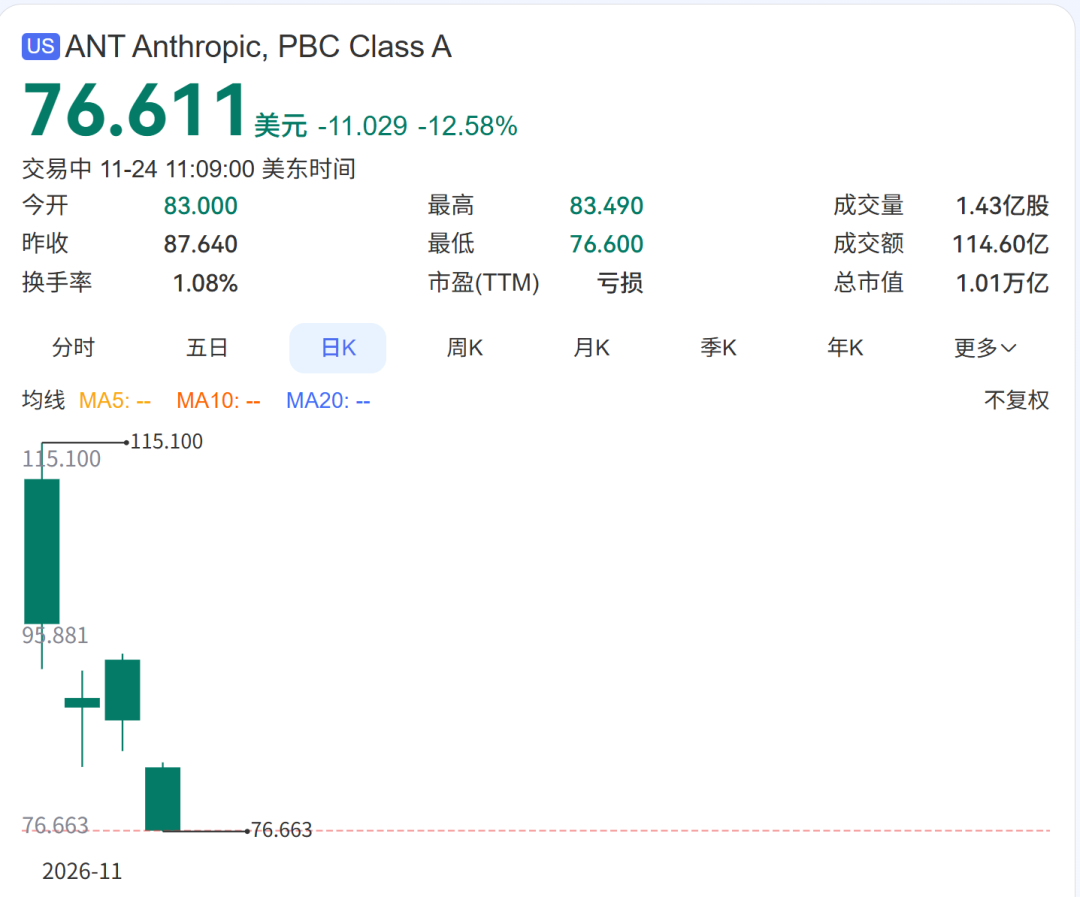
Last week, Anthropic had just completed the world's largest IPO, with a public offering of approximately $93.5 billion.
A few days later, the price in the secondary market was already below the subscription price for new share allottees.
The broken offering came quickly
Since listing on November 19, the stock price has been declining.
Let's break down the issuance. The base offering was approximately $81.3 billion. After underwriters fully exercised the greenshoe option, the total became approximately $93.5 billion. The company received approximately $91.6 billion in gross public offering proceeds, with the remainder going to shareholders selling old shares. Both amounts are gross.
At the same time, a $26 billion private placement was also settled.
Seven companies including Nvidia, Google, Microsoft, and TSMC subscribed. Adding the two transactions together gives $119.5 billion. The IPO record was set using the $93.5 billion public offering figure.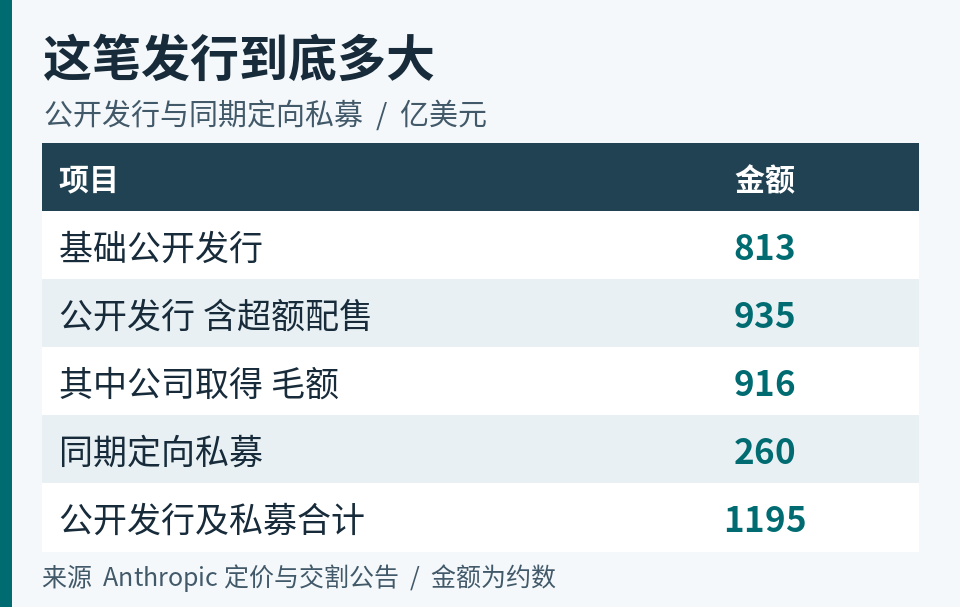
Tech stocks were already weak during those days. On November 23, the U.S. stock market rebounded noticeably, yet Anthropic still closed down about 1.4%.
For several consecutive days, the price buyers were willing to pay kept falling. It is already difficult to explain this stock's performance solely by the rise and fall of the broader market.
The prospectus also offers an observation point. Some employees and insiders had a selling window on the first day, with subsequent tranches unlocking later.
Just as new share trading began, potential selling pressure would affect buyers' bids. As for how much of the daily decline was caused by this, it is hard to separate from public market data.
At the time of issuance, Reuters reported a valuation of approximately $1.5 trillion. Based on the trailing twelve months' revenue as of the end of September in the prospectus, that is about 42.5 times.
This price left very high expectations for future growth. Even how much more was given away through a discount is worth buyers calculating.
A business customers already pay for
Looking at Claude's business, the money comes from two places.
Individuals and enterprises can subscribe according to plans. Enterprises and developers can also buy model usage, settling according to how much is used.
Claude Code, meanwhile, puts the product into workflows that development teams use every day. Claude product logo | Wikimedia Commons
When enterprises trial a model, a few people can open accounts and get it running. What really costs money is integrating it into code repositories, customer service systems, or internal materials for large numbers of employees and business processes. Usage follows the business, and only then does this business have a chance to move from trial budgets into departmental daily expenses.
As of the end of September 2026, more than 11,900 customers had contributed at least $100,000 in revenue to Anthropic over the past year, compared with more than 950 in the same period a year earlier. More than 1,900 customers reached the $1 million tier.
The group of customers at $100,000 and above contributed about 74% of revenue in the first three quarters of 2026.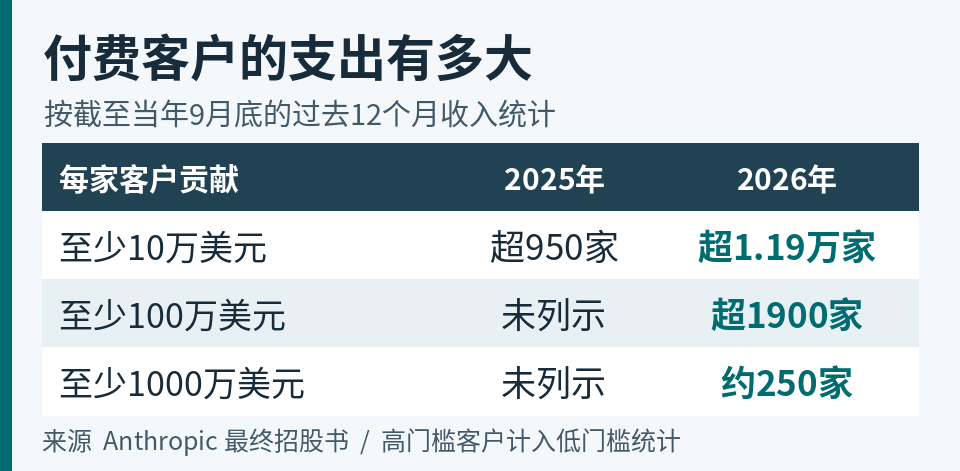
The company also gave a striking number: net revenue retention of about 900%.
According to the prospectus definition, taking the same group of qualified customers from a year earlier, comparing the revenue of this group in the third quarter of this year with the third quarter of last year, fixed-price individual subscriptions are excluded.
These customers who originally spent $1 now spend about $9 in total.
As the base grows larger, how retention moves depends on how much more business this group of customers will add Claude to next. For a customer expanding from a pilot to an entire department, procurement amounts can easily step up.
After rollout, more money must be earned back through usage frequency, coverage, and new tasks.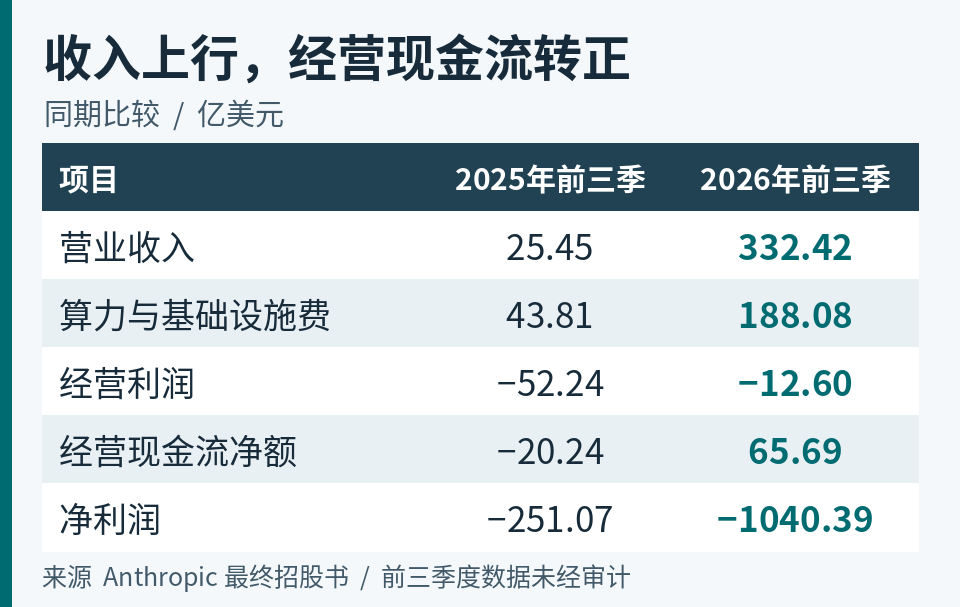
In the first three quarters of 2026, Anthropic generated $33.242 billion in revenue, compared with $2.545 billion in the same period the previous year.
Operating cash flow turned from net outflow to net inflow of $6.569 billion. Sales growth can already be seen in collections. How stable the cash coming in is still depends on the settlement cycles of major customers.
Discounts are also real. The company disclosed that from the second quarter to the third quarter, new model price cuts and contract discounts offset about $600 million in incremental usage revenue. Customers are willing to use more, and the platform also has to give up part of the price. This is a hurdle the model business must pass after achieving scale.
Enterprises are able to assign different tasks to different models. Flipping through an internal document and maintaining a piece of core code have very different accuracy requirements.
If Claude can handle complex tasks more reliably, buyers have reason to pay high prices. Pricing for ordinary tasks is often easier to push down by alternatives.
The computing power bill is heavier
This company has already had profitable quarters. In the second quarter of 2026, operating profit was $974 million. In the third quarter, revenue grew to $16.956 billion, but the operating result slid to a loss of $567 million.
Computing power and infrastructure expenses as a share of revenue rose from 48% to 58%.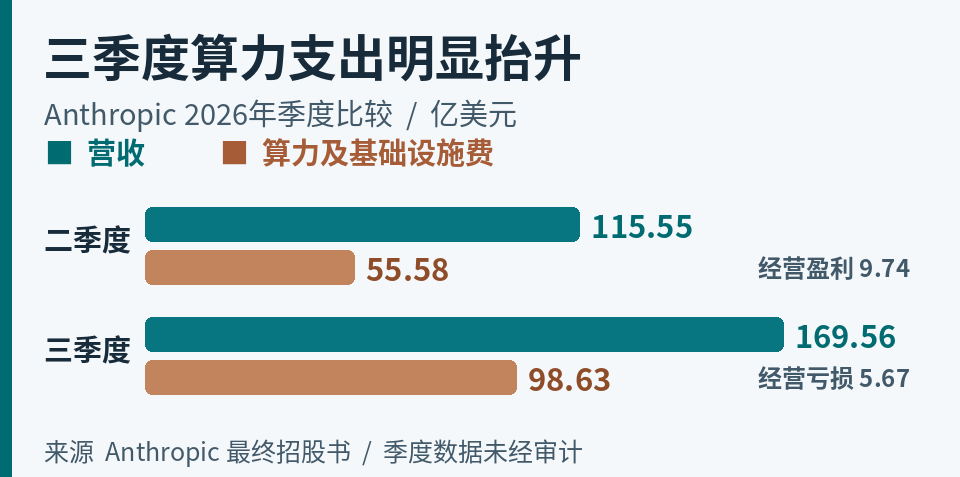
The company mainly attributed the quarterly swing to a loss on computing power delivered under about $5 billion in short-term commitments, as well as about $2 billion in non-cash expenses related to matching contributions. The latter affects the income statement. How fully the former machines can be utilized after arrival is what will affect this business every day.
Anthropic typically locks in computing power 12 to 18 months in advance. Sales can track usage weekly, but machines must be ordered more than a year ahead. If the judgment is right, the capacity on hand can accommodate customers. If the judgment is off, leased machines and signed contracts will still wait to be settled.
As of the end of September, fixed contractual obligations listed in the prospectus were about $320 billion, the vast majority being purchase commitments. Future rents that have been signed but not yet commenced are listed separately, at about $451.2 billion undiscounted.
Both items must be viewed according to delivery and payment years; the money will be paid out over multiple years.
There is another scary-looking number on the income statement. Net loss for the first three quarters was $104.039 billion, of which $94.324 billion came from fair value changes in financing instruments such as convertible bonds.
Operating loss for the same period was $1.260 billion, while operating cash flow was positive. To judge the business itself, these items must be read separately.
In the next financial report, the author will first look at how many discounts were used to achieve revenue growth, then compare computing power expenses and customer collections.
The computing power bill has arrived. Whether revenue has kept up, and how much cash remains after lease and purchase payments, only make judgment possible when these numbers are put together.
For the same computing power spending, training new models has a chance to make money only when the next-generation product comes out, while running tasks for existing customers usually brings cash in faster. The two expenditures fall on the same statement, but their payback times may differ greatly. Looking only at the total makes it easy to misjudge how much money expansion requires.
Turning another page to the cash flow statement, equipment purchases and some lease prepayments are also listed under investing activities. The turn to positive operating cash flow is progress.
Pressure spreads to peers
Gartner estimated on November 12 that global AI spending in 2027 will be about $4 trillion, of which infrastructure will be about $2.4 trillion, or 59%.
Its forecast for generative AI model spending is $51 billion. The two sets of numbers come from the same report, and the difference in where the money flows is very large.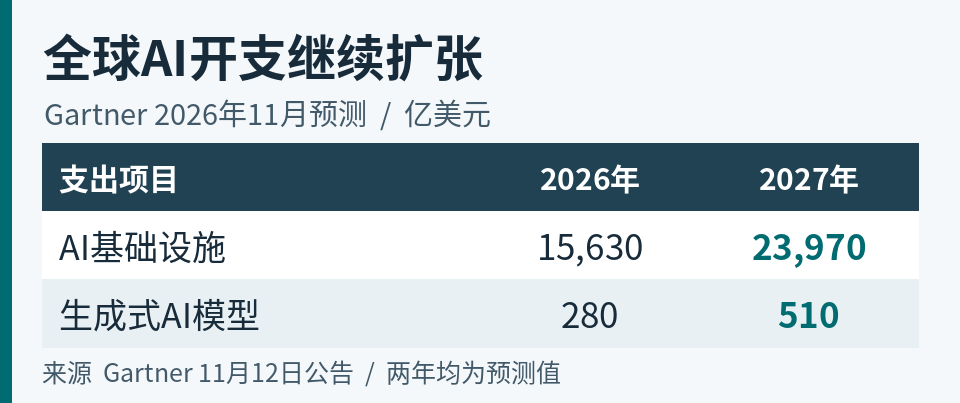
After chips and servers are delivered, suppliers have a chance to recognize revenue. Model makers take over the machines and still have to wait for customers to increase usage. Increased industry spending can be orders for suppliers, but for model makers it is often first a bill.
If Anthropic continues to weaken, model companies preparing to raise funds and list are likely to feel the change first. When negotiating valuations, investors now have a stock trading every day in their hands.
The previous financing round discussed how big they could become next year. This round, they may first pull out renewals and cash accounts.
For the supply chain, first look at orders on hand, then at the next batch of projects. Confirmed deliveries proceed according to contracts, while new data centers and additional racks must go through budgeting again. Suppliers relying on a single major customer for expansion are more sensitive to delivery delays.
Enterprises facing multiple customers and already having stable shipments have a larger buffer.
Share prices across companies can fall together on the same day, but the timing and magnitude of order damage will differ. Who cuts new procurement next quarter and who can still expand as usual will need to be found in deliveries and orders.
Model price cuts will also let some application companies spend less. If customers are willing to renew for the entire workflow, application providers have a chance to keep the saved usage fees in profit.
If revenue mainly comes from reselling usage, customers can turn around and compare prices, and the saved money will soon be given away as well.
Back to the cash account
The author's personal judgment is that with the stock broken below $83, what was discounted first was the portion of growth Wall Street was willing to give in advance. Anthropic has already proven that enterprises are willing to pay heavily for models.
In the next few quarters, the harder task is turning incremental revenue into cash that can be retained.
If the stock price continues to fall while customer renewals weaken and computing power costs remain high, global investors will be more cautious in valuing model companies.
Only when financing negotiations slow and expansion approvals slow will pressure move from stock quotes to equipment and data center orders.
As an industry leader, if its stock price continues to trade below the offering price, what is hit is not Anthropic's own financing ability. It will put a question mark on the assumption that "AI companies can stand firm after listing."
Model companies queuing for IPOs, the computing power supply chain relying on AI premiums to support valuations, and funds allocating AI as a main line will all need to recalculate.
What do you think about this hot topic of the broken offering? We look forward to your civilized and rational comments in the comment section.
Disclaimer: This article is only a financial hot topic analysis from a professional perspective. Data and materials are cited from public queries, company announcements, and Tonghuashun iFinD. The views are for reference only and do not constitute any investment or consumption advice.
#FinancialHotTopics #InDepthInterpretation #BusinessFinance #InvestmentBankingCircle #ListedCompanies #PrimaryMarket #IPO #AI #Anthropic
-
![]()
$55 Billion! Liang Wenfeng Becomes the World's Richest Large-Model Developer
-
![]()
Anthropic IPO Watch: A $1.5 Trillion Valuation and a Pricing Experiment in the AI Capital Era
-
![]()
What Are the Benefits of Becoming a DeepSeek Shareholder? | Juchao
-
![]()
The Wealth-Creation Myth Behind the Largest IPO in History
-
![]()
Chinese Brands Are Starting to Make Their Way into European Shopping Malls
-
![]()
China's Robotaxi Battle Heats Up in Dubai | Juchao
-
![]()
$952 Billion: Nvidia's Repurchase of a Guarantee Letter
-
![]()
A 50,000 Yuan C-Segment Car—Is Battery Swapping the Key to Stimulating Consumption?