Why Did Vivo Stumble Amidst the Flash Memory Mixing Fiasco?
 10/13 2026
 348
348

Don't Seat Consumers Who Spend 7,999 Yuan on Smartphones at the Kids' Table
Smartphone manufacturers have pushed the envelope in 'educating' consumers to the point where even flash memory is now subject to a 'lottery' system.
From Xiaomi to Apple, controversies over the use of mixed flash memory have arisen repeatedly. Not long ago, Apple, the premium leader among global smartphone manufacturers, faced backlash for its mixed flash memory strategy: the 256GB and 512GB versions utilized TLC, while the pricier 1TB and 2TB versions switched to QLC.
According to public reports, the 1TB version also mixed two types of flash memory particles, with most batches using QLC and only a few using TLC—leaving buyers at the mercy of chance. The 2TB version allegedly exclusively used QLC. Consumers paid more for larger capacities, yet performance didn't necessarily improve.
Consumer dissatisfaction is understandable. When paying the same price for the same phone model, they may end up with different internal components. Especially when spending extra for higher-capacity versions with the expectation of an upgrade, they instead worry about whether they've paid for inferior performance.
While manufacturers cite supply chain and cost considerations, consumers have a simple retort: 'You didn't pass the savings on to us, so why should we accept the gap?'
Yet, despite the complaints, phones continue to sell. Imaging, chips, systems, and branding provide other selling points that overshadow the controversies. Flash memory, hidden inside the device, can't be inspected or chosen before purchase, leading consumers to console themselves with the notion that as long as daily use feels similar, mixed components are acceptable.
Recently, many consumers have discovered that Vivo has become particularly bold in this regard. First, the X300 model faced hardware quality control issues due to mixed flash memory use. Then, it was found that the camera UI had been simplified and crippled, with new filters and camera features not being rolled out.
The most absurd part is that the new OriginOS 7 system was pushed for public testing with lingering bugs, causing compatibility issues. Its rating on Coolapk plummeted from 9.7 to 3.7 in just a few days, falling from first place to last. Who can be blamed for this?
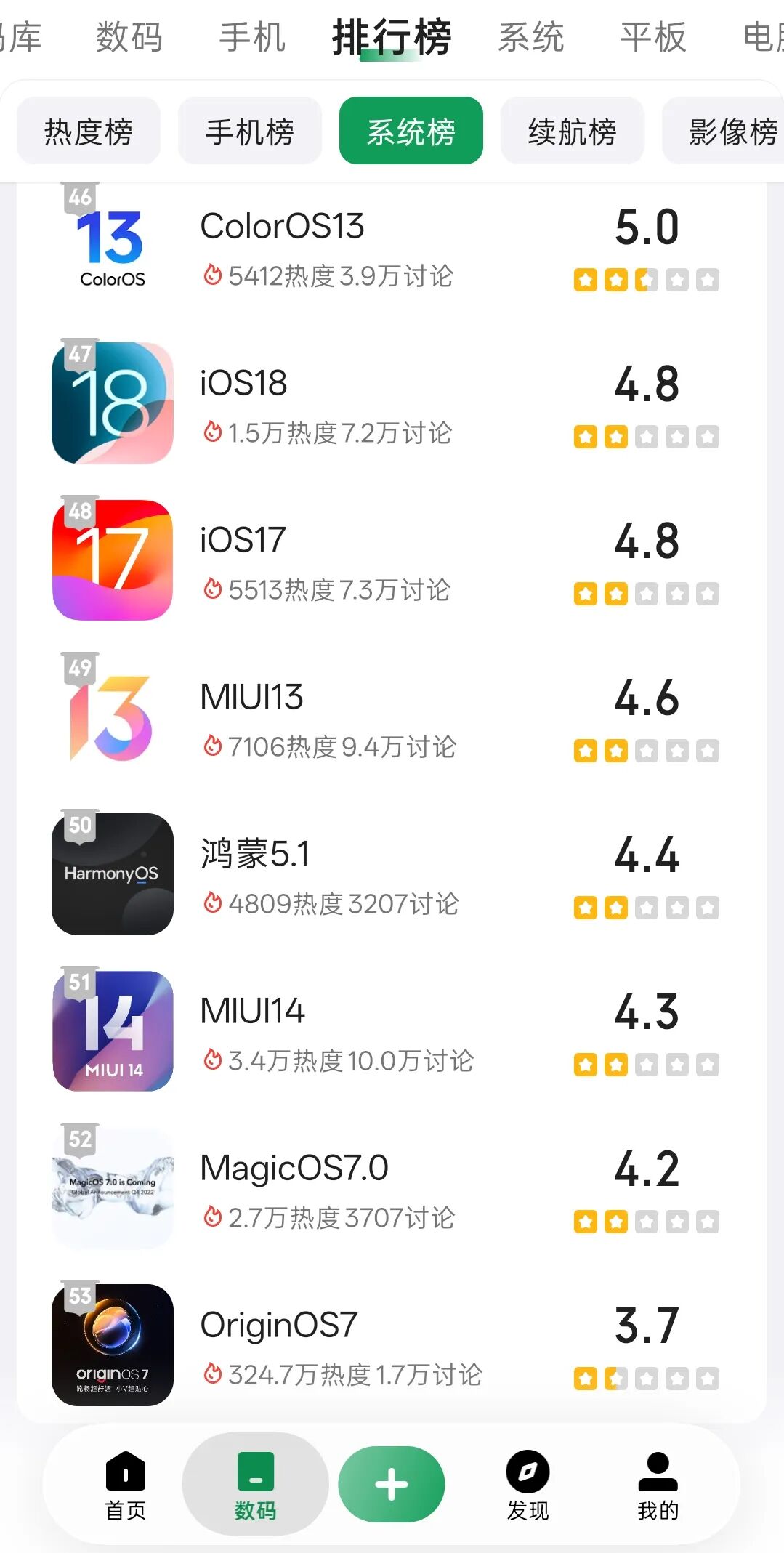
When consumers no longer investigate whether components come from the same supplier and only demand 'not too much performance difference,' Vivo's flash memory controversy has pushed this already-low bar even further: How large can the performance gap be under the same flagship label?
01
Flash Memory Can Be Mixed, But Flagships Shouldn't Be a 'Lottery'
Mixed flash memory use is nothing new in the smartphone industry.
For manufacturers, it's a standard supply chain practice. Capacity, pricing, and delivery cycles vary among suppliers, making it difficult for flagship phones to rely on a single vendor for a stable supply.
From Apple to Xiaomi, controversies over mixed suppliers for flash memory, screens, and RAM have persisted for years. However, what consumers truly mind isn't which vendor's components are inside but why products at the same price point may exhibit significant performance gaps. While consumers accept supply chain differences, they struggle to accept that the same model, advertised under the same standards, turns into a performance lottery.
The current Vivo controversy stems from performance gaps revealed by some users that go beyond 'slightly slower.'
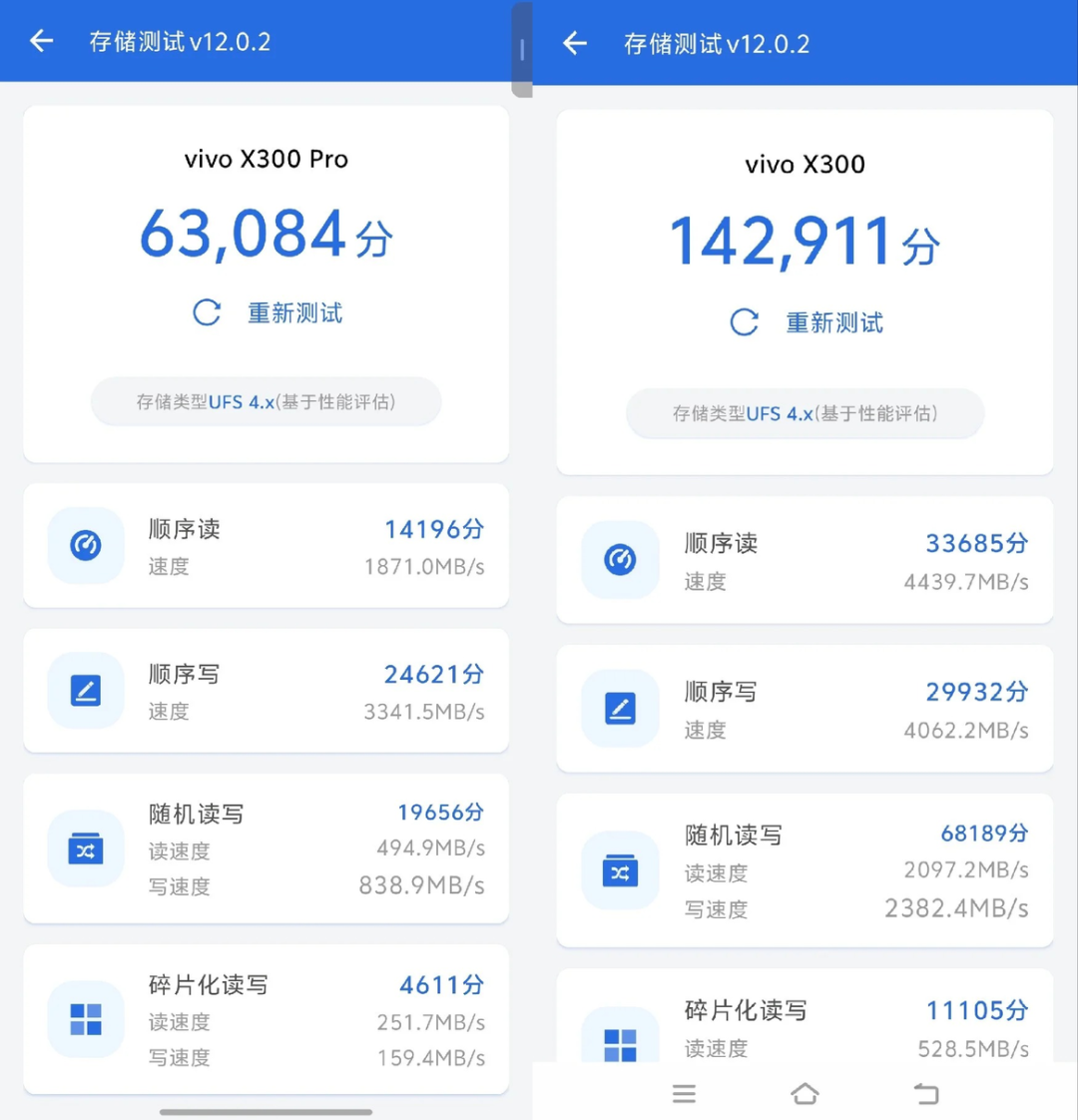
In storage tests shared by users, some X300 models scored over 140,000 points, while X300 Pro variants scored just over 60,000. More puzzlingly, some devices showed sequential read/write speeds of 3,000–4,000 MB/s but significantly lagged in random read/write performance.
For example, in one comparison, the X300 Ultra's random read speed was only 268.4 MB/s, while the X300 Pro reached 2,055.2 MB/s—nearly 7.7 times faster. Random write speeds differed by about 6.5 times.
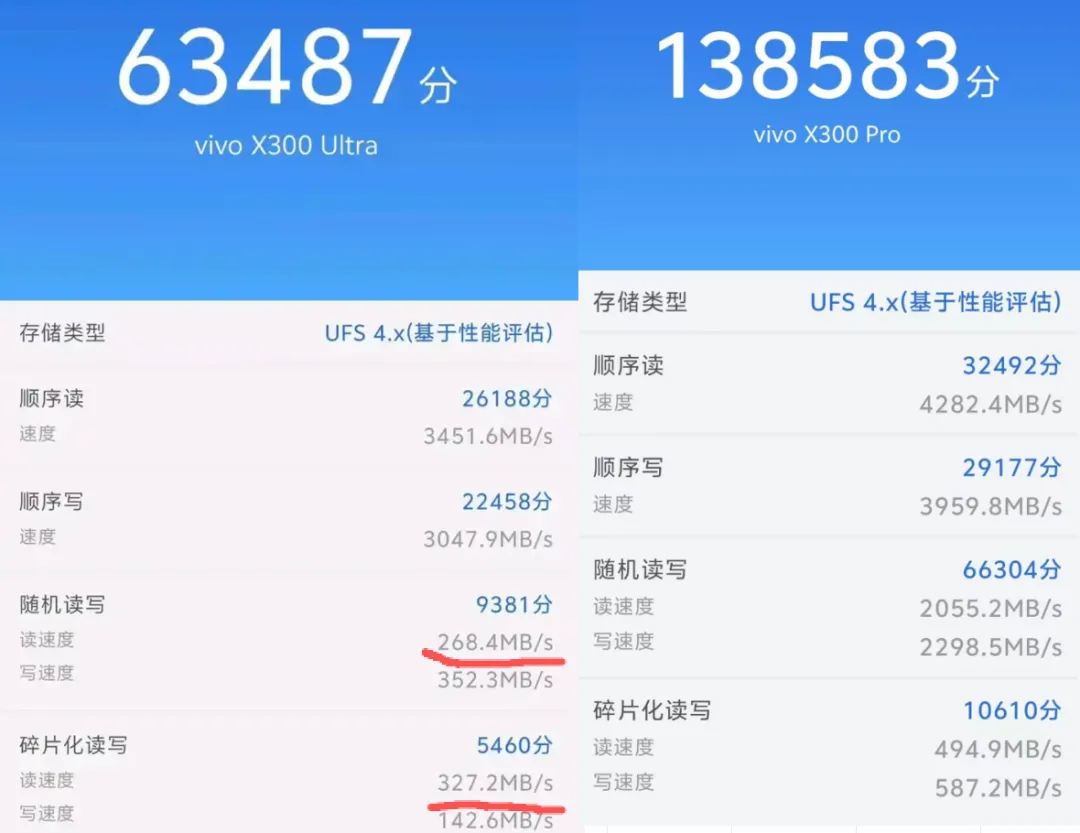
While these screenshots don't represent standardized benchmarks and the performance multipliers don't directly translate to real-world experience, they're enough to make consumers question why higher-priced flagships underperform and by how much.
As news of these significant performance gaps spread, new concerns emerged among Vivo users, with many wondering whether their 'low-scoring' devices truly feature the advertised UFS 4.1 storage.
After all, UFS 4.1 isn't a spec added by netizens but is explicitly listed on the official parameter pages for the X300 Pro and X300 Ultra. Given the stark test results, users' demand to confirm whether the actual hardware matches the advertised specs is entirely reasonable.
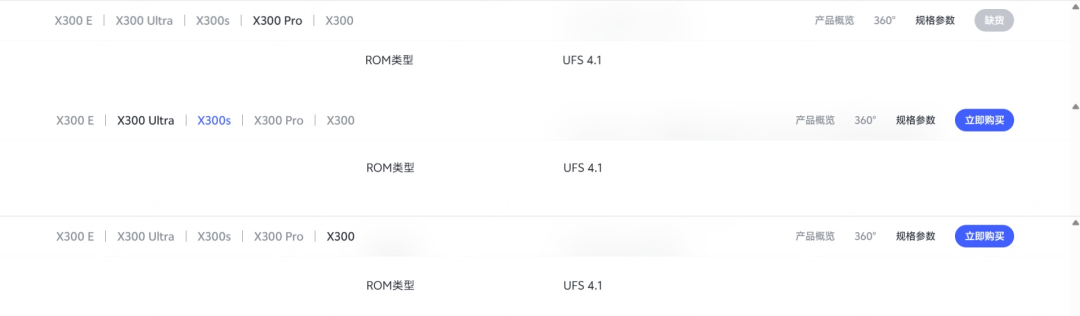
In response, Vivo's online customer service claimed that the relevant storage chips initially launched with UFS 4.0 standards but were later upgraded to full UFS 4.1 support via firmware updates after meeting hardware requirements, with device specifications updated accordingly. The continued display of UFS 4.0 in online queries was attributed to delayed information updates.
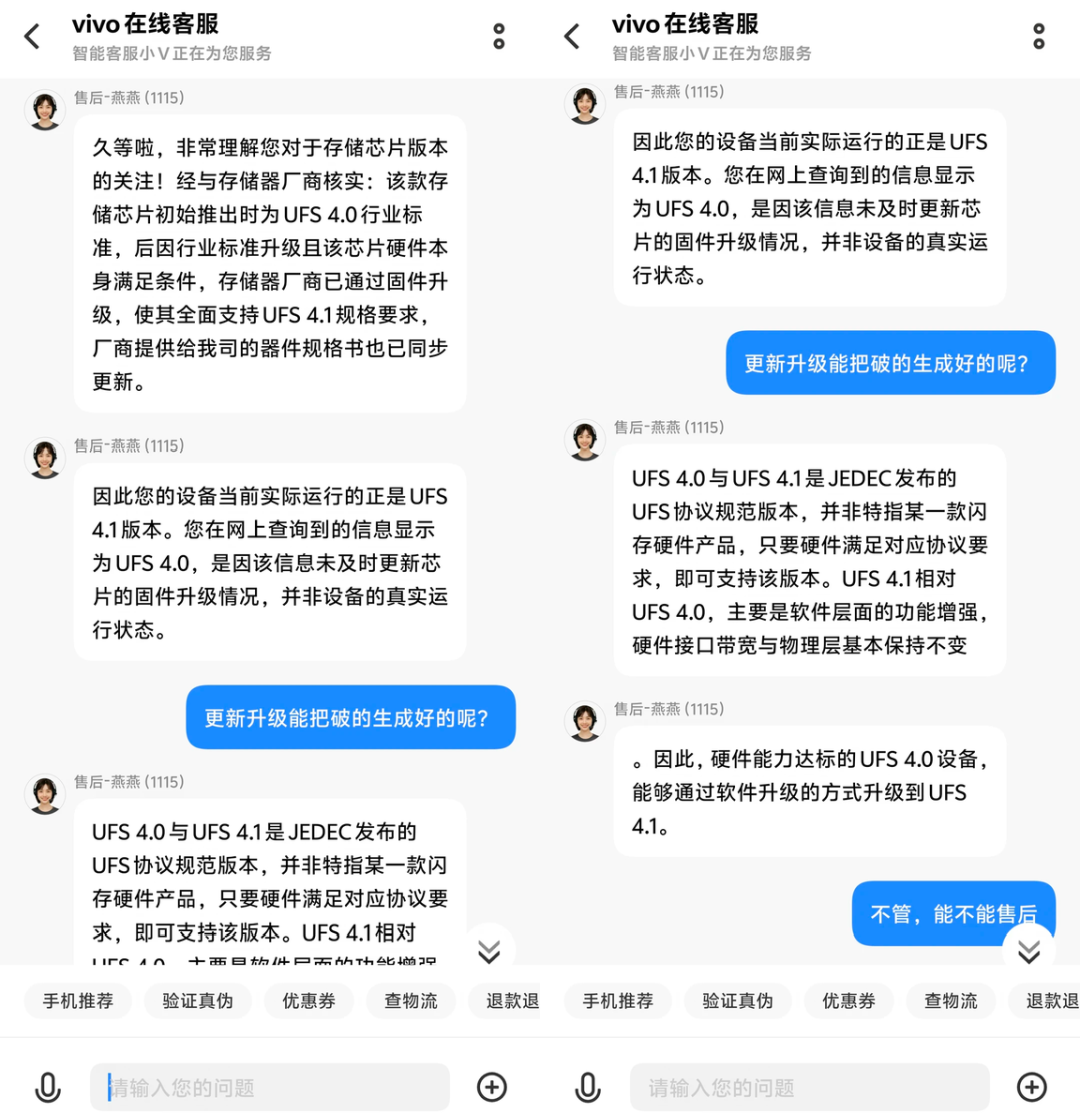
According to this explanation, users' devices comply with UFS 4.1 standards. However, consumers initially raised concerns about performance gaps, yet the customer service response focused primarily on specification versions, explaining why the storage could be labeled as 4.1 without clarifying why some devices performed noticeably slower.
An X300 Ultra user told Hyper Focus that their storage test scored just over 90,000 points, lower than their backup phone, prompting them to sell the device ahead of the new flagship's release.
An iQOO 15 user reported that a properly encoded H1 UFS 4.1 model scored 120,000 points in storage tests, while their G1-encoded device scored only 90,000, with random read/write performance differing by over twice. They claimed the hardware was permanently locked to UFS 4.0 and couldn't be upgraded to UFS 4.1 via OTA, questioning batch differences and demanding compensation or returns.
At this point, Vivo faces not just whether a particular flash memory should be labeled 4.0 or 4.1 but whether consumers can trust the same specification sheet to guarantee comparable product quality.
Some users argue that mixed flash memory is normal product logic but find it hard to accept significant performance gaps within the same model. Consumers may not care which vendor's name is on the chip but do care about paying the same price for noticeably slower performance.
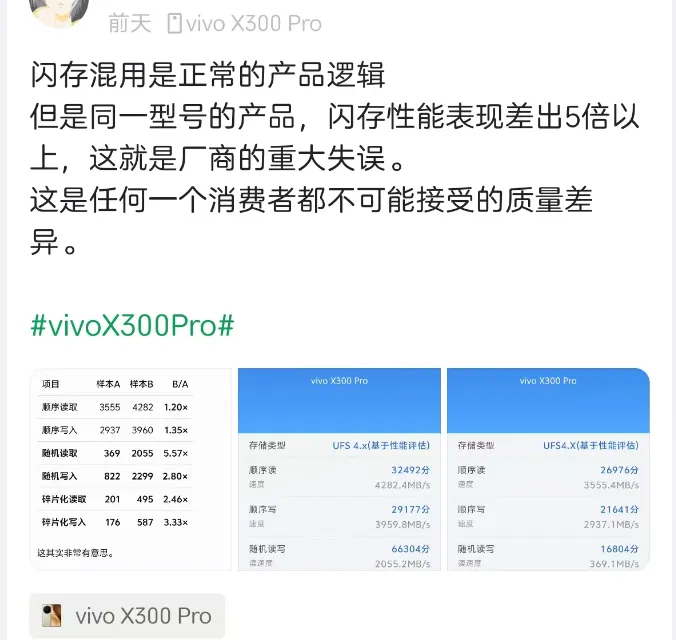
Of course, whether specifications match advertising claims must be verified, and performance gaps need testing under standardized conditions. However, even if both components ultimately comply with UFS 4.1, this controversy won't resolve itself. A shared specification label doesn't erase performance doubts or replace the manufacturer's responsibility to explain gaps and solutions.
Mixed components are a procurement choice for manufacturers, but controlling differences should be their job. Consumers can't choose components at purchase but must investigate models, run tests, and contact customer service to understand what they've bought—turning an ordinary purchase into absurdity.
When consumers have already conceded to 'not picking suppliers,' manufacturers should uphold product consistency as a baseline. They can't promote top scores while downplaying poor ones and then dismiss same-price performance disparities with 'all meet specifications,' leaving consumers to grapple with the doubts alone.
02
Another Flagship Controversy: Defining 'Ownership'
If the flash memory debate exposes gaps between flagship specifications and actual performance, another recent controversy surrounding the Vivo X300 series stems from Vivo's proudly touted imaging capabilities themselves.
Some X300 Pro users discovered that while their phones feature flagship-grade imaging hardware and Blueprint Imaging capabilities, certain software functions lag behind those available on the X300 Ultra, X300S, and other models.
For example, in the Blueprint Color Palette feature, some users found that while the X300 Pro supports color adjustment, it lacks capabilities like sharing color schemes via QR codes or importing schemes from other users—functions critical for building a user community and creative ecosystem around the tool.
Additionally, users reported that new filters and updated camera interfaces rolled out to other models in the series weren't pushed to the X300 Pro. This raised questions: Has Vivo's product hierarchy become so rigid that flagship hardware is deliberately crippled in software experience?
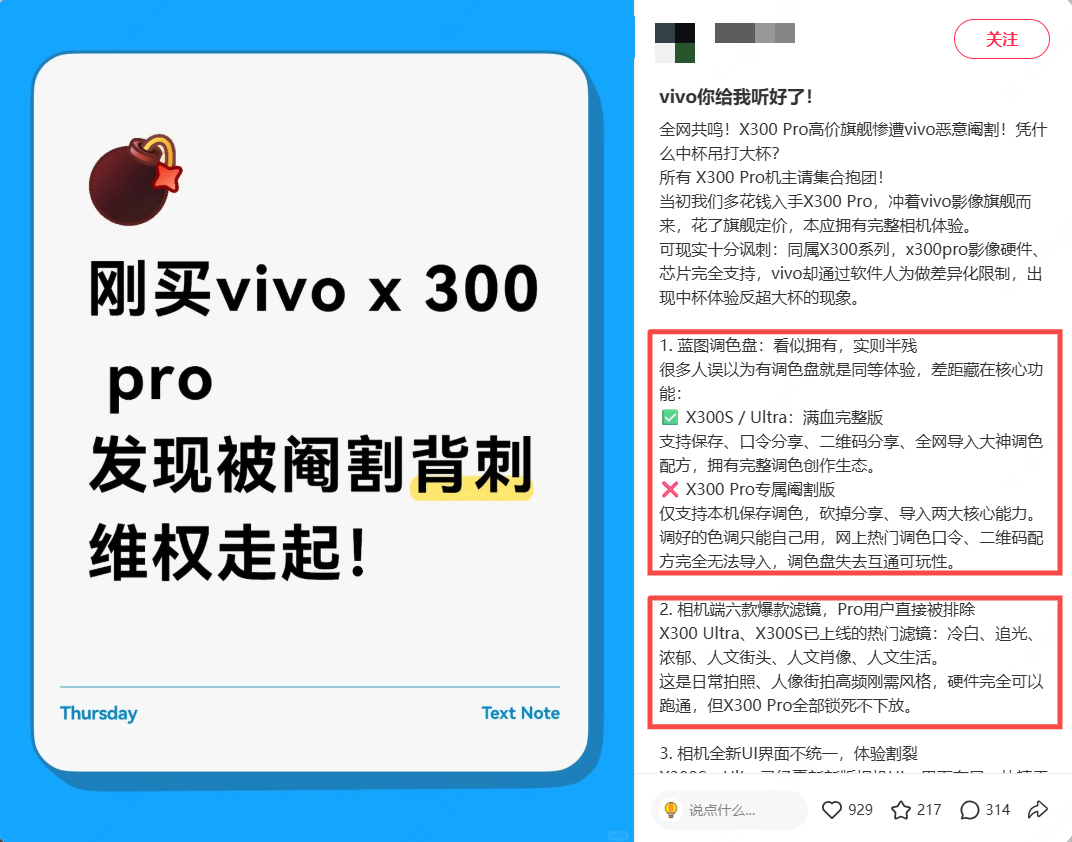
Vivo's response to user queries about these functional disparities sparked fresh controversy.
While it's understandable that flagship phones need to differentiate product positioning and that retaining some functional disparities among models is an industry norm, how manufacturers define and explain these differences tests their judgment and communication.
In a sensitive area like this, during Weibo discussions about the product, Wang Qiao, a Vivo product executive, responded to reasonable user requests by saying, 'Kids will be kids—just be happy. I think maturity matters.'
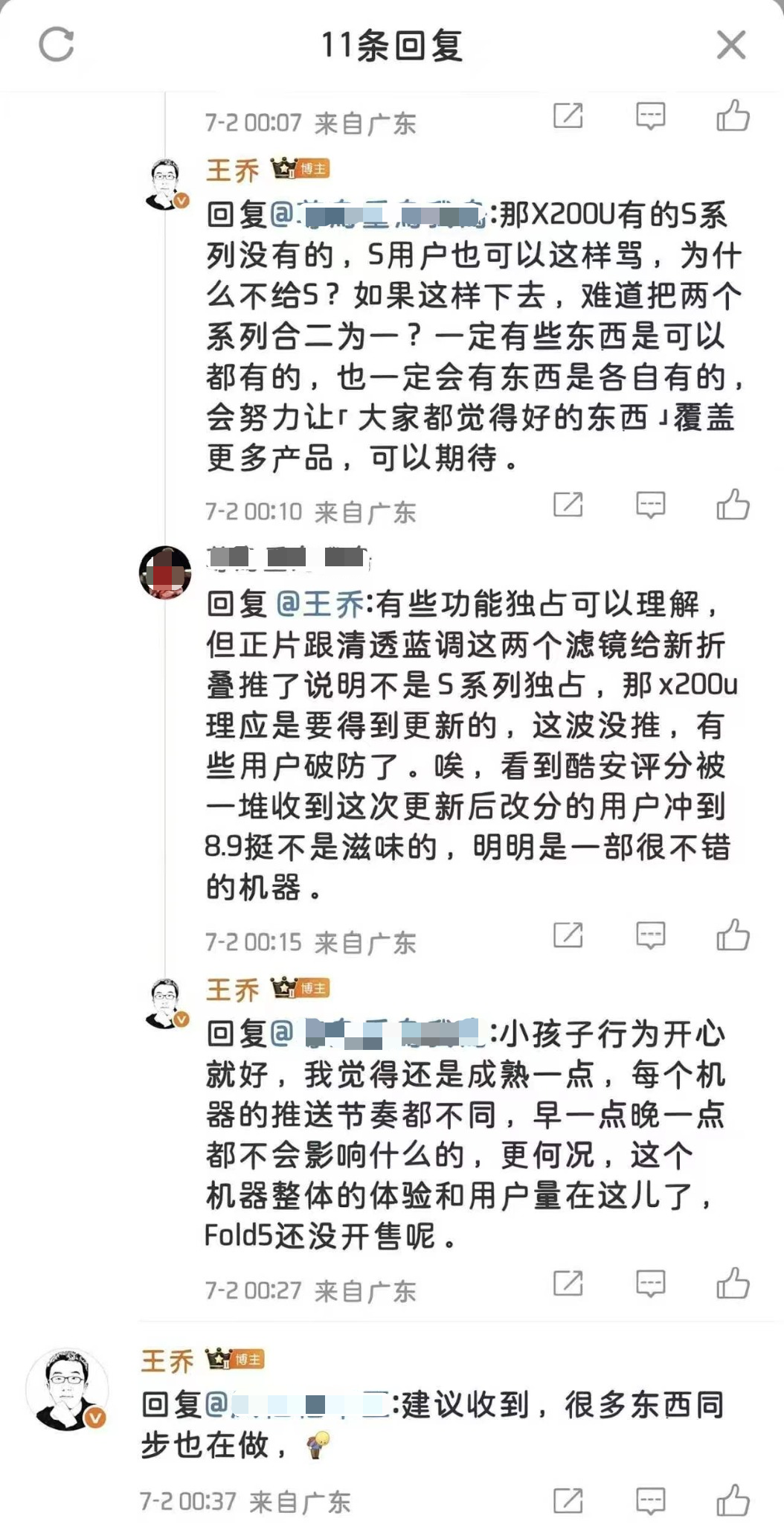
While this might have been a personal remark aimed at a specific user discussion, it came across as particularly jarring amid the current product controversy. Users weren't debating trivial emotional issues but questioning why a flagship phone priced at nearly 10,000 yuan lacked features already available on other models in the same series.
For consumers, the expectation isn't that manufacturers fulfill every demand but a simple explanation: Why aren't features supported by identical hardware across the lineup being rolled out? When will they be available? Will future optimizations address this?
Instead, when users raised product experience concerns, they received a judgment about 'maturity.' Spending 7,999 yuan on a phone only to be dismissed by a company executive as unworthy of a seat at the 'adult table' further inflamed user dissatisfaction.
Similar situations have arisen in discussions about iQOO series products. When users asked whether new models would further optimize high-refresh-rate adaptations to leverage screen capabilities, iQOO's Wang Kan evaded the question and, after persistent probing, snapped, 'The 15 doesn't support it—is that so hard to understand?'
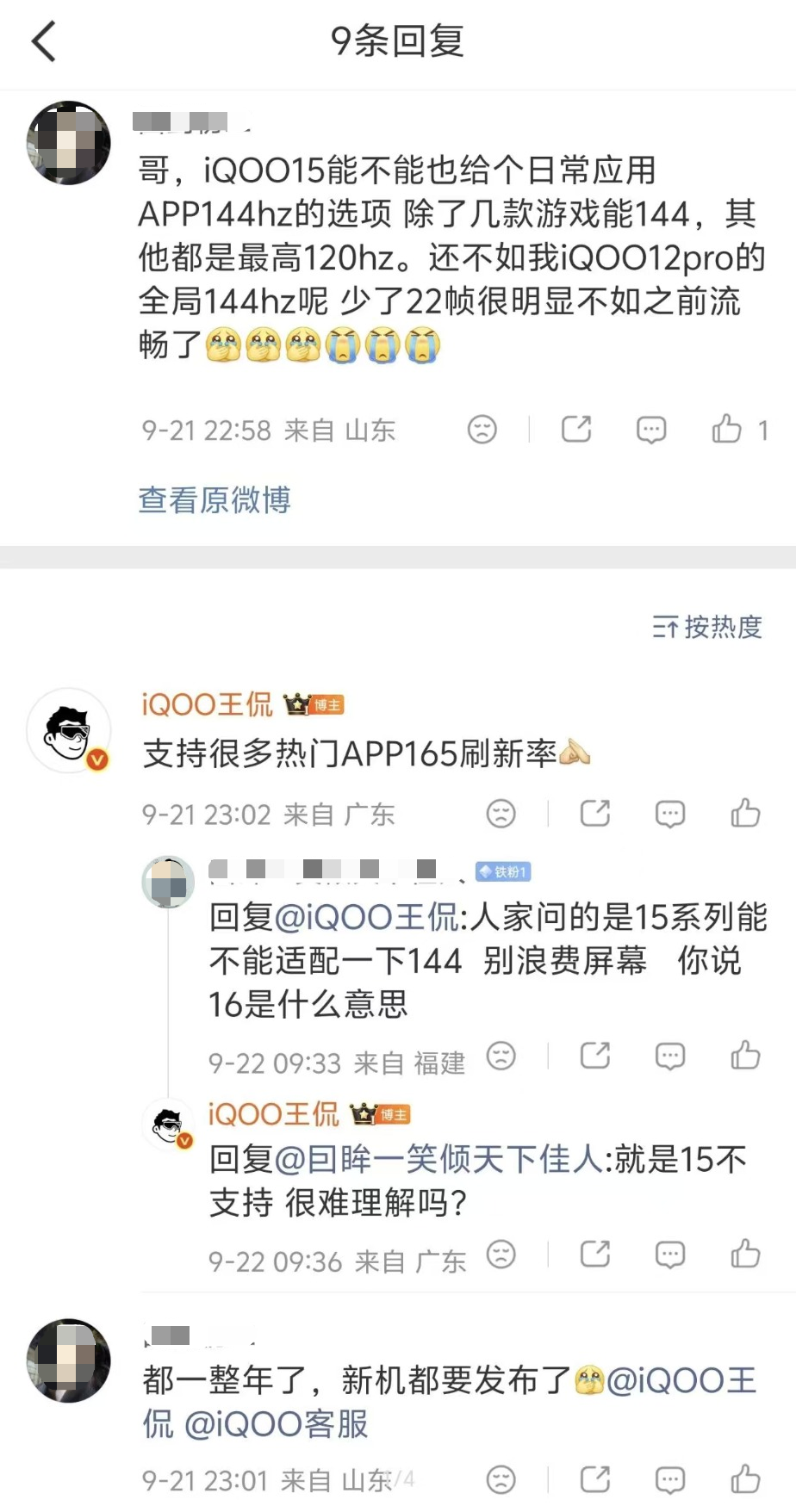
This contrasts sharply with the brand image Vivo cultivated in recent years.
'Blue Factory is pragmatic' and 'Blue Factory listens' became company hallmarks after Shen Wei repeatedly emphasized the value of 'duty' in internal meetings and product launches in 2023. These traits distinguished Vivo from other smartphone manufacturers.
Unlike some rivals prioritizing marketing hype, Vivo historically emphasized product refinement and user feedback, continuously optimizing experiences based on user input. This brand perception helped Vivo amass a loyal user base.
To reinforce this 'responsive' persona, in early 2024, Vivo executives like Huang Tao (Vice President of Products) and the OriginOS team became highly active on platforms like Weibo and Coolapk, engaging with users.
Whenever users criticized system usability or missing features (e.g., demands for unified imaging modes, optimized telephoto macro logic, or rolling out new functions to older models), executives often replied, 'Got it—will arrange.' Subsequently, Vivo frequently implemented user requests in remarkably short timeframes, sometimes even in the next OTA update.
However, when a manufacturer internalizes 'responsiveness' as a core brand asset or even persona, the recent spate of incidents and official responses—marked by evasion or confrontation—become glaring. This 'selective responsiveness' is rapidly eroding the once-pragmatic reputation, leaving consumers who've spent significant money feeling betrayed by marketing rhetoric.
In today's highly saturated smartphone market, competition based on hardware specifications is nearing its limits. The trust established between manufacturers and users is becoming a rarer competitive edge than the specifications themselves.
What Vivo has built is a trust system based on user feedback and collaborative product development. However, trust takes a long time to build but can be eroded by just a few disappointments.
When consumers encounter differences in flash memory performance, they receive explanations that it 'meets specifications.' When users raise issues about functional experiences, they are met with evaluations about 'maturity.' In such cases, their doubts extend beyond a single feature or chip; they question whether the user relationship they once trusted still exists.
In the inventory competition of the second half of the smartphone era, the key questions for Vivo may be how to ensure that 'being receptive to advice' goes beyond being just a brand label and how to truly embody 'integrity' in every user interaction.
- END -
-
![]()
Downward Adjustment of Export Tax Rebate Rate for New Energy Vehicles: Not a Bid to Reap 'Profits' from Overseas Expansion
-
![]()
Who is the Apple in the Era of Embodied AI?
-
![]()
Laughing No More! Brake Pedal Snaps—Is Lei Jun Actually the Biggest Winner? Netizens Say: Genius Move!
-
![]()
Huawei’s ‘Cullinan’ Rival Makes Its Debut: China’s First SUV with a Vertical Emblem—Is It More Prestigious Than Aito or Zunchi?
-
![]()
Blockbuster Move: Geely's Li Shufu Secures Approval to Acquire Stake in Century-Old Ford Motor's Spanish Unit
-
![]()
LiDAR Battle: RoboSense Sells 590,000 Units but Still in the Red, While Hesai Earns 70 Million—What's the Difference?
-
![]()
Vivo's Misstep: The Fallout from Widespread Flash Memory Controversy
-
![]()
Why Did Vivo Stumble Amidst the Flash Memory Mixing Fiasco?