Can Huawei’s Four ‘Jie’ Brands Maintain AITO’s Momentum? Who Will Lead the Charge?
 09/29 2026
 437
437
After AITO’s Transition Back to Seres
Huawei can now reallocate its resources to the other four ‘Jie’ brands.
Do these four brands have a ready-made market waiting for them?
Produced by Zhineng Technology
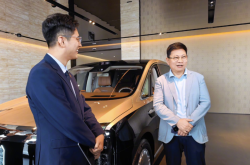
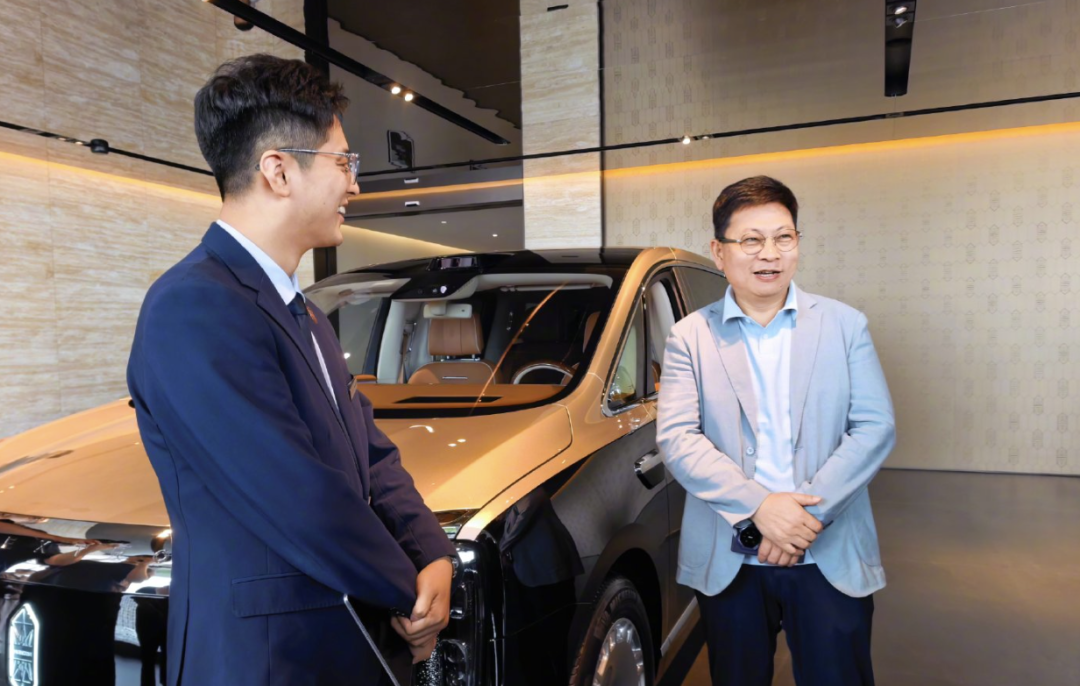
On September 24, Yu Chengdong visited Harmony Intelligent Mobility Alliance stores in Hefei, publicly explaining for the first time the rationale behind the adjustment of the AITO cooperation model. He stated that Seres has significantly enhanced its collaborative capabilities over the past few years and now seeks greater autonomy—a vision that Huawei supports. Subsequently, on social media, he announced that Huawei would now focus on Zunjie, Xiangjie, Zhijie, and Shangjie, ensuring each ‘Jie’ brand receives more substantial resources. This will enable their teams to refine products and enhance user experiences with greater dedication.
During September’s restructuring, Seres took the lead in AITO’s product definition, design, marketing, retail, and service operations. Consequently, personnel, budgets, store locations, and management attention previously dedicated to AITO are gradually being reallocated.
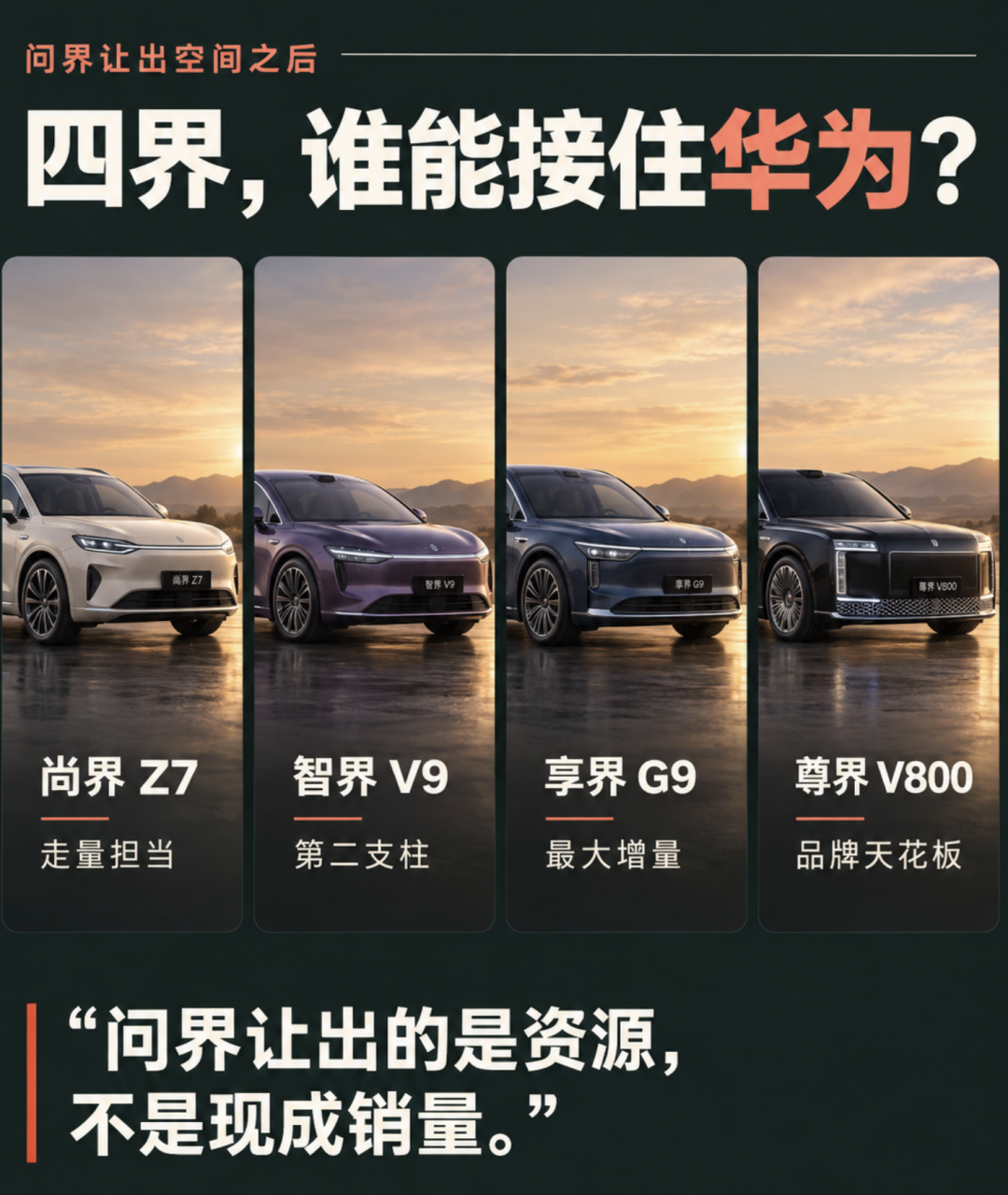
Third-party retail data reveals that from January to August 2026, the five brands under Harmony Intelligent Mobility Alliance sold approximately 330,000 units in total, with AITO accounting for about 208,000 units (63%). Shangjie sold around 50,000 units, Zhijie about 39,000 units, Xiangjie roughly 24,000 units, and Zunjie approximately 8,000 units. The combined sales of the four ‘Jie’ brands reached about 122,000 units, equivalent to 60% of AITO’s sales.
In June, the four ‘Jie’ brands contributed around 40% of Harmony Intelligent Mobility Alliance's total sales. In July, with the launch of new models like the Zhijie V9 and Shangjie Z7, their combined sales briefly surpassed AITO's, and in August, they still accounted for nearly half. AITO itself caters to the mainstream family SUV market, ranging from RMB 200,000 to over RMB 500,000, with five models including popular sellers like the M6 and M7, as well as flagship models like the M9, with cumulative deliveries exceeding one million units.
The four ‘Jie’ brands are expanding their model lineups, but most still rely on one or two new models for short-term sales growth.
1) Investment and Product Offerings by Brand
The Shangjie H5, priced starting at RMB 159,800, is Harmony Intelligent Mobility Alliance's first product targeting the mainstream family price segment. The Z7 and Z7T expand into coupes and station wagons. SAIC has assembled a team of over 5,000 people for Shangjie, with an initial investment exceeding RMB 6 billion, followed by additional investments to upgrade its Jinqiao factory.
Zhijie has made inroads into the new energy MPV market with the V9, selling nearly 9,000 units in July and over 8,000 units in August. Chery signed the Zhijie 2.0 cooperation agreement in 2025, investing over RMB 10 billion, expanding its R&D team to 5,000 people, and establishing an independent company.
Xiangjie, a project with cumulative investment from BAIC exceeding RMB 20 billion, has expanded its product lineup from the S9 sedan to include the S9T station wagon, G9 off-road SUV, and MPV V8, selling approximately 24,000 units from January to August. BAIC BluePark reported revenue of about RMB 11.6 billion in the first half of 2026, with a net loss attributable to shareholders of approximately RMB 1.94 billion.
The Zunjie S800, priced over RMB 700,000, along with the V680 and V800, enters the high-end MPV market priced between RMB 600,000 and RMB 1 million. JAC's mega-factory for Zunjie has a planned annual capacity of 200,000 units, with retail sales reaching about 8,300 units from January to August. JAC reported revenue of about RMB 22.1 billion in the first half of the year, with a net loss attributable to shareholders of approximately RMB 750 million.
While AITO remains, Huawei can reassign engineers, adjust new product launch schedules, and allocate prime display space in showrooms to other brands. However, it cannot transfer consumer trust in AITO's M7 and M9 models. As long as AITO continues to utilize Huawei's core technologies and remains within the Harmony Intelligent Mobility Alliance ecosystem, it will not automatically cede market share to the other four ‘Jie’ brands. After regaining operational control, Seres plans to enter new segments like sedans and MPVs, potentially intensifying competition between AITO and the four ‘Jie’ brands.
2) The Four ‘Jie’ Brands Gain Huawei’s Organizational Support
1. Shangjie
In terms of scale, Shangjie is the biggest beneficiary of AITO's restructuring, with retail sales of about 50,000 units from January to August, making it the top-selling brand among the four ‘Jie’ brands. In June, its monthly sales briefly approached 12,000 units, second only to AITO.
SAIC, the manufacturer behind Shangjie, boasts the largest manufacturing scale and most complete supply chain among the four partner automakers. It is well-versed in large-scale production, cost control, and dealership systems. Shangjie has the best opportunity to capture mainstream traffic in Harmony Intelligent Mobility Alliance showrooms. Its next model, a mid-to-large family SUV, will directly enter AITO's strongest market segment.
The RMB 150,000-RMB 250,000 price range is the most competitive segment in the Chinese auto market, with mature offerings from BYD, Geely, Leapmotor, Changan, and XPENG. Consumers in this segment care about intelligence but also prioritize price, space, energy efficiency, and after-sales costs. Huawei's brand halo remains effective in this segment but is less likely to command the same premium as the RMB 500,000 AITO M9.
Harmony Intelligent Mobility Alliance's technology and services can be offered at lower price points while maintaining sufficient profit margins. Shangjie could become the top-selling brand among the four ‘Jie’ brands, with realistic annual sales of 150,000-200,000 units. Whether it can scale further depends on SAIC's ability to integrate cost, manufacturing, and channel efficiencies into this model.
2. Zhijie
Zhijie is the oldest and most tumultuous brand among the four ‘Jie’ brands. The S7 faced initial delivery issues and multiple redesigns, while the R7 gained some market traction but never reached the scale of AITO's mainstay models. It wasn't until the 2026 launch of the V9 that Zhijie found a clear market position.
The rapid penetration of new energy MPVs aligns well with Huawei's strengths in cockpit technology, intelligent driving, and channel capabilities, enabling it to position a high-end MPV as a family smart space. In July and August, the V9 accounted for most of Zhijie's sales, making it the closest among the four ‘Jie’ brands to replicating AITO's blockbuster success. Chery has addressed Zhijie's past weaknesses by establishing a clearer organizational structure after independent operations.
Zhijie's strengths lie in Chery's deep vehicle development and export capabilities, combined with Huawei's strengths in intelligence and high-end marketing. However, the brand lacks a consistent identity. The S7, R7, and V9 span sedans, coupe SUVs, and MPVs, covering a wide product range but making it difficult for consumers to define what Zhijie represents. At its most successful, consumers understood AITO simply as a large intelligent SUV with deep Huawei involvement. If the V9 stabilizes, the R7 receives updates, and the RX is launched, Zhijie could achieve annual sales of 120,000-150,000 units and become the second pillar among the four ‘Jie’ brands. To become the next AITO, it must clarify its target audience.
3. Xiangjie
Xiangjie has seen the heaviest investment but needs to prove its market performance. BAIC has invested over RMB 20 billion, expanding its product lineup from the initial S9 sedan to include the S9T, G9, and V8, covering almost all major high-end new energy vehicle segments. However, retail sales reached only about 24,000 units from January to August. The S9 and S9T maintain steady sales but have not become mainstream choices in the executive luxury market. The G9, launched in August with a starting price of RMB 429,800, marks Xiangjie's entry into the high-end SUV market, directly competing with established models like the AITO M9, Li Auto L9, and Zeekr 9X.
Previously, Harmony Intelligent Mobility Alliance had a relatively clear division of labor, with AITO focusing on SUVs and Xiangjie on executive luxury. With AITO now led by Seres, this boundary has loosened, allowing Xiangjie to explore SUVs and MPVs, granting it the largest new segment space among the four ‘Jie’ brands. However, this space is far from vacant. The high-end SUV market is one of the most fiercely competitive segments for Chinese brands. AITO's presence grants Xiangjie entry but not victory.
Xiangjie needs at least one model, either the G9 or V8, to achieve stable monthly sales of 5,000 units to shed its image as a brand with a complete product lineup but weak brand recognition. BAIC BluePark's continued investment in Xiangjie represents a critical transformation that must yield returns soon. Strong investment brings resources but also sales pressure. A realistic goal for Xiangjie is to establish itself as a high-end brand selling 60,000-80,000 units annually.
4. Zunjie
Zunjie operates in a different market segment from the other three ‘Jie’ brands. The S800, priced over RMB 700,000, along with the V680 and V800, targets the high-end MPV market priced between RMB 600,000 and RMB 1 million. JAC's mega-factory for Zunjie has a planned annual capacity of 200,000 units, but for the foreseeable future, Zunjie cannot rely on volume to fill this capacity. The ultra-luxury vehicle market is inherently small, and Zunjie's mission is to establish Harmony Intelligent Mobility Alliance's brand ceiling, proving that Chinese brands can compete in the price segment occupied by the Mercedes-Benz S-Class and Maybach. With retail sales of about 8,300 units from January to August, Zunjie's performance is insignificant in the mainstream market but not a failure among new brands priced above RMB 600,000. The S800 has demonstrated that Huawei's brand, intelligent configurations, and Chinese-style luxury can attract high-net-worth users. The V680, V800, and the next SUV will test whether this appeal can extend beyond a single buzzworthy product to establish a stable brand.
Ultra-luxury brands rely on scarcity and high per-unit value. They cannot rapidly cut prices or expand into lower market segments to dilute factory costs, but consistently low sales volume increases depreciation and operational costs. By maintaining stable pricing and service experiences, Zunjie's primary contribution to Harmony Intelligent Mobility Alliance will be brand elevation, followed by sales volume.
AITO's restructuring has freed up four types of resources.
The first is personnel. Huawei's teams previously involved in AITO's product development, design, marketing, retail, and services can now support other brands, representing the most direct and tangible resource.
The second is channel space. With AITO shifting to exclusive franchises, display space and sales focus in some Harmony Intelligent Mobility Alliance stores will be reallocated. However, channel transitions take time, and AITO's departure may also reduce foot traffic. More display space for the four ‘Jie’ brands does not automatically translate into more effective leads.
The third is new segments. Previously, AITO dominated SUVs, Xiangjie focused on executive luxury, Zhijie on sedans and mid-to-high-end models, and Zunjie on the ultra-luxury market. Now, all four ‘Jie’ brands are expanding into SUVs and MPVs, erasing previous boundaries. This represents the largest growth opportunity but also the most direct internal competition.
The fourth is the attention of Yu Chengdong and Huawei's Consumer Business Group. Product launches, reviews, quality management, and marketing rhythms previously prioritized AITO. In automotive products, success often hinges not on a single missing technology but on the simultaneous management of hundreds of details. If the four ‘Jie’ brands truly receive more management attention, their product experiences could improve more noticeably than by simply adding another LiDAR sensor.
When all vehicles offer similar intelligent experiences, why would consumers choose Zhijie over Xiangjie or Shangjie over AITO? In the past, the five brands differentiated themselves by price and body style. In the future, clear brand positioning will be essential. Shangjie must address cost and scale for mainstream families, Zhijie must establish a stable perception of technology and youthfulness, Xiangjie must develop a brand personality beyond executive luxury, and Zunjie must maintain scarcity and service excellence.
Summary:
2027 may mark the first comprehensive test for the four ‘Jie’ brands. Shangjie needs at least two mainstay models to achieve stable volume sales. Zhijie's V9 must avoid being a one-hit wonder. Xiangjie must produce a true blockbuster with either the G9 or V8. Zunjie must expand its product lineup without significant price cuts.
If the four ‘Jie’ brands can only reach 250,000-300,000 units, it suggests AITO's restructuring primarily released Huawei's internal costs, and Harmony Intelligent Mobility Alliance has yet to establish multi-brand operational capabilities.
If the four ‘Jie’ brands exceed 400,000 units and each forms a distinct user perception, Huawei will have successfully replicated a winning project into a platform.
If the four ‘Jie’ brands approach or exceed 500,000 units, it will redefine Huawei's position in the automotive industry.
-
![]()
Save up to 12,000 RMB in Car Purchase Subsidies: Here's What You Need to Know
-
![]()
NIO and Geely Forge a 'Strategic Alliance'
-
![]()
Shenlong Technology Achieves in Just Over a Month What a 40-Year Joint Venture Couldn't
-
![]()
New Energy Vehicles Face a 'Scale Dilemma': Wan Gang and Zhu Huarong Offer Solutions!
-
![]()
What are the Eight Redundancies for L3 Autonomous Driving in the Qijing GX7?
-
![]()
Can Huawei’s Four ‘Jie’ Brands Maintain AITO’s Momentum? Who Will Lead the Charge?
-
![]()
Can Yi Jing and Qi Jing Replicate Aito's Triumph and Achieve Blockbuster Status with Major Automakers and Huawei?
-
![]()
Sunway Communication Doubles Down on High-End MLCC Amid Net Profit Decline, Despite Target's Losses and Domestic Breakthrough Challenges