Hongyi Secures IPO Registration Approval: How Will Production Scaling Align with OEM Demand?
 10/15 2026
 476
476
Source: Xiaocaimi
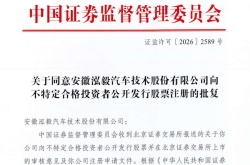
On September 20, the China Securities Regulatory Commission (CSRC) granted approval for Anhui Hongyi Automotive Technology Co., Ltd. to publicly issue shares to unspecified qualified investors. 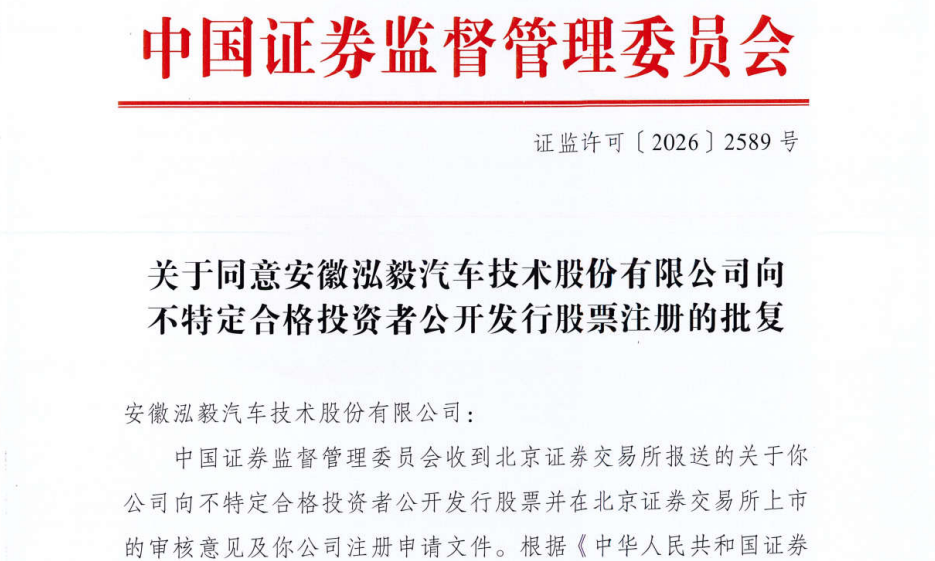
Hongyi's core operations encompass the design, research and development (R&D), and manufacturing of automotive stamping and welding parts, passive safety components (such as airbags), and die castings. Stamping and welding parts are integral to body and chassis assemblies, while die castings are essential for the production processes of complete vehicles and their components.
From 2023 to 2025, Hongyi's operating revenue surged from RMB 1.792 billion to RMB 2.888 billion and further to RMB 3.544 billion, marking a 22.72% year-on-year growth in 2025. Net profit attributable to shareholders climbed to approximately RMB 129 million, RMB 243 million, and RMB 300 million, respectively, with a 23.24% year-on-year increase in 2025. Non-recurring profit and loss attributable to shareholders stood at roughly RMB 116 million, RMB 231 million, and RMB 286 million, respectively. In the first half of 2026, the company reported an operating revenue of RMB 1.691 billion, up 9.18% year-on-year; net profit attributable to shareholders reached RMB 133 million, up 1.89% year-on-year; and non-recurring profit and loss attributable to shareholders amounted to RMB 128 million, up 5.65% year-on-year.
According to data released by the Ministry of Industry and Information Technology on October 12, China's automobile sales reached 23.271 million units in the first three quarters of 2026, representing a 4.5% year-on-year decline. However, new energy vehicle (NEV) sales soared to 12.472 million units, up 11.1% year-on-year, accounting for 53.6% of total new vehicle sales. Complete vehicle exports surged to 8.205 million units, up 65.8% year-on-year. While traditional auto sales face pressure, the growth in NEVs and exports suggests that auto parts companies cannot rely solely on domestic auto sales as a performance indicator.
Hongyi's body stamping and welding parts and airbags are compatible with vehicles featuring different powertrains. The key demand driver hinges on the company's ability to secure positions in new models with strong sales, maintain per-vehicle supply shares, and secure new model nominations during product iterations. Die castings are also influenced by new model development and tooling investment cycles, with order confirmations often not coinciding with vehicle production ramp-ups.
Historical growth has been closely tied to core customers and new project ramp-ups. In its second-round inquiry response, Hongyi revealed that Chery Automobile's sales were 1.881 million units in 2023, 2.6039 million units in 2024, and 2.8064 million units in 2025, with growth slowing from 52.6% and 38.4% to 7.8%. During the same period, Chery's procurement of body stamping and welding parts from Hongyi increased from 15% to 24% and approximately 30%. While customer expansion and increased supply shares may have fueled Hongyi's revenue growth, these factors may not continue to contribute at the same pace in the future. The company's 2025 year-end backlog, calculated based on three-month demand forecasts, was RMB 909 million, reflecting only short-term production needs and not directly indicating long-term locked-in revenue. If model terminal sales fall short of expectations, the company's forecasted orders may change.
Additionally, pricing pressures across the supply chain cannot be overlooked. After automakers cut prices to compete for sales volume, they often transfer some of the pressure to upstream suppliers through annual price negotiations. Hongyi's prospectus disclosed the impact of customer price cuts on its revenue: approximately RMB 55.71 million in 2023, RMB 121 million in 2024, and RMB 174 million in 2025, equivalent to 3.16%, 4.26%, and 5.02% of its main business revenue in those years, respectively. This indicates that new supply contracts must continuously offset price cuts on older products.
Although the company's average selling price for automotive stamping and welding parts rose in 2025, this does not necessarily mean no single product experienced price cuts. Changes in the sales mix of assembly parts, product specifications, and customer structure could raise the blended average price. The true test lies in the gross margin of the same products after annual price cuts and whether new model products can cover development, prototyping, and ramp-up costs.
On the cost side, the company's registration draft revealed that Hongyi's average steel procurement price fell from RMB 3,515.65 per ton in 2023 to RMB 2,966.54 per ton in 2025, providing some room for cost reduction. However, steel price declines can affect downstream pricing through price transmission mechanisms. Stamping and welding also rely on equipment depreciation, energy, labor, outsourced processing, and yield rates. When production lines operate at full capacity, fixed costs can be spread across more qualified products; however, if order ramp-ups are slow in the initial stages of new base operations, depreciation and management fees may accrue first, potentially raising per-unit costs.
Specifically, Hongyi's comprehensive gross margin declined from 19.49% in 2023 to 19.01% in 2024 and 17.23% in 2025. The company attributed the 2025 decline in main business gross margin partly to automaker price cut requests and higher fixed costs during the new base ramp-up period.
In terms of customer structure, revenue growth has also amplified customer concentration. In 2025, Chery Automobile's procurement from Hongyi generated RMB 2.348 billion in revenue, accounting for 66.25% of the company's operating revenue; the top five customers combined accounted for 83.66%. Chery Automobile indirectly holds a 38.70% stake in Hongyi through its affiliates, indicating a related-party relationship; related-party sales accounted for 69.06% of the company's operating revenue that year. While deep cooperation facilitates synchronous early-stage development, proximity-based supply, and stable delivery, it also means that changes in customer model schedules, procurement allocations, annual price cut amplitudes, and settlement rules will be more concentratedly reflected in the company's financial statements. Although revenue from customers like BYD and Geely has grown, it is unlikely to significantly alter Chery's dominant share in the short term. The pricing fairness involved in related-party transactions requires scrutiny, as the company's post-approval performance sustainability is closely tied to this issue.
Data shows that automakers typically pay after delivery, receipt, or settlement, while suppliers must pay for materials, wages, and equipment upfront. The registration draft revealed that Hongyi's accounts receivable stood at RMB 1.611 billion at the end of 2024, accounting for 65.93% of current assets; this fell to RMB 1.335 billion by the end of 2025, still representing 51.35% of current assets. The company explained that the 2025 decline was due to strengthened receivables management, faster customer payments, and reduced settlement via accounts receivable instruments. Net cash flow from operating activities was RMB 286 million in 2025, up from RMB 161 million the previous year; in the first half of 2026, it was RMB 212 million, up from RMB 73 million in the same period last year, which the company attributed mainly to increased sales receipts and reduced tax payments. While improved cash flow is a positive signal, it also reminds us that profits, receipts, and tax payment timings collectively affect cash flow. We cannot infer that all customer payment terms have shortened based solely on a half-year cash flow increase.
In the complete vehicle market, the rising share of NEVs is driving industrial technological upgrades. Electric vehicles also require body structural components and passive safety systems, but platform layouts, weight reduction requirements, collision performance, and production rhythms will change. Key challenges include how to connect high-strength steel with lightweight materials, how to conduct online inspection of weld quality, and how to balance weight, strength, and cost for instrument panel crossmembers. These factors will determine whether suppliers can pass customer verification and enter mass production.
Hongyi disclosed R&D projects in its registration draft, including lightweight instrument panel crossmembers, high-strength crossmembers, and body sub-assemblies. R&D investment increased from RMB 91.1858 million in 2023 to RMB 107 million in 2025, but its proportion of revenue declined from 5.09% to 3.01%. A declining investment proportion alone does not prove anything, but the company must provide verifiable results such as new product nominations, verification pass rates, yield rates, and stable delivery to demonstrate that R&D spending has translated into orders and gross margins.
After the IPO is completed, Hongyi's funded projects will still need to undergo customer verification, mass production ramp-up, and sustained delivery. The raised funds can improve capital arrangements during the construction period, supplement working capital, and enhance R&D and crash test conditions. However, they cannot lock in complete vehicle sales for the company, prevent annual price cuts by automakers, or guarantee receipts. If new equipment is invested ahead of demand, depreciation will pressure gross margins; if customers switch suppliers or model lifecycles shorten, capacity utilization and investment returns will slow further. For Hongyi, securing enough new model nominations outside of Chery will determine whether the financing-driven capacity expansion broadens customer coverage or further increases reliance on a single customer.
-
![]()
Are FAW and Leapmotor Forging an Unbreakable Alliance?
-
![]()
Hongyi Secures IPO Registration Approval: How Will Production Scaling Align with OEM Demand?
-
![]()
The Further Chinese Cars Advance, the Greater the Emphasis on Quality Should Be
-
![]()
Surpassing Toyota and Volkswagen to Become the 'World's No.1' in 4 Years: Where Will BYD Find 6.4 Million Incremental Sales? | MIRROR Pro
-
![]()
Milestone Achieved! Apple's Market Cap Surpasses $5 Trillion
-
![]()
Apple Order Cuts or Not, Apple Supply Chain Inventory Demands Attention!
-
![]()
Toyota’s North-South Integration at a Pivotal Moment: Huang Jian Steps In to Steer Key Initiatives
-
![]()
Avatr Steers Away from Pioneering Aesthetics, Embracing a More Mainstream Appeal