Ultrafast Nonlinear Optics Technology No. 107: Mid-Infrared Sub-Two-Cycle Pulse Compression
 11/16 2026
 477
High harmonic generation (HHG) is a key route to tabletop extreme-ultraviolet and soft X-ray light sources, and its cutoff photon energy scales with the square of the driving wavelength. Millijoule-level few-cycle mid-infrared pulses are therefore essential for developing water-window high harmonics and attosecond light sources. Chromium-doped zinc selenide (Cr:ZnSe) lasers, which can operate directly in the mid-infrared, offer a viable path toward simplified high-energy driving systems, but their pulse width still requires further compression. Recently, a collaboration involving SLAC National Accelerator Laboratory, the University of Central Florida, and other institutions reported a single-stage gas-filled hollow-core fiber (HCF) post-compression scheme in Optics Letters [1].
The experimental setup is shown in Figure 1. The experiment employed a Cr:ZnSe chirped-pulse amplification laser delivering 90 fs pulses centered at 2.45 μm, with an energy of 5.3 mJ and a repetition rate of 1 kHz. The laser was coupled into a ~1.5 m long argon-filled hollow-core fiber with a 1 mm inner diameter, where self-phase modulation broadened the spectrum. KBr and CaF₂ bulk materials were then used to compensate dispersion, compressing the pulse to 15 fs with an output energy of 3.3 mJ and a peak power of approximately 0.12 TW. The system used SHG-FROG, a spectrometer, and a beam profiler to characterize the pulse, and both compression and measurement were performed in a dry nitrogen environment to reduce water vapor absorption.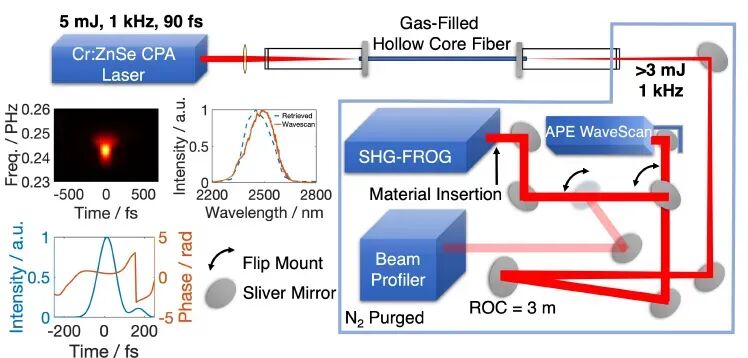
Figure 1. Setup for HCF spectral broadening, bulk material compression, and pulse characterization [1]
Figure 2 shows that the output spectral bandwidth broadens continuously as the argon pressure increases. At 24 psi, the total bandwidth between the spectral wings exceeds 1000 nm, corresponding to a Fourier-transform-limited pulse width of approximately 13 fs—sufficient to support sub-two-cycle pulses. Luna.jl simulations reproduced the main trends of bandwidth growth and spectral asymmetry well, indicating that gas pressure can effectively tune the nonlinear phase accumulation and the compressible bandwidth.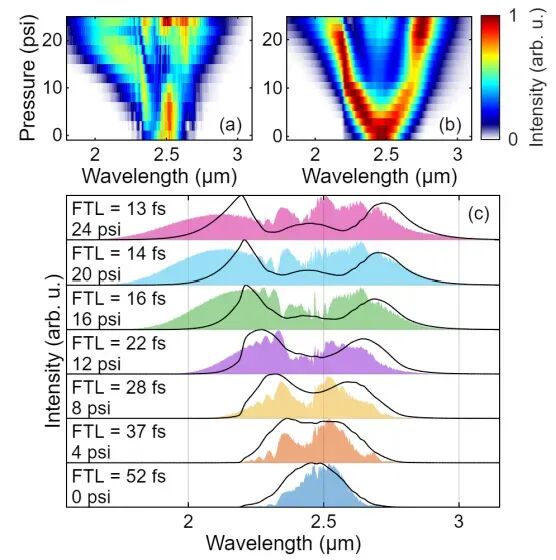
Figure 2. Experimental and simulated spectra at different argon pressures, and the transform-limited pulse widths corresponding to the measured spectra [1]
After obtaining the broadband spectrum, the authors used a dispersion combination of KBr and CaF₂ to adjust the spectral phase. Through SHG-FROG measurement and retrieval, they obtained a pulse width of 15 fs, corresponding to approximately 1.8 optical cycles at 2.45 μm—close to the 13 fs spectral transform limit. The measured and retrieved traces showed reasonable consistency, supporting the reconstruction of sub-two-cycle pulses. The compressed pulse still exhibits an asymmetric structure caused by higher-order dispersion, with 62% of the total energy concentrated in the main pulse. The authors note that further use of chirped mirrors to compensate third-order dispersion is expected to increase the energy fraction of the main pulse and improve the waveform.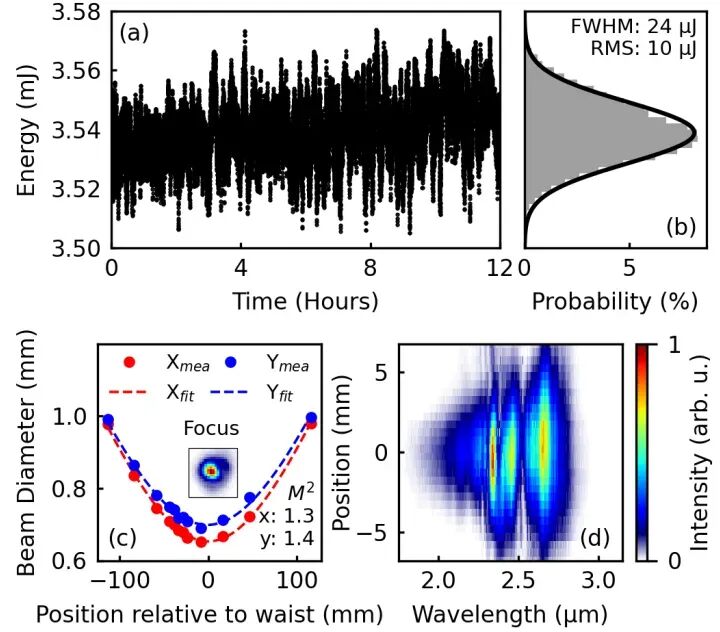
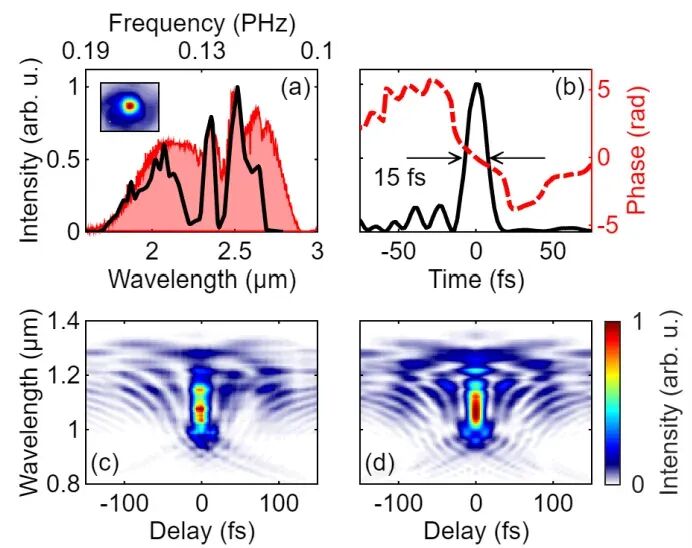
Figure 3. Output stability, beam quality, and compressed pulse characterization. The left panel shows long-term performance; the right panel shows the spectrum, time-domain waveform, and FROG trace [1]
The study also verified the long-term performance of the light source. A 12-hour measurement showed a root-mean-square relative fluctuation of the output energy of approximately 0.3%, and an average beam quality factor M² of about 1.35, close to the diffraction limit. These results indicate that while significantly shortening the pulse width, the system retains output stability and spatial quality suitable for strong-field experiments.
The original text emphasizes that this scheme combines the advantages of direct mid-infrared operation, high efficiency, and kilohertz repetition rate of Cr:ZnSe lasers with HCF post-compression, entering the sub-two-cycle regime while retaining multi-millijoule energy. The system outputs pulses at a 1 kHz repetition rate. The single-stage broadening and bulk compensation architecture has the potential to scale to higher energy. The authors point out that such pulses are suitable for driving soft X-ray high harmonics, thereby supporting attosecond research at absorption edges relevant to biology and chemistry. The soft X-ray range can also cover the K or L absorption edges of transition metals, providing element-selective probing methods for photochemistry, catalysis, and biological processes.
In summary, this work achieved millijoule-level mid-infrared sub-two-cycle pulses using a single-stage HCF and bulk dispersion compensation. The paper estimates that under appropriate phase-matching conditions, such driving light can support harmonic cutoff energies of approximately 250 eV, 600 eV, and 1 keV in argon, neon, and helium, respectively. This platform provides a new driving scheme for water-window high harmonics, attosecond light sources, and mid-infrared strong-field research.
References
[1] M. Britton et al. Generation of 3.3-mJ, 2.45-μm, sub-2-cycle laser pulses via hollow-core fiber pulse compression. Optics Letters 51(12), 3441–3444 (2026). DOI: 10.1364/OL.596520.
-
![]()
Mazda's Struggle and Transformation: A Case Study in Survival for Second-Tier Automakers | Cover Story: Japanese Automakers at the Crossroads of Transformation (Part VI)
-
![]()
Top 10 SUVs by Sales Are All Feeling a Bit Nervous Now
-
![]()
Eldest Son Returns with a Price Hike: Is AITO Using the New M8 to Take On the 9 Series?
-
![]()
Cerebras: Supply and Demand Are Both Fine — the Fab Is the "Big Headache"
-
![]()
Waymo vs. Tesla: How Far Has the Robotaxi Battle Come—and Will Automakers Become the Foxconn of Cars?
-
![]()
New Automakers Enter the Countdown to Integration
-
![]()
Chinese Automakers Break Into Canada by Making EVs Winter-Proof First
-
![]()
Chinese Cars Force Down Prices in Europe's Niche Off-Road Market