What Are the Technical Prerequisites for Level 3 Automated Driving?
 01/07 2026
 726
726
Recently, we've received numerous private messages via our platform inquiring about the technical prerequisites for Level 3 automated driving. Indeed, within the automated driving industry, Level 3 represents a pivotal milestone. Once achieved, the system will assume primary control over driving behaviors, with the driver transitioning to a supportive role. So, what technical conditions must be fulfilled to attain Level 3 automated driving?
What is Level 3 Automated Driving?
Level 3 Automated Driving, also known as Conditional Automation, markedly differs from lower automation levels. The primary distinction lies in its ability, under specific road conditions and operational scopes, for the vehicle to independently execute most driving tasks. These tasks encompass perceiving the surrounding environment, controlling steering, and managing acceleration and deceleration. The driver is relieved from the need for continuous manual operation but must be prepared to promptly resume control when the system requests a takeover.
This definition originates from SAE International's standardized classification system for driving automation, "Taxonomy and Definitions for Terms Used in SAE International Standard J3016: Automated Driving Systems." This system is widely recognized as the global benchmark for classifying automated driving levels. According to this standard, a Level 3 automated driving system can autonomously perform dynamic driving tasks (DDTs) within a defined Operational Design Domain (ODD). It also clearly specifies, through human-machine interactions, when the system assumes responsibility and when human intervention is necessary.
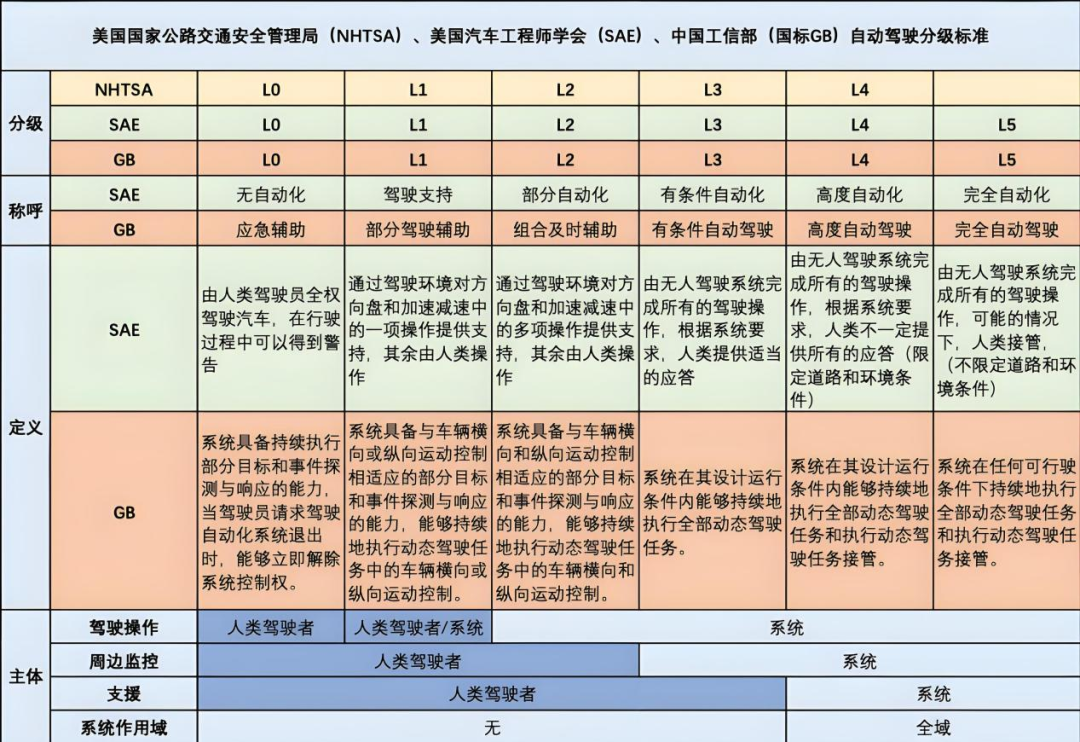
Classification of automated driving levels. Image source: Internet
In China, the authoritative technical specification for automated driving systems is the "General Technical Requirements for Autonomous Driving Systems of Intelligent Connected Vehicles" (GB/T 44721-2024), which came into effect in September 2024. This standard applies to both passenger and commercial vehicles equipped with automated driving systems. It provides specific guidelines covering overall requirements, operational conditions, functional safety, human-machine interaction, and data recording.
While the standard is not exclusive to Level 3, it explicitly outlines a comprehensive set of engineering and technical requirements. These requirements ensure that automated driving systems can safely and reliably perform dynamic driving tasks within specified conditions, handle abnormal situations, and interact effectively with drivers. All these aspects are crucial for the realization of Level 3 automated driving.
Achieving Level 3 automated driving entails more than just installing a plethora of sensors. This level corresponds to a series of specific technical capability requirements that must meet defined thresholds in standards, testing, system design, data processing, and other areas.
Perception and Environmental Understanding Must Operate Comprehensively and Reliably
Level 3 automated driving systems necessitate that vehicles perceive and understand their surroundings in real-time and accurately through multi-sensor fusion. To achieve this, high-precision cameras, millimeter-wave radars, LiDAR, and other sensors must be seamlessly integrated. Data fusion technology combines information from various sources, enabling the vehicle to construct a 360-degree environmental perception map. This map includes key targets such as road structures, vehicles, pedestrians, traffic signs, and signals. The accuracy and completeness of perception directly determine whether the system can operate safely in real-world, complex traffic scenarios.
To this end, each type of sensor must adhere to industry-recognized accuracy standards within its detection range. For instance, LiDAR must achieve centimeter-level ranging for static objects, while cameras must maintain high recognition rates for dynamic targets under varying lighting conditions. At the system level, the fused perception results must be stable and reliable enough to support subsequent decision-making and control.
Moreover, environmental perception transcends merely "seeing" objects; it requires "understanding" the scene. The system must effectively distinguish potentially hazardous targets from negligible distractions in complex traffic flows. This provides the downstream decision-making and planning modules with context-aware inputs to generate reasonable and safe vehicle control commands.
Decision-Making and Control Systems Must Be Capable of "Driving" Independently Under Specified Conditions
Achieving Level 3 automated driving necessitates more than just precise environmental perception. After acquiring perceptual data, the system must make safe driving decisions and execute controls. These controls include planning the vehicle's driving path, controlling acceleration and deceleration, and adjusting steering. Decision-making and control algorithms typically comprise deep learning, path planning, and motion control modules. These modules must meet two fundamental requirements: real-time performance and safety.
1. Real-time performance: In complex traffic environments, the system must respond to external changes within tens of milliseconds to ensure timely control commands.
2. Safety: Before making control decisions, the system must assess various potential risks within a certain range and avoid erroneous judgments as much as possible. For example, when encountering a sudden vehicle cut-in on a highway, the system must quickly judge and execute braking or evasive maneuvers without hesitation.
These capabilities are comprehensively verified through simulation, closed-course testing, and large-scale real-world road testing before commercialization. This ensures that the vehicle does not pose risks due to control errors within its ODD.
Functional Safety and Minimum Risk Strategy Are Mandatory Requirements
Automated driving systems must incorporate functional safety mechanisms to ensure a basic safety state in the event of software or hardware failures. According to ISO 26262, "Road Vehicles - Functional Safety," when the system detects an internal fault, it must activate corresponding safety mechanisms (e.g., fault handling, entering a safe state, issuing driver warnings) to minimize risks and ensure the vehicle remains in a safe condition. This is commonly understood as the Minimum Risk Strategy (MRS).
The MRS refers to automatically decelerating the vehicle and steering it to a safe location when the system can no longer operate safely. It also involves taking measures such as activating hazard warning lights to minimize accident risks. For example, if a severe perception failure occurs at high speeds, the vehicle must automatically determine a safe route, decelerate to a safe speed, and steer to an emergency stop lane—all within predefined logic and safety boundaries. Clearly defining the MRS and systematically designing its trigger conditions and execution behaviors are indispensable parts of Level 3 system design.
Human-Machine Interaction Design Must Clearly Specify When the Driver Should Intervene
The unique aspect of Level 3 automated driving is that it does not fully replace the driver but "entrusts" driving tasks under specific conditions while still requiring driver takeover. In this mode, human-machine interaction design becomes critically important, primarily manifesting in two aspects.
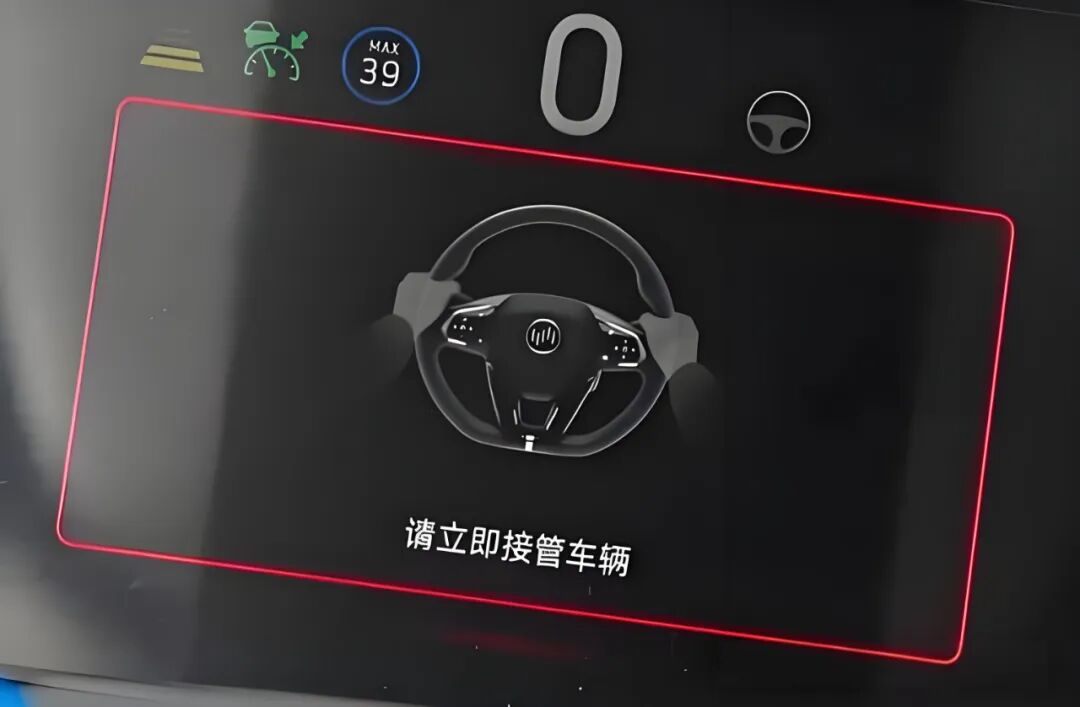
Image source: Internet
1. Direct feedback on system status: When Level 3 automated driving mode is activated, the cockpit display and auditory cues must clearly inform the driver of the current automation status and operational conditions (e.g., highway driving, daytime operation). This ensures that the driver understands the system's capabilities and limitations.
2. Clear takeover request and response procedures: When the system encounters situations beyond its capabilities, such as adverse weather, blurred road markings, or complex traffic conditions, it must issue takeover requests to the driver through visual, auditory, or other means. These prompts should have a clear time window, allowing the driver sufficient time to switch from automatic to manual driving. The system must also continuously monitor the driver's attention to ensure timely responses.
This differs fundamentally from Level 2 driver assistance, which requires continuous driver attention and readiness to operate. Level 3 allows the driver to relax somewhat but must ensure effective responses to takeover requests. Therefore, a Driver Monitoring System (DMS) must be installed to monitor the driver's status in real-time.
Data Recording, Storage, and Security Are Key Points for Technical Compliance
Automated driving systems continuously generate vast amounts of data during operation, including raw sensor data, vehicle dynamics, and system internal states and decision logs. The complete and reliable recording and storage of this data are essential for accident investigation, system optimization, and liability determination. Design specifications for data processing must comply with standard requirements.
To this end, vehicles must be equipped with a standardized Data Storage System (DSS) that records vehicle driving data (e.g., speed, acceleration, steering signals), environmental perception data (e.g., raw or preprocessed data from cameras, radars, LiDAR), and system operational status, driving decisions, fault codes, and human-machine interaction records.
The system must also feature an event-triggering mechanism (e.g., automatically saving data from a critical time window before and after collision warnings or system failures) and meet storage security requirements such as tamper resistance and physical damage resistance. These requirements are typically achieved through independent hardware units with write-protection functions. Access to stored data must be strictly encrypted and permission-controlled to protect personal privacy and data security.
Final Thoughts
The widespread discussion around Level 3 automated driving stems primarily from its fundamental shift in the primary responsible party for vehicle operation. It requires constructing a complete technical system within a defined ODD, with high-precision perception as the foundation, real-time safety decision-making as the core, and functional safety and data traceability as mandatory safeguards. This represents not just a breakthrough in individual technologies but a comprehensive innovation (or overhaul) of system architecture, safety philosophy, and standardization frameworks.
-- END --
-
![]()
Registered Capital Slashed to 372 Million Yuan! Yutong Optical Finalizes Industrial and Commercial Change Registration
-
![]()
Zhuque-3 Successfully Lands, and 'Time Traveler' Secures Another ¥100 Million in Funding: China's Commercial Space Industry Experiences a 'Dynamic August'
-
![]()
Autohome Faces a Shrinking Window of Opportunity
-
![]()
Even a Titan Like Musk Has Faced Setbacks in Fulfilling Promises
-
![]()
AI Office: The End of the Racing Era, Context Becomes the Key to Success
-
![]()
Domestic Vehicle Chassis Revolution ②: The Steering Wheel Remains, But Mechanical Connections in the Steering System Are Decreasing
-
![]()
Exploring MiniMax Design: Can Video Editing Be as Simple as Speaking?
-
![]()
Why Can SenseTime Achieve Profitability While CloudWalk Still Faces Challenges, Despite Both Adopting Large Models?