Why Is Space the Next Frontier for Computing Power? (With Concept Stocks)
 01/19 2026
 617
617
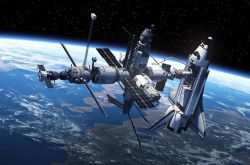
Confronted with the stark mismatch between Earth's limited resources and the soaring demand for AI computing power, humanity is now casting its eyes toward the boundless expanse of space. The revolutionary concept of space computing power is gaining increasing traction. Space computing power denotes a technology that places data centers and computational resources into orbital paths, enabling on-orbit data processing via satellites and their onboard computational hardware. It leverages high-speed inter-satellite laser communication for data transmission and real-time processing, with results then relayed back to Earth.
It's crucial to note that space computing power isn't a concept conjured out of thin air; rather, it's the outcome of the convergence between the AI boom and the maturation of commercial space technology. Its roots can be traced back to aerospace telemetry, tracking, and control (TT&C) as well as satellite data processing in the late 20th century. Initially, its primary applications were orbital calculations in space missions, remote sensing data transmission, and similar scenarios. With the evolution of commercial space and AI, exemplified by SpaceX's Starlink, the traditional model of satellites as "single-function, ground-reliant" entities has been disrupted. There's been a gradual shift towards deploying computing power on space-based platforms, onboard data processing, and integrated space-ground computing, ultimately giving rise to the distinct concept of "space computing power."
01. Why Develop Space Computing Power?
Having defined the essence of space computing power, we're compelled to ask: Why relocate computing power to space?
The root cause lies in the profound conflict between Earth's finite resources and the seemingly limitless expansion of AI computing power demand. Ground-based data centers are grappling with severe pressures related to energy, cooling, and land availability. In contrast, space offers infinite cooling capacity, abundant solar energy, and unique physical conditions, presenting a groundbreaking solution for upgrading computational infrastructure and propelling humanity to explore the vast cosmos.
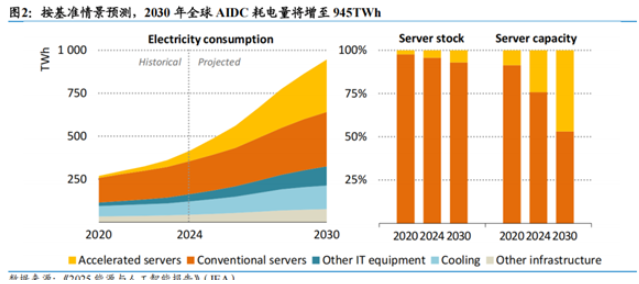
From the demand perspective, Guotai Junan Securities highlights that the training and inference of AI large models hinge on the continuous operation of massive high-performance chips (such as GPUs and ASICs), imposing extremely stringent requirements on the power supply for AI data centers (AIDC). Calculations by the China Academy of Information and Communications Technology suggest that by 2030, China's annual electricity consumption for data centers could exceed 400 billion kilowatt-hours, accounting for nearly 6% of total societal electricity use. The International Energy Agency further projects that by 2030, global data center electricity consumption will surge to approximately 945 terawatt-hours, representing slightly less than 3% of total global electricity use—more than double the 2024 level and exceeding Japan's current annual total electricity consumption. As AI technology continues to rapidly evolve, the strain on power resources is intensifying.
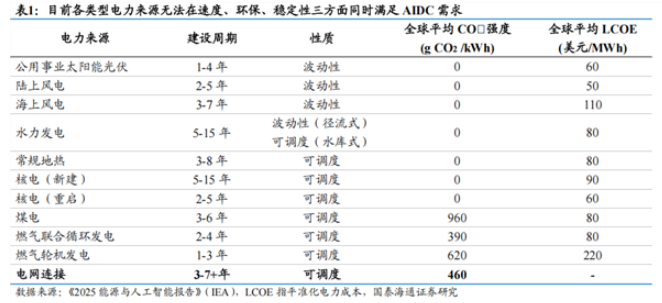
From the supply side, there are significant generational gaps among existing power resources in terms of construction cycles, dispatchability, and environmental friendliness. Green energy sources with dispatchable capabilities generally entail long construction cycles and cannot swiftly meet AI's energy demands in the short term. Conversely, energy sources with faster construction speeds often lack stability or come with high carbon emissions and environmental costs.
Currently, the only reliable power sources available for short-term (1-2 year) development are photovoltaic power generation and gas turbines. The "generational gap" in ground-based power grids directly limits their upgrade speed, resulting in a clear disconnect between energy supply and AI's power demands.
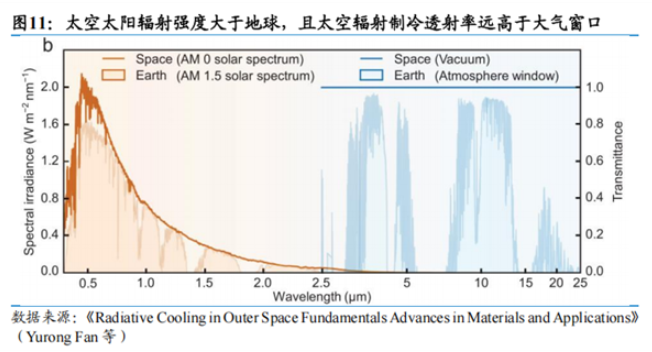
In contrast, space offers a vastly different environment: nearly infinite cooling space, continuous and abundant solar energy, and unique microgravity and high-vacuum conditions, painting a new blueprint for constructing next-generation computational infrastructure.
02. What Are the Core Technical Bottlenecks?
While the future of space computing power is vast, achieving its scale-up and commercialization still faces a series of interconnected foundational challenges. Key technologies such as highly reliable radiation-resistant chips, ultra-high-speed inter-satellite laser communications, and on-orbit assembly and maintenance remain major obstacles to its scale-up deployment and commercial operation.
Firstly, the extreme nature of the space environment imposes stringent requirements on hardware. Traditional ground-based chips cannot withstand the ubiquitous high-energy particle radiation in space, making them prone to data errors or even permanent damage. Therefore, developing highly reliable radiation-resistant chips capable of long-term stable operation in space is the cornerstone of building any space-based computational infrastructure. Without this "robust heart," subsequent developments are untenable.
Once computational nodes are established, high-speed data connectivity becomes crucial. Unlike ground-based networks that rely on optical fibers, space networks must depend on wireless transmission. Existing radio frequency (RF) communications have limited bandwidth and cannot meet the demands for massive data exchange. Although ultra-high-speed inter-satellite laser communication technology holds great promise, its extreme precision requires achieving laser beam acquisition, alignment, and stable maintenance between two satellites moving at high relative speeds. This is akin to threading a needle from a distance of ten thousand meters, posing enormous engineering challenges and reliability tests.
Finally, the long-term operation of space facilities cannot be sustained without maintenance and upgrades. Expensive satellites that fail or become technologically obsolete often become nothing more than space debris. Developing on-orbit assembly, maintenance, and even refueling technologies aims to imbue space infrastructure with extendable and repairable capabilities, thereby reducing lifecycle costs. This is an indispensable step toward commercial operation. In summary, breakthroughs in every link—from core chips to network interconnection and operational maintenance systems—are crucial, collectively paving a solid path toward the era of space computing power.
03. Industrial Chain and Related Stocks
Despite the towering technical challenges, these bottlenecks also signify new demands, fostering the emergence of an entirely new industrial ecosystem. From hardware manufacturing to operational services and terminal applications, a complete industrial chain for space computing power is beginning to take shape, with related companies accelerating their deployments.
From an industrial chain perspective, the space computing power chain can be divided into three closely interconnected segments:
Upstream (Hardware Foundation): This encompasses rocket launches, satellite platforms, onboard processors, laser communication terminals, and ground stations. It forms the physical basis of the industry and is undergoing disruptive changes characterized by "cost reduction and performance enhancement."
Midstream (Operational Scheduling): This segment includes constellation design and manufacturing, on-orbit operation and control, inter-satellite networking, and computational power scheduling platforms. It serves as the "brain and nervous system" of the industry, with the core focus on achieving efficient coordination.
Downstream (Application Ecosystem): This represents the final value realization layer and includes industry applications (such as remote sensing, transportation, and energy), enterprise cross-domain computational power scheduling, and terminal devices. It determines the market's ceiling.
Guosheng Securities points out that the current upstream landscape of space computing power is relatively stable, with SpaceX leading (due to its constellation scale and launch capabilities) and Amazon's Project Kuiper emerging as a significant player through its AWS ecosystem. The midstream is the most active "innovation field," with companies like Kepler and Skyloom specializing in optical relay and on-orbit transit, as well as Axiom/Loft providing on-orbit modular services, actively advancing the commercialization of on-orbit computing power. For instance, Kepler has publicly announced its on-orbit compute capabilities, while Axiom is advancing orbital data center nodes.
Relevant A-share concept stocks are shown in the following figure:

04. Conclusion
The concept of space computing power envisions a future where human intelligence and the cosmic expanse are deeply integrated. It's not only a forward-looking response to the energy and cooling dilemmas faced by Earth-based data centers but also a crucial step in seamlessly embedding computational capabilities into the fabric of deep space exploration. Its value lies in constructing a closed-loop system for extraterrestrial information perception, processing, and decision-making, thereby fundamentally transforming the efficiency models of remote sensing observations and planetary exploration and injecting powerful momentum into scientific research and space industrialization.
However, the path to this future is still fraught with challenges. A series of core technical bottlenecks—from radiation-resistant chips and inter-satellite laser communications to maintenance systems—are intertwined, forming a technological plateau that must be systematically overcome. Each breakthrough is vital for ensuring the reliable operation and continuous evolution of the entire system in extreme environments. This demands cross-disciplinary collaborative innovation and long-term investment.
Looking ahead, the development of space computing power may lead a new infrastructure revolution. It has the potential to offload some computational loads to space, forming a hybrid computing ecosystem that integrates space and ground networks. Despite the immense challenges, it represents not only the spatial extension of computing power but also the dual expansion of humanity's civilizational reach and intelligent boundaries.
- End -
-
![]()
Registered Capital Slashed to 372 Million Yuan! Yutong Optical Finalizes Industrial and Commercial Change Registration
-
![]()
Zhuque-3 Successfully Lands, and 'Time Traveler' Secures Another ¥100 Million in Funding: China's Commercial Space Industry Experiences a 'Dynamic August'
-
![]()
Autohome Faces a Shrinking Window of Opportunity
-
![]()
Even a Titan Like Musk Has Faced Setbacks in Fulfilling Promises
-
![]()
AI Office: The End of the Racing Era, Context Becomes the Key to Success
-
![]()
Domestic Vehicle Chassis Revolution ②: The Steering Wheel Remains, But Mechanical Connections in the Steering System Are Decreasing
-
![]()
Exploring MiniMax Design: Can Video Editing Be as Simple as Speaking?
-
![]()
Why Can SenseTime Achieve Profitability While CloudWalk Still Faces Challenges, Despite Both Adopting Large Models?