“Inescapable” Alibaba QianWen APP Showcases Divergent Trajectories of Large AI Models in China and the US
 01/19 2026
 629
629
Alibaba’s QianWen: Not the “Most Powerful” Model, But the Most “Alibaba-Centric” Model
Picture this: You wake up, pull back the curtains, and are greeted by the long-awaited snowfall. Without a second thought, you murmur, “What should I do on a snowy day?” Instead of receiving a robotic AI response, you're presented with a series of actionable travel suggestions, complete with options like “Book tickets?” or “Call to make a reservation?” The AI even tailors its recommendations to your preferences, selecting your favorite restaurants or travel routes based on past orders, or that “special meal” you crave but rarely indulge in. For a moment, it feels almost surreal—but upon closer inspection, you realize AI has seamlessly taken over your consumption pathways.
On January 15, Alibaba hosted the “Q&A for All” launch event for the new version of QianWen, announcing that the QianWen APP would fully integrate with Alibaba’s vast business ecosystem, encompassing Taobao, Alipay, Taobao Deals, Fliggy, and Amap. This integration enables AI-powered functions such as ordering food, shopping, and booking flights, now open for testing to all users. The goal is to propel the AI industry from “chat-based interactions” into the “era of task execution,” covering both digital and physical lifestyle scenarios.
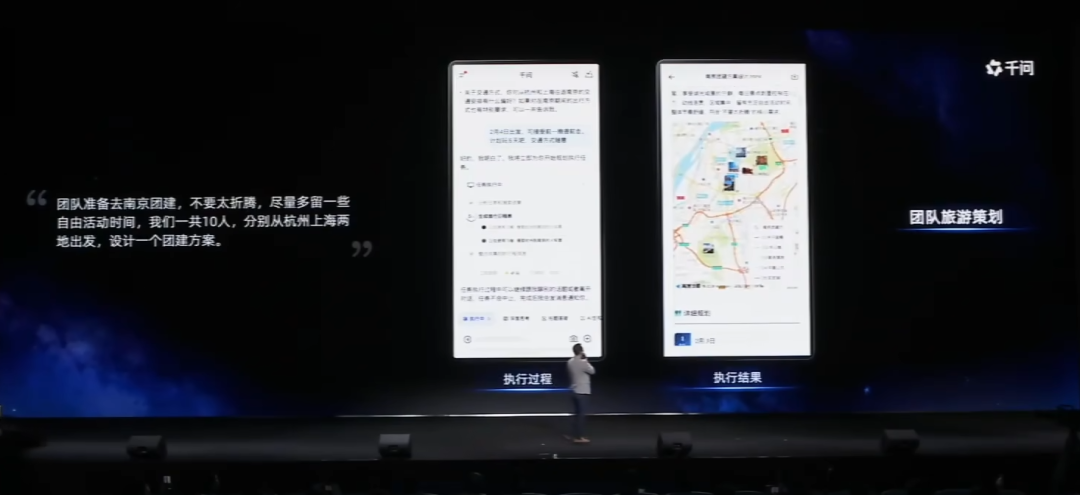
This means users can issue commands in the QianWen APP for tasks like ordering food, booking flights, or reserving restaurants—all handled directly by the app, significantly saving users’ time. Alibaba, often perceived as the most understated large model company, has carved out the clearest and most practical path to commercialization. The QianWen APP, integrated with Alibaba’s consumer businesses, appears to be an “unavoidable” presence for consumers.
01 QianWen Is Certainly Not the Most Powerful Large Model
Every large model released in China inevitably draws comparisons to ChatGPT.
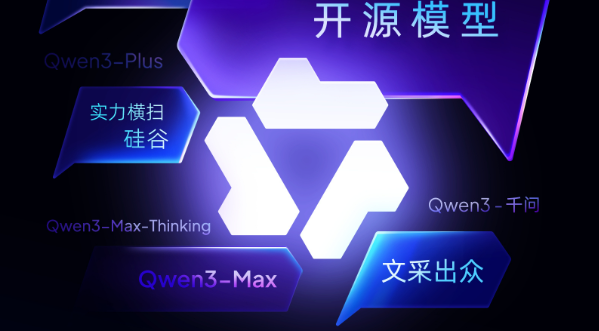
On November 17, 2025, Alibaba officially launched its “QianWen” project, targeting the AI-to-Consumer market and directly competing with ChatGPT. The QianWen APP comes preloaded with the Qwen3 large model, allowing users to switch to Alibaba’s most advanced model, Qwen3-Max.
From the development trajectory of large models, China excels in “engineering-driven implementation,” while the US leads in “paradigm-shifting breakthroughs”—fundamental, revolutionary changes in basic theories, assumptions, or cognitive frameworks within scientific or social domains. This is not a technological gap but a difference in industrial logic.
For instance, US large models like OpenAI’s GPT series, Anthropic’s Claude, and Google’s Gemini were never designed to be merely “user-friendly.” Instead, they aim to “redefine intelligence.” These models strive to push reasoning capabilities to approach or even surpass human levels, aiming for artificial general intelligence (AGI) in one leap. They emphasize “irreplaceability” and “technical ceilings,” seeking to unify multimodal data into a single world model.
In contrast, Chinese large model developers follow a different path. Their core strength lies not in pushing model capabilities to their limits but in maximizing industrial efficiency. Chinese large models resemble “industrialized AI,” prioritizing rapid integration into real-world business scenarios such as search, e-commerce, office productivity, customer service, manufacturing, and finance. The goal is to transform models into “production tools” rather than “academic marvels.” The proliferation of industry-specific models across sectors is a testament to this approach.
Large models have lowered barriers to software development and, in some cases, redefined workflows using models, altering software usage patterns (e.g., Photoshop). This has led to a sustained slowdown in SaaS revenue growth. After peaking in 2021, the SaaS sector entered a prolonged deceleration phase. By 2023, the disruptive impact of large models began eroding the once-stable cash flow barriers of SaaS companies, driving down valuations.
However, in absolute terms, the global SaaS market is projected to reach $580 billion by 2025, growing 16% year-over-year, and nearly $1 trillion by 2029, according to IDC. Over the long term, the SaaS market will evolve into an AI-driven application landscape, with pathways diverging: some companies will be replaced by large models, others will complete AI transformations, and new AI-native applications will drive incremental growth.

QianWen is just one of many large models, and no single standard exists to deem it the “best.” However, an undeniable fact is that QianWen has garnered significant attention from industry peers. Publicly available data shows that within two months of its launch, QianWen’s consumer-side monthly active users (MAU) surpassed 100 million, with rapid growth among students and white-collar workers. Multiple industry sources reveal that several competing platforms have imposed restrictions on the QianWen APP.

02 Why QianWen Is Drawing Industry Attention
The industry first sensed “something was off” with QianWen less than two months after its launch. Without aggressive marketing, the QianWen APP quietly surpassed 100 million consumer-side MAUs—a figure that even exceeded Alibaba’s internal expectations.
From an industry perspective, once user scale breaks out of niche circles, the nature of the game changes. AI transitions from being about “usability” to scaling for monetization and restructuring efficiency frameworks.
In Wu Jia’s view, president of Alibaba QianWen’s consumer-side business group, AI will handle 60–70% of routine tasks in the digital world within the next two years. This is not just a slogan but a judgment Alibaba is validating through its products. The newly released QianWen Task Assistant 1.0 is no longer a “chat companion” but a universal agent capable of task decomposition, planning, and tool invocation.
Its capabilities rest on three pillars: model-level programming, multimodal understanding, and ultra-long context comprehension. These enable it to “complete tasks from start to finish.”
Currently, the QianWen Task Assistant can handle over 400 digital tasks, spanning application development, Office productivity, tutoring, data analysis, and visual reporting—all time-consuming “black hole” tasks for professionals.
More importantly, QianWen goes beyond content generation. By integrating professional databases in education, healthcare, finance, and academia, it ensures output authority and timeliness, advancing AI from “talking” to “actionability.”
In lifestyle scenarios, QianWen takes an even bolder approach. Its goal is not to help users analyze options but to make decisions and execute them—shifting from “indecision” to “one-click ordering.” The QianWen APP is the first in the industry to natively integrate payment capabilities into AI dialogues, placing AI directly into the transaction loop rather than merely offering suggestions.
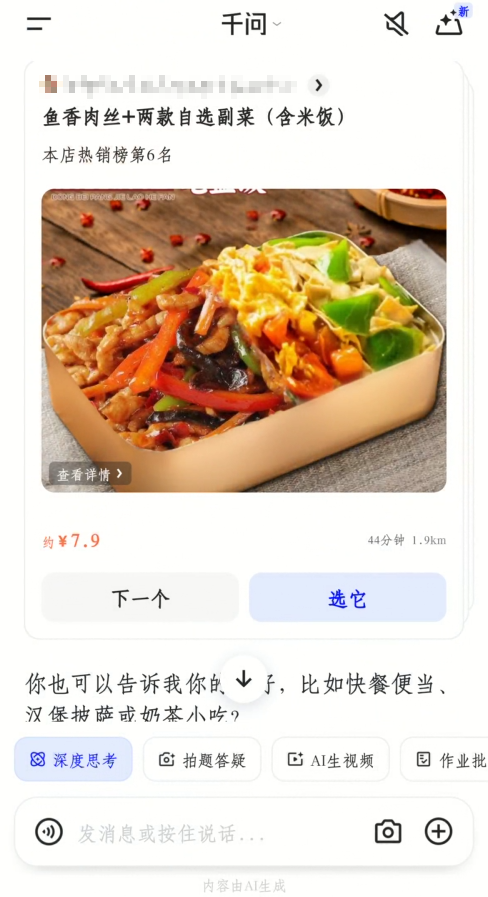
Meanwhile, QianWen deliberately sets boundaries. In educational contexts, Alibaba explicitly positions AI as a “teacher’s aide,” not a replacement. It has launched six educational tools, including AI-powered primary and secondary school exam question banks, homework grading, QianWen Mini-Classroom, and “learn by example” features. The focus is not on creating “magic” but on reducing repetitive labor to free up time for meaningful tasks.
Over nearly three decades of business development, Alibaba has built a comprehensive consumer ecosystem covering clothing (Taobao + Deals), food (Taobao + Deals), lodging (Fliggy), transportation (Fliggy + Amap), and entertainment (Youku, Maoyan, Damai). With robust supply-side support, Alibaba aims to solidify user loyalty and “wallet share” through product refinement and user experience optimization, fostering cross-ecosystem traffic and long-term competitive barriers. This strategy will underpin Alibaba’s sustained growth and stable valuation.
As AI quietly takes over tasks traditionally performed by humans, a truth emerges: AI is not merely upgrading tools but reshaping the division of labor in the digital world. QianWen is achieving this transformation in a subtle yet impactful manner.
03 The Future of AI Applications: Insights from Alibaba QianWen
Since Alibaba launched QianWen, a clear trend has emerged: AI is no longer confined to tech companies’ internal experiments but is now targeting everyday consumer scenarios.
The race to create AI applications that are both universally usable and indispensable has begun. Alibaba is not alone in accelerating this shift. ByteDance has also unveiled its strategy.
ByteDance announced its partnership as the exclusive AI collaborator for CCTV’s 2026 Spring Festival Gala, with Volcano Engine handling the AI cloud infrastructure and Doubao large model enabling interactive AI experiences for viewers.
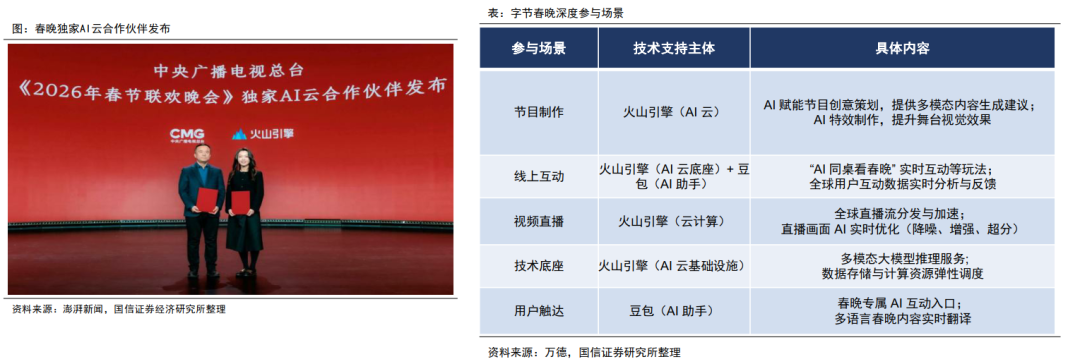
This marks ByteDance’s third involvement in the gala, but this time, the stakes are higher—it is the first time an AI assistant product is being showcased to a national audience.
At such a high-profile event, any lag, delay, or malfunction is unacceptable, making this a “nationwide stress test” and a public validation of Volcano Engine’s ability to handle ultra-high concurrency and stability demands.
For users, it means a more interactive gala experience. For ByteDance, the gala serves as more than exposure—it binds AI technology, cloud capabilities, and real-world scenarios into a closed-loop ecosystem. From program production to online interactions and global livestreaming, AI is quietly permeating every stage.
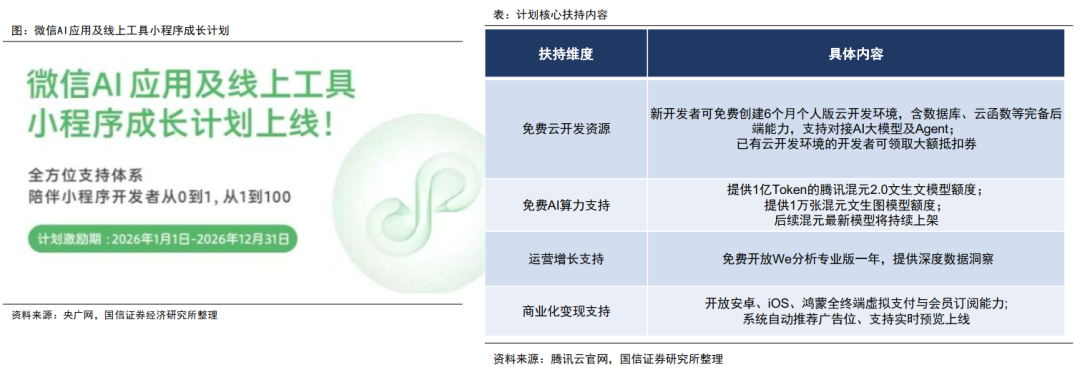
Additionally, Tencent launched the “AI Application and Online Tool Mini-Program Growth Initiative,” offering cloud development resources, AI computing power, data analytics, advertising monetization, and traffic incentives throughout 2026. The program supports all online mini-program developers, including individuals and enterprises, for applications like online tools, AI-native apps, and entertainment mini-programs. Developers can apply via the WeChat Mini-Program backend on desktop.
The initiative aims to lower barriers to AI application development by providing full-cycle resources, encouraging developers to transform ideas into scalable, profitable mini-programs. This drives the WeChat mini-program ecosystem from a tool platform to an AI service marketplace, solidifying Tencent’s competitive edge in AI applications.
When tech giants like Alibaba, ByteDance, and Tencent push AI into consumer lifestyles, the industry sends a clear signal: “AI is moving from labs to daily life.”
Epilogue
When Alibaba integrates QianWen into daily life and ByteDance showcases Doubao at the Spring Festival Gala, the competition is no longer about whose AI is superior. The real shift is that Chinese large models are collectively moving beyond capability demonstrations to vie for long-term presence in users’ lives.
This race is not won by parameters or hype but by transforming AI into a foundational capability—as ubiquitous as payments, maps, or e-commerce—seamlessly embedded into daily routines.
The AI that endures will not be the most talkative but the most context-aware, execution-oriented, and unobtrusive. It will not dominate headlines but will quietly take over decisions, choices, and repetitive tasks, reshaping the digital workforce.
As AI transitions from conversation to action, an era has irrevocably begun. The question is no longer “Will AI arrive?” or “Is AI safe?” but “Which AI will users trust?”—a question best answered by user growth and scale.
© THE END
All materials are sourced from official public information.
This article does not constitute investment advice.
Original content by Baker Street Detective. Unauthorized reproduction prohibited.
Images from public sources. Contact for removal if infringed.
-
![]()
Registered Capital Slashed to 372 Million Yuan! Yutong Optical Finalizes Industrial and Commercial Change Registration
-
![]()
Zhuque-3 Successfully Lands, and 'Time Traveler' Secures Another ¥100 Million in Funding: China's Commercial Space Industry Experiences a 'Dynamic August'
-
![]()
Autohome Faces a Shrinking Window of Opportunity
-
![]()
Even a Titan Like Musk Has Faced Setbacks in Fulfilling Promises
-
![]()
AI Office: The End of the Racing Era, Context Becomes the Key to Success
-
![]()
Domestic Vehicle Chassis Revolution ②: The Steering Wheel Remains, But Mechanical Connections in the Steering System Are Decreasing
-
![]()
Exploring MiniMax Design: Can Video Editing Be as Simple as Speaking?
-
![]()
Why Can SenseTime Achieve Profitability While CloudWalk Still Faces Challenges, Despite Both Adopting Large Models?