The Battle for Autonomous Buses: From a Technological Labyrinth to an Urban Transit Revolution
 01/19 2026
 680
680
By 2025, pilot projects for autonomous buses will have been launched in over 30 cities worldwide. Technology providers and operators are not only grappling with technical issues but also confronting real-world operational challenges in the intricate urban landscape.
When residents in Shenzhen can hail driverless buses with a single tap on their smartphones, and when Chinese technological solutions secure bids for Singapore's L4 autonomous bus routes, autonomous buses have already transcended enclosed test sites and ventured into the "deep waters" of global urban transportation. This silent technological war is reshaping the foundational logic of the century-old public transportation industry. The technological breakthroughs and scenario-based innovations underpinning this transformation are far more intricate than initially imagined.
The Triple Core Challenges of Autonomous Buses
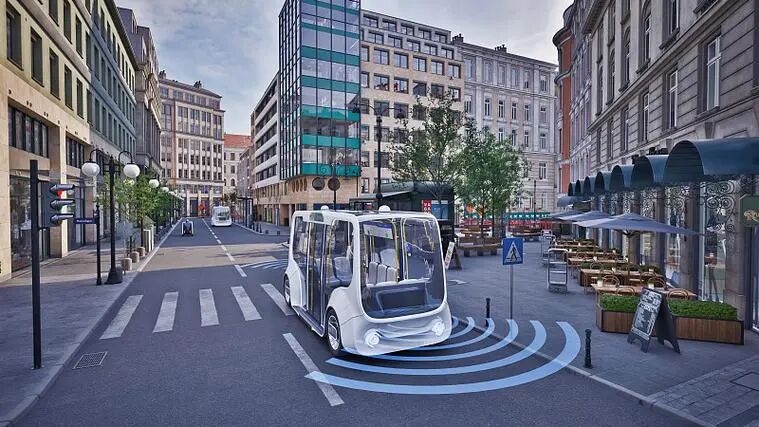
Autonomous buses are not merely "traditional buses sans steering wheels"; they are mobile intelligent terminals that integrate perception, decision-making, and control. The technical difficulties they face, especially in public transportation scenarios, present three formidable barriers.
1. Perception Precision: "Omnidirectional Awareness" in Complex Road Conditions
The perception challenges in public transportation scenarios far outweigh those encountered by private vehicles. Buses are large and have extensive blind spots, necessitating precise identification of pedestrians, non-motorized vehicles, and sudden obstacles on roads shared with cars. They must also navigate special conditions such as bus lane encroachment, crowded platforms, and adverse weather. Research indicates that 70% of urban road risks arise from unstructured interactions, such as pedestrians suddenly crossing or bicycles making illegal lane changes—termed "long-tail scenarios."
Early solutions that relied on multiple mechanical LiDARs provided 3D point cloud data but were prohibitively expensive, costing hundreds of thousands of yuan. Moreover, the mechanical rotating parts were prone to wear during high-frequency operations. Today, a "vision-dominant + solid-state LiDAR-assisted" architecture has become the mainstream. Surround-view cameras offer 360-degree environmental coverage, while solid-state radars focus on forward high-precision ranging. Paired with BEV fusion perception algorithms, these systems achieve precise parsing of pedestrian postures and vehicle turn signals, with perception distances exceeding 200 meters and positioning accuracy improved to the centimeter level.
2. Decision-Making Intelligence: "Human-like Negotiation" in Public Transportation Scenarios
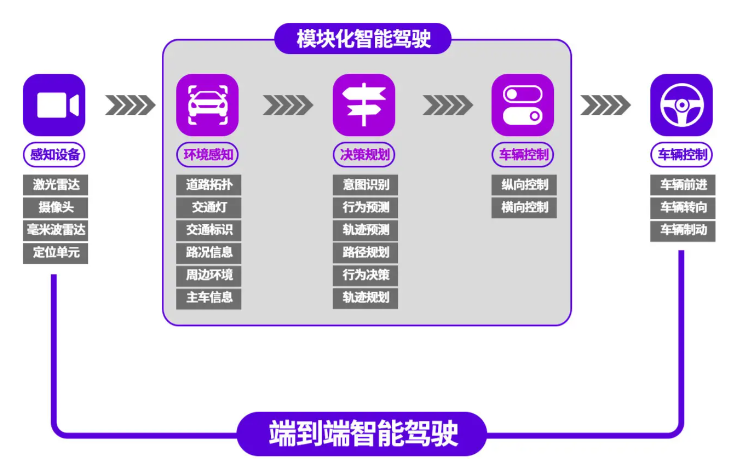
Bus operations differ fundamentally from those of private vehicles, requiring frequent platform entries and exits, precise docking, smooth starts and stops, and close interactions with passengers and other road users. Traditional modular algorithms struggle with complex scenario negotiations, but end-to-end large models are rising to the challenge.
Trained on massive datasets of public transportation scenarios, proprietary large models enable intuitive "see-and-decide" responses. For instance, at crowded platforms, the system adjusts parking positions based on passenger distribution. When encountering bicycles indicating turns, it not only recognizes gestures but also predicts trajectories and decelerates accordingly. This "cognitive ability" is central to achieving autonomy in public transportation, requiring the simultaneous fulfillment of safety, efficiency, and service quality.
3. Engineering Implementation: "Reliability Tests" for Scalable Operations
Public transportation demands "24/7, high-frequency, zero-failure" operations, imposing extreme reliability requirements on autonomous systems. Front-mounted mass production has emerged as a critical differentiator. Unlike retrofits, front-mounted solutions integrate wire-controlled chassis, sensor layouts, and power/cooling systems from the vehicle design inception. This approach reduces adaptation cycles from the industry average of 4–10 months to just 2 months and cuts lifecycle maintenance costs by over 30%.
Additionally, variations in road conditions across cities pose extra challenges. Singapore's "urban canyons" disrupt GPS signals, European old towns feature narrow roads, and China's mixed traffic flows are highly complex, demanding strong scenario adaptation from technological solutions. This necessitates forming "vehicle-road coordination" with roadside sensing devices, building comprehensive datasets covering diverse cities, weather conditions, and time periods, and continuously iterating algorithms through data flywheels.
The Profound Technological Value in Public Transportation Scenarios
Autonomous buses do not merely replace drivers; they reconstruct technology to address the core pain points of traditional public transportation. Their technological implementation holds far deeper significance than mere "driverlessness."
1. Breaking the "Impossible Trinity" of Operations
Traditional public transportation has long been trapped in a triangle of "efficiency, safety, and cost." Increasing frequency raises costs, controlling costs sacrifices service quality, and human errors introduce safety risks. Autonomous technology reconstructs the economic model through three key breakthroughs:
- Driverless operation eliminates the largest labor cost, reducing lifecycle costs by approximately 9.2% compared to traditional buses.
- Intelligent scheduling and green-wave coordination improve line turnover efficiency, with annual revenue per vehicle reaching 700,000 yuan.
- Algorithmic consistency avoids human errors, potentially reducing accident rates by over 80%.
Research shows that with a 60% occupancy rate, a 49-seat autonomous bus can achieve annual gross profits of 170,000 yuan over an 8-year lifecycle, with a 25% gross margin, ensuring commercial sustainability.
2. Reconstructing Public Transportation Service Capabilities
Technological empowerment upgrades buses from "fixed-route mobile carriers" to "flexible service terminals":
- Precision docking (error ≤5 cm) addresses boarding and alighting difficulties for the elderly and disabled, enhancing accessibility.
- Intelligent scheduling systems adjust departure intervals based on real-time passenger flow, increasing frequency during peak hours and optimizing routes during off-peak times to reduce empty runs.
- Vehicle-road coordination enables information exchange with traffic lights and roadside devices, improving travel efficiency by 20% and reducing energy consumption by 15%.
For rural or remote communities, autonomous buses can overcome labor shortages, extend service hours, and expand route coverage, addressing "last-mile" mobility challenges. This aligns with research findings that "rural residents prioritize service convenience in autonomous buses."
3. Promoting Sustainable Transportation
The environmental benefits of autonomous buses become particularly pronounced in scalable operations. By optimizing driving strategies to reduce abrupt acceleration and braking, they lower energy consumption and emissions by 10%–15%. The combination of electrification and autonomy further enhances energy efficiency, supporting carbon neutrality goals. Additionally, centralized intelligent scheduling reduces road occupation, alleviates congestion, and frees up urban public space.
European Commission studies indicate that widespread adoption of autonomous buses could reduce urban transportation carbon emissions by 30% and increase road capacity by 40%, making them a core component of sustainable transportation systems.
Global Race: Technological Breakthroughs of China's Solutions
Today, competition in the autonomous bus sector has entered a global, scalable phase. The global market reached $1.8 billion in 2024 and is projected to grow to $5.09 billion by 2029, with China leading in market growth and expected to reach 6.63 billion yuan by 2029.
China's core advantage lies in "scenario deep cultivation + technological iteration." For example, Mogo Auto has accumulated massive datasets of bus scenarios through regular operations in Shanghai, Dali, Tianjin, and other cities, covering diverse scenarios such as complex road conditions, extreme weather, and special population mobility. Its combination of front-mounted mass production and vehicle-road coordination forms a closed-loop iteration of "data-algorithm-engineering," enabling China's solutions to stand out in overseas bids like Singapore.
The ultimate goal of this technological revolution is to make public transportation a safer, more efficient, and inclusive mobility choice. As autonomous buses steadily dock at every urban platform, they carry not only the pride of technological breakthroughs but also the infinite possibilities of future urban transportation—a more inclusive, sustainable, and intelligent mobility ecosystem, quietly driven by the gears of technology.
-
![]()
Dispelling Myths: Official Clarifications and Tesla's View on the Longevity of New Energy Vehicles
-
![]()
2026 New Domain and New Quality Innovation Competition Kicks Off in Beijing: Leveraging the '922' Framework to Bridge the Gap from 'Competition to Market'
-
![]()
Laying Off Hundreds of Thousands: Can European Automakers Triumph?
-
![]()
Seres: Navigating Beyond the 'Realm'
-
![]()
iFLYTEK Anticipates RMB 200 Million Loss, Embracing 'Subtraction' and 'Addition': Abandoning Low-Margin Businesses and Betting on AI's Future
-
![]()
ByteDance’s ‘Most Loyal’ U.S. Investor Exits, Notching 15,000-Fold Returns
-
![]()
DeepSeek’s Liang Wenfeng Becomes World’s Wealthiest in AI, Net Worth Skyrockets to $36 Billion
-
![]()
How Can Embodied AI Overcome the Data Challenge of 'Being Able to Work'? Solutions from Five Leading Players