OpenAI's Revenue Exceeds $20 Billion by 2025
 01/20 2026
 617
617
01
Major Developments (New Models/Products/Open Source Initiatives)
①OpenAI Rolls Out Ad-Supported Free Tier of ChatGPT
In a piece titled "AI for Self-Empowerment," OpenAI introduces the novel concept of "capacity overhang" for the first time: current AI systems boast capabilities that far outstrip their practical societal applications. Bridging this gap will emerge as a central task in the future development of the AI industry.
To hasten the uptake of AI products, OpenAI has unveiled a free, ad-supported version of ChatGPT, aligning with its mission to "make AGI accessible to all of humanity." OpenAI clarifies that this move is not purely commercial and simultaneously unveils three guiding principles for managing "capacity overhang":
1. Facts First: Release performance comparison data between AI and humans across various tasks to facilitate a rational societal assessment of impacts;
2. Open Access: Guarantee that all individuals, businesses, and nations can access computing power and AI tools through complimentary services, standardized APIs, and collaborations with government entities;
3. Self-Empowerment: Craft highly customizable and scalable products to empower users in creating value. Data on ChatGPT usage reveals that advanced users invoke "thinking capabilities" seven times more frequently than the average user, yielding more economically beneficial outcomes.
OpenAI's stance is that AI's ultimate aim is not to supplant humans but to raise the ceiling on individual productivity. Thus, the company strives to transition more users from "using AI" to "using AI effectively," unlocking AI-driven GDP growth.
Short Comment:
This commercial pivot, centered on advertising and cloaked in a grand narrative, primarily revolves around launching an ad-supported free version of ChatGPT.
Faced with inherent user resistance to ads, OpenAI cloaks its urgent monetization needs with the rationale of "enabling broader AI access." The free version of ChatGPT will almost certainly not feature the latest GPT-5.2.
Nevertheless, this strategy remains crucial for OpenAI: offering free services cannot retain premium users but is vital for maintaining competition with Google. Introducing ads carries risks, but exploring non-subscription revenue streams is imperative. AI adoption cannot be achieved by OpenAI alone, but positioning itself as the "spokesperson" for AI accessibility is a strategic move.
②Anthropic Enhances Claude: Customizable Instruction Systems + Knowledge Bases
According to TestingCatalog, Anthropic is refining Claude's functionality by formally designating Cowork, the new AI collaboration tool, as the default primary interface, while developing two pivotal capabilities: customizable instruction systems and structured knowledge bases. This further propels Claude from a mere programming assistant to a comprehensive work platform.
The new iteration of Claude defaults to Cowork as the workspace, with traditional chatbot features manually activatable. The newly introduced Artefacts area on the interface's right side centralizes generated content such as code and documents, enhancing the user-centric experience.
The Knowledge Bases feature empowers users to create enduring, theme-specific knowledge repositories. Claude will tap into relevant knowledge bases when responding to queries and incrementally update information during conversations. It supports on-demand mounting of specific knowledge bases for current tasks to avoid context confusion, effectively enabling cross-session memory reuse for long-term project collaboration. The customizable instruction system (Customizable Commands) is tailored for programming.
Within this system, the Skills module facilitates the creation and management of custom skills, supporting text viewing or HTML previews; the Connectors module uniformly configures API connectors and permissions; the newly added Commands for Claude Code enables users to define nameable instructions, presumably for code automation, offering more precise execution control than general skills.
Short Comment:
Anthropic's robust competitiveness in AI programming is undeniable. This functionality update significantly enhances the user experience, with knowledge bases enabling context isolation and controlled memory, and customizable instruction systems providing clear execution boundaries. This is highly appealing to developers, tech enthusiasts, and long-term project collaborators. Notably, casual chat users may experience a decline in their experience, indicating a subtle user segmentation strategy.
02
Business Developments (Financing/Collaborations/Financial Reports)
①OpenAI Business Report: Revenue Exceeds $20 Billion by 2025
OpenAI's CFO, Sarah Friar, released a business report titled "A Business That Scales with the Value of Intelligence," systematically detailing OpenAI's evolution from technical research to commercial scalability.
Launched as a "research preview" in 2022, ChatGPT has, over three years, seamlessly integrated into users' learning, living, and working environments: students leverage it for problem-solving, parents for travel planning, engineers for code debugging, and writers for creativity inspiration. AI has become an integral part of people's "cognitive infrastructure."
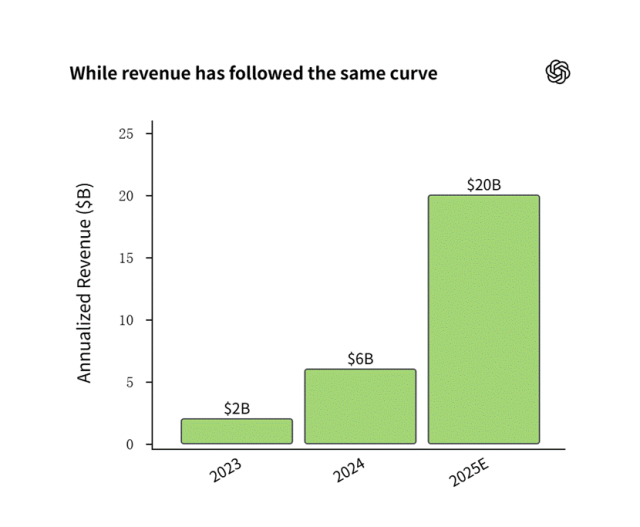
The widespread adoption of ChatGPT products has far surpassed official expectations, directly fueling unprecedented commercial growth: OpenAI's ARR soared from $2 billion in 2023 to $6 billion in 2024, surpassing $20 billion in 2025.
Thus, after temporarily slowing the arms race of heavy investments to enhance AI intelligence, OpenAI has prioritized monetization as one of its core short-term objectives.
Therefore, a monetization system encompassing individuals, enterprises, and ecosystems is essential: for individual users, providing more potent and reliable AI capabilities through subscription services like ChatGPT Plus; for enterprise and collaboration scenarios, introducing Workplace subscriptions and usage-based API pricing, directly linking costs to actual work output; at critical decision-making points as users transition from exploration, OpenAI begins incorporating clearly labeled ads and e-commerce referrals to ensure "value prioritization."
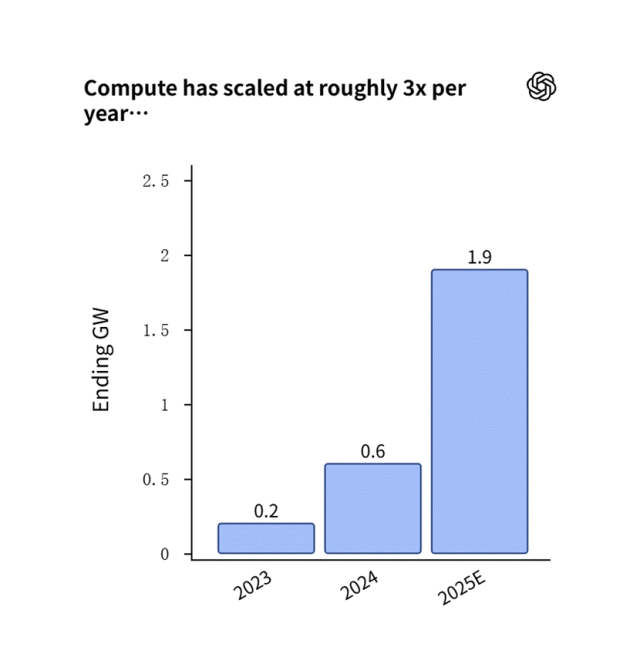
The report also highlights that computing power is the primary driver of OpenAI's performance growth. From 2023 to 2025, OpenAI's computing power consumption surged from 0.2GW to 1.9GW (a 9.5-fold increase), keeping pace with its revenue growth (a 10-fold increase).
OpenAI contends that increased computing power leads to higher user engagement and faster monetization. To mitigate single-supply-chain dependencies, OpenAI has embarked on constructing a diversified computing ecosystem, reducing inference costs to "a few cents per million tokens" while ensuring cutting-edge training, meeting high-frequency application demands in daily life.
OpenAI states that its 2026 company goals will concentrate on practical AI deployment, prioritizing integration in high-value sectors like medical diagnostics, natural science research, and enterprise process automation. Agents and continuous workflows will also become the focal point of next-stage product development, endowing AI with greater initiative.
Short Comment:
Although officials only emphasize revenue surges without mentioning substantial losses, the argument of "high synchronization between revenue and computing power" still underscores OpenAI's exorbitant computing costs. Maintaining current growth rates faces significant cash flow pressures.
Shortly after OpenAI announced incorporating ads into its products, its biggest competitor, Google, reiterated "no advertising plans for now." The Gemini ecosystem is deeply embedded within Google's proprietary products, enabling monetization through existing advertising systems without the need for ads in AI products. However, as an independent platform lacking proprietary traffic loops, OpenAI must forge its own business model.
Several months ago, data revealed a significant narrowing of the monthly active user gap between Gemini and ChatGPT, placing OpenAI at a clear competitive disadvantage. Introducing ads brings trust crisis risks that require vigilance.
Another notable point is that OpenAI has not ceased cutting-edge research to focus solely on commercialization. Officials explicitly state they are advancing agent and persistent workflow development, long-term venturing into high-value sectors like science, healthcare, and financial modeling, achieving a paradigm shift from "responsive AI" to "autonomous action AI."
However, simply releasing more powerful models no longer brings about qualitative changes in user behavior. At this juncture, users need AI assistants capable of accomplishing tasks, not encyclopedias capable of answering difficult questions. OpenAI's product innovation focus has shifted from "capability demonstration" to "value delivery." Breakthroughs in AI's ability to proactively execute tasks hold more value than introducing ads. After all, OpenAI has demonstrated that no matter how powerful a model is, it cannot change the world without large-scale, sustainable usage.
②Minimax Establishes Hardware Company in Guangzhou with RMB 70 Million Registered Capital
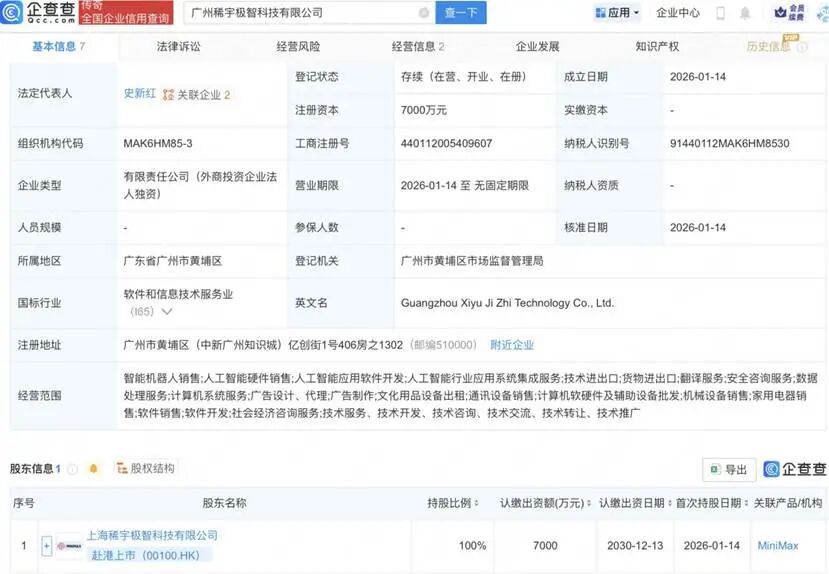
On January 14, Minimax registered "Guangzhou Xiyu Jizhi Technology Co., Ltd." in Huangpu District, Guangzhou, through its affiliated company "Shanghai Xiyu Jizhi Technology Co., Ltd.," with a registered capital of RMB 70 million. Its business scope encompasses intelligent robot sales, AI hardware and application software development, and industry system integration services, indicating its acceleration from large model R&D to integrated software-hardware and industry deployment.
Short Comment:
New-generation robots no longer rely on pre-programming but drive decision-making through large models. Minimax's registration of "intelligent robot sales" does not necessarily imply self-developed hardware but likely involves collaborating with robot manufacturers to provide large models as "brains," beginning to lay out embodied AI ecosystems and seize physical entry points for AI hardware.
-
![]()
Registered Capital Slashed to 372 Million Yuan! Yutong Optical Finalizes Industrial and Commercial Change Registration
-
![]()
Zhuque-3 Successfully Lands, and 'Time Traveler' Secures Another ¥100 Million in Funding: China's Commercial Space Industry Experiences a 'Dynamic August'
-
![]()
Autohome Faces a Shrinking Window of Opportunity
-
![]()
Even a Titan Like Musk Has Faced Setbacks in Fulfilling Promises
-
![]()
AI Office: The End of the Racing Era, Context Becomes the Key to Success
-
![]()
Domestic Vehicle Chassis Revolution ②: The Steering Wheel Remains, But Mechanical Connections in the Steering System Are Decreasing
-
![]()
Exploring MiniMax Design: Can Video Editing Be as Simple as Speaking?
-
![]()
Why Can SenseTime Achieve Profitability While CloudWalk Still Faces Challenges, Despite Both Adopting Large Models?