Introducing Gemini and Integrating MCP: Why Does Apple Still Invest Heavily in 'Catching Up' When iPhone Sales Soar Without AI?
 01/20 2026
 560
560
Models Aren't the Be-All and End-All; Experience Takes Center Stage
On one hand, the AI craze continues unabated. On the other, the consumer electronics market seems to be throwing a bucket of cold water on this 'AI frenzy,' suggesting that the acronym 'AI' might not hold as much sway as we once thought.
Kevin Twilley, Dell's product leader, recently stated at CES 2025 that their observations over the past year have revealed that AI features in PCs don't sway consumers' purchasing decisions. In fact, product promotions that heavily emphasize AI often end up 'confusing users more.'
It's not just Dell. Luca Rossi, president of Lenovo's Intelligent Devices Business Group, also diplomatically pointed out that most consumers still base their decisions on factors like the device's slim profile, battery life, and expandability. Only a few professional groups explicitly prioritize AI features.
Indeed, this rings true, at least for now. AI is far from being a decisive factor in the purchasing decisions of smartphone and PC consumers, both in our immediate vicinity and the broader market.
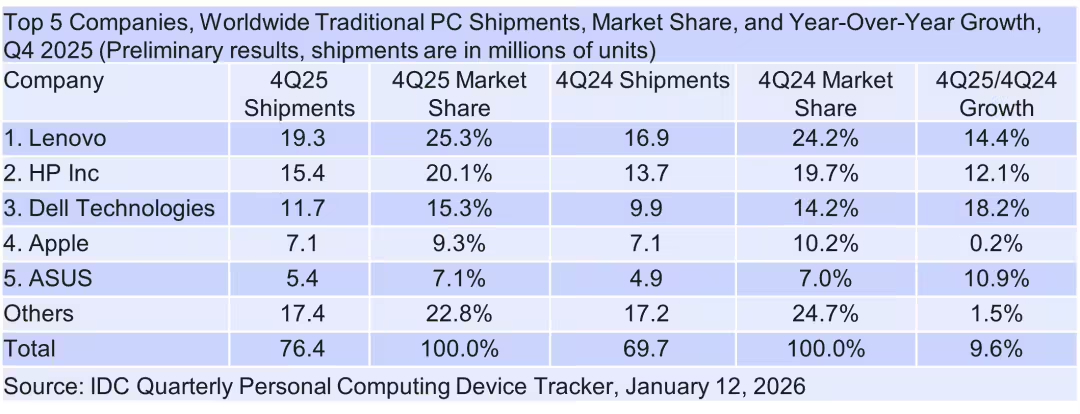
IDC recently released two consecutive market reports. One is the Q4 2025 Global PC Market Report, which shows that amidst the termination of Windows 10 support and memory shortages, Dell and Lenovo led the TOP 5 vendors with year-over-year shipment growth of 18.2% and 14.4%, respectively. There's no apparent correlation with AI.
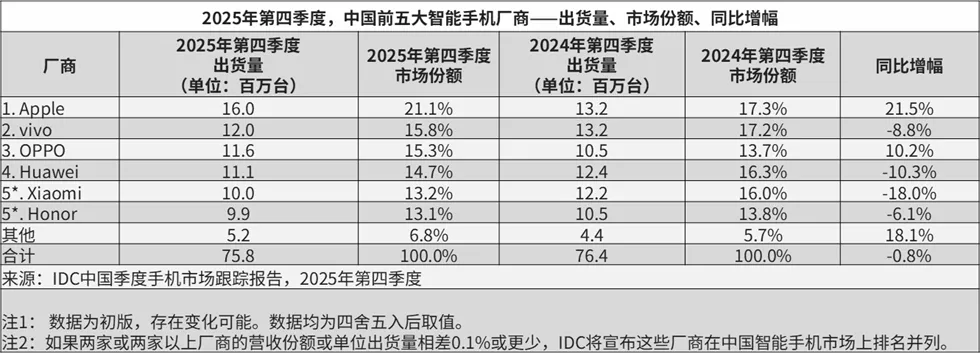
The other report is the Q4 2025 China Smartphone Market Report, which reveals that amidst the decline of domestic smartphone brands, the iPhone not only maintained its top position in the fourth quarter but also saw a significant year-over-year increase of 21.5% to 16 million units. This surge is primarily attributed to the continued appeal of the iPhone 17 series to domestic consumers.
As everyone knows, the Chinese version of the iPhone doesn't have any Apple Intelligence features enabled. No matter how you look at it, the iPhone 17 is almost the global mainstream flagship with the least emphasis on AI in this generation.
Yet, it's selling like hotcakes.
Over the past two years, many brands have perceived AI as a potent catalyst for market sales and visibility. However, the plethora of AI-centric marketing efforts has left consumers bewildered. This doesn't mean the consumer market has started to reject AI; rather, it has become desensitized to the overwhelming presence of 'AI.' What users truly care about is still the product experience that directly impacts their daily usage.
If the iPhone can still sell like hotcakes without relying on AI, and consumers are becoming immune to various AI promotional tactics, does Apple still need to continue investing heavily in catching up with global top-tier large models?
Frankly speaking, the answer to this question is not easily encapsulated in a single sentence.
Apple's AI Strategy Evolves with the Introduction of Gemini and MCP Integration
'We believe in owning and controlling the primary technologies behind our products and only participating in markets where we can make a significant impact. We believe in saying no to thousands of projects so that we can truly focus on the few that are truly important and meaningful to us.'
In 2009, Tim Cook, then Apple's COO, outlined Apple's decision-making philosophy to some extent. The question remains: what constitutes primary technology? Screens and chips are undoubtedly key factors influencing the smartphone experience, but Apple doesn't manufacture its own screens. However, it does develop its own chips.
So, is the foundational model for AI functions more akin to a screen or a chip?
A week ago, Apple and Google made a bombshell announcement, jointly declaring that the next generation of 'Apple Foundation Models' will be based on Google's Gemini and cloud technology. This will pave the way for future AI features and a more personalized Siri.
In fact, Google CEO Sundar Pichai had already hinted in April 2025 that he hoped Gemini could be integrated into the iPhone's Apple Intelligence features within the year, indirectly revealing Apple's considerations at the time. By November, Bloomberg reported that the two sides were finalizing a multi-year cooperation agreement, with Apple obtaining the right to use Gemini for approximately $1 billion annually. Leitech provided further analysis.
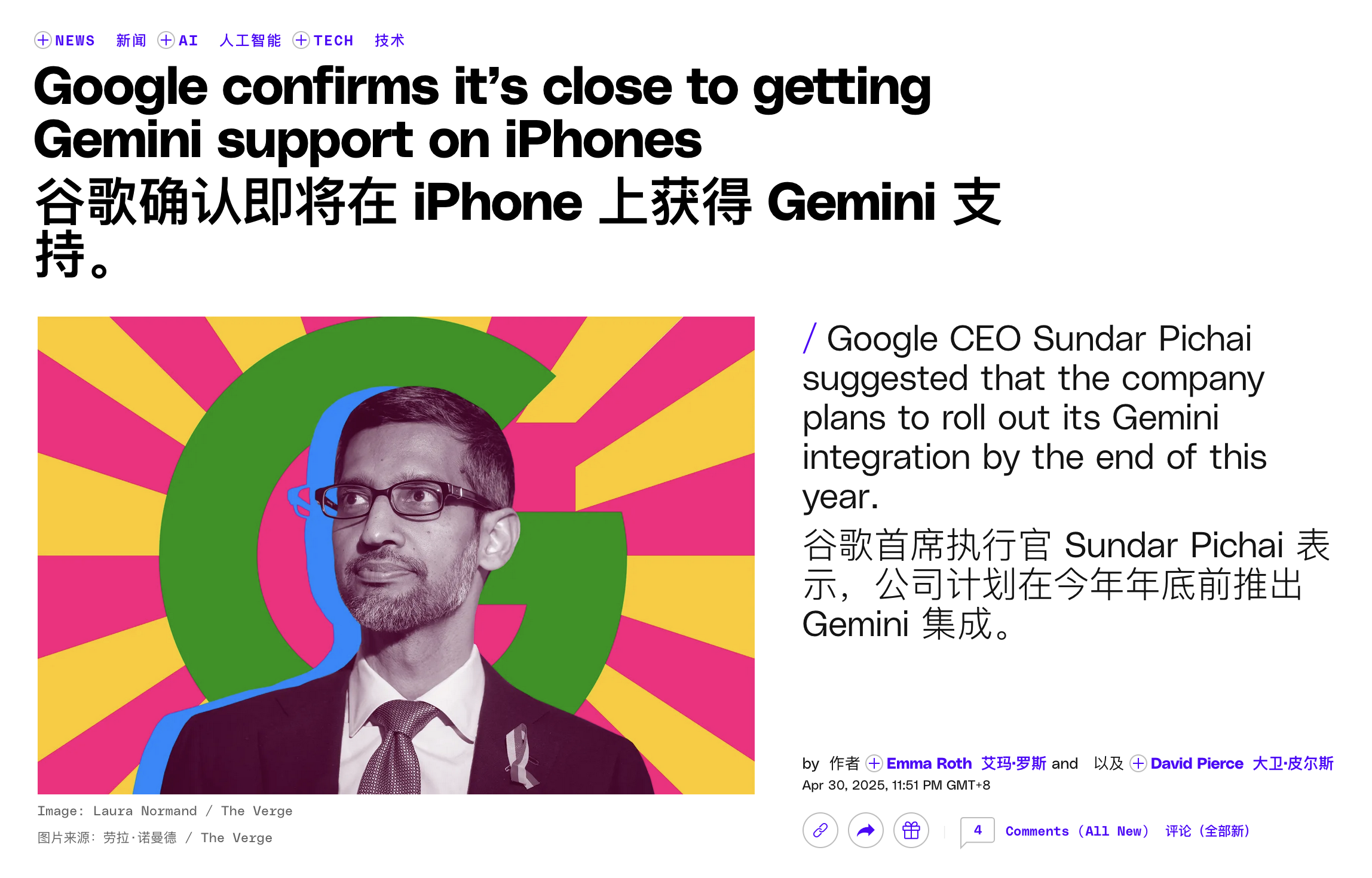
Image Source: The Verge
This isn't merely about 'adding a Gemini portal' or 'replacing ChatGPT with Gemini.' It's more like Apple acknowledging a reality: relying solely on self-developed models to reverse its disadvantage in AI experience in the short term is unrealistic. Thus, we see Apple opting for Gemini, which it deems the most capable.
However, this doesn't mean Apple is abandoning self-development. Over the past two years, Apple has been making strides in its own foundational model system. In official technical reports, Apple clearly introduced two types of models behind Apple Intelligence: an on-device model with approximately 3 billion parameters and a server model running on a private cloud computing platform.
At the same time, Apple has consistently emphasized the positioning of private cloud computing. This isn't an ordinary public cloud but an extension of device-level security models to the cloud. It allows larger models to run on the cloud while maintaining privacy boundaries as tightly as possible within an 'Apple-verifiable operating environment.' This includes the introduction of Gemini. The joint statement also underscored that Apple Intelligence will continue to run on Apple devices and private cloud computing.
In other words, although Apple has introduced a third-party Gemini at the model layer, it still maintains absolute control at the operational and capability layers (for developers).
However, the noteworthy changes don't stop at the foundational model. More critically, Apple is shifting the AI battleground from 'whose model is stronger' to 'who can better connect tools, data, and third-party applications.'
This brings us to App Intents and MCP. In Apple's designed architecture, the App Intents framework has always been the core pipeline for Apple Intelligence to interact with the outside world. It deeply integrates application actions and content with cross-platform system experiences, including Siri, Spotlight, widgets, etc. Third-party applications can execute actions and discover functionalities within and outside the app through App Intents.
In September of the previous year, code from the iOS 26.1 beta version indicated that Apple was providing system-level support for MCP and integrating it with the App Intents framework. This allows developers to continue writing familiar App Intents while the system maps these capabilities to the MCP world.
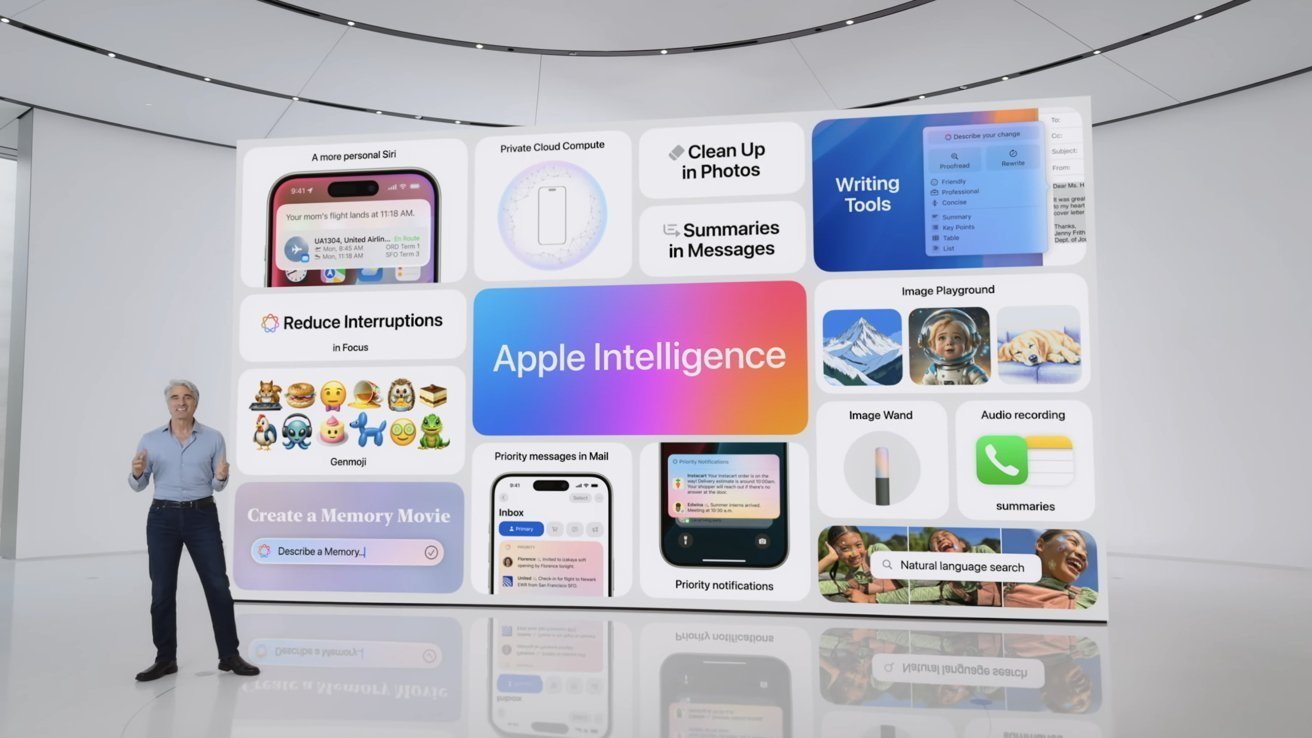
If this step truly materializes at this year's WWDC26, its significance will largely overshadow Apple's disadvantage in 'underlying models.' Because integrating MCP into App Intents primarily addresses whether 'models can reliably invoke tools.' When a system exposes a large number of app capabilities through a unified protocol and makes permissions, receipts, and failure handling system-level capabilities, the model becomes more like a replaceable engine.
Engines, of course, still have 'superior and inferior' distinctions. But regardless of whether it's Gemini, future self-developed models, or even other models, as long as they adhere to the same set of tool invocation and permission boundaries, the user experience will remain intact. Looking at these two lines together, it's not hard to draw a conclusion:
Apple will, of course, continue to train models; it must. It needs on-device models to solidify foundational capabilities into its system base. But it may not need to bet all its chips on 'catching up with global top-tier large models,' as models may not be the core pivot point in terms of product experience.
Where Is Apple's AI Headed?
At this juncture, it's challenging to simply summarize Apple's AI strategy as 'whether to develop large models.'
From introducing Gemini as the foundational model, adhering to the private cloud computing operation mode, to integrating MCP into App Intents, Apple has clearly outlined a new direction. Instead of trying to compete head-on with all opponents using the strongest model, it attempts to build a new system-level paradigm that makes AI a fundamental capability within iOS.
The question is whether this path can ultimately succeed, and there's no definitive answer yet. Because from a product experience perspective, Apple's new model of 'Gemini + private cloud computing + MCP' is essentially betting on a very specific and realistic thing:
Can Siri and AI features better meet user needs?
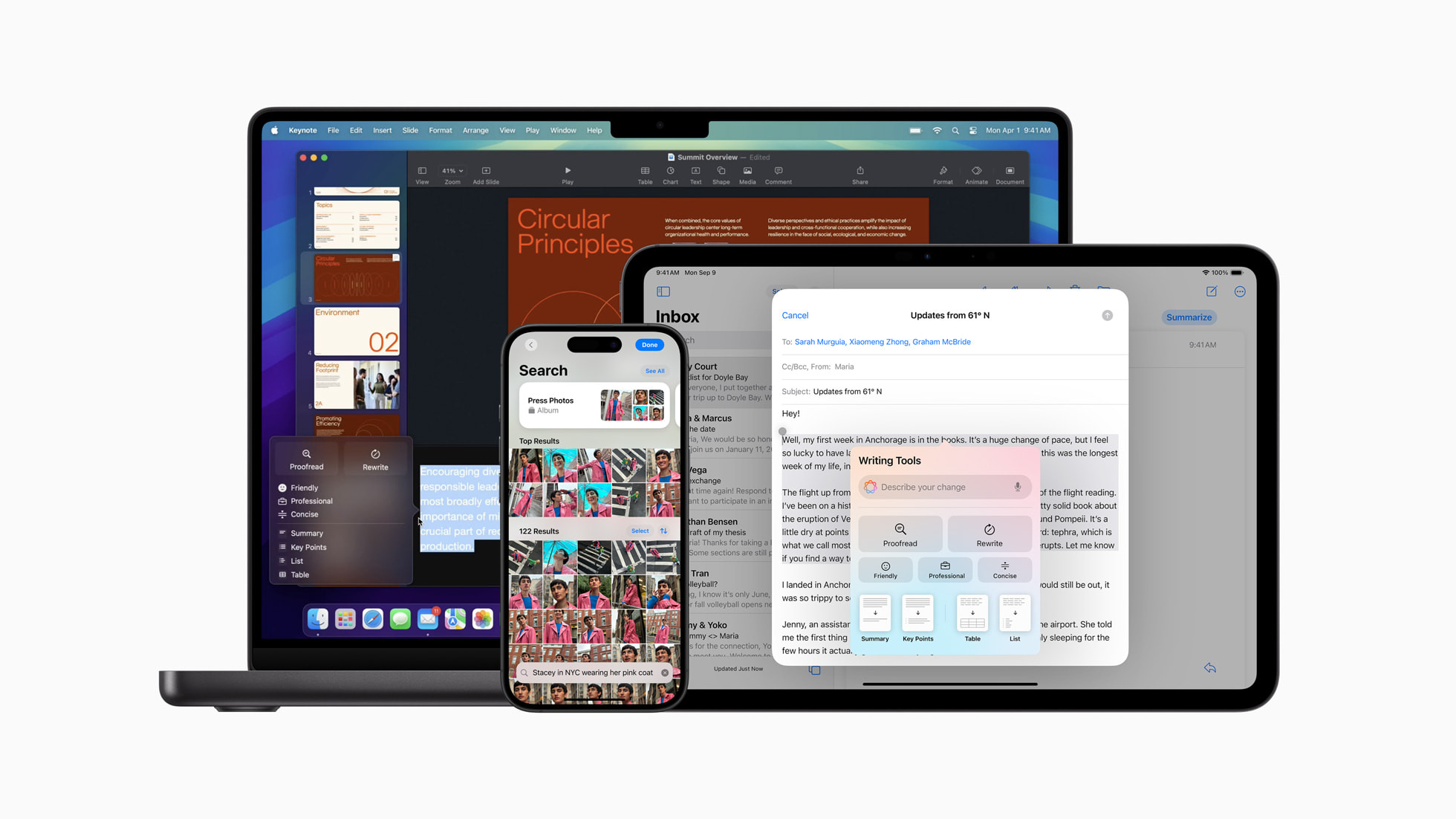
If AI only adds a layer of smarter natural language interaction while the underlying permissions, invocation boundaries, and system capability exposure remain unchanged, then regardless of whether it's Gemini or Apple's self-developed model behind, what users will ultimately perceive is just a slightly smarter Siri.
This is why, even after introducing Gemini, Apple still clings so tightly to private cloud computing and system boundaries. What it truly wants to control has never been the scale of model parameters but the extent to which AI can penetrate the core capability layer of iOS, rather than continuing to be isolated in individual AI functionalities.
So, can Apple sell well without relying on AI? Does it still need to train models?
The answer is yes, but more importantly, models aren't everything. Introducing Gemini is both a pragmatic choice and, to some extent, a necessary move. The more fundamental change is that Apple has chosen to refocus on user experience and, in turn, attempts to first make up for its shortcomings in foundational models rather than stubbornly persisting on its own. In short, Apple now cares more about the certainty of time and experience.
If, looking back a few years from now, users' evaluations of Apple Intelligence are more based on whether the experience has improved rather than who provided the model, then today's step may ultimately prove to be the right one.
This, perhaps, is the bet Apple truly wants to make.
Apple, AI, Gemini
Source: Leitech
All images in this article are from the 123RF Licensed Image Library.
-
![]()
Registered Capital Slashed to 372 Million Yuan! Yutong Optical Finalizes Industrial and Commercial Change Registration
-
![]()
Zhuque-3 Successfully Lands, and 'Time Traveler' Secures Another ¥100 Million in Funding: China's Commercial Space Industry Experiences a 'Dynamic August'
-
![]()
Autohome Faces a Shrinking Window of Opportunity
-
![]()
Even a Titan Like Musk Has Faced Setbacks in Fulfilling Promises
-
![]()
AI Office: The End of the Racing Era, Context Becomes the Key to Success
-
![]()
Domestic Vehicle Chassis Revolution ②: The Steering Wheel Remains, But Mechanical Connections in the Steering System Are Decreasing
-
![]()
Exploring MiniMax Design: Can Video Editing Be as Simple as Speaking?
-
![]()
Why Can SenseTime Achieve Profitability While CloudWalk Still Faces Challenges, Despite Both Adopting Large Models?