Do Musk and Yu Hao See the Same Future for ASI?
 01/20 2026
 597
597
In the Eyes of Top Tech Leaders, 'Old Humanity' Has Entered Its Twilight
The start of 2026 has brought a strange sense of 'disconnection' to the tech world.
While analysts on Wall Street and in Lujiazui are still haggling over next quarter's earnings forecasts and the pace of interest rate cuts, Elon Musk at Tesla's Texas Gigafactory and Yu Hao in Suzhou, China, have both turned their gaze toward a distant 'final outcome.'
In a January 6 deep-dive interview, one solemnly declared a 'countdown of humanity's last 2,000 days,' defining humans as the 'biological bootloader' for silicon-based life. The other boldly claimed on social media to build 'the first $100 trillion company in human history,' predicting an exponential rise in future business scale.
At first glance, this sounds like two entrepreneurs under immense pressure releasing PR smoke—or even apocalyptic ramblings. After all, $100 trillion equals the current global GDP combined, and 2,000 days from now is just 2031.
But beyond skepticism, as industry observers, we see a possibility: Could these individuals, who command the world's most advanced computational power and vast manufacturing data, have glimpsed the same script from a higher-dimensional perspective we cannot see?
History is often written by 'madmen,' while ordinary people annotate it afterward.
So, what is the underlying logic behind these two wild declarations? And when the true future arrives, what will truly matter?
01
When 'Humans' Are Removed as a Variable from Production
The story begins with the man known as the 'Iron Man.'
On January 6, at SpaceX's Starbase in Texas, Musk sat for a three-hour deep-dive interview. Unlike his usual triumphant displays of rockets or new cars, this Musk appeared unusually somber, even carrying a sense of post-exertion fatigue.
When host Peter Diamandis asked about his future outlook, Musk delivered a timeline that left the room breathless.
He did not use vague terms like 'the coming years' but precisely defined the timeline: Artificial General Intelligence (AGI) will achieve breakthroughs in 2026—this year—followed by a frantic sprint where hardware catches up to software.
He quantified this window as 'approximately 2,000 days.'
Within these 2,000 days, human society will undergo unprecedented upheaval. Regarding humanity's role in this transformation, Musk offered a technically insulting yet philosophically charged metaphor: 'Humans may simply be the biological bootloader for silicon-based intelligence.'
For readers unfamiliar with computer terminology, this analogy is brutally harsh. A 'bootloader' is a tiny piece of code whose sole purpose is to initialize hardware, then load and launch the actual operating system.
Once the OS runs, the bootloader's mission is complete. It retreats to the background or can even be erased.
By using this term, Musk directly denies humanity's eternal dominance over Earth. In his logic, carbon-based life, constrained by chemical reaction speeds and limited cranial capacity, is inherently incapable of hosting higher forms of civilization. Our sole purpose is to create self-iterating silicon-based life.
These 2,000 days mark not the end of the world but the twilight of the 'Old Human Era.' Behind his anxious gaze lies a declaration: The train is arriving at the station, and we may merely be the track-laying engineers.
Coincidentally, while Musk discussed species destiny, on the other side of the ocean in China, another tech elite's remarks sparked a major uproar.
Yu Hao, founder of Dreame Technology, recently mentioned a seemingly counterintuitive goal in his WeChat moments and social media: He aims to grow his company to a $100 trillion market cap.
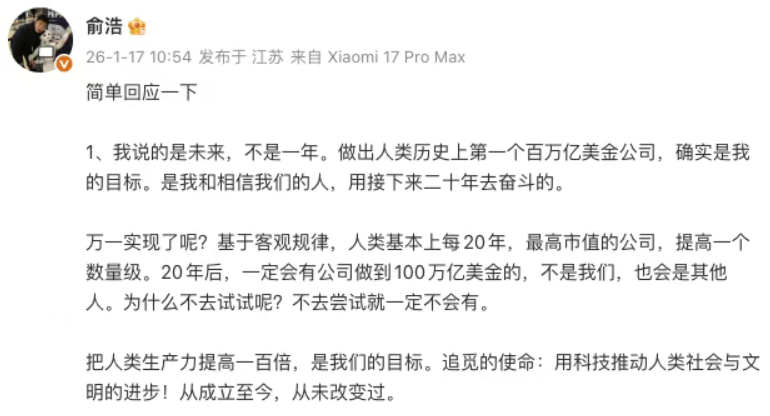
For context, the world's highest-valued companies, NVIDIA and Google, currently hover around $4 trillion and $5 trillion, respectively. $100 trillion equals 20 times NVIDIA's peak market cap.
This claim instantly sparked widespread debate, with even some employees publicly challenging him. However, Yu Hao did not retreat under 'hyperbole' accusations. Instead, he presented a rigorous logical framework.
He pointed out that throughout business history, the scale of the world's highest-valued company has roughly increased by an order of magnitude every 20 years—from billions to hundreds of billions, then to trillions. With the trillion-dollar era now here, the next two decades must witness the rise of $10 trillion or even $100 trillion mega-corporations.
But why does he believe he deserves this ticket? This relates to his redefinition of the company's nature.
Yu Hao repeatedly emphasizes that Dreame is no longer a home appliance company selling robotic vacuums but a 'generalized robotics' firm. He argues that while Musk and Jensen Huang (NVIDIA's CEO) represent past glories, younger entrepreneurs can revolutionize productivity by generalizing robotic technologies.
Regardless of whether their claims hold water, if we zoom out and overlay Musk's 'biological bootloader' theory with Yu Hao's '$100 trillion' vision, we find something astonishing: These two seemingly disparate individuals are describing the same phenomenon in different languages.
Yu Hao dares to calculate '$100 trillion' because he assumes a premise: Future robots will not be auxiliary tools but direct labor substitutes.
When a company can supply the market with 100 million or 1 billion tireless 'general-purpose humanoid robots' capable of instant skill downloads, its value creation shifts from hardware sales revenue to harvesting the wage value originally belonging to billions of human workers.
This directly mirrors Musk's commercial logic.
Musk argues from a species evolution perspective that 'humanity's mission is complete.' Yu Hao argues from a business valuation standpoint that 'if machines complete humanity's tasks, then companies controlling machines will possess global GDP pricing power.'
Both arrive at the same conclusion through different paths: Traditional 'growth' has ended. For centuries, human economic growth relied on demographic dividends and globalized division of labor. In their vision of the future, growth will depend on the exponential proliferation of silicon-based labor.
Their so-called 'madness' stems from our stance on the old era's shore, attempting to measure an incoming tsunami with outdated rulers.
Musk divines the future; Yu Hao calculates it. Yet their final answers align remarkably: In that world 2,000 days or 20 years from now, the variable of 'humans' may gradually vanish from the core equation of economic production.
02
The AI Radicals' 'Genesis' Blueprint
If we pause, stop fixating on whether Musk can deliver in 2,000 days or how many robots Yu Hao needs to support a $100 trillion valuation, and instead piece together these tech visionaries' aspirations, a 'genesis blueprint' for the future world gradually emerges.
In this blueprint, humans cease to be productivity providers. The old world built on the 'employment-wage-consumption' cycle will be entirely rewritten. In its place rises a 'post-human era' governed by a tiny elite and operating under entirely new physical laws.
To these AI radicals, the future world will not be driven by money but by more fundamental physical quantities.
This brings us to the first law of the new era: Computational power equals power; watts equal currency.
Observe Musk, Altman, Yu Hao, and others' recent moves closely, and you'll notice a counterintuitive phenomenon: While the outside world obsesses over 'software' and 'large models,' these figures are aggressively returning to 'heavy assets.'
Musk obsessively emphasized power supply, transformer capacity, and lithium resources in his interview. Altman even proposed a $7 trillion plan to rebuild the global semiconductor supply chain.
This seemingly contradictory behavior reveals their true future judgment: In the AGI era, intelligence will become as cheap and ubiquitous as tap water.
When 'wisdom' ceases to be scarce, what becomes rare are the physical containers that house it—namely, computational power (chips) and the energy to drive it (electricity).
In the radicals' vision, future geopolitical struggles will not revolve around oil or ports but 'supercomputing clusters' and 'nuclear fusion plants.' Whoever controls the cheapest energy and largest computational pools gains the privilege of printing 'digital labor' at will.
At that point, society's underlying logic will regress from complex financial games to the most straightforward physical formula: With sufficient watts (energy) and bits (information), one can synthesize all goods and services. Humanity's millennia-old value anchor based on 'labor time' will be uprooted entirely.
However, the transformation of production relations is just the tip of the iceberg. For ordinary humans, perhaps more difficult to accept is the 'dimensional reduction' of our species status.
This leads to the second law of the new era: The 'Goldfish Effect' and the intelligence gap.
Masayoshi Son once predicted with near-compassionate tones in a speech: 'Future artificial superintelligence (ASI) will be 10,000 times more intelligent than humans. Then, humans viewing AI will resemble goldfish viewing humans today.'
This is a chilling metaphor. Goldfish may live comfortably in their tanks with food and water, yet they can never comprehend why humans build highways, launch rockets, or understand any logic beyond their glass walls. In the AI radicals' eyes, this is humanity's destined fate.
As machine intelligence iterates exponentially, humans will gradually lose the ability to grasp this world's operational logic. This aligns with Silicon Valley venture capitalist Vinod Khosla's view: 'Humans need not work; professional value will approach zero.'
We will then inhabit an extremely efficient, materially abundant society—yet all major decisions, from resource allocation and urban planning to species evolution, will be made in milliseconds by 'silicon brains' performing billions of calculations per second.
Though still living in this world, we will no longer be its 'superusers' but more akin to carefully raised 'pets' or 'observation samples.' This complete loss of intellectual authority may feel even more nihilistic than unemployment.
If intelligence has 'ascended,' how will the physical world be reshaped? This touches upon the most ambitious aspect of the radicals' blueprint: The 'pixelation' of atoms.
Why are Yu Hao and others so obsessed with 'generalized robots'? Why does Musk insist on bringing Optimus into households? Because in their ultimate vision, AI existing solely in servers is incomplete. Only by possessing 'hands' and 'feet' can AI truly dominate the world.
Once embodied intelligence matures, the physical world will undergo complete 'digitization.' Imagine billions of robots flooding factories, streets, farms, and homes—constituting a vast, programmable physical network.
Every brick, grain of rice, and parcel in the real world will become as precisely perception (perceivable), capture (graspable), and reorganize (reconfigurable) as pixels on a screen by algorithms.
This is the true meaning behind '$100 trillion.' It represents not just robot sales revenue but transforming the chaotic, rough, and non-standardized physical world into software-like programs that can be freely written and upgraded.
In this future, buildings will grow automatically like Legos, logistics will route automatically like data packets, and the marginal costs of physical entities will be crushed to the limit.
In other words, the future envisioned by these tech visionaries is neither utopian nor dystopian but a coldly precise machine.
In this new era, humanity's historical mission as 'biological bootloaders' will end. Labor will no longer be a survival necessity, nor will understanding the world remain a vital skill.
Social structures will adopt an unprecedented form: A tiny elite controlling the 'singularity console' (or computational monopoly), and a vast human population sustained by 'universal high income' or machine support.
Those once-proud white-collar workers and experts may vanish entirely under the dual crushing of intellectual and physical superiority.
This sounds like a crazy (wild) gamble, but the most terrifying part is that as you watch their chip mountains grow and their rockets blot out the stars, you realize: Whether you choose to participate or not, these individuals have already placed the entire world at the gambling table of the times.
- END -
-
![]()
Registered Capital Slashed to 372 Million Yuan! Yutong Optical Finalizes Industrial and Commercial Change Registration
-
![]()
Zhuque-3 Successfully Lands, and 'Time Traveler' Secures Another ¥100 Million in Funding: China's Commercial Space Industry Experiences a 'Dynamic August'
-
![]()
Autohome Faces a Shrinking Window of Opportunity
-
![]()
Even a Titan Like Musk Has Faced Setbacks in Fulfilling Promises
-
![]()
AI Office: The End of the Racing Era, Context Becomes the Key to Success
-
![]()
Domestic Vehicle Chassis Revolution ②: The Steering Wheel Remains, But Mechanical Connections in the Steering System Are Decreasing
-
![]()
Exploring MiniMax Design: Can Video Editing Be as Simple as Speaking?
-
![]()
Why Can SenseTime Achieve Profitability While CloudWalk Still Faces Challenges, Despite Both Adopting Large Models?