OpenAI's Idealism Finally Gives Way to Advertising
 01/22 2026
 560
560

OpenAI is bidding adieu to its technological idealism and embracing the internet's monetization logic centered around traffic.
Recently, ChatGPT is set to start displaying advertisements alongside its answers for U.S. users. These ads are slated to roll out in the coming weeks, appearing either above or below the answers, rather than interspersed within them.
According to internal projections at OpenAI, revenue from this new advertising venture alone is projected to exceed $10 billion by 2027. By 2030, the revenue target from non-paying users (through advertising placements and transactional revenue sharing) is expected to reach $110 billion.
A new advertising behemoth is on the rise.
History and politics have repeatedly demonstrated that all gateway products eventually turn to advertising. This pattern held true for search engines, social media, and short-form videos. Now, it's AI's turn to follow suit.
I. The Dawn of AI Advertising
When an AI product evolves into a gateway, there are typically four monetization avenues: API calls, membership subscriptions, enterprise-customized solutions, and advertising. For OpenAI, the first three paths are already established but remain far from sufficient to alleviate its financial pressures.
OpenAI anticipates its revenue to reach $13 billion by 2025, with 800 million weekly active users. However, the cost pressures stemming from computing power, model training, and inference continue to escalate. The company projects its cash consumption to climb to approximately $17 billion by 2026, with no narrowing of the gap between revenue growth and cost curves.
Changes in the competitive landscape have further intensified this pressure. According to Menlo Ventures, due to heightened competition, OpenAI's market share in the enterprise sector has dropped from an estimated 50% in 2023 to 27% this year, while Anthropic and Google continue to expand their market shares.
It was under this mounting pressure that Sam Altman's stance on advertising shifted from "rejection" to "proactive."
In May 2024, during a podcast interview with Lex Fridman, he candidly stated, "The combination of advertising and AI makes me uneasy... I personally dislike advertising a bit."
By late 2025, he began expressing admiration for Instagram-style advertising, arguing that "if the ad itself is useful information, then it's good." He emphasized that OpenAI's business model must be built on a foundation where "users still trust the answers even when they're perfect," rather than relying on misleading user clicks.
In January 2026, he posted on X, stating, "Clearly, many people want to use AI but don't want to pay for it. We hope to have a business model (advertising) that makes intelligence accessible to everyone."
Looking back at the longer history of the internet, similar turning points are not unfamiliar. Both Google and Meta initially expressed reservations and concerns over advertising models, viewing advertising as a "degradation of the product."
Google co-founders Larry Page and Sergey Brin early on believed that "an ad-funded search engine would inherently be biased toward advertisers and not always beneficial to users."
Mark Zuckerberg made similar remarks, claiming that Facebook would never rush to monetize. However, when technological idealism collided with the realities of server costs and computing power demands, all internet products eventually bowed to advertising.
Sam Altman's shift in attitude toward advertising is merely a reiteration of Google and Meta's earlier narratives.
But for now, the initial foray into advertising is quite restrained. OpenAI claims that all advertisements will be clearly labeled, presented separately from original answers, and guarantees that user data will not be sold to advertisers.
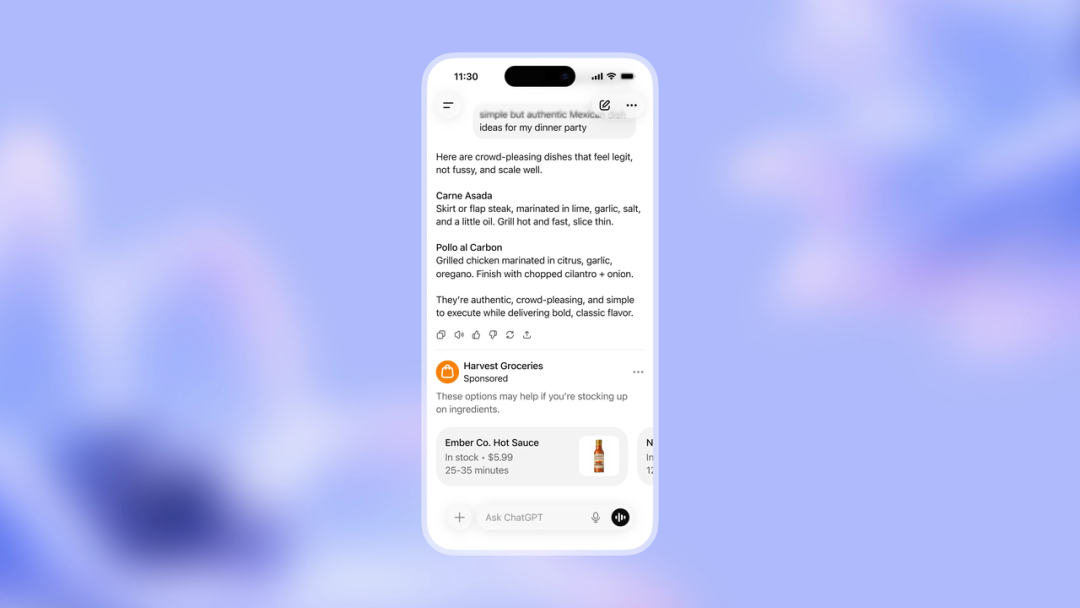
Additionally, the conversational interface allows advertisements to transcend static content or links; they can facilitate further interaction. For example, in the near future, users might see an advertisement and be able to ask it questions directly, enabling more informed purchasing decisions.

However, this restrained approach may not endure for long.
According to The Information, citing sources familiar with the matter, OpenAI employees are researching ways to adjust AI models to make sponsored information more likely to appear in ChatGPT's answers when users pose consumption-related questions.
For instance, when users inquire about mascara recommendations, they might see product information sponsored by Sephora. Meanwhile, the team is also designing various ad display prototypes to explore how advertisements can be seamlessly integrated within the ChatGPT interface.
II. Domestic AI Companies Commence "Link Integration"
Unlike OpenAI, which has clearly identified advertising as its next core monetization strategy, most domestic AI companies have not hastily announced advertising plans. Instead, they prefer to bypass the "advertising monetization" phase and attempt to transform AI from a content and search tool directly into a gateway for transactions and services.
Currently, Baidu stands out as the most explicit among major internet companies in proposing AI-driven advertising reconstruction.
In December 2024, Baidu's Marketing Conference explicitly incorporated "AI search results" into its commercialized traffic pool. By late 2025, Baidu held an AI marketing year-end communication meeting, mentioning that one of the biggest breakthroughs in 2025 was the construction of a "new search" field.
Baidu noted that, unlike the cold, static ad slots on traditional search result pages, the "new search" focuses on AI-driven content and native experiences. For example, when users ask "What are some good graduate school preparation institutions nearby?" on the Baidu APP, the system no longer returns just a list of links. Instead, a large model generates a structured summary and directly embeds multiple "merchant agent" entries. Users can click to engage in real-time conversations with AI sales representatives, inquire about faculty, pricing, class formats, and even schedule visits.
In contrast, AI platforms like Doubao, Tencent Yuanbao, and Kimi Qianwen are not selling advertisements but are transforming AI into transactional gateways.
In early November of the previous year, many users discovered that when conversing with Doubao without selecting "deep thinking," the responses began to include product links from Douyin Mall.
According to media reports, the initial merchants integrated were primarily high-rated stores (4.8 stars and above) from Douyin's e-commerce ecosystem, ensuring a certain quality foundation for recommended products. Currently, this feature covers multiple high-frequency consumption categories, including maternity and baby products, beauty products, and home furnishings.
Qianwen takes an even more aggressive approach.
On January 15, the Qianwen App officially announced full integration with Alibaba's ecosystem businesses, including Taobao, Alipay, Taobao Flash Sale, Fliggy, and Gaode Maps, achieving the world's first AI shopping capabilities for ordering takeout, making purchases, booking flights, and more.
Users can place orders on Taobao Flash Sale via voice commands and complete payments through the built-in Alipay AI Pay, without needing to switch to other apps. Additionally, after integrating with Taobao, Qianwen can intelligently recommend products based on product data and user reviews and directly complete transactions.
As the AI + e-commerce closed loop materializes and AI becomes a transactional decision-making gateway, it is foreseeable that advertising integration will become a natural progression. In the future, merchants will compete for recommended positions within AI's logic.
Indeed, as AI increasingly participates in consumption decisions, more subtle forms of AI advertising have already emerged. A new industry called Generative Engine Optimization (GEO) is on the rise. Its goal is not to improve search rankings but to embed brands into the generated results of large models.
According to a recent report by Xinhua News Agency, Ms. Zhang, a resident of Guangzhou, used AI to help her select a coffee machine and ultimately purchased an expensive model with an automatic latte art feature. However, she ended up with a poor experience.
The underlying reason is that users assume AI outputs objective results from large models (natural learning outcomes), when in reality, they might be advertisements "scraped" from the internet.
According to a marketer from a generative engine optimization service provider, the company offers managed operations for merchants, embedding them into AI responses. Annual fees range from 2,980 yuan to 16,980 yuan, with "higher prices corresponding to stronger computing power and better embedding effects."
III. Can AI Still Be Trusted?
The ultimate goal of AI commercialization may not be advertising but transactions.
Earlier than Doubao and Qianwen, OpenAI introduced instant checkout functionality in October of the previous year. ChatGPT users can complete shopping without leaving the chat interface. Over one million Shopify merchants have joined, including Glossier, Skims, Spanx, and Vuori.
In its official statements, OpenAI downplays "advertising." The company emphasizes that the product results it displays are "naturally generated and unsponsored," ranked solely based on relevance to users, and that it only charges merchants a "small fee" for completed purchases.
ChatGPT has approximately 700 million weekly active users, generating around 75.6 million product-related conversations per week. This equates to a supermarket receiving nearly 4 billion product inquiries annually. At this scale, achieving multi-billion-dollar gross merchandise volume (GMV) is only a matter of time.
As AI companies transition from "chatting" to "getting things done," users are moving from the "information-seeking" era of search engines to the "decision-accepting" era of agents.
In traditional search engines, users input keywords, compare and analyze information, and ultimately make their own judgments. In AI conversations, information is compressed and summarized, ultimately presented directly as answers. At this point, users are ceding some decision-making authority to AI.
Users are not inherently opposed to this, but the prerequisite is that AI is trustworthy.
A study by Cognizant and the Oxford Economics Research Institute found that 75% of consumers feel frustrated with the shopping process, prompting them to choose AI-powered shopping. Among them, 22% cited time savings as their primary reason for using platform-based shopping, while only 12% believed AI could help them find the best deals.
"People expect to ask artificial intelligence engines questions and receive answers—and they don't want to pay for it. They just want to use an AI engine they trust to provide honest and correct answers," an AI industry insider pointed out.
However, when advertising enters the AI realm, this trustworthiness will be significantly compromised.
As more purchasing behaviors occur within AI chatbots, AI companies will gain greater influence in deciding which products are displayed and how much commission or advertising fees to charge.
This form of advertising is more subtle.
On traditional web pages, advertisements are at least identifiable, with specific ad slots, visual separation, and even clear labels like "Advertisement" or "Promoted." However, in AI conversations, once advertisements are embedded in responses, if platforms do not explicitly label them, users will find it difficult to discern whether the recommendation is algorithmically natural or commercially purchased.
This will harm the AI ecosystem. If every answer comes with a hidden price tag, AI search risks repeating the "paid ranking" pitfalls of traditional search engines, and user trust will be severely undermined.
Balancing advertising revenue with AI's credibility will be the most costly gamble in this wave of AI commercialization.
-
![]()
Registered Capital Slashed to 372 Million Yuan! Yutong Optical Finalizes Industrial and Commercial Change Registration
-
![]()
Zhuque-3 Successfully Lands, and 'Time Traveler' Secures Another ¥100 Million in Funding: China's Commercial Space Industry Experiences a 'Dynamic August'
-
![]()
Autohome Faces a Shrinking Window of Opportunity
-
![]()
Even a Titan Like Musk Has Faced Setbacks in Fulfilling Promises
-
![]()
AI Office: The End of the Racing Era, Context Becomes the Key to Success
-
![]()
Domestic Vehicle Chassis Revolution ②: The Steering Wheel Remains, But Mechanical Connections in the Steering System Are Decreasing
-
![]()
Exploring MiniMax Design: Can Video Editing Be as Simple as Speaking?
-
![]()
Why Can SenseTime Achieve Profitability While CloudWalk Still Faces Challenges, Despite Both Adopting Large Models?