Yundong Intelligence Files for Listing on HKEX: Does It Possess Scale and a Competitive Edge?
 01/22 2026
 572
572
In the long-term yet "under-the-radar" domain of in-vehicle communication, the window for capitalizing on opportunities is once again opening.
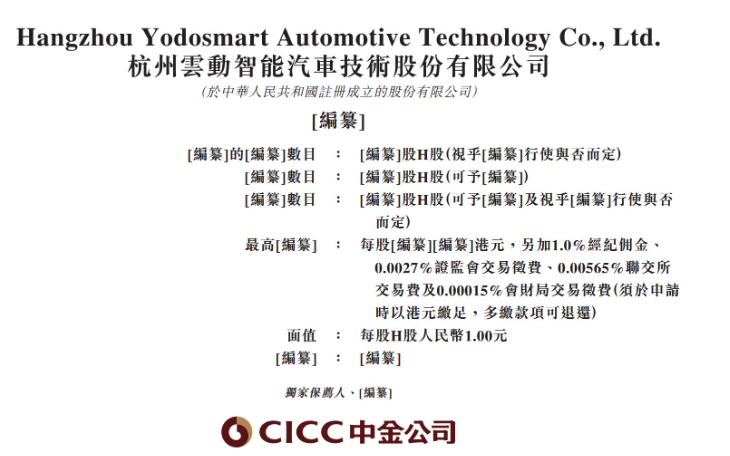
According to disclosures from the Hong Kong Stock Exchange on January 19, 2026, Hangzhou-based Yundong Intelligence has submitted its prospectus to the HKEX, marking its bid to join the ranks of tech-driven companies at the forefront of the intelligent vehicle industry chain.
Against the backdrop of the gradual waning of 4G vehicle networking dividends, the accelerated integration of 5G in vehicles, and the concurrent promotion of eCall national standards and satellite communications, this domestic in-vehicle communication solution provider, established in 2016, finds itself at a pivotal industry juncture.
Is Yundong Intelligence going public amidst a cyclical upturn, or is it using an IPO as a hedge against growth uncertainties?
4G-Driven Growth in In-Vehicle Communication
A retrospective look at Yundong Intelligence's growth trajectory closely mirrors the ebb and flow of China's in-vehicle communication industry over the past decade.
Founded in 2016, Yundong Intelligence has a clear mission: to provide vehicle manufacturers (original equipment manufacturers, or OEMs) with comprehensive solutions for in-vehicle communication and intelligent connectivity. Its core offerings include Telematics Box (T-Box), emergency call terminals (eCall), central gateways, and certain sensor and domain control-related products, complemented by customized design and technical services.
From a business model standpoint, Yundong Intelligence transcends being a mere module vendor; it positions itself as a system-level solution provider closely aligned with the OEM ecosystem. It integrates hardware resources such as communication modules, chips, and antennas on one end, while seamlessly embedding into the OEM's vehicle electronic and electrical architecture on the other, delivering platform-based solutions tailored to national standards and vehicle models.
This strategy proved particularly effective during the rapid proliferation phase of 4G vehicle networking, with the company's performance growth curve directly reflecting its success.
The prospectus reveals that Yundong Intelligence's annual revenue soared by 93.2% year-on-year to RMB 398 million in 2024, with gross profit climbing from RMB 48.36 million to RMB 109 million, and operating profit reaching RMB 55.51 million during the same period. Net profit also expanded from RMB 10.945 million to RMB 40.145 million.
Amidst this operational expansion, its industry standing remains robust, at least within niche segments. According to Frost & Sullivan data, Yundong Intelligence ranks as China's third-largest domestic provider of in-vehicle communication solutions, holding approximately a 7% market share. In 2024, it topped the domestic manufacturers' list in terms of 4G in-vehicle communication control unit shipments, with a 7.8% market share.
Clearly, Yundong Intelligence has capitalized on the most definitive industrial dividend period of "4G as a standard pre-installation feature."
Over-Reliance on Chery and Slowing Growth
However, at this critical juncture, this self-proclaimed "leader in domestic in-vehicle communication solutions" faces deep-seated anxieties. Entering 2025, Yundong Intelligence's growth trajectory has undergone noticeable shifts. In the first nine months of 2025, its revenue grew by a mere 16.7% year-on-year to RMB 301 million, with a profit of RMB 22.98 million during the period.
From an industry perspective, this is hardly surprising. As 4G enters a low-growth phase, Yundong Intelligence's heavy reliance on the T-Box's single-product structure exposes it to risks, with limited resilience against cyclical downturns.
In 2024, its flagship business, T-Box, accounted for 83.5% of Yundong Intelligence's total revenue, with shipments reaching 1.1385 million units. By the first three quarters of 2025, revenue from this business declined by 3.7% year-on-year instead of growing. This adjustment comes amidst a backdrop where the pre-installation rate of vehicle networking in Chinese passenger vehicles has neared 85%, with 4G penetration entering a "high-base slowdown" phase, while 5G remains primarily a market for existing upgrades.
Compared to its peers, Yundong Intelligence's business structure appears even more fragile. Referencing listed companies like Huihan and Gaoxing Xingwulian (backed by a listed parent), both boast more diversified customer bases. The latter's T-Box and other products are widely deployed in key models from Geely, Changan, Chery, and other brands. Financial data indicates that Gaoxing Xingwulian's automotive product sales revenue grew from RMB 321 million in 2022 to RMB 482 million in 2024, reaching RMB 367 million in the first three quarters of 2025, demonstrating a more balanced and steady growth trajectory.
In contrast, Yundong Intelligence exhibits a pronounced "Chery dependency." From 2023 to the first three quarters of 2025, revenue from its top five customers consistently exceeded 95%, with Chery, its largest single client, contributing a staggering 87.2% in the first three quarters of 2025.
Yundong Intelligence's performance is almost entirely tied to Chery. While this "narrow-channel" model brought stable orders and rapid scaling in the early stages, it has also made its pricing power, risk resistance, and growth ceiling clearly visible. Especially as industry competition accelerates from single-product comparisons to full-stack capabilities and ecological synergies, such dependence could become a bottleneck for scaling up.
Indeed, even within Chery's ecosystem, Yundong Intelligence faces competition from multiple players like Huihan, Lianyou Technology, and Gaoxing Xingwulian, with pricing and market share highly subject to market dynamics.
While the company's operational challenges are one aspect of its listing application, another issue heavily discussed in the market is the delicate balance between cash flow and dividends.
As of September 30, 2025, the company held only RMB 5.96 million in cash and equivalents on its books. Under such tight liquidity conditions, Yundong Intelligence announced its first-ever cash dividend of RMB 15 million just before submitting its prospectus. While not non-compliant, this move is easily interpreted by capital markets as a typical pre-IPO financial arrangement, intensifying scrutiny over its fundraising plans.
5G, eCall, and Satellite Communications: Where Is Yundong Intelligence's True 'Second Curve'?
That said, capital markets bet on future expectations. What truly determines the success of Yundong Intelligence's IPO is not its 4G historical performance but its ability to secure a position in the next round of in-vehicle communication upgrades.
This judgment hinges on three key areas: 5G, eCall, and satellite communications.
From an industry perspective, data from the Gaogong Intelligent Automotive Research Institute shows that from January to November 2025, China's pre-installation shipments of 5G vehicle models reached 5.619 million units, up 91.1% year-on-year. The 5G RedCap solution, which balances cost and performance, is widely seen as a key technological pathway for 5G penetration into mid-to-low-priced vehicle models.
Yundong Intelligence has already made strides in this direction, including products like the AT507 5G RedCap and expanding its portfolio with new intelligent antennas and non-terrestrial network product lines. However, progress remains limited in terms of volume. As of the first three quarters of 2025, the company shipped approximately 27,300 units of 5G in-vehicle communication solutions, still lagging significantly behind industry leaders. To some extent, this reflects the current transitional phase of 5G adoption in vehicles—still moving from pilots to scale, with competition intensifying ahead of full market opening.
In contrast, eCall presents a more deterministic growth opportunity. With eight ministries and commissions, including the Ministry of Industry and Information Technology, jointly issuing the "Automotive Industry Stable Growth Work Plan (2025-2026)," pre-installation of high-performance communication modules and emergency call systems has been explicitly encouraged, pushing eCall from an "optional feature" toward institutionalized implementation.
In this niche segment, Yundong Intelligence holds a relatively strong market position. According to its prospectus and third-party data, the company ranks among the top three domestic manufacturers in emergency call terminal shipments, boasting a solid customer base and first-mover advantage. Compared to the uncertainties in the 5G arena, eCall resembles a business line with "visible orders."
As for the more long-term prospects of satellite communications and V2X synergy, they represent the industry's technological ceiling rather than short-term financial solutions. In-vehicle communication solutions supporting NR-NTN satellite communications and achieving "ground + satellite" hybrid coverage are penetrating downward from high-end models. However, factors such as R&D investment, system integration complexity, and OEM adoption timelines suggest that such products are unlikely to contribute significant revenue in the near term.
Overall, Yundong Intelligence appears to follow a conventional path. Its listing logic does not rest on sustained hyper-growth but rather on a structural bet: leveraging the scale, customers, and cash flow accumulated during the 4G era to seize the time window for the full rollout of 5G, eCall, and satellite communications, while preemptively locking in financing capabilities amid the industry's capitalization cycle.
The company's ultimate success hinges on whether it can truly upgrade from a single T-Box supplier to a cross-domain communication and connectivity platform provider.
-
![]()
Enflame Tech's IPO Journey: Navigating Over 5.9 Billion Yuan in Losses and Soaring Debt in Q1 This Year
-
![]()
Trillion-Yuan Giant Li Shufu 'Streamlines': Could Levc Be the Casualty?
-
![]()
AI Competes for Electricity and Generates Power in the Gobi Desert
-
![]()
The First Batch of Victims of the AI Bubble: Programmers
-
![]()
ByteDance, DJI, and Xiaohongshu Secure Top Three Positions Among China’s Fastest-Growing Unicorns
-
Tesla's in-car voice system in China is finally learning to 'understand human language'
-
![]()
Foreigners Are Amazed: Chinese Electric Vehicle Drive Systems Unveil Innovative 'Poses'
-
![]()
700,000 Brothers and the Future of Robots: Behind JD.com's 'Nirvana Plan'