Spring Festival Red Envelope War Rekindled: Is the Distribution of 1 Billion Red Envelopes by Four Tech Titans Just a Tactic to Secure a 'New Ticket' in the AI Era?
 01/27 2026
 740
740
In pursuit of the ultimate entry point for AI.

The red envelope frenzy is back, and it's no ordinary skirmish. Tencent, Baidu, ByteDance, and Alibaba have all jumped into the fray, setting the stage for an epic showdown.
On January 25th, Tencent unveiled that Yuanbao would be distributing a staggering 1 billion yuan in cash red envelopes during the Chinese New Year of the Horse. Almost simultaneously, Baidu joined the race, announcing a 500 million yuan red envelope campaign for its Wenxin series products, with individual prizes capped at 10,000 yuan. Earlier, ByteDance had officially declared its collaboration with Huoshan Engine and Doubao for a CCTV Spring Festival Gala appearance. Meanwhile, Alibaba had secured exclusive naming rights for Bilibili's New Year's Eve countdown party, offering red envelopes and a share of the prize pool for AI-generated videos.

Image source: Bilibili
This scenario is not unfamiliar. A decade ago, red envelopes were a battleground for payment entry points, later evolving into a tool for driving e-commerce traffic, and eventually fading into the background. Tech companies became more cautious, meticulously calculating ROI, and the act of distributing red envelopes seemed no longer worthwhile.
But now, it's back with a vengeance. The reason is straightforward: this time, the target of the red envelopes is not payments, e-commerce, or content platforms, but AI assistants.
Moreover, all the red envelope games in this round are intricately linked to each company's AI offerings. It's not just about opening an app and tapping once; users must engage with Yuanbao, Doubao, Qianwen, or Wenxin, generating content and completing tasks to claim their rewards.
In essence, tech companies are using cash incentives to lure you into installing AI assistants on your phone, opening them up, and ideally, keeping them there. This explains the staggering stakes: 1 billion yuan, 500 million yuan, collaborations on the scale of the Spring Festival Gala, and New Year's Eve countdown naming rights, all aimed at securing a prime spot.
This spot is not just for the limelight of Spring Festival traffic but for a seat at the table of the next generation of 'super entry points.'
With search, information feeds, and e-commerce already mature, the imagination behind this year's red envelope battle lies in 'AI assistants,' the super entry point for user interaction with AI. Whoever can first transform users' daily needs into 'asking AI first' may secure a new ticket to the AI era in advance.
Therefore, this new round of red envelope battles is essentially a quest for acquiring, retaining, and winning the hearts of new users for AI assistants. Red envelopes are just the bait; the real bet is on which AI will be the default choice on your phone in the coming years.
And that's the true motive behind the resurgence of this round of New Year red envelope battles.
The red envelope war is back, but the strategic focus has shifted to AI.
Before the 2014 Chinese New Year of the Horse, WeChat red envelopes suddenly made their debut, triggering a nationwide craze among WeChat users. The following year, WeChat once again revolutionized the mobile payment landscape with its 'shake' feature and 500 million yuan in red envelopes.
Meanwhile, the annual Spring Festival red envelopes gradually became a key battleground for internet tech companies to acquire users. Alibaba, Baidu, Kuaishou, Douyin, Xiaohongshu, Bilibili... all joined the fray, using red envelopes to exchange for installations, daily active users (DAU), and brand awareness on the grand stage of the Spring Festival Gala.
However, in recent years, the red envelope battle has clearly cooled down as the internet industry approached its ceiling and the incremental gains from red envelopes became increasingly limited. By 2023, Spring Festival red envelopes had almost vanished, with no gala-level spending or nationwide interactive participation. Tech companies preferred to invest their money in more certain advertising and direct conversions.
Yet, it's evident that Tencent, Baidu, ByteDance, and Alibaba are now sparking a new round of red envelope battles for the Chinese New Year of the Horse, centered around consumer-facing AI assistants.
In fact, this shift began with the latest Bilibili New Year's Eve countdown party, where Alibaba secured exclusive naming rights for Qianwen and designed a new red envelope game: users could generate a 'New Year Cheers' video using the Qianwen app to claim cash red envelopes of up to 888 yuan and participate in sharing a multi-million yuan prize pool.

Image source: Qianwen
The key lies not in the amount but in the path. The red envelope is not an independent feature but is tied to a specific AI behavior—generating content. You can't claim the money without opening Qianwen, entering prompts, and invoking the model.
Baidu's Wenxin red envelope campaign will run from January 26th to mid-March, offering a total of 500 million yuan in cash red envelopes, with individual prizes capped at 10,000 yuan. Users must also engage in dialogue, generate content, and participate in AI Spring Festival couplets, AI portraits, and AI fortune-telling within the Wenxin assistant to claim their red envelopes. Additionally, Baidu has set up daily timed password guessing for hidden red envelopes and collecting 'Fantasy Life Cards' to share the prize pool, enticing users to continue using the Wenxin assistant.
Tencent Yuanbao will distribute 1 billion yuan in cash red envelopes starting February 1st. In addition to daily login rewards, users can earn more opportunities to draw red envelopes through tasks, including limited-edition Xiaoma Cards worth 10,000 yuan in cash. This red envelope campaign also supports sharing via WeChat and QQ, laying the foundation for further social virality. According to BlueWhale News, citing internal sources at Tencent, Yuanbao will also introduce new gameplay, currently undergoing internal testing invitations.
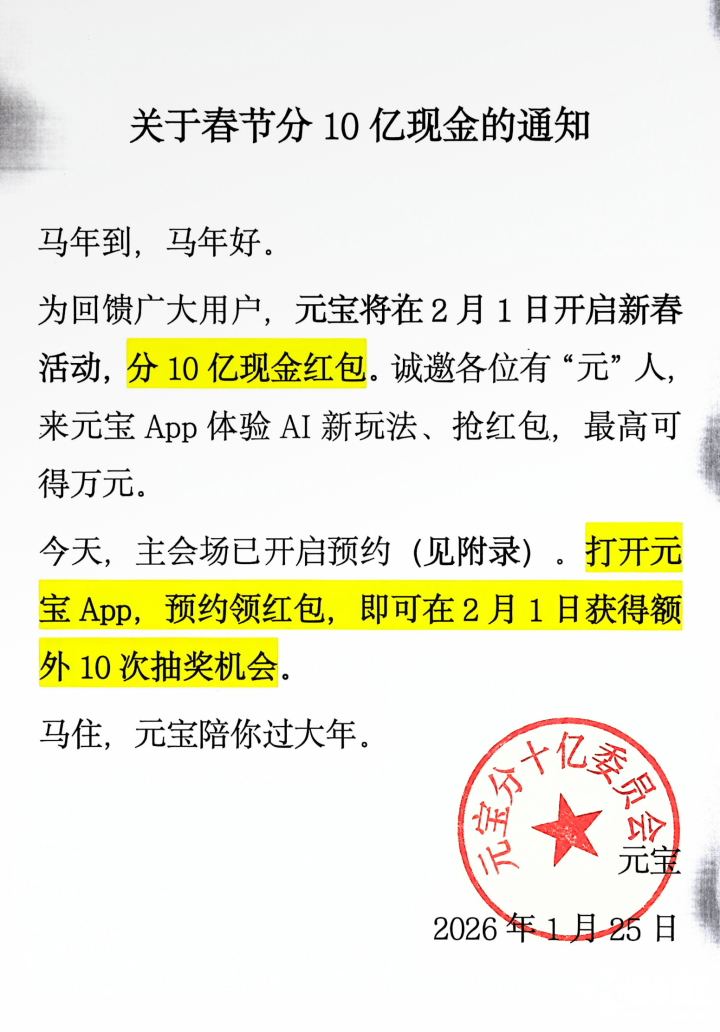
Image source: Yuanbao
On the other hand, leveraging its role as the exclusive AI cloud partner for CCTV's Spring Festival Gala, ByteDance's Doubao, although already a strong leader, is not resting on its laurels but will introduce various interactive gameplay options. However, the specific gameplay has not been announced yet, but it can be expected that it will still involve actual user engagement and cash red envelope rewards.
In fact, this round of red envelope rewards is largely embedded into product interaction and experience. To generate content, engage in dialogue, complete tasks, use repeatedly, and participate in interactions. The money is not given out all at once but is used as a lure along the path of using AI assistants.
And this timing is quite delicate.
Over the past year, competition for consumer-facing AI applications has noticeably intensified. The gap in model capabilities is narrowing, and functional homogenization is increasing. Relying solely on being 'smarter' is no longer sufficient to create a decisive advantage. The real differentiators are now becoming who has a larger user base, who has higher usage frequency, and who becomes the 'default entry point' for more users sooner.
In this race, ByteDance's Doubao is clearly ahead. It was not the first AI assistant to launch but has expanded the fastest. Relying on promotion, user experience, and iterative advantages, Doubao's active users have significantly surpassed other domestic AI applications. Data from QuestMobile at the end of 2025 showed that Doubao had 155 million weekly active users, while DeepSeek ranked second with 81.56 million and Yuanbao third with 20.84 million.
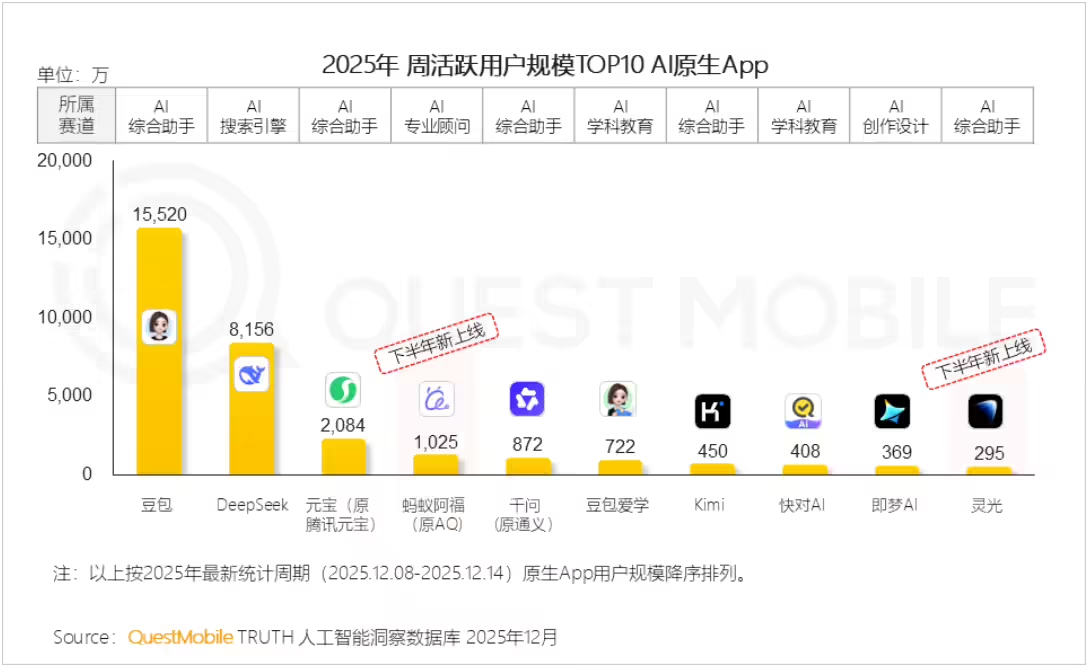
Image source: QuestMobile
Doubao's success poses a very real pressure on the other three companies. If they don't aggressively boost their user base and usage habits during the only remaining loudspeaker event—the Spring Festival—they may miss the critical window for shaping user perceptions of AI assistants.
The bubble theory is irrelevant; the key is that AI is becoming more useful.
From the end of last year to now, a recurring keyword in discussions about AI has been 'bubble.' Some argue that model capabilities have plateaued, applications are becoming increasingly homogenized, and the killer products have yet to emerge. This wave of enthusiasm is more driven by emotions than by actual demand.
But in less than a month in 2026, a completely different narrative is emerging. A prime example is Qianwen.
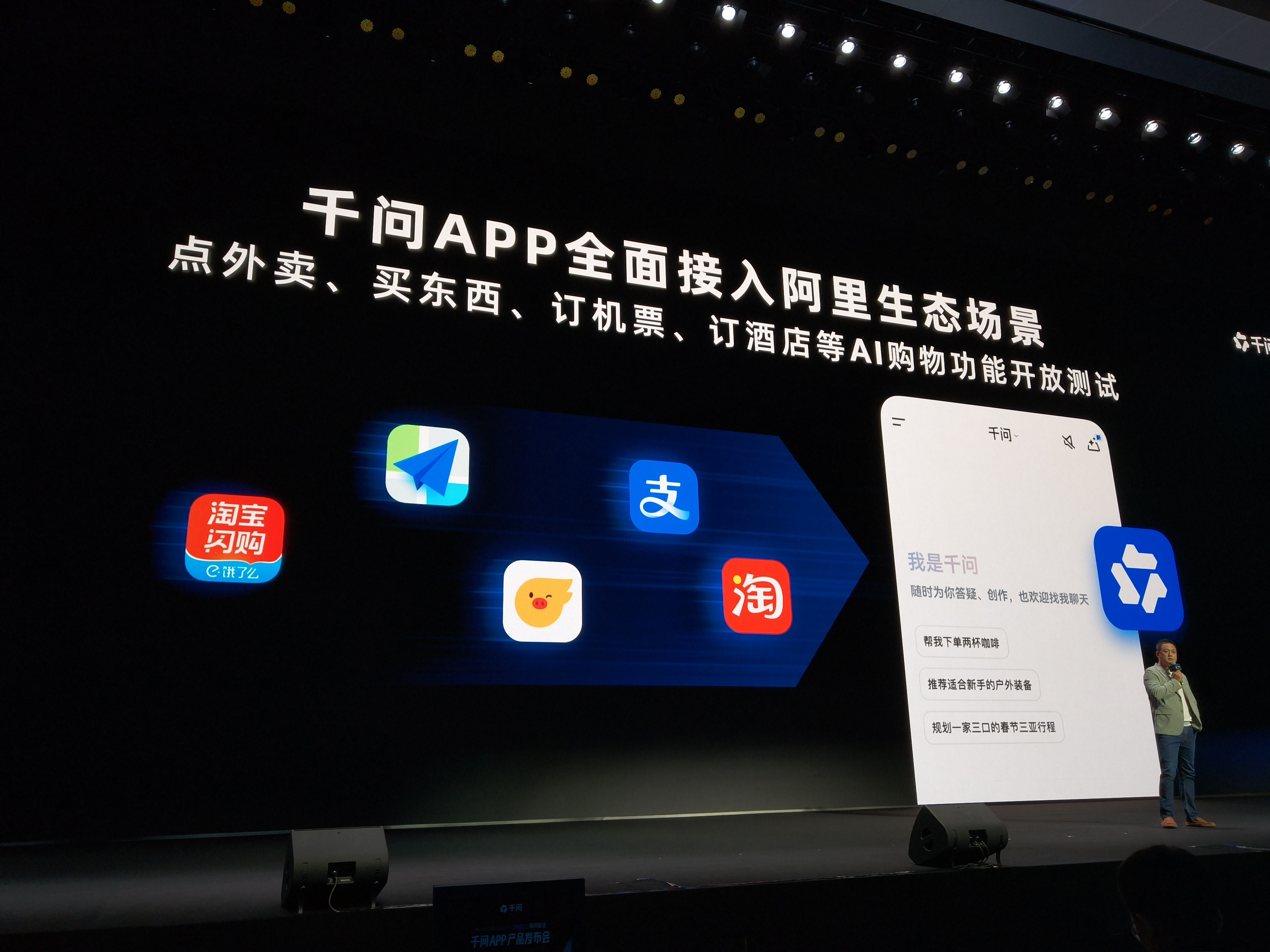
Image source: Leitech
In 2025, Qianwen was primarily a chat-based AI assistant. In mid-January, Qianwen underwent a significant upgrade, which the company dubbed the dawn of AI's 'task execution era.' Specifically, Qianwen became an entry point for directly executing tasks. Instead of just asking, 'Which restaurant is good?' you can now ask it to book a table, flight, or hotel and check routes, with back-end integrations with real business services like Alipay, Taobao, Fliggy, and Gaode Maps.
AI has transitioned from 'giving advice' to 'executing tasks for you.'
This shift from generative AI to intelligent agent AI is also happening globally. Building on Claude Code, Anthropic introduced a more general-purpose intelligent agent AI application—Claude Cowork—targeting daily office scenarios. Meanwhile, the unexpectedly popular Typeless in the AI community doesn't focus on large models and parameters but solves a very specific problem:
Converting voice input into structured text, automatically cleaning up filler words, and rearranging sentences and tones based on different scenarios like emails, documents, and chats.
The common thread among these products is clear. They no longer strive to be 'more human-like' but are more useful; they don't attempt to answer all questions but excel in one or two high-frequency scenarios. To some extent, this means the value judgment criteria for AI are changing, from 'how smart it is' to 'how much it can save me trouble.'
CES 2026 sent an even more direct signal. The Leitech CES reporting team observed at the event that AI is no longer just a slogan on display stands but has been integrated into a vast array of specific devices: smart homes, wearables, robots, cleaning appliances, displays, and glasses. Many products don't seem flashy or even a bit plain, but they clearly optimize the experience around real-world scenarios rather than marketing around parameters.

Image source: Leitech
More importantly, AI is shifting from the cloud to the edge. More and more manufacturers are emphasizing local execution, multi-modal perception, privacy protection, and low-latency responses rather than just 'connecting to the cloud.' This reflects not a technical route dispute but a change in product logic.
When AI truly enters daily life, it must become stable, controllable, affordable, and always available.
Putting all these pieces together reveals a hard-to-ignore fact. AI hasn't cooled down; it has just moved from a 'showcasing phase' to an 'implementation phase.' In this context, the so-called 'AI bubble theory' is no longer relevant. The premise of the bubble theory is that this wave of AI remains at the conceptual level, a distant vision, a technological showcase. But now, things have changed.
In conclusion
So, this round of New Year red envelope battles may seem like a cash giveaway, but at its core, it's a race for entry points. Especially as AI gradually evolves from a chat tool to a task execution gateway, with users forming new usage habits, tech companies can't afford to stay out. Red envelopes are just the lure; what's truly being contested is which AI you'll turn to first when you open your phone next time.
Doubao Yuanbao Qianwen Wenxin
Source: Leitech
Image credits: 123RF Authentic Library Source: Leitech
-
![]()
Registered Capital Slashed to 372 Million Yuan! Yutong Optical Finalizes Industrial and Commercial Change Registration
-
![]()
Zhuque-3 Successfully Lands, and 'Time Traveler' Secures Another ¥100 Million in Funding: China's Commercial Space Industry Experiences a 'Dynamic August'
-
![]()
Autohome Faces a Shrinking Window of Opportunity
-
![]()
Even a Titan Like Musk Has Faced Setbacks in Fulfilling Promises
-
![]()
AI Office: The End of the Racing Era, Context Becomes the Key to Success
-
![]()
Domestic Vehicle Chassis Revolution ②: The Steering Wheel Remains, But Mechanical Connections in the Steering System Are Decreasing
-
![]()
Exploring MiniMax Design: Can Video Editing Be as Simple as Speaking?
-
![]()
Why Can SenseTime Achieve Profitability While CloudWalk Still Faces Challenges, Despite Both Adopting Large Models?