Li Xiang Takes a Bold Gamble, Wagering on Embodied AI
 01/27 2026
 761
761
Produced by / Electric New Species Author / Wang Xin
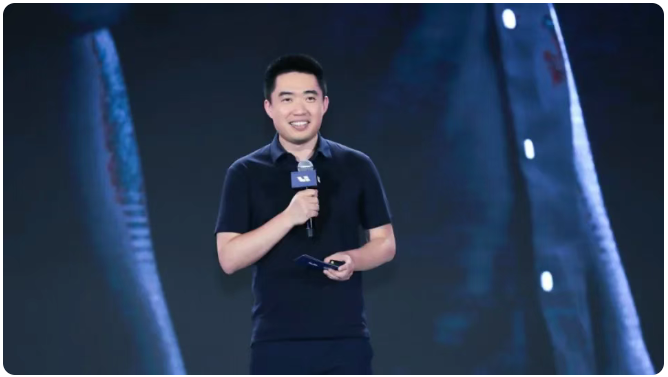
At precisely 10:30 a.m. on January 26, Li Xiang, the CEO of Li Auto, unexpectedly convened an online all-staff meeting.
The meeting was unheralded, and its content took everyone by surprise. For nearly two hours, Li Xiang largely steered clear of discussions on sales or deliveries. Instead, he repeatedly underscored the significance of AI, embodied AI, and humanoid robots.
Li Xiang declared, “Beyond cars, Li Auto is unequivocally committed to developing humanoid robots and will expedite their market introduction.”
This statement was far from casual. From his engagement in the AI Talk in late 2024 to the Q3 2025 earnings call, and now this impromptu meeting, Li Xiang's fascination with 'robots' has become increasingly evident.
However, the question persists: With Li Auto currently grappling with multiple pressures, including declining deliveries, a spate of executive departures, and low internal morale, is this high-profile bet on humanoid robots a strategic vision or merely a distraction?
01. Li Auto Bets on Embodied AI
Li Xiang envisions 'embodied AI' as the defining identity for Li Auto's future. No longer content with being a mere 'mobile home,' he aspires to transform cars into 'intelligent agents in the physical world,' endowed with perception, a brain, nerves, and a body.
In his perspective, smart cars are essentially robots.
This is not just rhetoric. In June 2025, Li Auto quietly established two secondary departments—'Spatial Robots' and 'Wearable Robots'—under its product division, with the smart glasses Livis as its inaugural product. This move underscores that Li Auto's exploration of robots has long transcended the automotive realm.
More critically, Li Auto is restructuring its organization to align with an 'embodied AI company.' According to internal sources, the company is poised for a new round of R&D reorganization, dividing into a foundational model team, a software ontology team, and a hardware ontology team. Notably, automobiles and humanoid robots fall under the same hardware ontology team.
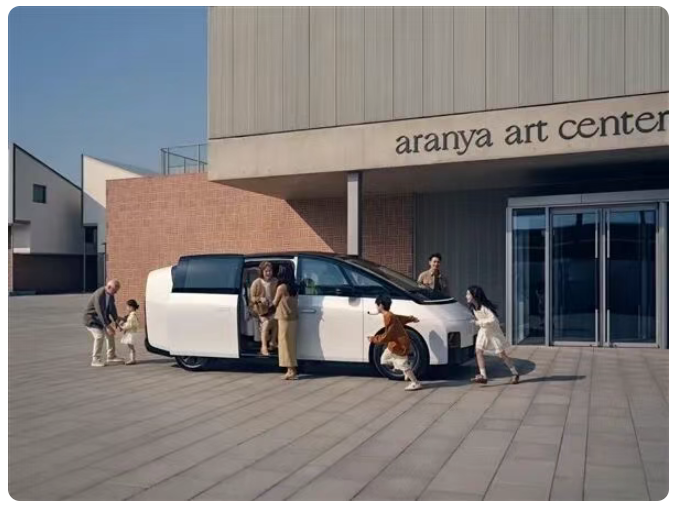
This indicates that Li Auto's future technological roadmap will revolve around 'agents' rather than traditional vehicle platforms.
This transformation is rooted in logic. The electric vehicle market has reached a saturation point, with parameter wars and price wars eroding profits.
Li Xiang himself acknowledges that if smart cockpits merely transplant smartphone apps into cars, it is redundant. Hence, he has chosen a third path: redefining cars through embodied AI. This path is arduous, but if successful, it could create a generational gap with competitors.
Notably, Li Auto is not starting from scratch. In January 2024, Liao Pingping, a graduate of Beihang University, joined Li Auto to lead a wheeled dual-arm robot project for industrial scenarios like factory screw tightening. Although the project faced temporary setbacks due to supply chain and technical bottlenecks, the core team remained intact.
Now, recruitment has resumed, covering the entire chain from dexterous hands, bipedal locomotion, joint modules, and sensors, with most positions marked as 'urgent,' signaling a serious commitment.
02. Humanoid Robots: A Strategic New Pillar
Li Auto's pursuit of robots is not merely about creating new hardware but also about securing talent, technology, and capital.
In the latter half of 2025, former intelligent driving head Jia Peng, production head Wang Jiajia, and former CTO Wang Kai collectively departed to establish the embodied AI company 'Zhijian Power,' swiftly attracting investment from top-tier dollar funds. This entrepreneurial wave is siphoning away Li Auto's core technical talent.
At the all-staff meeting, Li Xiang directly stated, “We need to recruit the best people and bring back those who left for robot startups.”
Behind these words lies a blend of anxiety and retaliation. Humanoid robots have become his new lever for retaining talent and attracting capital. The capital market has responded positively, with Li Auto's U.S. stocks surging over 7% intraday following the announcement.
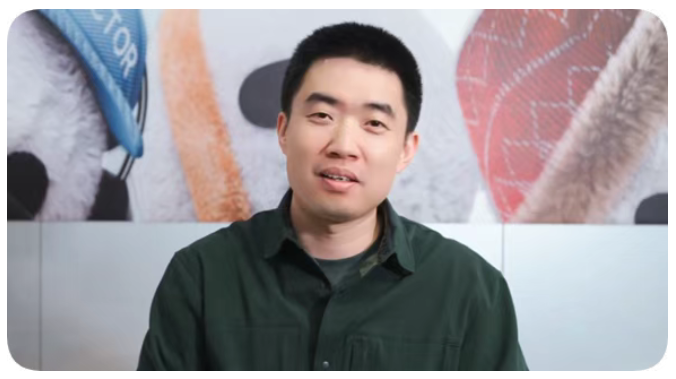
However, the challenges are substantial. Humanoid robots are far more complex than cars. Cars primarily control planar motion with fewer than 10 degrees of freedom, while humanoid robots possess around 50, necessitating coordinated whole-body movements and proactive environmental interaction.
Tesla CEO Elon Musk once remarked that developing Optimus is far more challenging than the Model X. What Li Auto is pursuing now is a biomimetic route akin to Optimus, enabling robots to utilize human tools and adapt to human environments.
Industry experts highlight that dexterous hands pose the biggest challenge. They are not merely actuators but also tactile sensors. Current mainstream VLA (vision-language-action) models lack tactile feedback, a critical modality for 'action,' significantly diminishing intelligence levels.

Among Li Auto's current recruitment positions, dexterous hand-related roles are the most numerous, indicating an understanding of the technical bottleneck.
Nonetheless, technology alone is insufficient. Seres' robot team exceeds 200 people, while Tesla's Optimus team surpasses 800. A robot company CEO estimates that Li Auto would require at least a 200-person team working for two years to approach the level demonstrated by XPeng's IRON in November of the previous year.
Meanwhile, Li Auto's 2025 deliveries declined by 19% year-over-year. Although cash reserves are substantial, intelligent driving, chip development, and model iterations are all consuming significant resources. The extent to which resources can be allocated to robots remains uncertain.
03. 2026: The Final Window for AI Integration
At the meeting, Li Xiang made a pivotal judgment: “2026 is the last year for all companies aiming to become AI leaders to 'board the train.'”
This statement warrants closer examination. 'Boarding the train' does not pertain to car manufacturing but to securing a core position in the AI era. He believes that by 2028, L4 autonomous driving will become a reality.
At that juncture, only companies that simultaneously master foundational models, chips, operating systems, and embodied AI will survive. There will be no more than three such companies globally, and Li Auto aims to be one of them.
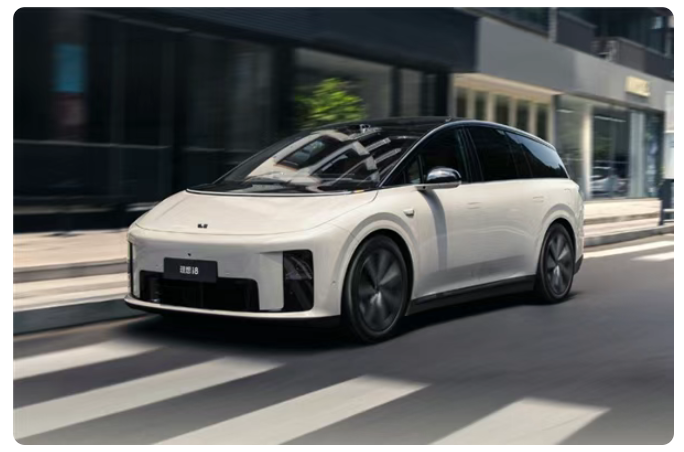
This timeline is not arbitrary. At the Q3 2025 earnings call, Li Xiang predicted, “In the next decade, the most valuable products in the embodied AI field will undoubtedly be smart cars with both autonomous and proactive capabilities.”
He views cars as 'embodied AI products in the physical world,' essentially competing for terminal entry points in the AI era.
Why 2026? Because the integration of large models and autonomous driving is reaching a tipping point. End-to-end large models are beginning to replace traditional modular autonomous driving systems, making perception, decision-making, and control integration feasible.
Whoever can first deploy large models onto real vehicles and achieve stable operation will control the 'operating system' of the AI era. Li Auto clearly does not want to miss this window.
However, internal employees are not entirely convinced. Some left comments on the company intranet: “I don't understand,” “I don't know the significance of this meeting.”
Employees in the manufacturing department were more direct: “I'd rather hear reflections from the top leader and the overall strategy for 2026.”
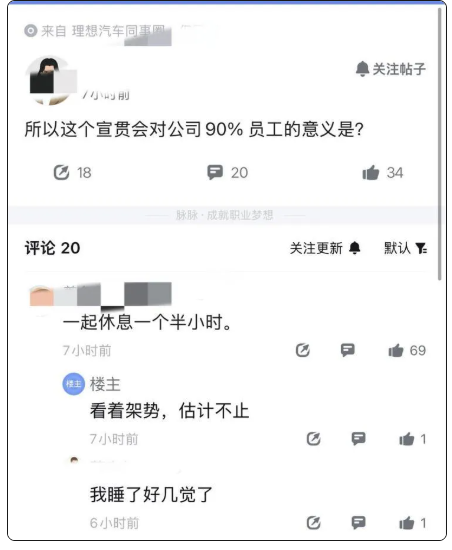
This indicates fatigue within Li Auto over the 'AI grand narrative.' As sales targets are repeatedly lowered and executives depart, employees are more concerned with survival than a robot vision a decade away.
Li Xiang's gamble is substantial. He is attempting to use the concept of 'embodied AI' to upgrade Li Auto from an automaker to an AI-native company.
However, historical experience dictates that technological visions must align with commercial realities. Looking too far into the future may lead to collapse before dawn.
Keynes' famous quote, “In the long run, we are all dead,” resonates particularly in the tech industry.
Summary
A High-Stakes Gamble, A Strategic Breakthrough
Li Auto's bet on humanoid robots appears to be a technological expansion but is essentially a strategic breakthrough.
Facing the red ocean of electric vehicles, talent drain, and growth bottlenecks, Li Xiang is leveraging 'embodied AI' to reshape the company's narrative.
He aims to transform Li Auto from a 'new energy vehicle player' into an 'AI-native intelligent agent company,' securing a favorable position during the critical 2026 window.
This path is fraught with risks. High technical difficulty, significant investment, and long return cycles, coupled with low internal morale and intense external competition, make it challenging.
However, from another perspective, without this gamble, Li Auto might remain trapped in the 'parameter arms race' indefinitely.
While humanoid robots may not generate profits in the short term, they can unify technical directions, attract top talent, and enhance capital market imagination—all things Li Auto desperately needs right now.
Li Xiang declared, “Li Auto will definitely develop humanoid robots,” with a firm tone. But the real test is not whether they can build them but whether, in the process, they can stabilize their core business, retain key teams, and fulfill promises to users.
After all, even the grandest AI vision must be supported by cars sold one by one. Otherwise, the robots may not stand up, and the company could collapse first.
-
![]()
Registered Capital Slashed to 372 Million Yuan! Yutong Optical Finalizes Industrial and Commercial Change Registration
-
![]()
Zhuque-3 Successfully Lands, and 'Time Traveler' Secures Another ¥100 Million in Funding: China's Commercial Space Industry Experiences a 'Dynamic August'
-
![]()
Autohome Faces a Shrinking Window of Opportunity
-
![]()
Even a Titan Like Musk Has Faced Setbacks in Fulfilling Promises
-
![]()
AI Office: The End of the Racing Era, Context Becomes the Key to Success
-
![]()
Domestic Vehicle Chassis Revolution ②: The Steering Wheel Remains, But Mechanical Connections in the Steering System Are Decreasing
-
![]()
Exploring MiniMax Design: Can Video Editing Be as Simple as Speaking?
-
![]()
Why Can SenseTime Achieve Profitability While CloudWalk Still Faces Challenges, Despite Both Adopting Large Models?