Differentiation Among AI Enterprises: Big Players 'Invest Heavily', Small Players 'Seek Financing', and Mid-sized Players 'Await Opportunities'?
 01/30 2026
 670
670
Backed by their financial prowess, Tencent's Yuanbao and Alibaba's Qianwen staged remarkable comebacks last year.
This year, AI giants are even more generous.
First, Huoshan Engine, a subsidiary of ByteDance, was announced as the exclusive AI cloud partner for the 2026 CCTV Spring Festival Gala, with Doubao AI deeply involved in the gala's interactions. Then, Tencent announced the launch of its Spring Festival event on February 1st, where users can share 1 billion yuan in cash red envelopes on the Yuanbao App, with individual red envelopes reaching up to 10,000 yuan.
In response, Ma Huateng directly stated, 'We hope this move can recreate the moment of WeChat red envelopes 11 years ago.'
Subsequently, Baidu also announced its participation in the Horse Year Spring Festival event, investing 500 million yuan in red envelopes, and Baidu AI will also appear as the chief AI partner at the 2026 Beijing Radio and Television Station Spring Festival Gala...
Clearly, when it comes to AI, these big players still adhere to the classic hunting rule of not striking unless it's a knockout blow.
In fact, these moves aren't explicitly targeted at anyone, but many second and third-tier AI investors, including Kunlun Tech, still feel a sense of suffocation:
To compete for user scale, tens of billions can now be spent on Spring Festival marketing alone. So, when the AI business model becomes clear, who can withstand the onslaught from these big players?
After this Spring Festival, shouldn't AI mid-sized players reconsider their ecological niche in the AI industry?
iFLYTEK Targets G-to-B, Kunlun Tech Goes Overseas?
Currently, the typical AI mid-sized players are mainly veteran AI players represented by Kunlun Tech and iFLYTEK.
In particular, Kunlun Tech, whose chairman, Fang Han, once explicitly stated, 'As a mid-sized internet company, Kunlun Tech's only dream is to become a giant.'
So, faced with strategic threats from big players, have iFLYTEK and Kunlun Tech found a way to break through?

The answer is yes, and they vary.
Let's start with iFLYTEK. On the path of localization, iFLYTEK has gradually built an independently controllable AI core technology research and model training system integrating algorithms, computing power, and data, thus forging a unique AI to B/G business advantage route.
The direct manifestation is that in 2024, according to the 'China Large Model Winning Bid Project Monitoring Report' released by a third-party agency, Smart Hyperparameters, iFLYTEK disclosed a winning bid amount of 847.808 million yuan, ranking first in the general-purpose large model vendor ranking, far ahead of Baidu and Alibaba Cloud, becoming the bidding champion of 2024.
In 2025, iFLYTEK once again achieved the dual firsts in the number of winning bids and the amount disclosed among general-purpose large model vendors, with 210 winning projects and a disclosed amount of 2.31568 billion yuan.
The overall winning projects are mainly distributed in industries such as education, healthcare, communications, energy, and government affairs, with a significant proportion of central and state-owned enterprises.
So, in terms of moats, iFLYTEK has now carved out a path and has withstood the competitive tests of the AI consumer market and rivals like Alibaba and Baidu. As long as it continues, it can form its own differentiated competitive advantage.
In contrast, Kunlun Tech has taken a clever approach.
After going public in 2015, Kunlun Tech gradually began to expand overseas to avoid competition with Chinese internet giants, continuing into the AI era.
As of the first three quarters of 2025, Kunlun Tech achieved overseas business revenue of 5.41 billion yuan, accounting for 93.3%.
Obviously, compared to iFLYTEK, Kunlun Tech hasn't found a new breakthrough path internally but has simply switched markets, opting for one with easier access to niche growth opportunities, such as in South America and Africa.
Its overall development path is quite similar to that of Tecno Mobile.
However, there's a problem here: Although Kunlun Tech has achieved continuous revenue growth in recent years (except for 2021 and 2022), during the previous internet overseas expansion phase, both domestic and overseas internet business models were clear and validated. Kunlun Tech's task was simply to open up markets and engage in the 'dirty work' that giants were unwilling to do.
Therefore, Kunlun Tech was able to avoid being crushed by domestic and foreign giants and even thrived quite well.
However, in the AI era, the drawbacks of this route have gradually emerged.
1. The AI path is unclear, making exploration and defense difficult.
Since the current AI technology routes and commercialization paths are not yet clear, early entrants like Kunlun Tech must not only explore new consumer markets but also new directions and validate AI business models...
The result is greater overall uncertainty and higher trial-and-error costs. For AI mid-sized players with limited resources, this undoubtedly becomes a marathon-like arduous test.
At this point, while some are willing to tread the path and make mistakes, most giants are naturally pleased to see this happen.
However, the biggest challenge will be whether Kunlun Tech can defend its success once it establishes an AI business model and completes market education.
After all, looking no further than last year's food delivery war, once Alibaba and JD.com clarified the market size and commercialization path of food delivery and instant retail, and knew that someone had previously succeeded and profited, they immediately invested hundreds of billions of yuan to go all in.
The result is clear to everyone. Even a strong player like Meituan was torn open a gap by Alibaba and JD.com.
The same applies overseas. In fact, Kunlun Tech faces even more severe strategic threats from Google and Meta and is more vulnerable to having its fruits picked by others.
Moreover, under the immense pressure to profit from AI investments, even if Kunlun Tech can continue to focus on 'small but tough' markets, it must also make prudent financial choices.
2. Clashing with AI giants head-on is not the best strategy.
In its financial reports, Kunlun Tech's business lines, besides AI large models, include AI browsers, AI social, AI video/short dramas, and more.
These AI businesses are indeed imaginative, but the problem is that most of them are also the 'backyards' that giants cannot afford to have encroached upon.
The reason giants like Alibaba, ByteDance, Google, and OpenAI are allowing Kunlun Tech to thrive now, besides its underdevelopment and the need to explore new directions, is that they are focusing on AI infrastructure (computing power, data) and general-purpose large models, exploring the path to a Super APP to seize the entry point of the AI era.
It's evident that once Alibaba and Tencent's AI infrastructure is up and running, Ant Group will launch Afu, and Tencent Yuanbao will launch Yuanbao Pai, attempting to explore AI social networking. There's also the earlier example of Kuaishou's Kling AI...
Clearly, even Tencent, with its monopolistic strength in the domestic social networking market, fears being disrupted in the AI era. So, how can Meta (Facebook), which also started in social networking overseas, accept the rise of a new giant by its side?
The same applies to AI browsers, AI video, and AI office businesses.
Google, Netflix, and Microsoft can accept an AI mid-sized player that grows by tackling tough challenges but are unlikely to tolerate a Kunlun Tech that threatens their strategic positions...
3. Ecological shortcomings: The dividing line between AI giants and mid-sized players.
Compared to Alibaba, Google, and Microsoft, AI mid-sized players like Kunlun Tech and iFLYTEK are at a significant disadvantage in terms of ecological layout.
For example, Alibaba's comprehensive ecological layout allows users to achieve various functional needs, such as ordering food delivery, booking hotels, and shopping, through Qianwen with a single statement. This systemic experience upgrade cannot be provided by any standalone AI product (software), not even Doubao or DeepSeek.
Similarly, Google and Microsoft can integrate AI directly into their operating systems and Office suites, leaving other AI players with only a 'functional' slot rather than an independent 'product' space...
In this way, while Kunlun Tech may achieve innovative breakthroughs at the functional level, it's difficult for it to grow into a new AI giant...
AI Mid-sized Players: As Long as They Stay in the Game, There's Still a Chance?
In fact, Fang Han, the helm of Kunlun Tech, was already well-prepared for the strategic threats from AI giants as early as 2024.
At that time, in an interview with 'LatePost', Fang Han mentioned, 'In 2022, we considered what the endgame of AIGC would be. An unavoidable topic is what giants like Google and ByteDance would do.'
Subsequently, when explaining Kunlun Tech's breakthrough opportunities, he mentioned two points:
One is to go global; the other is to pursue generalized vertical categories. 'In the mobile internet era, there are two particularly good examples: Why can Bilibili and Xiaohongshu still thrive despite the presence of giants? It's because they excelled in vertical categories and then generalized. Xiaohongshu started with beauty and fashion and generalized to offline wine and tourism; Bilibili generalized from anime to medium and long videos.'
This is almost Kunlun Tech's main focus now.
However, there's a significant regret regarding the latter point: Fang Han later seems to have only remembered vertical generalization but forgotten about 'excelling'.
According to the third-quarter report of 2025, Kunlun Tech's business lines now fall into three major categories: AGI and AIGC business, overseas information distribution and metaverse business, and investment business.
Within the AI sector, there are nine sub-businesses: AI large models, AI intelligent assistants, AI video, AI music and audio, AI games, AI social, short drama business, social entertainment platform StarMaker, and AI computing power chips.
It's worth noting that among domestic players, only Alibaba and Baidu (iQIYI) have such a comprehensive AI layout, but neither can match Kunlun Tech in terms of hard power and financial resources.
The remaining players like ByteDance (Doubao), Kuaishou (Kling), and Tencent (Yuanbao) were all highly focused initially.
In particular, Tencent only recently launched Yuanbao Pai.
In comparison, Kunlun Tech seems to have dispersed its resources and energy.
After all, from a research and innovation perspective, is it easier to build an extreme moat by concentrating 1.543 billion yuan in research and development fees on a single vertical business or by spreading it out?
This question is worth Fang Han's reflection and attention...
Furthermore, after comparing with iFLYTEK, we also notice that Kunlun Tech's all-in move on AI seems too aggressive, to the point where its core gaming business, which it used to excel at, is almost categorized as 'others'.
According to Tianyancha APP, in the first half of last year, Kunlun Tech's revenue mainly came from 'online advertising business', 'Opera search business', and 'short drama platform business', accounting for 38.39%, 18.51%, and 15.62% of revenue, respectively.
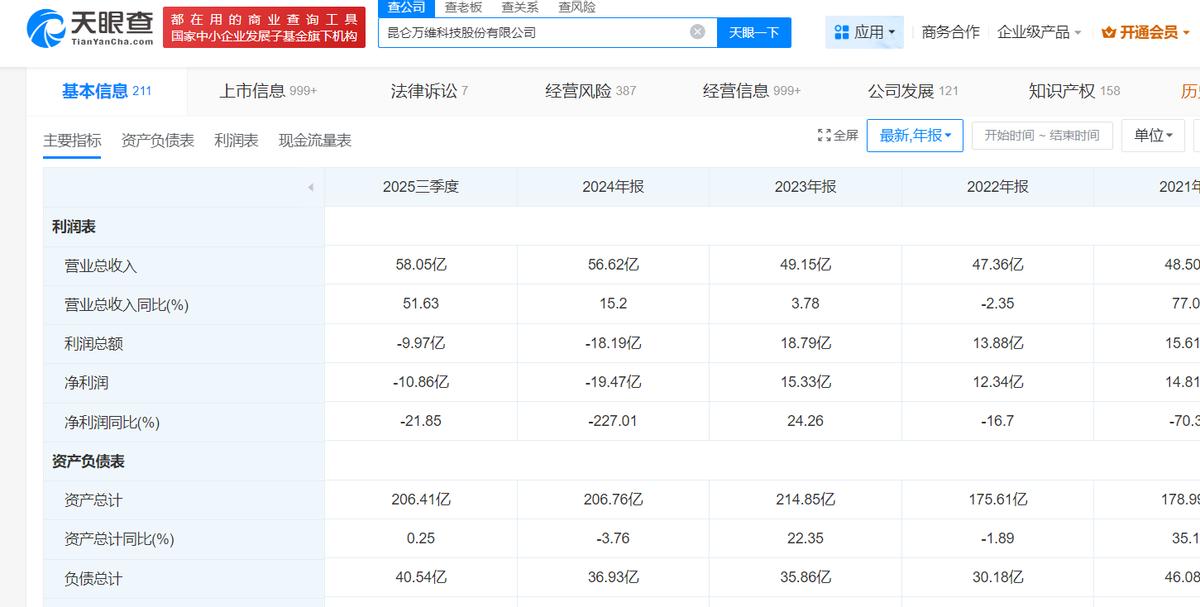
In contrast, its once-core gaming business only generated 239 million yuan in revenue, accounting for 6.4%.
Of course, it must be acknowledged that Kunlun Tech's new businesses are performing exceptionally well. For example, its advertising business achieved a 61.05% year-on-year revenue increase during the reporting period.
However, even so, in the current era of AI burning money, whether to have more confidence in doubling down on AI or to leave a growth fallback, Fang Han seems should not let this most profitable cash cow business continue to decline?
In comparison, iFLYTEK still retains profitable cash cow businesses like recording pens and learning machines and has achieved the dual first in national high-end learning machine sales for four consecutive years.
Therefore, from this perspective, whether to find its AI ecological niche or to add a bargaining chip to its dream of becoming a 'new era giant', shouldn't Kunlun Tech and Fang Han undergo a major strategic adjustment?
To streamline its business portfolio, concentrate its efforts on major tasks, and raise more strategic resources...
In fact, Wang Xing, the founder of Meituan, once said, 'Most people think war is composed of struggles, but in reality, war is composed of waiting and suffering.'
An investor also believes that AI giants are currently in a 'euphoric' phase, but 'once a thing has been done for several years without results', internal tensions will emerge, especially organizational ones. At that point, if startups are still in the game, they may have an opportunity.
In any case, Kunlun Tech has the potential to achieve its dream, but the premise is that it must stay at the table and wait for the day when Lady Luck smiles upon it...
Disclaimer: This article is based on the company's legally disclosed content and publicly available information and provides commentary, but the author does not guarantee the completeness or timeliness of this information. Additionally, the stock market is risky, and entry should be cautious. This article does not constitute investment advice, and investment decisions should be made at your own discretion.
-
![]()
Registered Capital Slashed to 372 Million Yuan! Yutong Optical Finalizes Industrial and Commercial Change Registration
-
![]()
Zhuque-3 Successfully Lands, and 'Time Traveler' Secures Another ¥100 Million in Funding: China's Commercial Space Industry Experiences a 'Dynamic August'
-
![]()
Autohome Faces a Shrinking Window of Opportunity
-
![]()
Even a Titan Like Musk Has Faced Setbacks in Fulfilling Promises
-
![]()
AI Office: The End of the Racing Era, Context Becomes the Key to Success
-
![]()
Domestic Vehicle Chassis Revolution ②: The Steering Wheel Remains, But Mechanical Connections in the Steering System Are Decreasing
-
![]()
Exploring MiniMax Design: Can Video Editing Be as Simple as Speaking?
-
![]()
Why Can SenseTime Achieve Profitability While CloudWalk Still Faces Challenges, Despite Both Adopting Large Models?