Haste Makes Waste: Yuanbao Party Isn't the Embodiment of AI Socialization Yet
 01/30 2026
 652
652
Haste Makes Waste: Yuanbao Party Isn't the Embodiment of AI Socialization Yet
Editor | Qian Jiang
Tencent has once again set the social sphere ablaze, this time in the name of 'AI'.
The significance of socialization is undeniable; it could even be hailed as the crown jewel of the internet industry and a well-deserved strategic stronghold. Tencent's accomplishments over nearly three decades have repeatedly demonstrated that whoever claims this stronghold can consistently launch dimensionality reduction strikes in subsequent competitions.
Therefore, since the dawn of the AI era, AI socialization has become a highly coveted goal for many entrepreneurs.
Interestingly, prior to this, although numerous activities fell under the umbrella of 'AI socialization', they were seldom labeled as such. Instead, they were given more specific names, such as AI companions, AI companionship, or virtual lovers, among others.
The fundamental reason, it seems, is that these models have not revolutionized the current mainstream social methods and, therefore, struggle to uphold the banner of 'AI socialization'.
Now, with Tencent, the long-standing leader in domestic socialization, stepping into the arena and once again raising the banner of socialization in the name of AI, can Tencent define what 'AI socialization' truly is?
AI Group Chat ≠ AI Socialization
Tencent's so-called AI socialization primarily refers to the Yuanbao Party function, which is currently undergoing beta testing on the Yuanbao app.
Yuanbao Party resembles ordinary group chats but boasts two core differences:
Firstly, in addition to chatting, Yuanbao Party supports 'watching together' movies, competitions, or listening to music. It mirrors the voice or video rooms found in some stranger-focused dating apps, offering a richer array of entertainment options than traditional group chats.
Secondly, and most crucially, Yuanbao Party incorporates an additional Yuanbao AI compared to traditional group chats. Group members can @Yuanbao to answer questions, summarize chats, generate emojis, and more, acting as a group chat atmosphere enhancer or AI management robot.
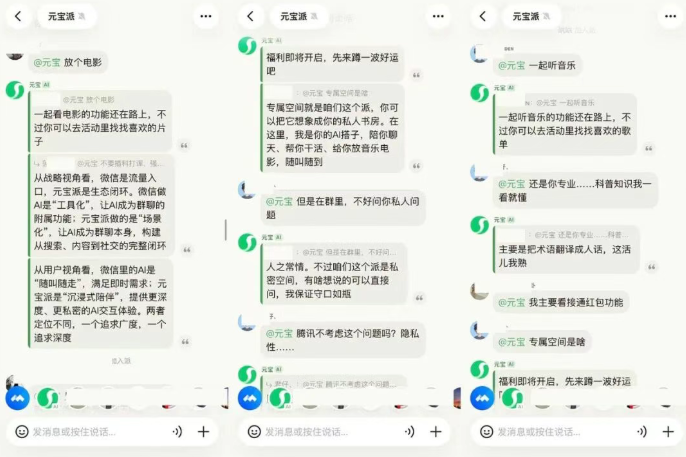
▲ In Yuanbao Party, Tencent Yuanbao livens up the group chat atmosphere. Screenshot of Yuanbao Party
Honestly, from a product logic perspective, this combination is not particularly groundbreaking.
Take the example of Yuanbao Party's AI group chat robot. This form has been popular since the QQ era in 2015 or even earlier. Back then, for a few hundred yuan, one could introduce a text robot into a group chat.
On one hand, similar to Yuanbao AI, this group chat robot could liven up the group atmosphere, such as playing idiom relay games, word guessing games, and answering basic questions like the weather. On the other hand, it could assist administrators in managing the group chat, such as sending group messages, approving new members, muting sensitive remarks, or removing members from the group.
Later, these forms gained widespread popularity in WeChat groups for a while, but thanks to Tencent's regulation in this area, related businesses have been treated as gray industries. (This does not include Enterprise WeChat groups.)
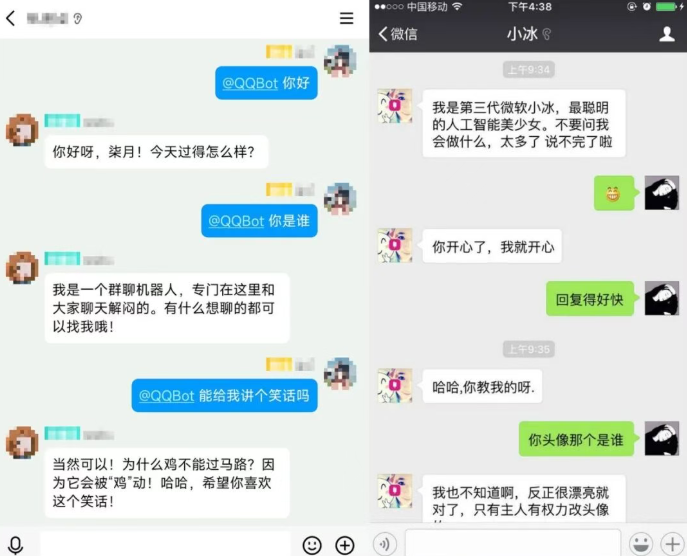
▲ Early QQ group robots and Microsoft XiaoIce's application cases in WeChat. Image source: Network
Therefore, this scenario is neither new nor particularly innovative.
If we must point out a change, it might be that compared to traditional text robots, those based on large models possess stronger agent capabilities, are more human-like and natural, and can handle a wider range of scenarios.
Interestingly, we recently came across another application also labeled as AI socialization—Bubbl.
This is an overseas application that can integrate into social software like WhatsApp and iMessage as a plugin. It summarizes your chat content (both group and private messages), simulates your chat style, and then joins group chats on your behalf to help you manage various messages.
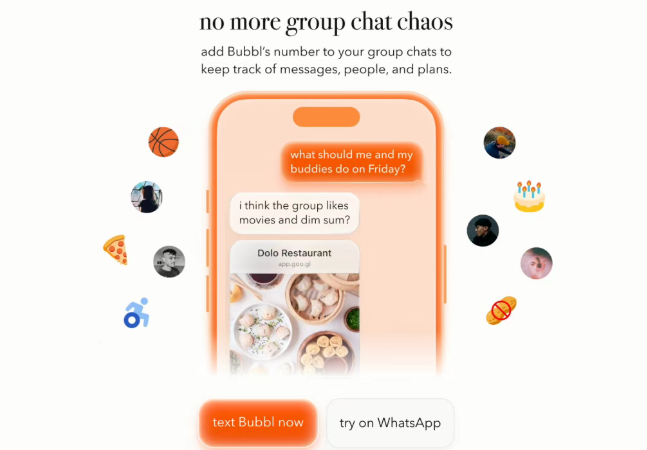
▲ Screenshot of Bubbl's official website
You see, similarly based on group chats, Yuanbao Party adds AI to the group to lead everyone in play, while Bubbl creates an AI avatar for users to have AI manage various messages, freeing up people's time.
These are two completely opposite AI socialization experiments.
Of course, we cannot determine who is right or wrong now, but what is certain is that neither can truly be equated with socialization. Instead, they are more akin to 'AI assistants' or 'AI tools'.
Yuanbao Party is a tool within the group, while Bubbl is a tool on social software. If we must link them to socialization, honestly, there is some connection; but to say they represent socialization in the AI era does fall short.
How Will Socialization Evolve with AI?
So, how should AI socialization be approached? Or, what constitutes socialization in the AI era?
We believe that the essence of socialization is 'connection', a network of relationships that are intertwined, where you are in me, and I am in you.
This is why we still cannot live without WeChat; all our connections are on it. This is also why we cannot use WhatsApp or Instagram; our connections are not there.
If we acknowledge this premise, then two assumptions can be made:
The first assumption is that 'connection' changes.
This assumption is based on treating AI as an independent entity and assigning it some social roles.
Under this premise, before the AI era, connections were singular, meaning connections between people. However, after entering the AI era, these connections have expanded, becoming connections between people and AI, and even between AI and AI.
That is, we need to incorporate AI into these connections and then reconstruct all previous relationship networks, communication methods, and interaction modes based on this role.
Over the past two-plus years, many entrepreneurs have explored this direction, but most of these explorations have been singular.
For example, the widely known AI companions essentially represent a one-way connection between people and AI. They are private and completely personal, and therefore cannot be woven into a 'net'.
Additionally, many companies have attempted to use AI to transform public social relationships. However, upon closer inspection, they have not truly altered these social relationships. Instead, like Yuanbao Party, they have made AI more of an atmosphere enhancer or technical support role.
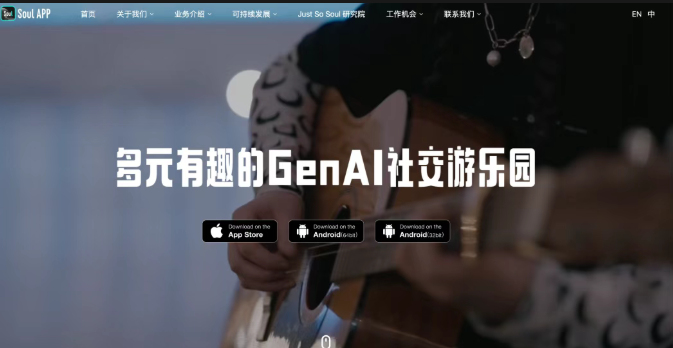
▲ Screenshot of Soul's official website
For example, Soul, which has been closely associated with the AI label since 2024, only uses AI for more precise user matching, AI-assisted conversation tactics during interactions to lower communication barriers, and AI chat companions to enhance user engagement.
Therefore, this is currently the most awkward aspect of AI socialization. For a long time, people have not found the underlying variable that distinguishes AI socialization from traditional socialization, leading to only optimizations within the traditional framework.
When Connections Are No Longer Scarce, Expression Begins to Reshape Social Play
If the assumption of 'connection' changing does not hold, then we can proceed to the second assumption: 'connection' remains unchanged.
Over thousands of years, human social methods have undergone numerous changes with technological advancements, but the essence of socialization—'connections between people'—has not changed.
For instance, before the discovery of electrical signals, people primarily communicated through letters, leading to a type of friendship known as 'pen pals'. This type of relationship persisted until the late 20th century, gradually disappearing with the rise of the internet.
However, even so, the method of communicating with and establishing emotions and connections with people from distant places through text has not disappeared. After the internet's rise, people gained access to email, MSN, QQ, and even WeChat's Drifting Bottle...
What I mean is that technology has only changed communication methods; the essence of establishing emotional connections between people has never changed.
Of course, after entering the internet era, especially the mobile internet era, our definition of socialization has become richer.
Because technological advancements have made 'connections' no longer a luxury; they are always present and always accessible. Therefore, we often engage in self-expression online—that is, who I am and what I am doing.
This is a richer form of socialization where people establish a 'personality' through avatars, introductions, and constantly updated statuses. We no longer expect a response from a specific individual; instead, we seek resonance from a group or a certain type of person.
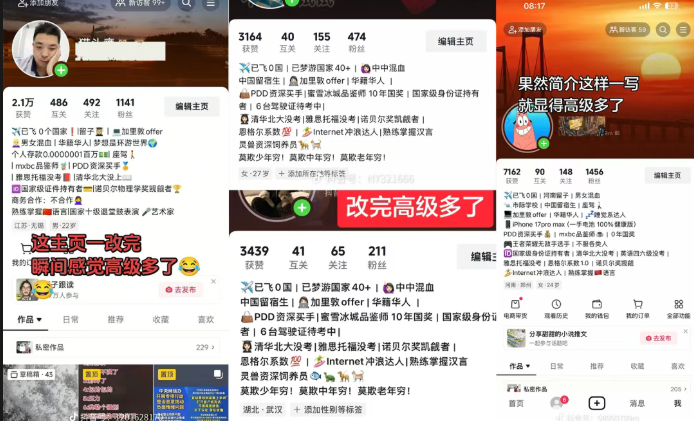
▲ The recent trend of modifying introductions on platforms like Douyin, where people express their individuality through revised introductions
For example, from the earliest blog posts in the blog era to QQ Space's status updates and Weibo posts, and later to Moments and Douyin, it has always been a one-to-many form of socialization. Throughout this process, technological advancements have continuously enriched the media, from text to real photos and then to short videos.
Therefore, today, whether you admit it or not, an important change is that people's social focus has started to shift from graphic platforms to short video platforms.
People share fun videos with each other on Douyin, and 'nurturing sparks' has also become popular among young groups. New bonds, new connections, and new relationship networks are forming on these new platforms.
The reason behind this is not difficult to understand; people are spending more and more time on short video platforms. Interesting short video content has replaced Weibo posts, public account articles, and other content forms, becoming a new form of social currency.
So, what does this change have to do with AI?
Of course, it has a lot to do with it because new social methods based on AI have started to emerge repeatedly.
For example, the recent 'Sexual Quotient Guru' incident that gained notoriety online. Many people focused on the underlying unhealthy values or sensational teaching content. However, the true reason this incident went viral was that people continuously used AI to imitate and create secondary content based on this 'Sexual Quotient Guru'.
Similar phenomena abound, such as people using ChatGPT to generate pictures in the style of Studio Ghibli or actions like 'having ChatGPT summarize my five strengths and weaknesses based on my information'.
That is, content created using AI has become an emerging tool for gaining attention and self-expression. This new type of content created based on AI capabilities has also become people's new form of social currency.
Speaking of which, we must mention another important exploration direction in the current AI socialization track—AI videos.
In October last year, OpenAI launched SoraApp, a short video application generated by AI. This year, major domestic companies like ByteDance launched AI video products like Suibian; Alibaba launched AI Mini Theater on its Qianwen app.
The key reason why AI videos may become a new form of social play is that they establish AI personas and offer interactive features like AI duets with friends. If using AI to generate content becomes the primary way for everyone to express themselves in the future, then new social relationships will inevitably be established on such platforms.
Of course, we still need to be clear that this, like Tencent's and Baidu's experiments with AI in group chats, is only one direction of early exploration in AI socialization. It's hard to say who is right; it's also possible that everyone is wrong.
However, one definite conclusion is that we need to understand socialization in the AI era in a more transcendent way. After all, following old maps will not lead us to new continents.
What Does Tencent Want?
So, what does Tencent ultimately want?
Frankly speaking, Yuanbao Party itself is not particularly impressive or truly innovative. However, Tencent is still willing to invest heavily, laying down 1 billion yuan for its path. Clearly, this is not because Yuanbao Party is perfect but because Tencent understands better than anyone that they must make changes.
This understanding can be gleaned from Tencent's overall actions around this year's Spring Festival Gala.
A very crucial signal is that in this large-scale attempt at 'AI socialization', Tencent did not choose to launch it on WeChat but instead placed it on a brand-new product like Yuanbao. This choice at least releases two important messages.
First, Tencent has not taken the route of 'AI-izing WeChat' but instead chosen the opposite path—socializing Yuanbao.
For a long time, the outside world has generally believed that WeChat is the best soil for Agent implementation:
For example, third parties can provide AI capabilities through mini-programs or package Agents as WeChat friends and add them to group chats. Even multiple Agents can collaborate in groups to complete complex tasks. This method naturally aligns with existing user habits and collaboration logic.
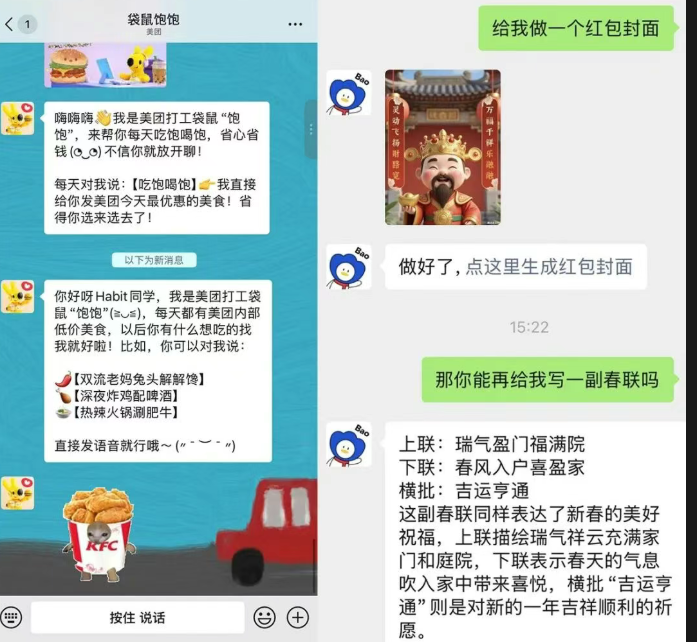
▲ WeChat Red Packet Cover Assistant and Meituan's AI Enterprise WeChat Friend
Even WeChat has made numerous attempts in this regard. For example, the previously launched Red Packet Cover Assistant was essentially an 'AI friend' that users could interact with to generate and configure red packet covers.
Additionally, Meituan once operated an Agent in WeChat, also in the form of a friend, capable of initiating greetings, sending coupons, recommending dishes, and engaging in simple interactions.
However, until today, these attempts have never been systematically amplified. Instead, Tencent has chosen to place the true landing point of Agents in a brand-new application like Yuanbao.
Second, Tencent has begun to actively promote the migration of WeChat social relationships to Yuanbao.
When we trace the growth trajectory of WeChat, we can identify three pivotal milestones: the importation of contact list relationships, the facilitation of stranger connections via the "Shake" feature, and the integration of QQ friend relationships.
Presently, the dynamic between WeChat and Yuanbao mirrors that which once existed between QQ and WeChat. All friend relationships within the Yuanbao Party must originate from WeChat connections—this is fundamentally a transfer of social capital from an established product to a newcomer.
This situation sheds light on Tencent's underlying strategy: in their quest to explore social interactions in the AI era, they are not content with merely modifying a highly developed and structurally sound product. Instead, they aspire to cultivate an entirely novel social form that is inherently compatible with AI.
Much like WeChat and QQ, which were hallmarks of their respective eras, Yuanbao is designed as an AI-native platform, embodying not just the present but also pointing towards the future.
Hence, the spotlight has never truly been on Yuanbao Party itself; rather, the emphasis lies in the necessity to nurture new, towering social structures in a fresh, evolving landscape.
-
![]()
Registered Capital Slashed to 372 Million Yuan! Yutong Optical Finalizes Industrial and Commercial Change Registration
-
![]()
Zhuque-3 Successfully Lands, and 'Time Traveler' Secures Another ¥100 Million in Funding: China's Commercial Space Industry Experiences a 'Dynamic August'
-
![]()
Autohome Faces a Shrinking Window of Opportunity
-
![]()
Even a Titan Like Musk Has Faced Setbacks in Fulfilling Promises
-
![]()
AI Office: The End of the Racing Era, Context Becomes the Key to Success
-
![]()
Domestic Vehicle Chassis Revolution ②: The Steering Wheel Remains, But Mechanical Connections in the Steering System Are Decreasing
-
![]()
Exploring MiniMax Design: Can Video Editing Be as Simple as Speaking?
-
![]()
Why Can SenseTime Achieve Profitability While CloudWalk Still Faces Challenges, Despite Both Adopting Large Models?