China's AI in 2026: A Brutal Battle Over Inventory, Increment, and Variables
 02/24 2026
 557
557

The divergence in AI strategies among these tech giants essentially mirrors the trade-off between technological aspirations and commercial realities. These strategic choices are neither superior nor inferior; they merely represent differing visions for the ultimate outcome of AI. When the noise surrounding subsidies fades away, what will truly define the next generation of AI will not be short-term gains or losses, but rather a deep reverence for the essence of technology and a long-term strategic vision.

Original Content by Xinshang AI New Tech Team
AI enthusiasts have likely been bombarded with the following meme comparing Chinese and U.S. AI developments in recent days. 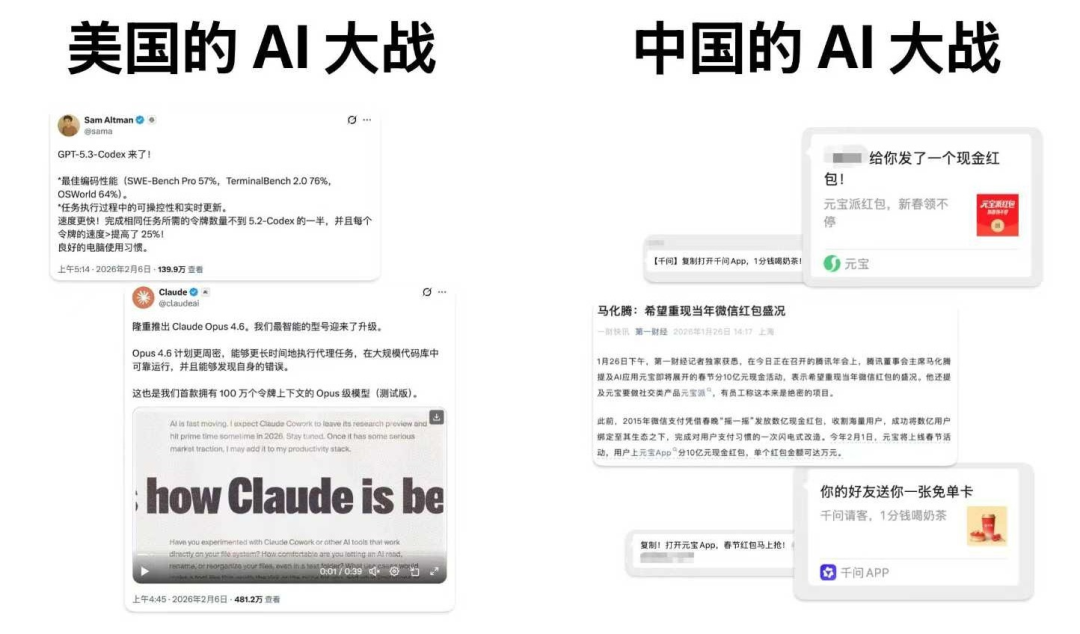 ▲Photo/Internet
Some claim this represents the fundamental difference in the AI rivalry between China and the U.S. After all, in the West, Claude and ChatGPT are taking turns to unleash big moves, with every line of code seemingly destined to change the world. Meanwhile, in China, discussions revolve around who hasn't yet scored a 1-cent milk tea deal. The comment section is filled with lighthearted banter, with some self-deprecatingly remarking, "They're gazing at the stars; we're scrambling for pennies." But is that really the case?
The Technical Obstacle: Viewing Downmarket Commercialization as a 'Giant's Waterloo'
Many years ago, we reflected on how the Chinese invented gunpowder but used it solely for fireworks, delighting the senses through sight and sound, while Westerners transformed it into firearms that pried open the gates to modern civilization.
Yet, standing on the threshold of the 2026 Spring Festival, in the realm of AI, there seems to be a bizarre, historic reversal.
While Silicon Valley continues to compete over who has larger model parameters, who burns money faster, or who can secure billions in financing from NVIDIA and Wall Street, Chinese internet giants have quietly loaded gunpowder into the rifling of commerce. And once again, we're accused of being overly pragmatic, neglecting technological progress.
First, we must acknowledge a harsh reality: In the U.S., AI is science; in China, AI is business.
This is not a derogatory statement. U.S. AI giants can rely on dollar hegemony and corporate backers to experiment in a greenhouse of unlimited budgets. But Chinese AI firms, from day one, face the deadline of profitability. Splashing cash isn't the goal; survival is. Learning to generate revenue while burning money is itself a survival skill far more challenging than simply boosting parameters.
Second, the so-called Waterloo is precisely the dawn of the industrial revolution.
Moreover, if we consider the sheer technological shock, GPT-5.3-Codex or Claude Opus 4.6 combined might not deliver as powerful a jolt as the bombshell dropped by Seedance 2.0 in recent days.
Why? Because Seedance 2.0 has done something that terrifies the industry: the video quality and controllability it demonstrates are approaching the lower limits of professional CG pre-rendering. This is the true "Chinese-style shock."
Finally, don't underestimate "1-cent milk tea" and "red envelopes."
Many scoff at Alibaba's AI-powered milk tea orders or Tencent's red envelopes. But consider this: a decade ago, parents viewed smartphone use as frivolous. Now, how many grandparents don't use smartphones?
Downmarket penetration is the alchemist's stone of an industry.
An AI that ensures smooth red envelope grabs during the Spring Festival has a stronger moat than one topping academic benchmarks.
So, don't rush to mock China's giants for being "low-class."
They're conducting an unprecedented AI commercialization stress test for China—and the world. And the first step in this test? Winning the Lunar New Year defensive battle.
By year's end, the AI war among the new "BAT" trio—ByteDance, Alibaba, and Tencent—has shed its veneer of civility, entering a no-holds-barred spending spree.
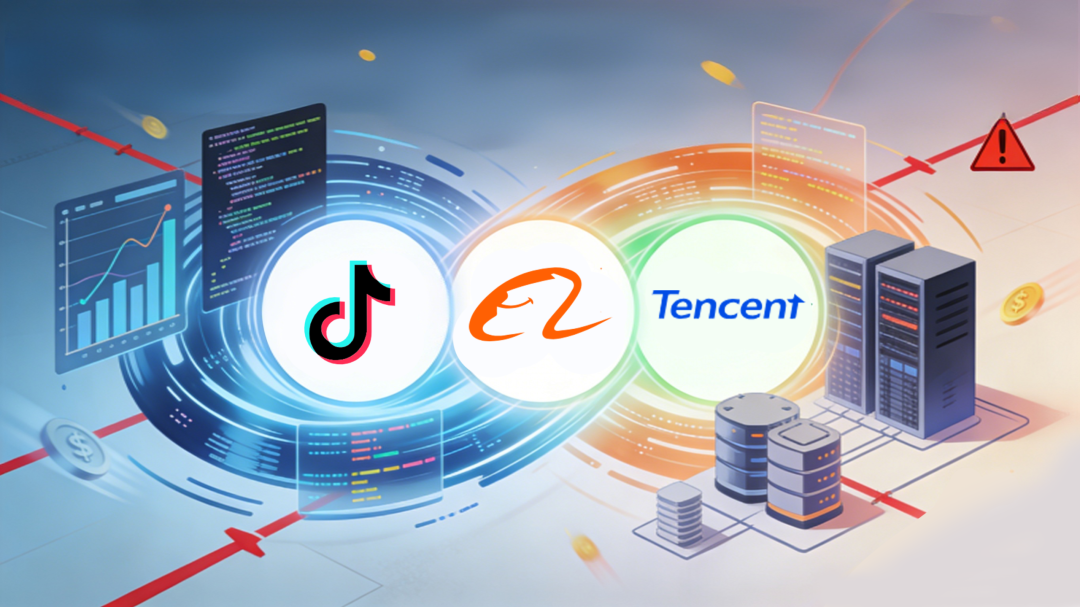 ▲Photo/AI-Generated
This isn't just a price war; it's a life-and-death struggle for "who secures the next mobile internet tickets." After all, whether gunpowder becomes fireworks or firearms depends on whether you face a festival or a war.
And now, the war begins.
The Rearview Mirror of History: All AI Awaits Its 'iPhone 4 Moment'
To grasp the battlefield dynamics, let's rewind the timeline by 15 years.
There's nothing new under the sun. Today's AI war closely resembles the eve of the mobile internet explosion. Let's revisit how smartphones gradually emptied our wallets and reshaped the world.
Around 2011, if you bought a smartphone, what did you do most often? You swiped at "Fruit Ninja," watched a tiny runner dash across the screen. Back then, touchscreens were merely novel toys. Users found the keyboard-less screens somewhat useful—for gaming.
Yet it was Fruit Ninja, Angry Birds, and Temple Run that demystified smartphone technology for us. This phase could be called the smartphone popularization period.
Soon after, Meituan, Dianping, and Lashou initiated the infamous "Thousand-Group War." Streets teemed with promoters urging you to download apps. Giants burned subsidies frenziedly: 9.9 RMB movies, 1 RMB gourmet meals. Were they just squandering money? No. Their goal was to forcibly reshape your payment habits.
This war taught Chinese people to bind cards to phones and spend via mobile. This phase was the habit-formation period.
By 2014, the final battle for mobile payments erupted. Didi and Kuaidi burned billions during a snowy winter. After this clash, the mobile internet landscape was set. WeChat Pay and Alipay cemented their roles as the "water, electricity, and coal" of mobile internet. No matter how other apps struggled, they merely bore fruit from these two trees.
This battle determined whether you'd use Alipay or WeChat Pay for the next decade—the entry point lock-in period.
Now, let's return to 2026. Where does China's AI stand?
From 2023 to 2025, people teased chatbots in ChatGPT, generated anime-style beauties in Grok, and gasped at Sora's release, declaring, "The film industry is doomed!" This was AI's "Fruit Ninja moment." People watched the spectacle, tried it out, but uninstalled it after two days due to a lack of pressing needs.
By late 2025, things changed. You'll notice Tencent's Yuanbao, Alibaba's Tongyi Qianwen, and ByteDance's Doubao all began exploring what AI could actually do—or how to monetize it. They started subsidizing memberships, integrating AI into DingTalk, WeChat, and Feishu.
This marks the eve of AI's "Thousand-Group War."
All giants now realize: The era of play is over. They must teach users to accomplish real tasks via AI—even pay for it.
Why the urgency? Fear.
Fear's name is Nokia.
Until 2011, when the "Thousand-Group War" began, Nokia remained a top-three global smartphone seller by volume. It was still profitable, still massive, still seemingly impenetrable. Yet in everyone's mind, Nokia's era had ended.
Today's WeChat, Taobao, and Douyin are yesterday's Nokia. They still boast hundreds of millions of daily active users and generate staggering revenue. But if AI truly births a new ecosystem—where a single voice command to an AI completes shopping, socializing, and entertainment—
—then whoever lags becomes the next Nokia.
Driven by fear, Pony Ma, Jack Ma, and Zhang Yiming—China's most powerful internet figures—have made starkly different choices.
The Deep Waters of Gameplay: Each Giant Pursues Its Own 'Imperial Seal'
While all appear to be throwing money around, vying for the Lunar New Year spotlight, and distributing red envelopes, a closer look reveals divergent goals beneath their seemingly aligned strategies. Tencent's "Defensive Offense" and the Aesthetics of Traffic Violence.
Legend has it that years ago, Pony Ma and Tencent's founders held a meeting where he asked: What's our greatest trump card?
A few executives answered "cash," but Pony and most agreed it was "traffic."
What does Tencent fear most today? Not that its AI is less intelligent or has fewer parameters than rivals. It fears AI reshaping social relations and Tencent losing its traffic gateway.
Thus, Tencent's strategy is clear: Mirror WeChat Pay's high-frequency playbook. Ensure AI evolves within Tencent's ecosystem.
Tencent is in commercialization's first phase: It's not rushing to monetize AI directly but using it to solidify WeChat's moat. This is a "defensive offense." Tencent doesn't want to create a WeChat disruptor; it wants WeChat to become that disruptor.
Alibaba's "Hasty Cultivation" and Survival Anxiety
Compared to Tencent's steadiness, Alibaba seems impatient, even prematurely sprinting. From 1-cent milk tea to 1-cent cola, bread, and Hema supermarket deals, what is Alibaba doing? It's skipping the entertainment and social phases, diving straight into phase two: commercialization and monetization.
This urgency stems from Alibaba's existential anxiety. Pinduoduo is eroding its e-commerce base; ByteDance is seizing ad revenue. Alibaba Cloud, its future hope, desperately needs a new growth engine.
Thus, Alibaba's strategy: Not just usage, but transactions. Quark Browser clearly can't fulfill this, hence the emergence of Qianwen and Lingguang. AI now permeates DingTalk, Xianyu, Aoxia, and other Alibaba apps.
This is very Alibaba: pragmatic, efficient, money-centric. But if users rebel against this utilitarian AI, Alibaba might repeat its past social media missteps—rising early but arriving late.
ByteDance's "Dimensional Disdain" and High-Stakes Gamble
The most intriguing player is ByteDance. As China's sole internet firm consistently launching DAU-exceeding-100-million apps in recent years, ByteDance's year-end battle tactics are enigmatic.
Doubao secured the 2026 Spring Festival Gala's AI interactive slot. Logically, this should be a cash-burning, red-envelope-laden, user-acquisition frenzy. Yet leaked details suggest ByteDance's public welfare during the gala pales compared to Alibaba and Tencent's past extravagance.
Is ByteDance short on cash? Hardly. Its cash flow might be China's strongest. The only explanation: Zhang Yiming disdains short-term skirmishes.
Today's Doubao, Yuanbao, Qianwen, even ChatGPT, Grok, and Gemini, are merely transitional forms. ByteDance wants a native AI—a product entirely distinct from today's recommendation-algorithm-based offerings, one capable of disrupting interaction logic as Today's Headlines disrupted portals and Douyin disrupted short videos.
Zhang Yiming is betting: When Alibaba's users tire of paying and Tencent's users tire of typing, ByteDance will unveil an addictive, AI-generated-stream-based product—like the vertical swipe that once hooked users—to end the game.
This is Zhang Yiming's arrogance and bias: I don't compete for short-term gains; I redefine the rules.
Final Guess: Who Secures the Ticket?
In business, there are no absolute rights or wrongs—only winners and losers. But in AI's infinite game, history offers a cruel lesson:
Those rushing to harvest often lose to those planting trees; yet tree-planters might be uprooted by those inventing new species. But inventing new species is arduous. Pioneers often die in the pre-dawn darkness. Once validated, tree-planters and fruit-pickers will swarm in with overwhelming resources to seize the spoils.
AI's war has just entered the qualifying rounds. For us ordinary folks, don't rush to pick sides or panic. Let the bullets fly a while longer.
After all, when trillion-dollar giants panic, burn money recklessly, and claw at each other, it signals that true technological upheaval and social stratification shifts are nigh.
- END -
-
![]()
Who’s Sounding the Alarm on ‘Rushed Vehicles’?
-
![]()
Over 5.3 Billion Yuan in Losses Over Three and a Half Years! Can Yonyou Reverse Its Fortunes Through Streamlining and AI Transformation?
-
![]()
Baidu AI Adopts Free Model: A Strategic Maneuver in Traffic and Monetization
-
![]()
Silicon-Based OLED Pioneer Unveils Financial Results: H1 Shipments Outpace Entire 2025 Volume
-
![]()
AI's First "Lost Summer"
-
![]()
Zeiss Makes Another €2.2 Million Bet: Will Eye Tracking Be the Next Big Thing in the Smart Glasses Industry?
-
![]()
RUNTO Ranking | Global Top TV ODM Factories' Shipment Figures for July 2026
-
![]()
Dealer Service Operational Prowess | How After-Sales Managers Can Harness Efficiency and Expertise to Secure Trust in the New Energy Era