During the Spring Festival, I did some research: Meituan's AI is genuinely here to solve problems
 02/24 2026
 711
711

The most important thing is not to help users spend money, but to help them save money and time. Author I Wang Bin
Cover I Batman: The Dark Knight
The Spring Festival, a definitive entry point for traffic, yet an uncertain window for commercial trial and error.
At this juncture, nearly everyone's consumption decisions lean toward the option with the highest certainty.
Whether the New Year's Eve dinner reservation is secured, if the gathering spot is suitable, if the elderly can sit comfortably, where to continue after the meal, and how to stack discounts for the best value. In the special atmosphere of the New Year, any misstep in any link (link) can directly translate into embarrassment, waste, or even family conflict.
Against this backdrop, Meituan's recent announcement of upgrading "Wen Xiaotuan" seems particularly fitting. According to official sources, during the Spring Festival holiday, users can obtain precise local dining, entertainment, and leisure options through conversational interactions, and the AI agent can also recommend the optimal coupon usage plan.
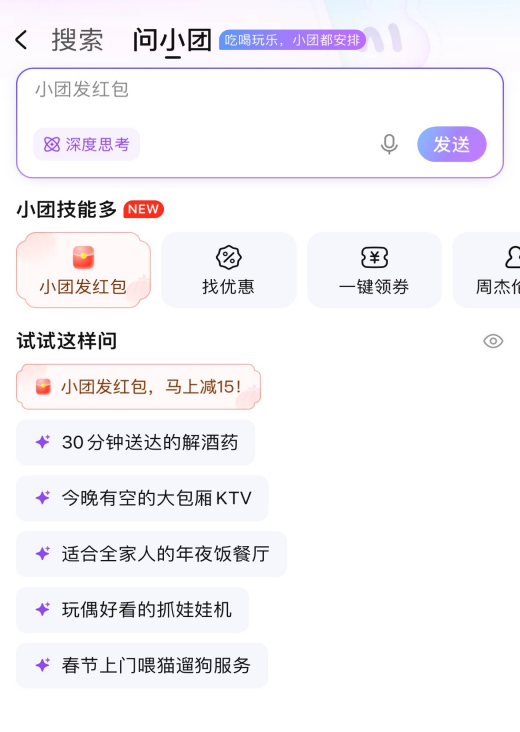
Meituan Upgrades "Wen Xiaotuan" AI Assistant
Meituan's AI move suddenly made me realize something: during the Spring Festival, what everyone needs most is not AI to handle tasks for me, but to filter and recommend precise information—something that Xiaotuan, embedded within the Meituan App, can precisely accomplish.
An abundance of search results does not necessarily make decision-making easier. Complex coupon stacking does not necessarily mean more savings. Just because a merchant's page shows it's open does not guarantee availability upon arrival. In the Spring Festival context, information lag and errors are quickly amplified.
The future belongs to AI Agents is almost a consensus, and Meituan AI has chosen to start from its core moat business—local life—and enter the vertical track (track).
Amid the current heated "red envelope, free order" subsidy wars among other AI players, Meituan's move to "stay true to itself" becomes increasingly intriguing: In a scenario with highly dynamic information, complex supply, and extremely high fulfillment requirements, what exactly do users need from AI? And what kind of AI can meet those needs?
AI has already entered our lives, but how close is it to the "local" realm?
Over the past year, large models have been embedded into nearly all digital products.
From office software to search engines, from video platforms to e-commerce pages, whether for entertainment or productivity, AI is becoming a default configuration. Writing emails, creating PPTs, editing videos, generating images—more and more daily tasks now rely on it. Technology's presence is internalizing into a background capability.
However, AI's penetration into the latter stages of consumer decision-making remains limited.
At the content level, AI generates content; at the recommendation level, AI sorts; at the search level, AI understands queries. But when it comes to spending money, especially in local life decisions, AI's reach becomes cautious.
E-commerce might be an intermediate ground. It wasn't until recently that companies like OpenAI began large-scale (massively) attempting to integrate recommendations with shopping paths. Even then, the supply structure of online e-commerce is relatively stable, with transparent inventory and pricing, and standardized fulfillment paths—essentially still occurring in the digital space.
Local life's dining, entertainment, and leisure add another layer. Content generation happens in the digital space, while local life unfolds in the physical world. The physical world is not a static database; it's constantly changing. Whether a restaurant is open, if private rooms are available, if the merchant is temporarily closed, if prices are adjusted during holidays, how discounts are combined—these variables constitute the real decision-making environment.
Using AI to help users spend money does not align with users' real needs at present. Currently, in dining, entertainment, and leisure scenarios, users' most urgent need is to find a reliable store and a service that can be ordered now and fulfilled immediately. In other words, it's about analyzing and matching consumption needs based on real, accurate information and providing immediately tradable options for users to choose from.
This is a more conservative but also more realistic expectation. Therefore, the value of AI, especially AI Agents, in local life scenarios is already clear: the most important thing is not to help users spend money but to help them save time and money.
If not, the Agent is just a search box in a different form. And this is precisely the first dividing line faced by local life AI.
When large model capabilities become homogeneous, the key differentiator in experience lies in whether it can take responsibility for outcomes. In a highly dynamic, immediate fulfillment scenario like local life, any suggestion implies a certain responsibility.
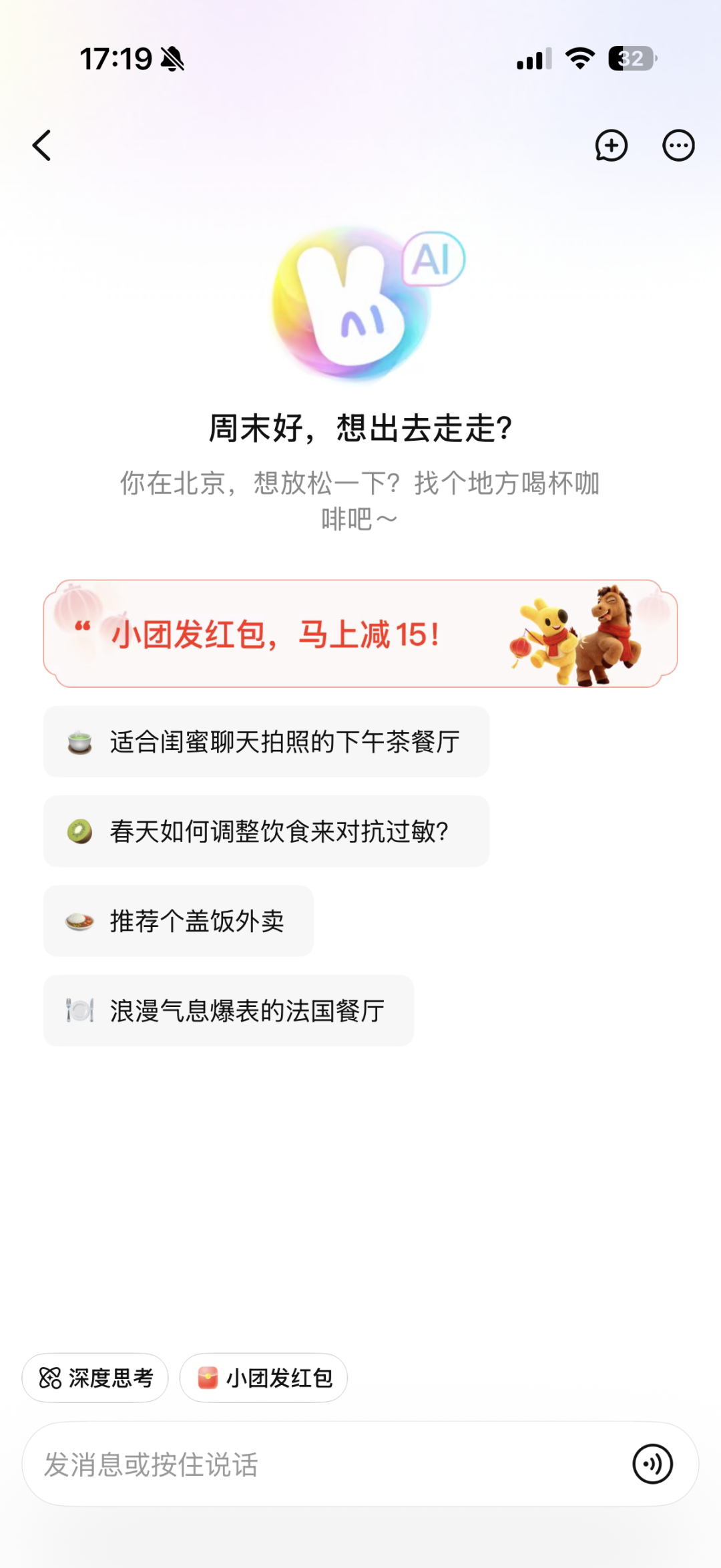
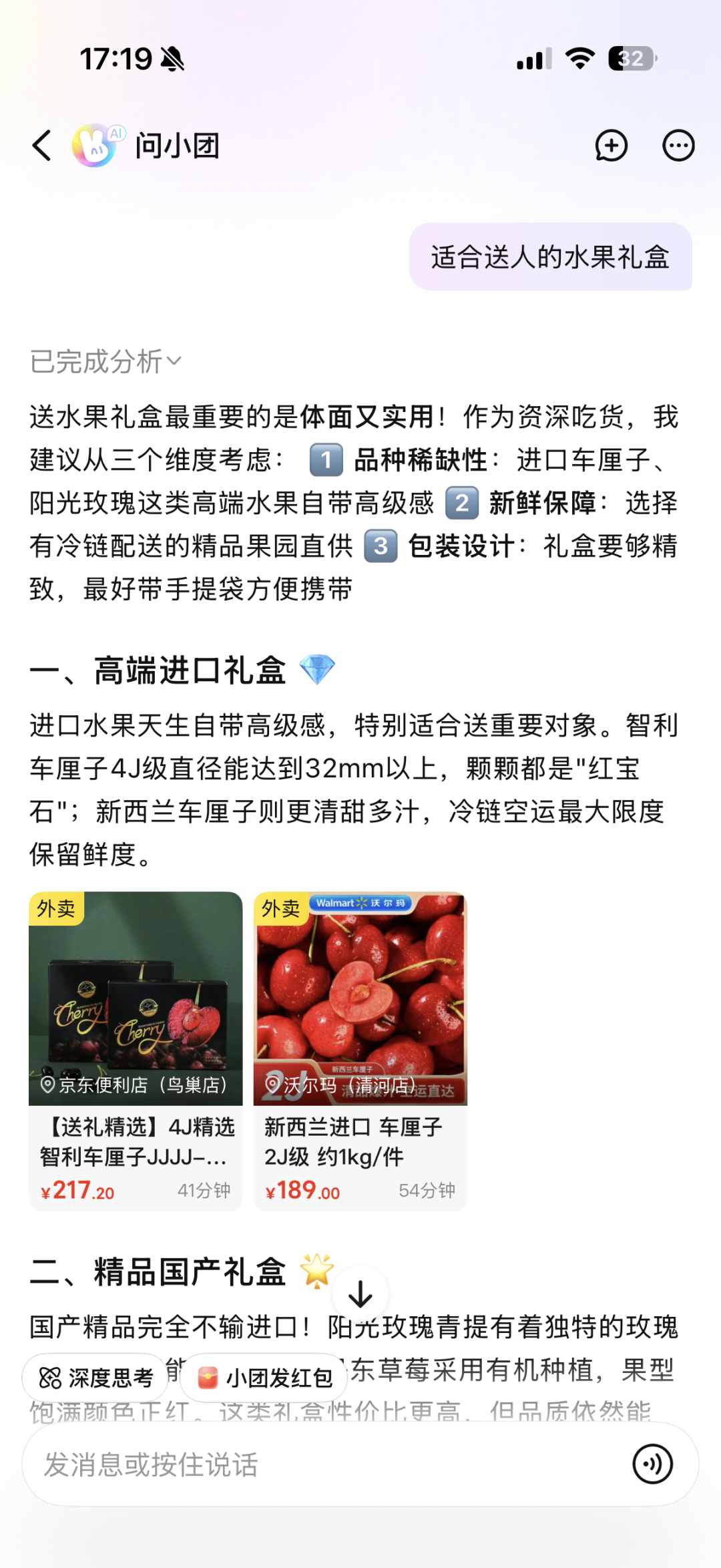
Wen Xiaotuan
This becomes the underlying logic behind Meituan's upgrade of Wen Xiaotuan. A few days ago, DonLi, the product lead for Meituan's AI agent "Xiaotuan," stated in an interview that Meituan's starting point for AI products is "hardcore problem-solving capability," which, when mapped to specific experiences, means delivering "authenticity."
And the value of authenticity, from the user's perspective, is saving money, saving time, and avoiding pitfalls.
Dining, Entertainment, and Leisure Can Also Have an AI Assistant
A background note: This is Meituan App's AI transformation's first major test in a true sense. Early last year, Meituan first disclosed its AI strategy, divided into three directions: AI at work, AI in products, and Building LLM. Under AI in products, Meituan will leverage AI to transform existing B2B and B2C products, with currently launched products including Xiaotuan and Xiaomei.
Among them, "Xiaomei" is a brand-new native AI Agent App that supports users' various daily interactions and AI "task-handling" needs; "Wen Xiaotuan," as a tool, is embedded within the Meituan App, focusing on AI-powered information queries and searches.
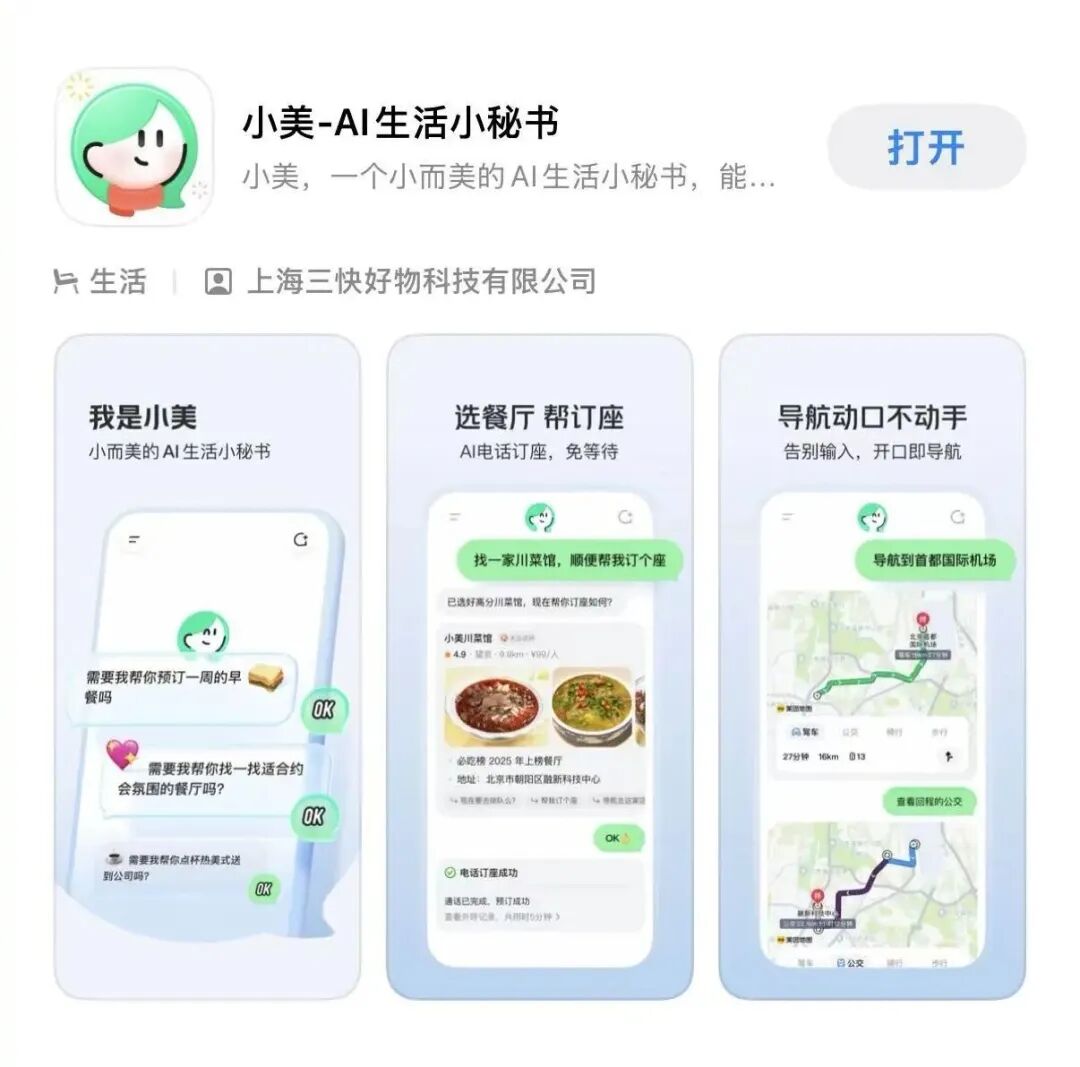
Meituan's standalone AI product, Xiaomei
After the upgrade, Xiaotuan becomes an AI butler capable of automatic planning and coupon collection, essentially an AI-driven reconstruction of local life information and transactions to enhance the overall user experience.
The Spring Festival scenario happens to be the most complex for local life needs. During the holiday, merchant operating hours are unstable, various discount information is abundant, red envelope stacking rules are complex, and cross-scenario planning needs explode. More information does not necessarily mean easier choices; more discounts do not necessarily mean real savings.
Meituan's decision to upgrade Wen Xiaotuan is supported by dual pillars of supply and demand.
From the platform's basic matching function, Wen Xiaotuan's capability lies in effective and immediate matching. Lead DonLi publicly stated that Meituan's local life information's completeness and update timeliness can reach "over 95 points."
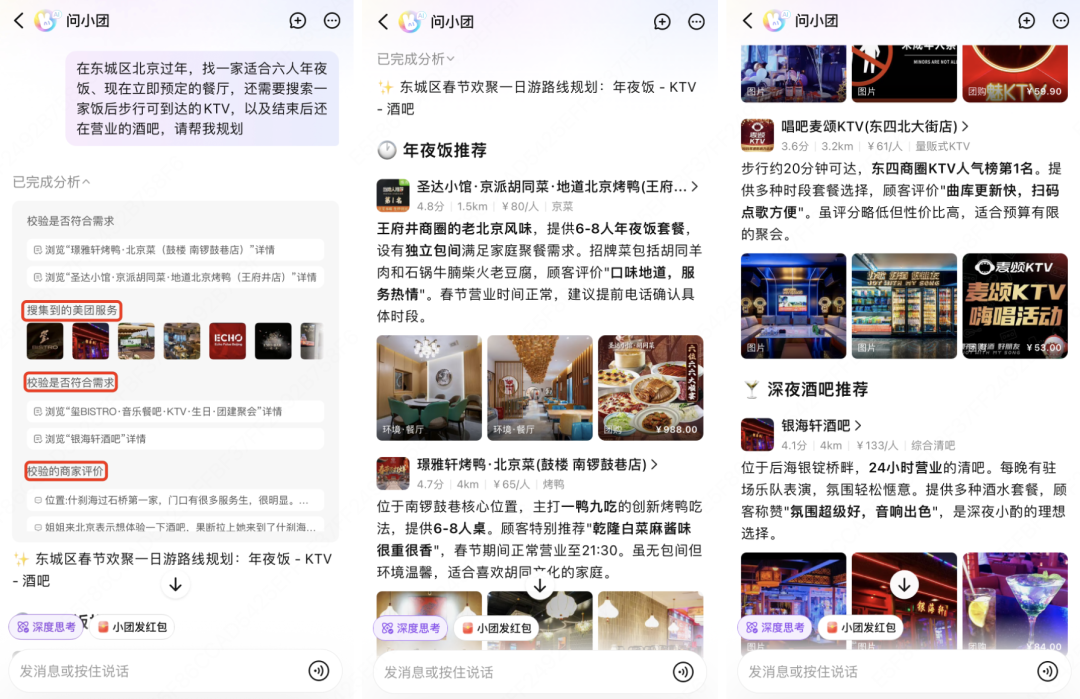
This "Wen Xiaotuan" upgrade aims to address users' real pain points in local life during the Spring Festival
On the one hand, information supply is trustworthy. AI only screens within the platform's fulfillable supply system, searching for real existing Meituan merchant information and services. Consumer experience is safeguarded; beyond basic information like "can I go," it validates merchants based on real user reviews from ecosystem infrastructures like Dianping, ultimately answering "is it worth going."
On the other hand, service matching is precise. AI automatically matches complex conditions such as headcount, time, distance, reservability, operating status, and suitability for elderly and children, completing multi-round screenings for users to achieve immediate service and consumption deliverability.
Besides, there's assistance in decision-making actions. Based on merchant recommendations and immediately tradable options, Wen Xiaotuan can achieve automatic coupon collection and optimal coupon combinations, reducing users' costs of switching between rules.
Thus, a multi-step process that originally required searching, comparing, calculating coupons, confirming operating status, and planning routes is compressed into a single conversation and order placement.
This does not conflict with Meituan's advantageous logic in the mobile internet era. Saving users time and money has long been its emphasized value direction. The difference is that in the AI era, this capability no longer relies on users flipping through pages, screening, and combining themselves—it can be automatically completed through models and information systems.
Valuably, when recommendations, validations, coupon collection, and transactions are integrated within the same closed loop, users' local life information service experience transforms from reliable, cost-saving information searches into concrete consumption plans. And this transformation, in turn, shortens decision paths, strengthens platform matching efficiency, and enables Meituan's original commercial flywheel to gain new driving variables.
In Local Life, Real Information Infrastructure Is the Foundation of AI Value
Objectively speaking, Meituan's upgrade of Wen Xiaotuan this time is not a groundbreaking technological path breakthrough.
It is understood that besides being powered by Meituan's self-developed LongCat model, Wen Xiaotuan also integrates various mainstream large models based on different user needs, enabling better completion of different tasks. During actual experiences, whether given clear instructions or vague, long, complex sentences, relatively clear responses can be obtained. From a model perspective, this is more like an integration and orchestration.
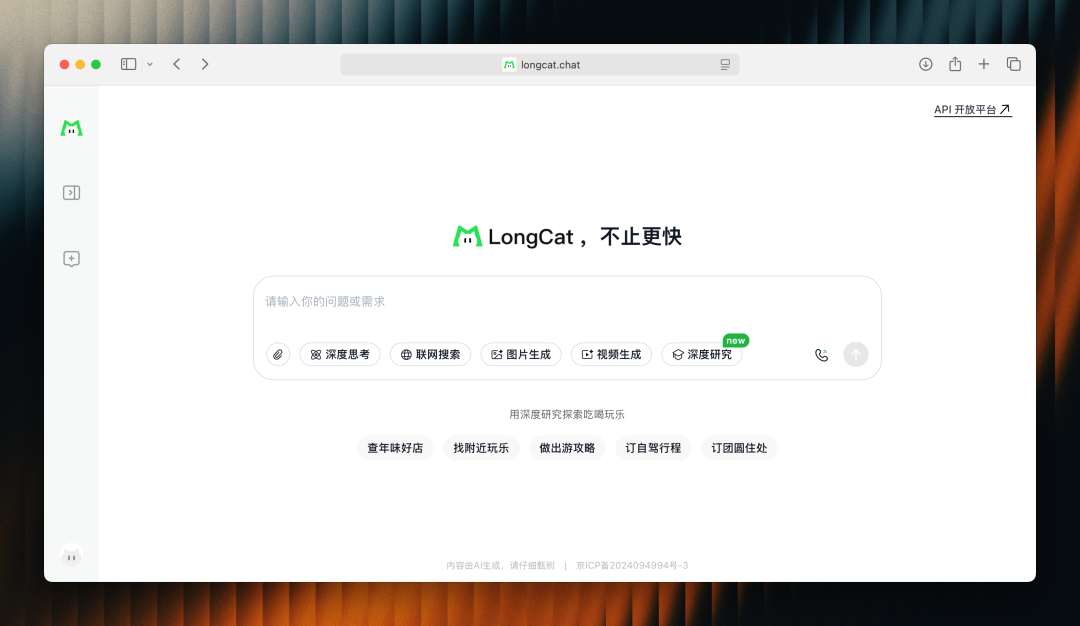
Meituan LongCat
But from a commercial path perspective, Wen Xiaotuan's significance lies in its focus. It is a concrete manifestation of Meituan's entry into the AI era, targeting users' real needs, and a reorganization of its local life capabilities accumulated over the past decade.
Local life itself is a tough business, heavy on offline operations and frequent updates. The difficulty of AI cut into (entering) local life scenarios lies not only in the natural complexity of language understanding but also in the extremely high underlying information maintenance costs.
Merchant basic information is not a one-time entry. Coordinates, business district relationships, traffic routes, operating hours, table quantities, private room situations, facility conditions—all these require continuous updates. More complex are dynamic states: closures and new openings, temporary holiday changes, service capacity variations, equipment updates, even down to whether pets are allowed or parking is provided.
Maintaining this information relies not just on back-end submissions. Over a long period, Meituan has built a diverse and solid system: continuous submissions from its ground sales teams, merchant ecosystem updates and feedback, on-site data from riders during fulfillment, real statuses from in-store verification and transaction chains, and user-generated content (UGC)... All these are repeatedly calibrated and structured through an "AI + manual" verification mechanism to form a callable data foundation.
Coupled with the authentic reviews accumulated by Dianping over the years, it provides another layer of linguistic support for the model. This backs up recommendation credibility and serves as understanding material for experience dimensions.
Amid the large model wave, more and more platforms are integrating conversational capabilities. In the digital content realm, model capabilities might determine the experience; in local life, information accuracy, update frequency, verifiability, and final deliverability truly determine result reliability. Without a solid foundation, models will only amplify errors.
From this perspective, Meituan is clearly betting on more than just a traffic (traffic) war during the Spring Festival—it's translating its supply system, information network, and fulfillment capabilities accumulated in local life over the past decade into AI-era product forms to better serve users.
If the future belongs to AI Agents, then the coordinate of local life must lie in the precision of the real world.
The Spring Festival is merely a demonstration under high-pressure scenarios. At least in the local life realm, AI value relying on red envelopes or trending topics clearly doesn't hold. Users still ultimately need an optimal solution that saves time, saves money, and avoids pitfalls.
Just like what Meituan has been doing all along.
© All rights reserved by Shanshang. Unauthorized reproduction is prohibited.
-
![]()
Doubao Work Unveiled! Domestic AI Leaders Fully Commit to the 'Work' Sector
-
![]()
Who’s Sounding the Alarm on ‘Rushed Vehicles’?
-
![]()
Over 5.3 Billion Yuan in Losses Over Three and a Half Years! Can Yonyou Reverse Its Fortunes Through Streamlining and AI Transformation?
-
![]()
Baidu AI Adopts Free Model: A Strategic Maneuver in Traffic and Monetization
-
![]()
Silicon-Based OLED Pioneer Unveils Financial Results: H1 Shipments Outpace Entire 2025 Volume
-
![]()
AI's First "Lost Summer"
-
![]()
Zeiss Makes Another €2.2 Million Bet: Will Eye Tracking Be the Next Big Thing in the Smart Glasses Industry?
-
![]()
RUNTO Ranking | Global Top TV ODM Factories' Shipment Figures for July 2026