This Spring Festival Sees E-commerce Take a Subtle Step Back
 02/24 2026
 597
597
The advent of new technologies has not only enriched people's spiritual and material lives but also signaled the inevitable decline of established powers with the rise of new leaders. This Spring Festival, the understated presence of major e-commerce platforms marked another subtle shift in the internet landscape.
Cover image source: Unsplash
What stole the limelight this Spring Festival? The answer is unequivocally AI and robots.
Switching on the TV to watch the Spring Festival Gala, from CCTV to local stations, robot-themed performances stole the show, ranging from dance and martial arts displays to fashion shows, captivating audiences and subtly becoming a new highlight of the Spring Festival festivities.
Meanwhile, scrolling through social media, one is immediately bombarded with various AI applications. The red envelope battle between Qianwen and Yuanbao raged on, while Seedance 2.0 quickly made a splash on short video platforms with its powerful generative capabilities. Even offline, the new electronic darling of the masses has become the versatile Doubao.
The ascent of new technologies has significantly boosted people's spiritual and material well-being. However, the emergence of a new generation of leaders is often accompanied by the decline of the old guard. This Spring Festival, the muted presence of major e-commerce platforms signaled another nuanced change in the internet industry.
From the fierce bidding wars for CCTV Spring Festival Gala sponsorships to the relentless pursuit of 'business as usual' during the festival, e-commerce has long dominated the scene in recent years. Whether traditional e-commerce giants like Tmall, Pinduoduo, and JD.com, or new internet stars like Douyin, Kuaishou, and Xiaohongshu, all sought to capitalize on the high traffic during the Spring Festival to boost their e-commerce businesses.
However, with AI and robots disrupting this tradition, it appears that the future of domestic e-commerce may be bidding farewell to its heyday.
1
Spring Festival Gala Sponsorship Trends
The sponsorship rights for the CCTV Spring Festival Gala have always been a barometer of public attention. Especially since 2015, internet companies have officially overtaken traditional manufacturers as the dominant force in collaborations with the CCTV Spring Festival Gala, leading to more frequent interactions between large and small screens during the event.
For the 2026 CCTV Spring Festival Gala, although there was no single title sponsor, traditional consumer brands took a backseat while cutting-edge technology took center stage, based on the announced list of partners.
According to Cailian Press statistics, in the field of robots and AI, the 2026 CCTV Spring Festival Gala announced partnerships with companies such as Unitree Technology, Volcano Engine, Galaxy General, Songyan Power, Magic Atom, and Dreame Technology. ByteDance's AI company Volcano Engine and its large model Doubao also collaborated with the 2026 CCTV Spring Festival Gala.
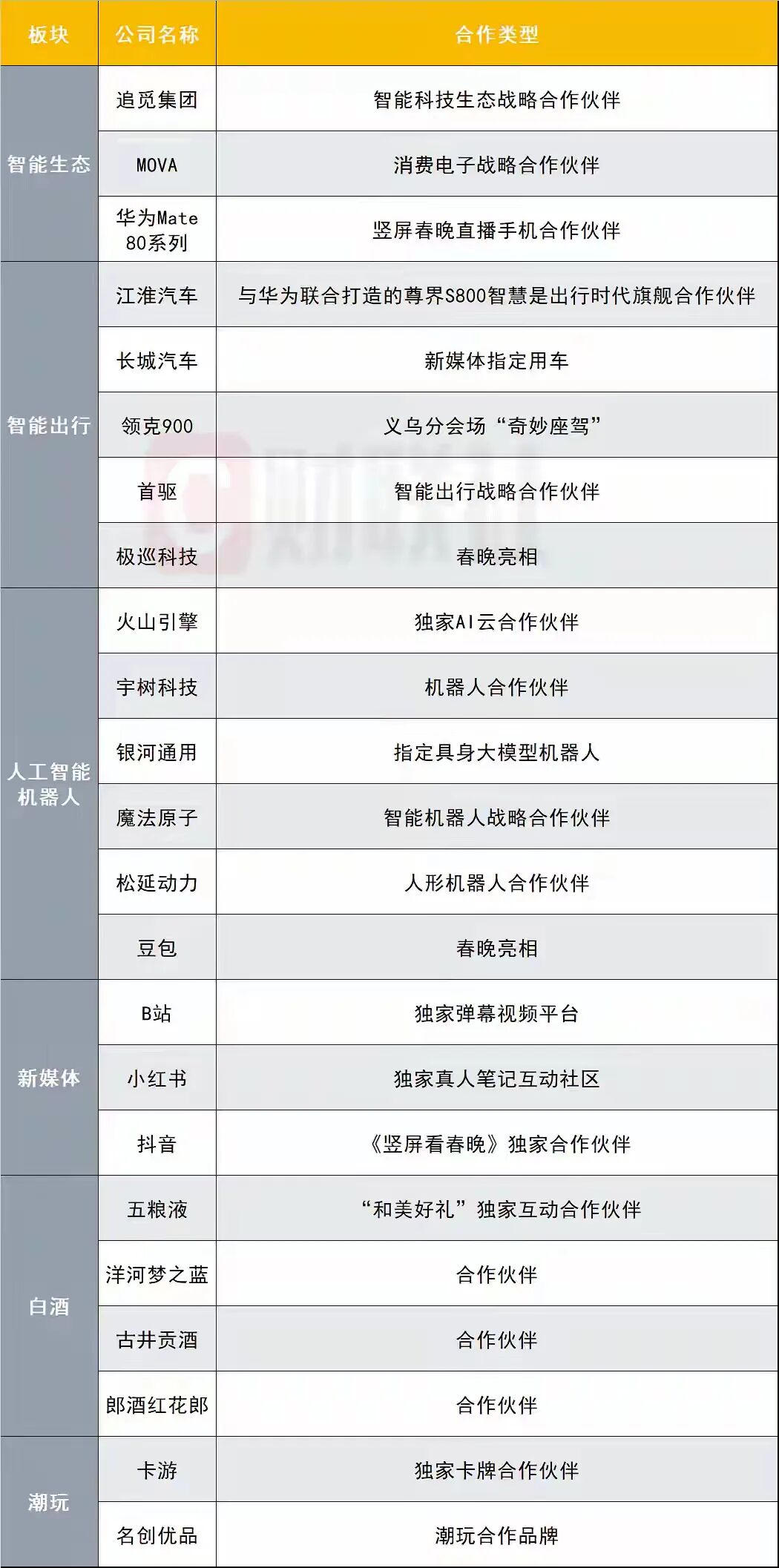
Among internet platforms, this year's CCTV Spring Festival Gala only collaborated with Douyin, Bilibili, and Xiaohongshu, limited to new media dissemination, including vertical screen viewing, bullet screen videos, and real-person note interactions.
In contrast, the previous 2025 Spring Festival Gala featured an exclusive e-commerce interactive platform, secured by Taobao with a generous 2.5 billion yuan in red envelopes, along with physical prizes such as cars, phones, and concert tickets for users.
From this year's local TV Spring Festival Galas, the sponsorship C-positions previously occupied by e-commerce, short videos, and social software have largely been supplanted by AI large model companies' marketing efforts.
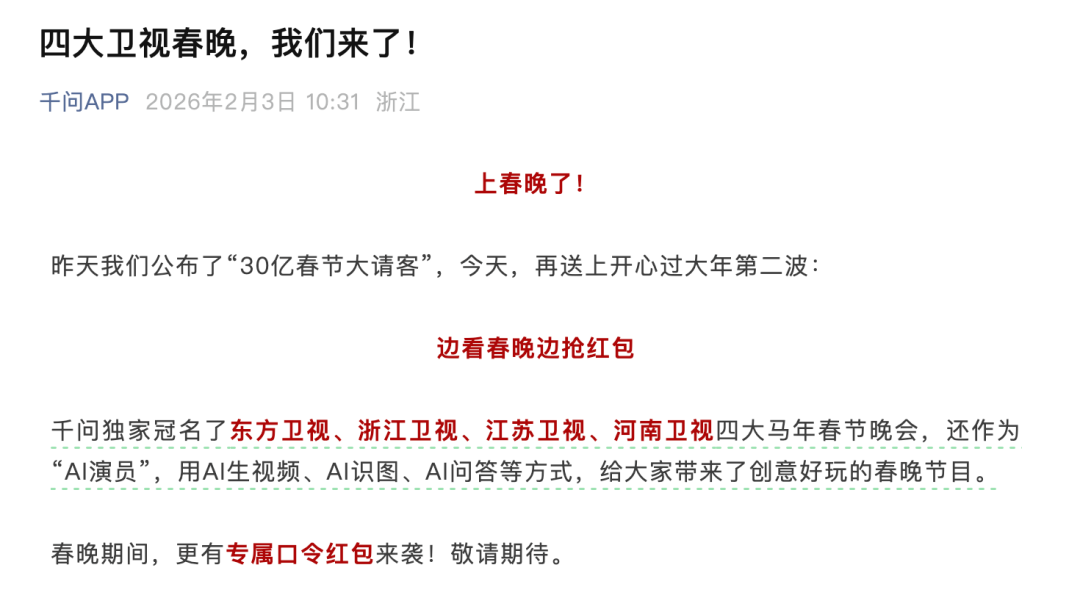
Among them, Qianwen, backed by Alibaba, once again showcased its financial clout. After announcing the '3 billion yuan Spring Festival giveaway' for free milk tea in early February, it invested another 3 billion yuan during the New Year, securing exclusive sponsorship for the Spring Festival Galas of four major satellite TV stations: Henan, Dragon TV, Zhejiang, and Jiangsu. This not only achieved full-link brand exposure in opening and closing credits, corner logos, oral promotions, and interactive pages but also participated in program co-creation as the official AI partner.
Although Tencent's Yuanbao App did not secure the sponsorship rights for local TV Spring Festival Galas, it deepened its cooperation with the Liaoning Spring Festival Gala. Besides becoming a special broadcasting partner, many programs on the Liaoning Spring Festival Gala also incorporated soft advertisements for Yuanbao.
Another internet giant, Baidu, also collaborated with two Spring Festival Galas to promote its products. Baidu Maps became the exclusive special partner for the Tianjin Crosstalk Spring Festival Gala, while Baidu App secured the chief AI partner position for the Beijing TV Spring Festival Gala.
If we also consider Tengshi Automobile as the exclusive title sponsor for the Shenzhen TV Spring Festival Gala, Gujing Gongjiu for the Anhui TV Spring Festival Gala, and Kuaishou as the main sponsor (title sponsor) for the Liaoning TV Spring Festival Gala, this year, from the CCTV Spring Festival Gala to local satellite TV Spring Festival Galas, e-commerce platforms have vanished from the list of major partners. Especially the 'Tmall, Pinduoduo, JD.com' trio, which used to compete fiercely for attention during the Spring Festival, have had an unusually 'low-key' year this time.
2
E-commerce Maintains 'Business as Usual'
In fact, similar to previous Spring Festivals, major e-commerce giants still launched 'business as usual' campaigns this year, offering certain traffic subsidies and activity support to merchants who can ship normally during the Spring Festival.
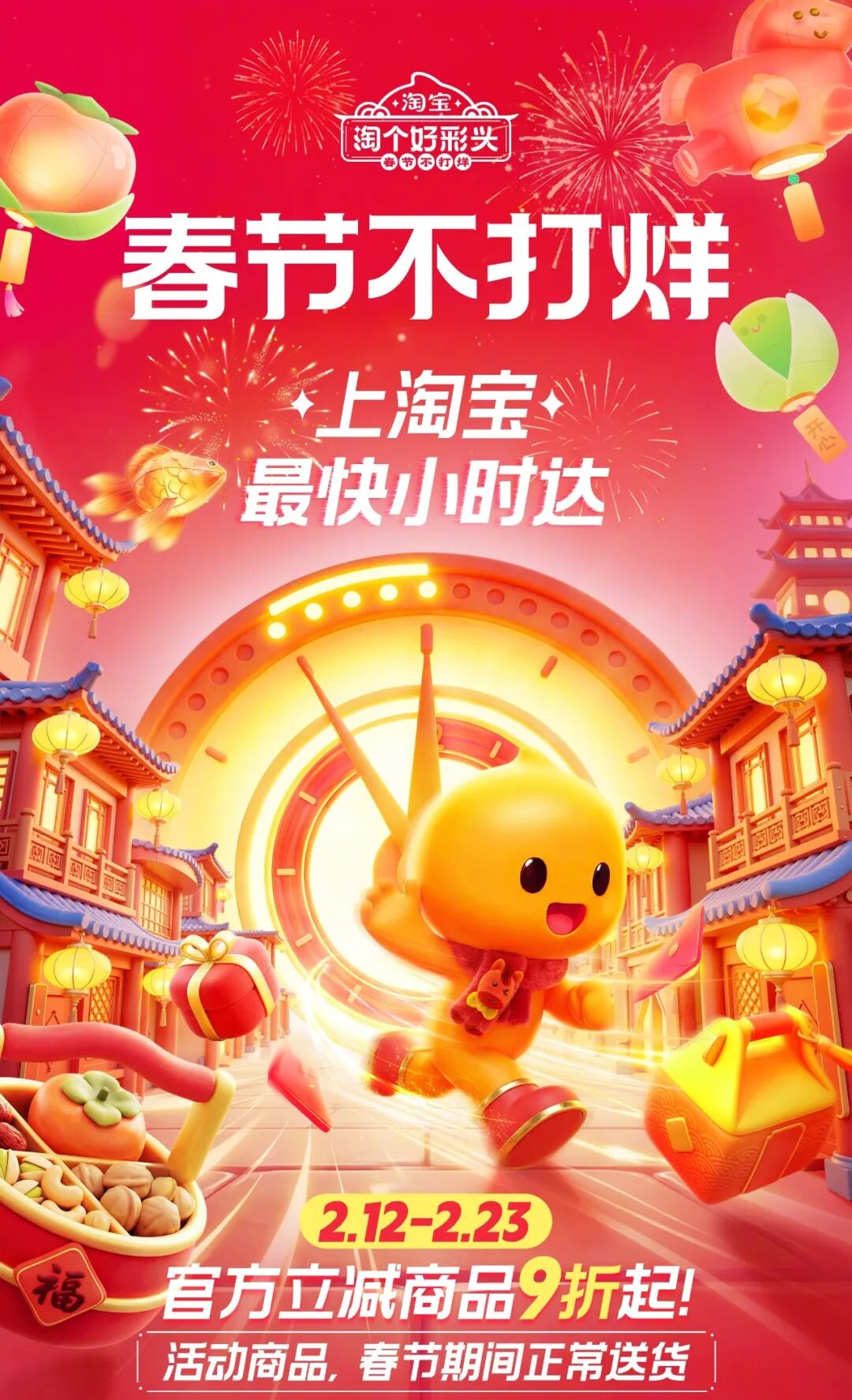
For Taobao and Tmall, the 'business as usual' campaign started on February 12 and covered the entire Spring Festival holiday, with normal delivery available in 220 cities across the country. Additionally, Tmall Supermarket supported normal delivery in 100 key cities nationwide, with delivery efficiency at least half a day earlier compared to last year's average 'next-day delivery.'
JD.com, for its part, JD Logistics will uphold its commitment to 'serve during the Spring Festival' for the 14th consecutive year, ensuring normal ordering and delivery for consumers in over 360 cities and more than 2,200 districts and counties across the country, as well as in many locations worldwide, even on New Year's Eve and the first day of the Lunar New Year.
Pinduoduo's 'business as usual' campaign ran from February 7 to February 24, allowing merchants to participate by setting the 'business as usual' service label. The platform provided traffic support and logistics fulfillment guarantees for participating products. In terms of traffic support, Pinduoduo also prioritized the display of participating products in key positions such as the search end, personalized recommendation feed, and APP homepage.
Additionally, platforms like Douyin E-commerce and Kuaishou E-commerce also launched dedicated 'business as usual' event pages, offering users exclusive subsidies, rapid delivery, and other guarantees.
Although platforms have been encouraging merchants to fulfill orders as usual during the holiday, from a user's perspective, one can still sense that more merchants are choosing to close during the New Year this year. Those that continue to ship normally are basically high-premium big brands, with few small and medium-sized merchants willing to do so during the New Year.
For small and medium-sized merchants, due to the increasingly low-profit margins faced by the industry in the past year or two, the 'cost-effectiveness' of giving up rest and family reunions during the Spring Festival to continue operating has become increasingly low. For some merchants integrating industry and trade, the Spring Festival holiday is the only break in the entire year, with some manufacturers even shutting down for the entire month of February.
Furthermore, logistics and delivery face practical challenges during the Spring Festival. Especially since the State Post Bureau explicitly required in the '2026 Spring Festival Delivery Service Guarantee Plan' to 'ensure basic services are uninterrupted during the Spring Festival holiday' while prohibiting forced overtime and requiring full payment of overtime wages, further echoing the policy-level protection of couriers' rights.
Ordinary merchants have low willingness to work overtime during the Spring Festival, and the costs of logistics and other infrastructure have also risen. If additional investment is made in advertising at the front end, it will be difficult for e-commerce platforms to handle the large traffic during the Spring Festival, even if they can obtain it.
It is worth mentioning that although some e-commerce platforms still retain the 'business as usual' campaign function, they also provide merchants with more autonomy. For example, Douyin Mall has launched a 'delayed delivery' function, allowing merchants to independently choose to close or shorten the delayed delivery time during the period from the 11th day of the twelfth lunar month to the eighth day of the first lunar month. At the same time, Douyin Mall has also relaxed key indicators such as service processing timeliness and Feige average response time for merchants during the Spring Festival.
3
The Real Test Comes After the Spring Festival
Although e-commerce has relinquished its 'C-position' on this year's Spring Festival stage, even failing to secure a 'supporting role,' it remains a battleground for giants and the foundation of businesses in the overall landscape of China's internet technology industry.
In a sense, it's not that e-commerce has lost the high traffic during the Spring Festival, but rather that it no longer needs to prove its value with more promotional investments.
From a marketing perspective, whether it's the battle for title sponsorship of the Spring Festival Gala on the big screen or the red envelope and lucky bag battles on the small screen, it essentially boils down to giants vying for users' attention.
In other words, if big companies want users to notice something, they must place their products in the highest-traffic areas, no matter the cost.
Taking Alibaba's long-standing cooperation with the Spring Festival Gala as an example, in 2016-2017, to regain the payment market lost to WeChat's 'Pearl Harbor sneak attack' with red envelopes, Alibaba consecutively became the exclusive interactive partner for the Spring Festival Gala. The 'Collect Five Blessings' campaign launched by its Alipay subsidiary went viral online and became a new Spring Festival tradition.
In 2018, to promote the shift of its e-commerce business from PC to mobile, Alibaba shifted its cooperation focus from Alipay to Taobao. That year, it launched the 'Taobao Lucky Bag Red Envelope Rain' campaign, distributing over 1 billion yuan in cash red envelopes and introducing interactive games like 'Clear 1,000 Shopping Carts,' significantly increasing the number of mobile Taobao users.
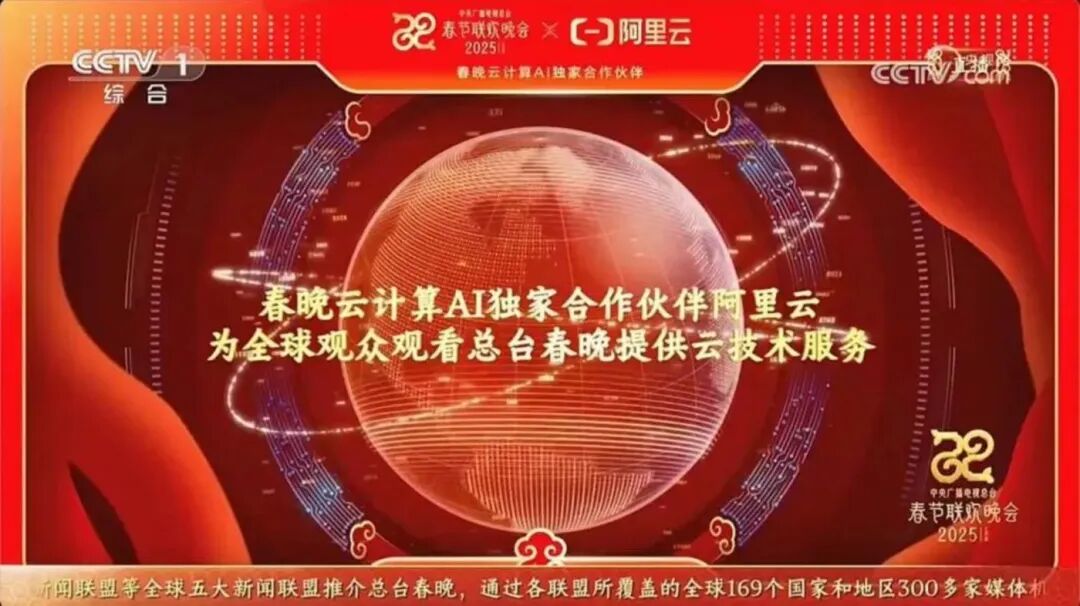
In 2025, Alibaba returned to the Spring Festival Gala stage after seven years, achieving two exclusive collaborations: the exclusive e-commerce interactive platform led by Taobao and the exclusive cloud computing and AI partner role deeply participated in by Alibaba Cloud in a technical capacity. This coincided with Jack Ma's clear statement of 'focus on AI e-commerce' within Alibaba...
From this perspective, the significance of the Spring Festival as a barometer does exist, but the source of the wind is essentially determined by leading companies, the market, and users. After the wind blows, what remains and what is taken away still depends on the vitality of the products themselves.
In this regard, e-commerce seems to have already completed the early stage of user accumulation. Although its growth momentum is no longer as fierce, it is still climbing upwards. What it seeks next is not only to continue maintaining growth but also to achieve a leap in 'quality.'
For AI applications and robots still in the 'pioneering' stage, although they are currently in the limelight, the real test has yet to come. When the New Year's flavor fades, red envelopes recede, and users return to their daily lives, who will continue to be used and paid attention to will truly mark the first step of a long march.
-
![]()
Doubao Work Unveiled! Domestic AI Leaders Fully Commit to the 'Work' Sector
-
![]()
Who’s Sounding the Alarm on ‘Rushed Vehicles’?
-
![]()
Over 5.3 Billion Yuan in Losses Over Three and a Half Years! Can Yonyou Reverse Its Fortunes Through Streamlining and AI Transformation?
-
![]()
Baidu AI Adopts Free Model: A Strategic Maneuver in Traffic and Monetization
-
![]()
Silicon-Based OLED Pioneer Unveils Financial Results: H1 Shipments Outpace Entire 2025 Volume
-
![]()
AI's First "Lost Summer"
-
![]()
Zeiss Makes Another €2.2 Million Bet: Will Eye Tracking Be the Next Big Thing in the Smart Glasses Industry?
-
![]()
RUNTO Ranking | Global Top TV ODM Factories' Shipment Figures for July 2026