AI Becomes the Key Narrative for Kuaishou: After Short Videos, Kling Faces Competition from Douyin's 'Opportunistic Moves'?
 03/27 2026
 744
744
On March 25, Kuaishou released its financial report, showing a year-on-year revenue increase of 11.8% to 39.6 billion yuan in Q4 2025, with adjusted net profit rising 16.2% to 5.5 billion yuan. For the full year 2025, total revenue grew 12.5% to 142.8 billion yuan, while adjusted net profit reached 20.6 billion yuan, up 16.5%, with the adjusted net profit margin improving to 14.5%.
This financial report is thoroughly infused with AI, particularly highlighting that Kuaishou's video generation model, Kling AI, generated 340 million yuan in revenue in Q4. Ironically, on the same day as the report's release, OpenAI announced the formal discontinuation of operations and support for its AI video generation application, Sora.
Kuaishou is now at a stage where market saturation competition is inevitable.
According to QuestMobile data, as of October 2025, the de-duplicated active user base and monthly average usage time per user for typical new media platform apps reached 1.149 billion and 3,367.5 minutes, respectively, representing year-on-year growth of 7.3% and 5.4%. Meanwhile, the penetration rate across the entire internet has reached 90.1%. The industry is nearing its peak scale, leaving little "unexplored territory," and participants' overall growth trends are inevitably slowing.
This is why AI, and particularly Kling, are so crucial.
Publicly traded companies always need a narrative anchor that can rekindle imaginative potential. The AI video generation track ( track , "track" or "field") creates a tension between technological imagination and commercial uncertainty—a tension that capital markets love.
This tension means that AI generation is both a narrative anchor and a variable in itself. The revenue generated by Kling in the financial report is a positive signal; on the other hand, Sora's shutdown reminds the market that technological viability does not guarantee commercial success.
Kling has secured an entry ticket, but the distance from entry to dominance remains unmeasurable.
The Fundamentals in the Era of Market Saturation
In Q4 2025, Kuaishou's daily active users reached 407.7 million, up 1.7% from 401 million YoY, while monthly active users averaged 740.7 million, a 0.7% increase from 735.6 million YoY.
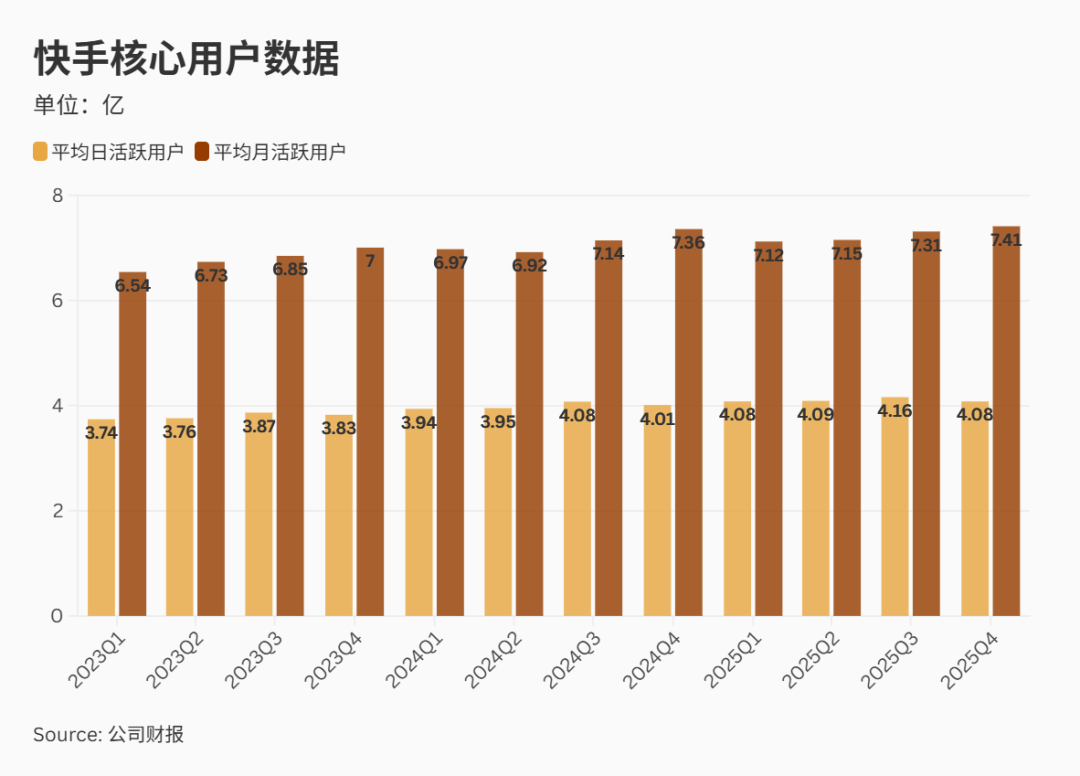
Placing this data in a longer timeline, from Q1 to Q4 2025, Kuaishou's MAU growth rates were 2.8%, 3.3%, 3.4%, and 0.7%. User scale continues to grow, but less efficiently than before.
As previously mentioned, the entire content industry is facing a trend of "natural deceleration." The space for growth driven by new users is shrinking, prompting platforms to shift toward reallocating existing users and refining operations.
Against this backdrop, the focus of growth has shifted. Instead of chasing diminishing traffic expansion, the emphasis is on improving efficiency within the existing user base. From basic content supply and distribution matching to advertising conversion and e-commerce marketing, business actions aim to deeply mine the value of existing users by optimizing efficiency.
Clues can be found in the financial report. Regarding the content ecosystem, the report emphasized that the upload volume of high-quality content works increased by over 15% YoY, while the penetration rate of daily dual-private messages rose nearly 3 percentage points YoY.
Q4 online marketing service revenue increased by 14.5% to 23.6 billion yuan from 20.6 billion yuan YoY, primarily due to AI's accelerated penetration and innovative applications across multiple online marketing scenarios. Specific examples include optimizing marketing material display formats to increase spending in the short drama vertical and upgrading products like UAX fully automated ad placement solutions, AIGC marketing material generation tools, live-streaming digital avatars, and digital employees.
Other services (including e-commerce) revenue increased by 28.0% to 6.3 billion yuan from 4.9 billion yuan YoY. AI also contributed here, such as through the implementation of large models like OneRec and OneSearch, leveraging e-commerce knowledge graphs to improve recommendation diversity and repurchase efficiency using large models. Additionally, more functional order AI diagnostics were introduced to reduce refund rates before shipping.
Notably, Q4 e-commerce GMV reached 521.8 billion yuan, up 12.9% YoY. According to insights from the Q2 2025 earnings call, Kuaishou will stop disclosing quarterly and annual e-commerce GMV separately from Q1 2026, encouraging external focus on other metrics that better reflect long-term value creation. This adjustment aligns with industry peers' practices.
In sync with the rhythm of market saturation competition, the importance of e-commerce scale narratives is declining, much like Taobao, JD.com, and Pinduoduo, which have long abandoned GMV disclosures. While GMV visual presentation (visually demonstrates) platform matching capabilities, it offers limited insight into profits, commission rates, and fulfillment quality.
Within the efficiency optimization of core businesses, AI's presence is particularly strong.
AI's value in cost reduction and efficiency enhancement is undeniable. However, when AI acts as an efficiency amplifier, it primarily tightens existing processes, with its disruptive potential yet to be proven.
This is why the market holds higher expectations for AI, focusing not just on "efficiency gains" but on whether it can construct new supply and demand structures. In contrast, Kling's video generation capabilities offer a narrative direction beyond efficiency optimization: not just making existing systems work better but attempting to reshape content production methods and supply scales.
The Unfinished Business of AI Video Generation
Sora's six-month product journey provides a sobering reference for this field.
In September 2025, OpenAI released the video generation model Sora 2 and launched the iOS social app Sora, which quickly topped the Apple App Store, surpassing ChatGPT's growth record in downloads.
However, Sora's popularity plummeted within months. By January 2026, downloads had dropped 45% MoM, declining sharply for two consecutive months. OpenAI cited reallocating computing resources as the reason, noting that video generation consumes far more computing power than text. According to industry analyst SemiAnalysis, Sora's daily operating costs reached $15 million.
In December last year, Disney announced a $1 billion investment in OpenAI and signed a three-year licensing agreement allowing users to generate video content using over 200 Disney classic characters on Sora. This "powerhouse collaboration" sparked heated discussions on domestic and international social media, seen as a prelude to rewriting industry rules. Now, with OpenAI exiting the video generation business, the future of this partnership remains unclear.
Kling, to some extent, carries similar expectations but follows a more stable development path than Sora.
Commercially, in addition to the previously mentioned revenue, the earnings call revealed that Kling's ARR (annualized run rate) exceeded $300 million in January this year, with confidence in achieving over 100% YoY revenue growth this year.
Models like Sora, both domestic and international, have demonstrated the upper limits of AI video generation capabilities, including complex scenes, long takes, and coherent storytelling. The next step for products is to establish stable paid habits in large-scale creative scenarios beyond technological spectacle.
Since December last year, Kuaishou has released Kling O1, Kling 2.6, motion control features, and Kling 3.0, each update lowering the barrier for creators to enter professional-grade content production and materializing its commercial potential. For example, Kling 2.6's "synchronized audio-visual output" eliminates post-production voiceover disconnections, while motion control enhances character performance controllability.
According to *Wall Street See*, citing Everbright Securities, benefiting from the widespread dissemination of motion control features on overseas social media in South Korea and Russia, as well as membership promotion activities, Kling's daily revenue reached 2.5 times the December 2025 average on January 3, 2026.
 Kling 3.0 generation effect; Source: Kling AI WeChat Official Account
However, Kling's direct competitor, ByteDance's Seedance, cannot be overlooked.
In February this year, Seedance 2.0 launched on Jimeng AI and Doubao, quickly achieving viral spread and mainstream attention under ByteDance's traffic support. According to *CICC Insight*, citing QuestMobile data, Jimeng AI's domestic DAU rose from 3.28 million on February 2 to 5.72 million on February 23 as the primary entry point.
Pricing-wise, Seedance's low-cost penetration and user acquisition strategy are more pronounced, giving it an edge in mass-market expansion. Kling, meanwhile, offers a detailed pricing system targeting professional users' tiered needs.
Domestic AI video generation is now at the global forefront in terms of competitive speed. Amid intense competition, local products are advancing technologically and commercially faster than overseas counterparts. While no paradigm-shifting disruptive products have emerged at the delivery level,
It is crucial to recognize that the fuel driving this competition is not just technological self-driven innovation but also strong demand-side traction.
The domestic market's capacity to consume AI video content is nearly unparalleled globally, with daily consumption time on short video platforms, the density of content creators, and the high-frequency demand for video materials in commercial marketing collectively forming a massive market with strong willingness to pay for AI video tools.
Moreover, this demand is extending toward more vertical, narratively deep content forms, pointing to even greater commercial imagination.
Final Thoughts
"Whether we like it or not, the era of AI reconstructing the world of light and shadow has arrived." This was stated by the Deputy Director of the Television Drama Department at the National Radio and Television Administration at the Shanghai Film and Television Production Conference.
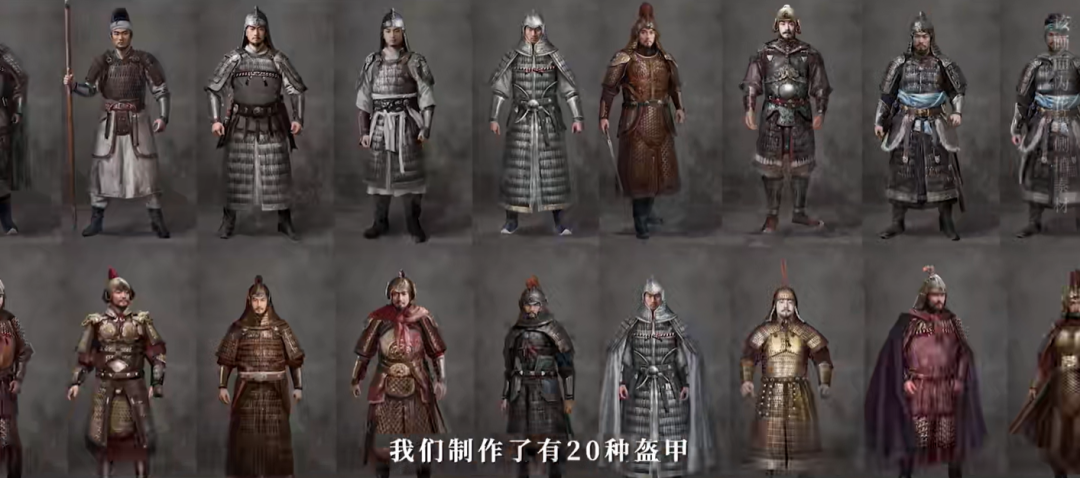 Source: Tencent Video's *Peace in Taiping Years* production special
At the same conference, the President of Huace Film & Television Group shared how the long drama *Peace in Taiping Years* used 8K ultra-HD filming and AIGC technology to restore over 8,000 costumes and 550 scenes from the late Tang to early Song dynasties.
During Kuaishou's Q4 earnings call, management mentioned Kling AI's deep involvement in producing virtual scenes and special effects for the hit drama *Peace in Taiping Years*, ensuring quality while significantly reducing costs.
iQIYI CEO Gong Yu recently stated in an interview with Shenzhen TV that AI-powered commercial blockbusters could arrive as soon as this summer. Meanwhile, the explosion of AI short dramas and comic-based dramas is triggering another industry reshuffle. Short drama production, in particular, is shifting from the asset-heavy model of live-action filming and on-site coordination to a rapid-generation, mass-replication "AI paradigm."
Every supply-side reconstruction presents an opportunity to place new bets. Among internet companies' many "second curve" attempts, AI undoubtedly represents the highest-potential opportunity window—and the most challenging one.
*The featured image and in-text illustrations are sourced from the internet.
-
![]()
The Allure of 'Acquisition Spree': Li Shufu's Left Turn, Xu Jiayin's Right
-
![]()
Strategic Transformation Yields Results: Phoenix Optics Reports 10.9% YoY Rise in Core Net Profit for H1 2026
-
![]()
Three Key Growth Trajectories Synergize! Crystal-Optech Reports 3.478 Billion Yuan in Revenue for H1 2026
-
![]()
Semi-Annual Report Sparks XPENG Motors Buzz
-
![]()
1.6 Billion Big Order Secured! SeeYA Technology's Revenue Soars by 287.87% in the First Half of the Year
-
![]()
Baidu's Profits Plunge by 68%: Unraveling the Mystery Behind the Numbers
-
![]()
Baidu’s Profits Tumble by 68%! Where Has All the Money Gone?
-
![]()
Hynix’s Taobao Store Shuts Down Abruptly: What Should Customers Do About Warranty Services for Memory Modules?