Can Baidu, No Longer Centered on Advertising Revenue, Rise to Prominence with AI?
 02/27 2026
 689
689
Can Baidu, Expanding Beyond Search, Carve Out a Place Among Leading Tech Firms with AI?
Investors Should Let Go of 'Overoptimistic' Expectations for Baidu.
On February 26, Baidu unveiled its financial results for the fourth quarter of 2025, along with its annual report for the year. The financial report revealed that Baidu's total revenue for the fourth quarter of 2025 amounted to 32.7 billion yuan, marking a 5% increase from the previous quarter but a 4% decrease year-over-year compared to 34.1 billion yuan in the fourth quarter of 2024.
For the entire year of 2025, revenue reached 129.1 billion yuan, a 4% dip from 133.1 billion yuan in 2024. Net profit attributable to the parent company also plummeted from 23.76 billion yuan to 5.59 billion yuan.
Unsurprisingly, Baidu's performance once again left the outside world somewhat 'disappointed.' Public sentiment and capital markets are expected to focus their criticism sharply on two key areas: advertising and AI.
However, just as everyone was poised to continue lambasting the decline of its traditional business, Baidu made a symbolic move that directly preempted external criticism: it altered its financial reporting approach, no longer treating advertising revenue as the linchpin of Baidu.
So, why is Baidu redefining its financial reporting strategy at this juncture? Has AI genuinely emerged as Baidu's new growth driver?
01
Shelving the 'Outdated Cash Cow'
Baidu has officially bid farewell to its 'search advertising era.'
Investors who have closely followed Baidu will be well-acquainted with the term 'Baidu Core.' Over the past decade, this phrase has frequently cropped up in Baidu's financial statements and earnings calls, essentially serving as a shorthand for 'online marketing services' (commonly referred to as search advertising, bid ranking, and information feed ads).
It was the bedrock of Baidu's business empire, a veritable cash cow that consistently provided the cash flow needed to support various cutting-edge technological ventures. However, in the latest financial report for the fourth quarter and full year of 2025, this long-standing statistical method, symbolic of the search-dominated era, has been overhauled and redefined.
A seemingly innocuous yet subtly significant note on the change in financial reporting approach appeared in the footnotes of the financial report: 'Starting this quarter, we have redefined Baidu Core as Baidu's general business.'
Baidu's general business encompasses Baidu Core's AI new business, traditional business, and other ventures. Traditional business primarily consists of traditional advertising services offered across search, information feed, and other product lines.
It's crucial to note that changes in the reporting approach of a publicly listed tech behemoth often reveal more about management's strategic intentions than the actual numerical fluctuations.
When a core business that once reigned supreme and contributed the lion's share of profits is officially labeled as 'traditional business' and lumped together with other marginal businesses into a category called 'general,' the commercial undertone is unmistakable: the strategic significance of search within Baidu has effectively 'diminished.'
By redefining it in this manner, Baidu's management is essentially making a candid admission to the capital markets: traffic monetization based on search is no longer, and cannot be, the cornerstone of Baidu's future growth story.
However, this shift was not proactively initiated by Baidu but rather an inevitable outcome forced by fierce competitive dynamics.
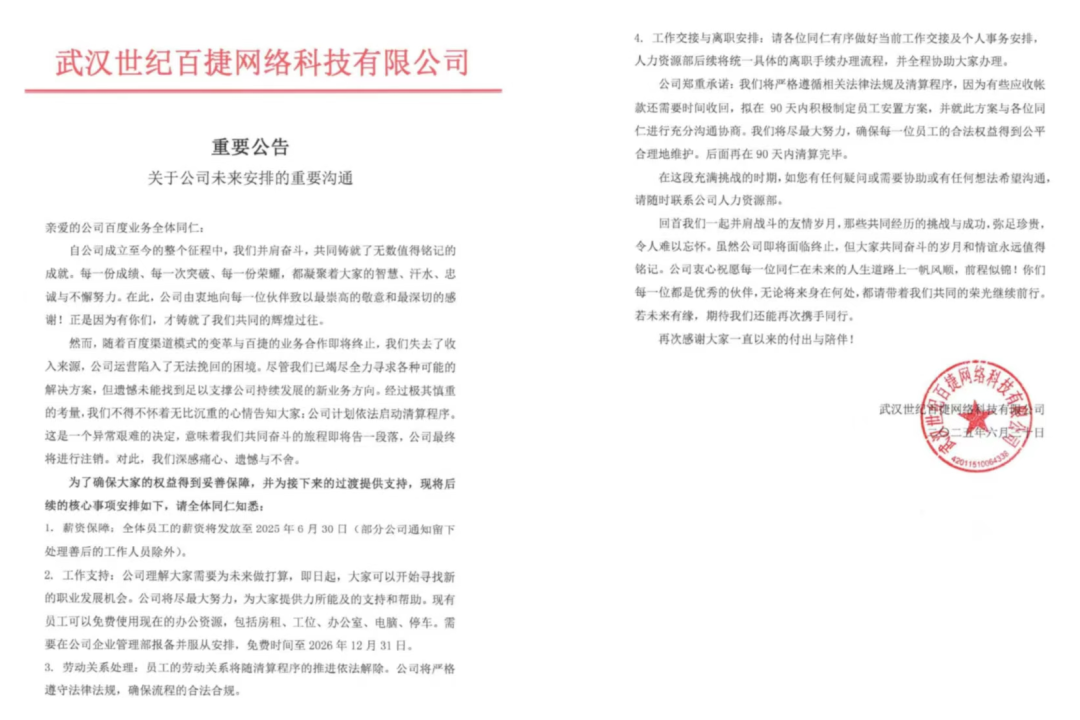
In July 2025, Baidu was reported to have undertaken a major restructuring of its agency system, abolishing exclusive agency mechanisms in six cities—Xiamen, Fuzhou, Chongqing, Wuhan, and Jinan—and fully transitioning to a service provider operational model. Baidu's general agent in Hubei, Wuhan Shiji Baijie Network Technology Co., declared bankruptcy liquidation.
According to the financial report, advertising revenue classified as 'traditional business' in the fourth quarter of 2025 reached 12.3 billion yuan, while the third-quarter report showed Baidu Core's online marketing revenue at 15.3 billion yuan. Behind this shift lies a microcosm of the reshaping of China's internet traffic landscape.
In today's internet ecosystem, the channels through which users access information have fundamentally transformed. UGC communities like Douyin and Xiaohongshu, along with chatbots such as Doubao and Qianwen, are continuously siphoning user attention and search intent that once belonged to search engines.
When consumers seek a good restaurant, plan a travel itinerary, or even search for a professional skills tutorial, they increasingly prefer to complete the process directly within content platforms or use AI applications to obtain ad-free answers, rather than relying on a search box that aggregates web links.
This shift in user attention inevitably leads to a reallocation of advertiser budgets. Against the backdrop of an overall tightening of corporate marketing budgets due to macroeconomic conditions, advertisers increasingly prioritize 'brand-effect unity' and immediate conversion rates. This makes traditional search advertising, which relies solely on keyword bid ranking, hit a formidable and difficult-to-break ceiling.
Since the decline of the overall advertising market is already an open secret across the industry, and this downward trend is destined to continuously drag down the company's overall valuation and price-to-earnings ratio, for Baidu, even though advertising revenue still accounts for a significant proportion, ceasing to disclose it separately is undoubtedly the most rational approach to managing expectations.
However, this is not merely a financial sleight of hand to mask business declines. When we set aside the historical stereotype of Baidu as 'just a seller of search ads' and carefully dissect this redefined data, we find that business crossover points have already emerged.
This is the flip side of the coin and the most crucial incremental information in Baidu's financial report.
Baidu's Chief Financial Officer, He Haijian, highlighted a set of key data to the outside world after the financial report release: 'Revenue from Baidu Core's AI new business exceeded 11 billion yuan in the fourth quarter, accounting for 43% of Baidu's general business revenue.'
This means that the 11.3 billion yuan in AI new business revenue and the 12.3 billion yuan in traditional advertising revenue are now neck and neck, almost forming an even split.
Such a result represents a watershed moment for any established tech giant attempting to transform.
For a long time, Baidu's AI business was perceived by the outside world as merely a showcase of technological prowess during product launches, a 'cost sinkhole' that devoured huge investments each year but struggled to deliver substantial commercial returns. The capital markets' biggest reservation about Baidu has never been its technological capabilities but rather its inability to monetize its technology on a large scale.
However, the solid quarterly revenue figure of 11.3 billion yuan means that after a protracted, painful, trial-and-error period filled with external ridicule, Baidu has finally made strides in transitioning from R&D investment to commercial monetization.
AI is no longer a marginal exploration project but has genuinely begun to shoulder significant responsibilities on the financial statements, becoming the new engine propelling Baidu's continued journey. This explains why Baidu dared to relegate its former cash cow to 'traditional business' at this moment.
A company that generates tens of billions in quarterly revenue from AI, with AI revenue accounting for nearly half of its total, cannot be simply dismissed as 'falling behind' or 'collapsing.' To some extent, Baidu is tenaciously completing a transformation.
02
Baidu Has Embraced AI, but AI Has Not Fully Embraced Baidu
However, while the financial report suggests that AI has finally become Baidu's new protagonist, the awkward reality is that while AI has taken center stage at Baidu, Baidu has not yet secured a leading position in China's AI landscape.
During the recent Chinese New Year season, major tech companies engaged in a tacit 'money-throwing' war targeting AI applications. Baidu, as usual, invested substantial resources to acquire users, but the results were somewhat underwhelming.
Wenxiaoyan, once touted as 'China's first large model application,' could not compete with Doubao, Qianwen, or Yuanbao, let alone surpass Baidu Wenku and Baidu Chengpian within its own ecosystem. On leaderboards of active AI products, Wenxiaoyan had already slipped beyond the top 15. Baidu's management is more aware than anyone of this retreat of its flagship C-end super app in the traffic pool.
This is why Baidu recently established PSIG (Personal Cloud and Intelligent Interaction Business Group). By bringing Wenku and Baidu Netdisk to the forefront, it is essentially making a pragmatic 'retreat.'
Since it cannot compete with ByteDance and Alibaba in the broad, general-purpose AI assistant arena, it is better to retreat to its most proficient and fortified positions: Baidu Wenku and Baidu Netdisk. Fortunately, after AI-powered reconstruction, these two veteran products remain highly competitive, with genuine user willingness to pay, and they continue to serve as Baidu's most solid moats.
However, this also means that Baidu's C-end AI story likely has limited upside. Future C-end narratives will probably be confined to a few specific productivity scenarios, and Baidu must constantly guard against competitors 'upending the table.'
In addition to reaching a ceiling in the C-end market, Baidu faces equally structural and thorny challenges in the B-end market.
Baidu has long prided itself on its 'full-stack' AI capabilities, ranging from underlying Kunlun chips and PaddlePaddle frameworks to Wenxin large models and upper-layer AI applications, all self-developed. While this sounds technically impressive, Baidu's 'full-stack' approach differs fundamentally in commercial logic from those of Alibaba and ByteDance.
Alibaba and ByteDance possess vast internal business lines and traffic pools, allowing them to fully digest their full-stack capabilities internally and directly activate the flywheel of 'computing power-data-applications.' As long as internal businesses become more efficient, the investment pays off.
However, Baidu lacks such massive, high-frequency internal application scenarios to 'feed' its AI. It must take its full-stack technology externally and struggle to find B-end clients willing to pay.
This explains why the recent news of a potential 'spin-off and independence' of Kunlun chips caused such a strong market reaction.
Baidu does hold extremely valuable hardcore assets in its hands, but within an ecosystem lacking massive internal demand, forcibly retaining underlying computing power behemoths like Kunlun chips is essentially squandering precious time windows.
In today's AI computing power frenzy, this is even seen by some aggressive investors as 'another form of slow suicide.' Letting them operate independently to embrace broader external markets would instead be the path to maximizing value.
However, if we zoom out further, we find that Baidu's greater constraints in the AI era stem not from specific business lines or executive decisions but from its corporate DNA and foundational business.
First, Baidu's foundational business is search engines, which determine its position in this transformation.
For e-commerce or social media giants like Alibaba and Tencent, AI is a tool for 'empowerment'; for search engines, generative AI is inherently 'disruptive.' This means that the more Baidu invests in general AI, the more it seems to be dismantling its own old walls. This 'internal conflict' is a pain point unique to Baidu among major tech companies.
More importantly, Baidu's search business simply cannot serve as a 'cash cow' for AI. An NVIDIA engineer told Chaojujiao that Baidu is actually quite 'resource-constrained' when it comes to AI.
Here, 'resource-constrained' does not mean Baidu lacks cash on its balance sheet but rather that, in the current deep-pocketed arms race of large models, Baidu's 'ammunition' appears severely insufficient.
The foundation of general AI large models is computing power, and behind computing power lies tens of thousands of GPU clusters and astronomical capital expenditures.
Look at Baidu's competitors: behind Alibaba, Tencent, and ByteDance stand e-commerce, social gaming, and short-video businesses—super cash cows in their prime, generating massive daily revenues. They have the confidence and continuous cash flow to fund AI's future and even tolerate prolonged strategic loss periods.
While Baidu's full-year revenue for 2025 reached 129.1 billion yuan, this figure pales in comparison to ByteDance's spending on computing power servers. This explains why Baidu is often seen as the AI 'major player' most eager to monetize—not because Robin (Li Yanhong) lacks patience but because Baidu's harsh 'resource' reality simply does not allow it to continue engaging in attrition warfare with these giants.
Rather than being dragged down in a computing power arms race against these titans, finding a niche that can sustain itself is the most sober and rational business choice.
Therefore, returning to the opening statement of this article, it may be time for market investors to abandon 'unrealistic fantasies' that Baidu can recreate its BAT-era glory or once again disrupt the era with general AI or next-generation search forms.
Baidu, which no longer discloses advertising revenue separately, is indeed shifting toward AI—but not toward the starry-eyed AGI dream but toward a pragmatic, survival-driven business strategy.
Re-evaluating Baidu as an 'AI utility factory' with specific moats undergoing a difficult transformation may be the most objective way to perceive this company.
After all, living in the reality of financial statements is far more grounded than living in grand narratives.
- END -
-
![]()
Doubao Work Unveiled! Domestic AI Leaders Fully Commit to the 'Work' Sector
-
![]()
Who’s Sounding the Alarm on ‘Rushed Vehicles’?
-
![]()
Over 5.3 Billion Yuan in Losses Over Three and a Half Years! Can Yonyou Reverse Its Fortunes Through Streamlining and AI Transformation?
-
![]()
Baidu AI Adopts Free Model: A Strategic Maneuver in Traffic and Monetization
-
![]()
Silicon-Based OLED Pioneer Unveils Financial Results: H1 Shipments Outpace Entire 2025 Volume
-
![]()
AI's First "Lost Summer"
-
![]()
Zeiss Makes Another €2.2 Million Bet: Will Eye Tracking Be the Next Big Thing in the Smart Glasses Industry?
-
![]()
RUNTO Ranking | Global Top TV ODM Factories' Shipment Figures for July 2026