German Chancellor Mertz’s China Visit: Automotive Industry as a Pivotal Economic and Trade Bridge
 02/27 2026
 495
495
From February 25 to 26, German Chancellor Friedrich Mertz embarked on his inaugural visit to China since assuming office. Prior to his departure, he extended Chinese New Year greetings to the Chinese people and expressed gratitude for China’s warm reception during the Spring Festival.
Against a backdrop of global economic volatility and industrial restructuring, Mertz’s visit is widely regarded as a strategic mission focused on industrial cooperation and economic strategy. Particularly in sectors such as automotive, Sino-German collaboration remains the cornerstone of bilateral economic and trade relations.
An Industry-Centric Visit
According to the schedule released by the German Chancellor’s Office, Mertz attended a symposium of the German-Chinese Economic Advisory Committee in Beijing and held high-level meetings with Chinese counterparts. During his stay, he toured the Forbidden City and visited the German automaker Mercedes-Benz. He then traveled to Hangzhou to inspect Chinese robotics firm Unitree Technology and German energy company Siemens Energy.
The itinerary reflects a balanced focus on traditional manufacturing and cutting-edge technologies. Mercedes-Benz symbolizes Germany’s manufacturing prowess, while robotics and energy technology firms highlight future industrial trends. This “anchor the present, explore the future” approach underscores Germany’s industrial strategy—preserving manufacturing strengths while accelerating engagement with emerging tech ecosystems.
Earlier, at the CDU party congress, Mertz emphasized, “Today’s foreign policy is inseparable from foreign economic policy, which forms the bedrock of our economic strategy.” For Germany, a nation heavily reliant on exports and high-end manufacturing, industrial布局 (strategic deployment) is central to its global economic positioning.
The accompanying business delegation was unprecedented in scale, featuring executives from Volkswagen, BMW, Mercedes-Benz, Bayer, Siemens, Adidas, Henkel, DHL, and Commerzbank. Such a high-profile representation underscores the business community’s confidence in the Chinese market.
Before departing, Mertz explicitly rejected the notion of “decoupling” from China, warning that such a move would be self-defeating. He stressed that China’s global influence is indispensable for resolving international challenges and urged deeper Sino-German collaboration.
German business leaders echoed this sentiment. Germany’s Stern magazine reported that Volker Treier, head of foreign trade at the Association of German Chambers of Commerce and Industry, called for strengthened cooperation with China ahead of Mertz’s visit. Amid rising global uncertainties, he highlighted the practical value of collaborating in environmental technology, circular economy, and medical innovation.
Automotive Industry: The Core of Bilateral Cooperation
Official data from the German Federal Statistical Office reveals that China reclaimed its position as Germany’s largest trading partner in 2025, surpassing the U.S. Sino-German trade volume consistently exceeds $200 billion, with two-way investment stock surpassing $65 billion—accounting for nearly a quarter of China-EU totals.
New research from the Cologne Institute for Economic Research (IW Köln) shows German direct investment in China reached €7 billion in 2025, a four-year high, while investment in the U.S. declined sharply. Corporate sentiment is equally telling: 93% of German firms in China plan to maintain operations, with 53% intending to expand investments.
German companies view China’s market scale, industrial ecosystem, and innovation pace as irreplaceable strategic assets. As Germany’s automotive, chemical, and machinery sectors navigate green transitions and digital upgrades, new energy, smart manufacturing, and electrification have become key areas for Sino-German collaboration.
Within this framework, the automotive industry remains paramount. German automakers like Volkswagen, Mercedes-Benz, and BMW have deep-rooted operations in China. Beyond being a top global market, China has emerged as a hub for technological innovation, supply chain integration, and electrification.
BMW Chairman Oliver Zipse noted that as the industry accelerates toward electrification, intelligence, and autonomous driving, global collaboration is essential for shared prosperity. He emphasized China’s dual role as the world’s largest auto market and an innovation powerhouse driving technological change, urging companies to establish deep roots in China to sustain global competitiveness.
During Mertz’s visit, Zipse accompanied the delegation and signed a memorandum of understanding with CATL to enhance supply chain collaboration in reducing carbon footprints for electric vehicle batteries, systematically lowering lifecycle emissions. This partnership underscores the evolution of Sino-German automotive cooperation toward deep supply chain integration and sustainability.
BMW has invested over ¥120 billion in China, establishing production bases in Shenyang, four R&D innovation centers, and three software companies, creating a comprehensive localization ecosystem.
Meanwhile, Volkswagen Group continues expanding its R&D footprint in China. In November 2025, its new test facility for Volkswagen (China) Technology Co. (VCTC) opened in Hefei, becoming Volkswagen’s largest R&D center outside Germany. The company’s China-exclusive CEA regional electronic architecture has been delivered on schedule, with three Chinese joint ventures set to launch new models equipped with this architecture, enhancing local autonomy in software-defined vehicles.
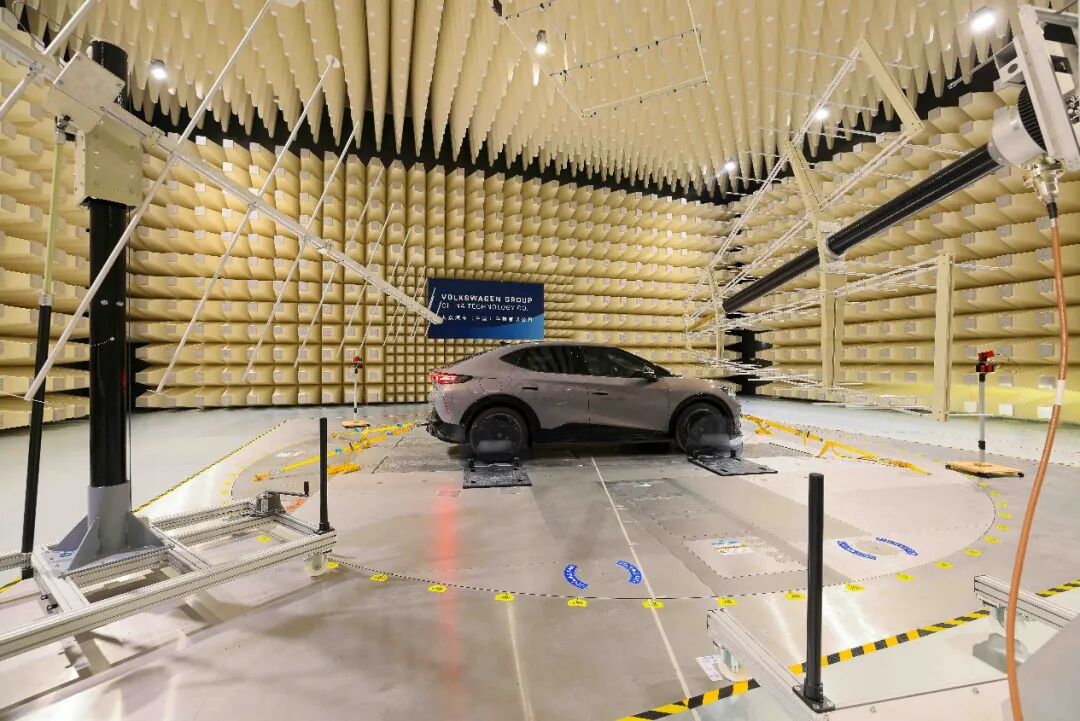
VCTC Electromagnetic Compatibility (EMC) Laboratory in Hefei, Anhui
Image Source: Volkswagen Group
VCTC Chairman and CEO Ralf Brandstätter stated that amid global turbulence, Mertz’s visit signals stability, dialogue, and pragmatic cooperation. For Volkswagen and European industry, China is not just a sales market but an innovation source and key pillar of global value creation. “In e-mobility, software, AI, and battery technology, China is setting industry rhythms at unprecedented speeds,” Brandstätter said.
From electrification platforms to local R&D systems, and from digital collaboration to supply chain synergy, China’s market is rapidly evolving from a “sales hub” to an “innovation hub.” The automotive industry, as the most representative sector, continues to inject stability and forward momentum into Sino-German economic relations.
Understanding China’s High-Tech Sector: A Must for Germany’s Transformation
Zheng Chunrong, director of the Center for German Studies at Tongji University, noted that Mertz’s visit—his first as chancellor—holds significant value in deepening understanding of China’s development trajectory through firsthand inspections and high-level dialogue, fostering a more reality-based interaction framework.
Mertz’s tour of Hangzhou’s high-tech firms sends a clear message: Germany aims to systematically assess China’s technological advancements in robotics, new energy, and digitalization, along with the underlying industrial logic. From manufacturing system upgrades to digital ecosystem construction, China’s pace and scale in emerging industries have become unavoidable topics for European policymakers and industry leaders.
For Germany’s traditional manufacturing sector, transformation is urgent. Energy restructuring, carbon neutrality goals, and intensifying global competition demand faster technological iterations. Relying solely on European tech systems may create mismatches between R&D cycles and market evolution. Collaborating with Chinese high-tech firms and integrating into China’s market-driven innovation ecosystem will be critical for enhancing global competitiveness.
After comprehensive global risk assessments, the German business community increasingly recognizes China’s unique advantages in high-tech application scenarios, industrial chain support, and R&D efficiency. Deep integration, rather than isolation, is becoming a strategic consensus at the corporate level.
Seeking Certainty in Uncertain Times
Amid accelerating international restructuring, rising unilateralism, and pressures to reshape global supply chains, stable, transparent, and predictable cooperation frameworks are more vital than ever.
Sino-German industrial structures are highly complementary, with broad shared interests. Supporting free trade and upholding rules-based multilateral systems are pragmatic choices for both sides. As China launches its 15th Five-Year Plan, traditional sectors like automotive and chemicals are poised for efficiency gains through green and digital upgrades, while emerging fields like AI and biopharmaceuticals offer expansion opportunities, injecting new growth into bilateral cooperation.
The automotive industry, as the deepest and largest area of Sino-German collaboration, will continue serving as both a “ballast stone” and “propeller.” From market integration to joint R&D, and from vehicle manufacturing to supply chain synergy, deepening ties in this sector provides stable support for bilateral relations. Addressing competitive challenges through dialogue and elevating cooperation in quality and scope are key to sustainable Sino-German ties.
Mertz’s first China visit comes amid global industrial restructuring and rising European economic uncertainties. For Germany, under export pressures and accelerating industrial transformation, stabilizing Sino-German economic and trade relations and deepening industrial cooperation through dialogue mechanisms align closely with real economic interests and corporate needs.
The visit’s long-term impact will hinge on specific cooperation outcomes and German domestic political feedback. However, at minimum, the trip has sent a clear signal: In an era of interconnected industrial chains, particularly in the critical automotive sector, Sino-German relations retain strong practical foundations and ample policy adjustment space.
Image: From the Internet
Article: Auto Review
Layout: Auto Review
-
![]()
Can the Brand-New Hongqi H7 Forge Its Own Identity in the Hybrid Vehicle Market?
-
![]()
Challenges in Redeeming Certificates for New Cars: Mercedes-Benz Dealership Group Grapples with Operational Hurdles Once Again
-
![]()
Porsche Returns to Volkswagen, Ending the 'Electric Ferrari' Story
-
![]()
"Chinese Version of Mythos": Can It Rise to the Challenge and Keep Pace?
-
![]()
Equity Changes Hands Three Times in Seven Years: JMCG Leans on Contract Manufacturing for Survival Amid Brand Deficits
-
![]()
Automotive Market News: Nine Departments Jointly Roll Out Aftermarket Consumption Initiatives
-
How Electronic Fabric Became the Critical Chokepoint for AI’s Trillion-Dollar Computing Infrastructure
-
![]()
Depreciation Rate on Par with Mobile Phones: Just 40% Value Retention After Three Years—Why Do Battery Electric Vehicles Lose Their Worth?