OpenClaw Frenzy: Our Concern Shouldn’t Just Be 'Replacement,' But How to 'Coexist' with AI
 03/12 2026
 479
479
Produced by | He Xi
Layout by | Ye Yuan
OpenClaw arrived with far more force than imagined.
Earlier this year, I wrote an article about OpenClaw and Moltbook. My assessment at the time was that such tools weren’t something ordinary people needed to jump on immediately—real usability might only come six months later, so everyone should just stay tuned and give it a try occasionally.
Now, that view seems too conservative.
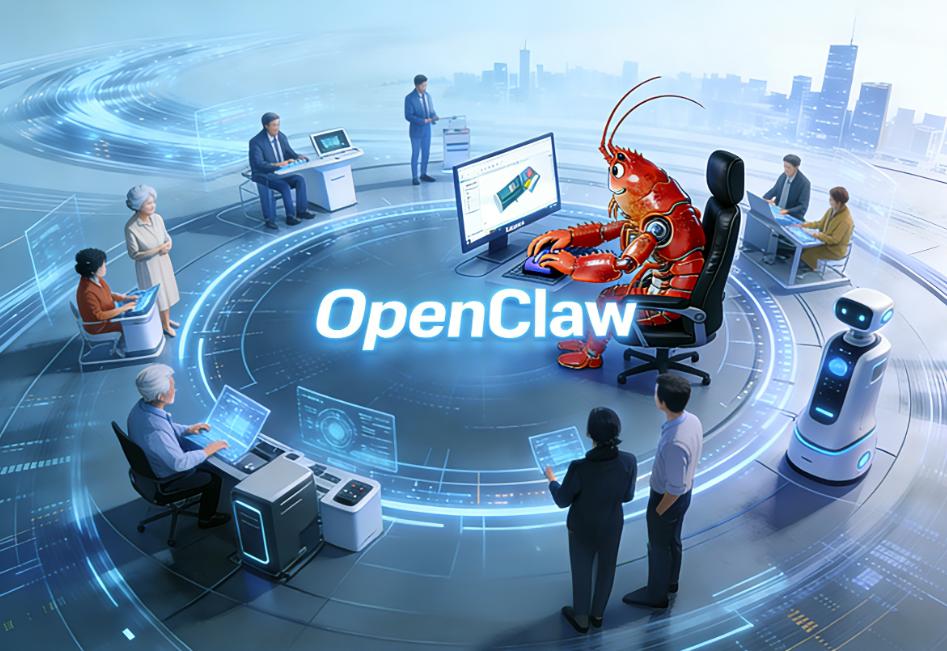
On March 6, a long queue formed outside Tencent’s headquarters in Shenzhen. Nearly a thousand developers and AI enthusiasts brought their computers, waiting for engineers to help them install an open-source project called 'OpenClaw' on the spot—they called this 'raising lobsters.' The line included programmers, retired engineers, and even elementary school students accompanied by their parents. Pony Ma even shared it on his Moments, marveling, 'I didn’t expect it to be this popular.'
This fervor isn’t unique to Tencent. Almost simultaneously, tech giants like Baidu, Alibaba, ByteDance, Xiaomi, and Meituan all jumped in. The secondary market even saw a whirlwind of 'lobster concept stocks.' Why are over 13 tech giants heavily investing at the same time? What makes OpenClaw drive the global tech circle wild? Has the 'iPhone moment for AI' truly arrived?
This article will dissect the era-shifting implications behind the 'lobster craze' from three dimensions: the motivations driving tech giants to join en masse, OpenClaw’s fundamental reshaping of AI paradigms, and the real situation of ordinary people amid this frenzy.
01
Behind the Tech Giants’ Rush to 'Raise Lobsters'
The collective move by tech giants to 'raise lobsters' may seem like trend-chasing, but in reality, they’re being cornered by 'survival challenges' at three levels.
Level 1: Billions in computing power built up, but where’s the money?
Over the past two years, tech giants have poured resources into large models, only to hit a dead end—ordinary users chatting for a day consume Tokens worth less than the electricity cost, and a $3 monthly subscription offers unlimited use, barely supporting billion-dollar computing clusters.
OpenClaw is different. A heavy user’s daily Token consumption can match hundreds of casual chat users. Media reports indicate that OpenClaw’s 'lobster farming' has exploded computing demand, with Token usage surging millions of times over. This shows AI is truly shifting from 'chatting' to 'working'—and working burns money.
This is good news for cloud providers. Baidu’s lightweight application servers saw nearly 10,000 new daily users after the Spring Festival. No matter which Agent succeeds, it will need cloud resources and burn Tokens.
Level 2: The 'gateway' is being bypassed
Previously, users needed to open a tech giant’s APP or webpage to access AI services, keeping the gateway firmly in their hands. OpenClaw changes this—users give instructions directly in a chatbox, and it calls all tools and services itself.
What does that mean? You don’t need to open the Starbucks APP to order coffee, Taobao to track a package, or WPS to write a weekly report. One chatbox does it all.
The 'APP castles' tech giants spent over a decade building can suddenly be bypassed.
Level 3: Open-source communities are 'stealing' the narrative
OpenClaw’s open-source community already offers over 8,000 'skills'—from social media management to code development, literature organization to investment advice.
In the past, tech giants defined the direction of technological evolution. Now, an open-source community and an independent Austrian developer are redefining AI’s boundaries. Tech giants are no longer the rule-setters but followers.
Faced with these challenges, tech giants aren’t sitting idle. Leveraging their resources, they’re breaking out along different paths.
Type 1: Cloud Providers – Selling Shovels
Representatives: Alibaba Cloud, Tencent Cloud, Baidu Intelligent Cloud. The strategy is straightforward: I don’t raise lobsters myself, but I provide the best ponds and feed.
Baidu launched a zero-deployment service, DuClaw, for just 17.8 RMB a month, with one-click setup.
Type 2: Model Companies – Selling Brains
Representatives: Moonshot AI (KimiClaw), MiniMax (MaxClaw), Zhipu (AutoClaw). The goal is to make their models the default 'brain' called by OpenClaw.
The results were immediate. Step, from Jueyue Xingchen, briefly ranked first globally in model calls, while MiniMax’s M2 series saw Token consumption surge over sixfold from December last year.
Type 3: Internet Giants – Domesticating Wild OpenClaw
Representatives: Tencent and ByteDance. The strategy is more complex: take the open-source OpenClaw, domesticate it into a 'safe and controllable' version, and integrate it into their ecosystems.
Tencent is mass-producing lobsters. Pony Ma shared on Moments a matrix of Tencent’s 'lobster' products: self-developed lobsters, local lobsters, cloud lobsters, enterprise lobsters, cloud desktop lobsters, security-isolated lobster rooms, cloud security guards, knowledge bases... with more products on the way.
Why are internet giants doing this? Because security is the biggest pain point of the open-source version—who dares let an open-source tool freely operate their computer? A 'domesticated version' from a tech giant is safe, compliant, and ready to use, making it the preferred choice for businesses and individuals.
Type 4: Device Makers – Card Positioning from Hardware
Representatives: Xiaomi (Xiaomi miclaw), Huawei, Lenovo. The strategy is to integrate Agent capabilities deeply with hardware at the device and operating system levels.
After Xiaomi launched its 'phone lobster,' Lei Jun personally shared it on Moments.
For tech giants, this isn’t just a battle to 'break out'—it’s a 'must-win' self-revolution. Success isn’t measured by whether they can replicate OpenClaw, but whether they can redefine their irreplaceable role in the new AI era.
02
Not Just an 'iPhone Moment,' But the 'Execution Era'
After discussing why tech giants are rushing to 'raise lobsters,' let’s talk about how OpenClaw is 'changing' AI.
After OpenClaw’s explosion, many called it AI’s 'iPhone moment.' That’s accurate but incomplete.
Let’s compare OpenClaw to the iPhone:
The 2007 iPhone’s core innovation was an interaction revolution—replacing complex keyboards and styluses with intuitive multi-touch. It made 'fingers' the ultimate tool for human-machine interaction. What it did to the ecosystem was destruction and reconstruction: it ended Nokia’s physical keyboard era and spawned the million-strong App Store.
What about OpenClaw? Its core innovation is a capability revolution—upgrading AI from a 'conversational advisor' to an 'executive employee.' It makes 'natural language' the ultimate command for humans to direct machines. What it does to the ecosystem is deconstruction and reshaping: it refactor s (reconstructs) the entry point status of super-APPs and spawns a new labor market of 'skills.'
Fundamentally, the iPhone lowered the barrier for human-machine communication; OpenClaw changes the nature of communication itself—from 'asking questions' to 'assigning tasks.' The iPhone was the creator of the mobile internet; OpenClaw is the pioneer of the 'execution internet.' It doesn’t create Apps but freely combinable 'digital employees.'
To put it bluntly: iPhone + App Store = information and services at your fingertips. Want a ride? Open the App and tap a few times. Want to shop? Open the App and tap a few times. Your role is always 'operator' and 'consumer.'
OpenClaw + Skill Store = tasks and execution automated. Want to organize an event? Tell your AI: 'Plan a 50-person industry salon, including venue booking, guest invitations, and agenda scheduling.' Then, it actually does it. Your role evolves into 'commander' and 'creator.'
This is a leap from 'knowing' to 'doing.'
Two hard metrics prove OpenClaw’s impact on AI:
First, Token consumption.
On the openrouter platform, OpenClaw’s weekly Token usage quadrupled. This means AI is truly shifting from 'chatting' to 'working'—because working consumes Tokens exponentially.
More tellingly, the main foundational models behind OpenClaw’s daily Token consumption are all Chinese: Step from Jueyue Xingchen, MiniMax, and Kimi rank top three. Chinese AI is earning globally.
Second, computing power is getting more expensive.
Because 'working' demands more, computing resources are running short. In January, Amazon AWS raised machine learning capacity block prices by ~15%; Google Cloud announced price adjustments for some data transfers in May, doubling in North America. Domestically, Wangsu Technology and Ucloud followed with price hikes.
This is concrete evidence of the 'execution era’s' arrival at the infrastructure level.
In short, OpenClaw demonstrates the magic of commanding machines through language to complete tasks. It transforms AI from a 'co-pilot' to an 'executor,' from a tool aiding thought to an 'employee' directly intervene ing (intervening in) production processes.
What we’re witnessing is the formal entry of 'digital labor' as a new production factor onto the historical stage.
03
Behind OpenClaw’s Frenzy: Ordinary People’s Anxieties and the Reshaping of AI Relationships
While tech giants celebrate in the capital markets and tech geeks debug late into the night in communities, what do ordinary people see in this 'lobster craze'?
Currently, three topics are sparking heated online discussions.
Topic 1: 'Will I still have a job?'
This isn’t just a vague discussion about 'AI replacing humans' but specifically about 'whether my role will be replaced.'
On platforms like Xiaohongshu and Zhihu, debates over 'who OpenClaw will eliminate first' persist. Junior copywriters, data entry clerks, basic translators, and even some legal assistants and accountants are on net friend s’ (netizens’) 'high-risk lists.'
One netizen’s comment gained traction: 'Tools used to make humans more relaxed; now, stronger tools make humans feel useless.'
Meanwhile, some are actively discussing 'how to prove to my boss that AI’s work needs me to back it up'—a struggle for survival amid crisis.
Topic 2: 'Is this thing safe? Will it sell me out?'
On lifestyle platforms like Weibo and Douban, discussions about OpenClaw’s privacy risks are intense.
'Your AI assistant might know you better than your partner'—under this post, opinions split: tech geeks say 'convenience trumps privacy,' while ordinary users feel 'creeped out, like being exposed.'
This anxiety isn’t unfounded. On March 10, China’s National Internet Emergency Center issued a risk warning: OpenClaw typically requires high system permissions during operation, and without proper safeguards, attackers could gain full system control if they exploit vulnerabilities.
The Ministry of Industry and Information Technology’s Cybersecurity Threat and Vulnerability Information Sharing Platform had already issued warnings in February.
Some netizens shared their experiences 'taming' OpenClaw, likening it to raising an 'electronic pet that flips through drawers'—requiring constant supervision. This 'monitoring cost' is something ordinary people didn’t anticipate.
Topic 3: 'Can I learn this? Will I fall behind if I can’t?'
On Douyin and Kuaishou, many creators now offer 'OpenClaw step-by-step tutorials,' with comment sections filled with 'my eyes get it, but my hands don’t' and 'is there a version that installs itself while I lie down?'
Discussions about 'Gen Z mastering AI while Gen X still uses Excel' resonate widely. Some parents worry that while they can’t understand these tools, their kids use them effortlessly, widening the 'digital generation gap' within families.
Meanwhile, the internet is flooded with training courses labeled 'AI Era Essentials' or 'OpenClaw Gold Rush Camp,' priced from 9.9 RMB to thousands. One netizen joked: 'The first people earning money from OpenClaw are those teaching it.'
An Overlooked Angle: From 'Tool' to 'Companion'
Beyond anxiety, another trend is quietly emerging—OpenClaw is being 'personified.'
Some users assign personalities to OpenClaw, having it report work in their preferred style.
Others use it as a 'confidant,' sharing troubles because it 'keeps secrets and doesn’t judge.'
More intriguingly, after deploying OpenClaw on Baidu APP, over 20% of users task it with investment and finance management, including stock monitoring and investment strategy backtesting. Yimi Fund’s Qieman platform even launched a 'Qieman Lobster Intelligent Agent,' offering fund diagnostics and asset allocation advice.
This suggests that when a technology is powerful enough to deeply intervene (intervene in) personal lives, its role blurs. It’s no longer just a cold tool but could become a digital companion, personal secretary, or even a family member.
This brings not just efficiency gains but profound impacts on interpersonal relationships, family structures, and emotional needs.
Finally, the author argues: This may be the dawn of a new era.
Jensen Huang compares the AI industry to a 'five-layer cake': energy, chips, infrastructure, AI models, and the application layer at the top. In his view, the application layer where OpenClaw resides is 'the most productive area currently, offering the greatest returns to cloud giants.'
But OpenClaw’s significance extends beyond commercial returns.
It’s AI’s 'iPhone moment,' opening a new era of consumer-grade intelligent applications;
It’s the opening act of the 'execution era,' formally introducing 'digital labor' as a new production factor;
It’s also a 'coming-of-age ritual' for human-AI relationships—we must learn to coexist with these 'digital employees' and 'electronic family members.'
Outside Tencent’s Shenzhen headquarters, the crowd lining up for 'lobsters' has dispersed.
But the door has opened.
-
![]()
Doubao Work Unveiled! Domestic AI Leaders Fully Commit to the 'Work' Sector
-
![]()
Who’s Sounding the Alarm on ‘Rushed Vehicles’?
-
![]()
Over 5.3 Billion Yuan in Losses Over Three and a Half Years! Can Yonyou Reverse Its Fortunes Through Streamlining and AI Transformation?
-
![]()
Baidu AI Adopts Free Model: A Strategic Maneuver in Traffic and Monetization
-
![]()
Silicon-Based OLED Pioneer Unveils Financial Results: H1 Shipments Outpace Entire 2025 Volume
-
![]()
AI's First "Lost Summer"
-
![]()
Zeiss Makes Another €2.2 Million Bet: Will Eye Tracking Be the Next Big Thing in the Smart Glasses Industry?
-
![]()
RUNTO Ranking | Global Top TV ODM Factories' Shipment Figures for July 2026