Tech Giants Compete in the Lobster Race, There's No Escaping It
 03/12 2026
 533
533

It's been a long time since we've seen tech giants so embroiled in competition.
On March 9th, Pony Ma said on WeChat Moments, 'I didn't expect lobsters to be so popular.'
Just two days later, on March 11th, it was officially announced that a full range of Lobster matrix products would be rolling out. There were even rumors that WeChat would introduce an AI agent focused on security, forming a closed loop with user privacy at the bottom layer level.
On the same day, Feishu CEO Xie Xin also posted on WeChat Moments, stating that while individuals experimenting with agents is exploration, enterprises using agents is a responsibility.
Then he shifted gears, 'This is also the problem we aim to solve—helping both individuals and enterprises raise lobsters more conveniently and safely.'
Soon after, Feishu launched a one-click deployment feature for OpenClaw, eliminating the need to even fill in an API key, and offered free trials.
Even Zhou Hongyi announced that 360 would launch a secure Lobster, promising one-click deployment, no data deletion, and no leaks.
Mobile phone manufacturers weren't far behind. Xiaomi launched an internal test for Lobster on its phones, while at the Honor Magic v6 launch event, it was announced that a Lobster universe would be built based on the Honor ecosystem.
Huawei's He Gang also revealed on Weibo that he had tried HarmonyOS's Xiaoyi Claw for a few days and found it quite useful.
Each company's main selling point was that, without dwelling on the past, they now had a bunch of lobsters on hand.

Image Source: AI Generated
While tech giants are fervently following suit, governments and capital are starting to cool down.
The National Internet Emergency Center issued a 'Risk Warning on the Secure Application of OpenClaw,' emphasizing the serious risks of privacy and confidentiality leaks under high permissions.
Subsequently, some government agencies and universities also issued warnings, reminding people of the security risks associated with intelligent agents.
On Xianyu, services for complete on-site uninstallation of Lobster have noticeably increased.
Lobster concept stocks, which had been rising for several days, have also undergone continuous shocks and adjustments.
After a day of significant declines, the market opened on March 12th with MINIMAX rising 5%, still surpassing Baidu in market value; Xunce rose 6.5%, and Zhipu rose 1.56%.
Of course, the risk concerns of tech giants and the outside world are not entirely divergent.
What can be foreseen is that lobsters built on various mature platforms will address two current pain points of lobsters:
First, the difficulty of installation and deployment will significantly decrease, and second, enhancing security will become a top priority.
01
Opportunities Tech Giants Can't Miss
The popularity of lobsters presents an opportunity for tech giants eager to monetize.
Previously, investments in AI large models have been substantial, with money being burned far faster than it could be earned.
Moreover, everyone believes that the competition in AI large models has just begun, and throwing money is inevitable.
Last year, Manus, a lobster-like AI agent model, was offered for sale to Meta for billions of dollars, showcasing its potential.
This year, just one month after OpenClaw went open-source, Kimi launched KimiClaw on February 16th, requiring a membership of at least 159 yuan/month to use.
A week ago, Alibaba Cloud's Bailian and Tencent Cloud both launched memberships for cloud server experiences with Lobster, starting at just 7.9 yuan/month.
In the past two days, Tencent launched five major Lobster services, while Zhipu released a localized AutoClaw 'Australian Lobster' for free trial during the beta phase.
The AI price war is back. After all, during the Spring Festival, red envelopes were used to boost daily active users, and it's clear that giants aim to attract users for free and drive smaller players out of the battlefield.
After all, this is a new round of AI competition that no one dares to miss.
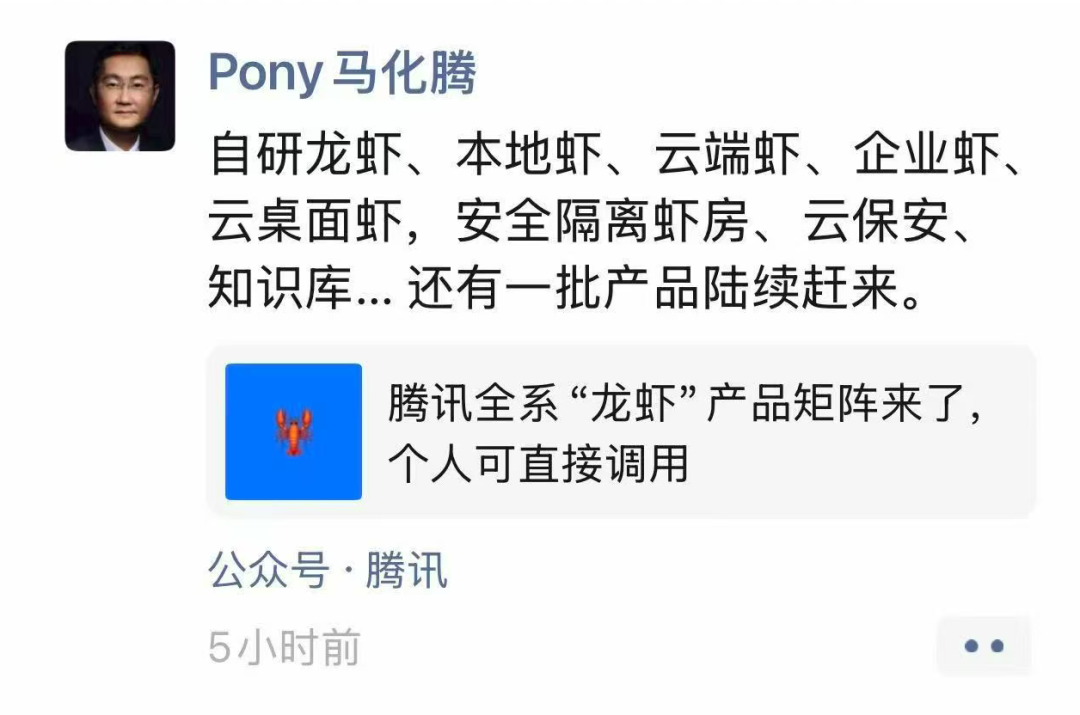
Image Source: WeChat Moments
The first round of competition, sparked by ChatGPT's debut in 2022, was an 'Algorithm War,' focusing on whose AI was smarter.
Giants competed on computational power and models, striving to create AI that better understood human language and thought.
The second round, initiated by DeepSeek in 2024, was an 'Equity War,' focusing on whose AI was more efficient and user-friendly.
Through distillation and algorithm optimization, excellent results could be achieved with lower computational costs.
Now, the third round of competition, initiated by Lobster, is an 'Application Access Point War.'
When lobsters become true assistants, whose assistant will occupy users' computers and phones?
In the future, there will be no need to spend time downloading a plethora of software applications.
We can simply tell the lobsters, and they will download skill packages, find and open software, and solve problems for us.
Lobsters may become the sole intermediary layer connecting us to all software.
All software will become part of the underlying operations, which could be fatal for many internet companies that rely on it for survival.
From another perspective, whoever captures this access point will hold the discourse power over the next generation of AI ecosystems.
This is why no giant dares to miss this war. They are all accelerating product launches and offering free experiences, just to capture users' minds.
The enthusiasm of various tech giants has, in turn, heated up the lobster trend, creating a heating cycle.
02
The Unavoidable Competition for Intelligent Agents
Different AI vendors play different roles and adopt different strategies in this competition.
Vendors like Zhipu and Kimi, primarily focused on AI large models, previously competed on whose model was smarter.
Lacking the funds and algorithms of giants, they generally had to find alternative paths, serving as bottom layer tools and earning money from computational resources.
Quickly adapting to lobsters allows them to transform their model capabilities into tangible benefits that users can accept with lower barriers, retaining users within their membership ecosystems.
The opportunity for exponential growth lies here.
For hardware vendors like Xiaomi and ZTE (previously involved in Doubao phones), hardware products like phones and computers are essential carriers for AI implementation.
Directly adapting within their systems allows users to start using them immediately upon purchase, creating generational competitive differences from other brands.
Will devices centered around lobsters dominate in the future?
For software platforms with user traffic like Alibaba, Tencent, Weibo, and Feishu, their lifeblood lies in user engagement time and frequency.
If posting on Weibo, chatting on WeChat, or handling work can all be done without opening apps, simply by telling lobsters, then these platforms' traffic and the moats protecting their commercial value will collapse.
Quick adaptation means proactively embracing change, building new moats, and not being left behind by the times.
Of course, for cloud computing vendors like Tencent, Alibaba, and Huawei, the popularization of lobsters will lead to exponential growth in the number of AI users and frequency of use, driving up demand for cloud servers and computational power.
Early layout and securing cloud server orders for raising lobsters will allow them to capitalize on the next round of computational power monetization and truly benefit from industry growth.
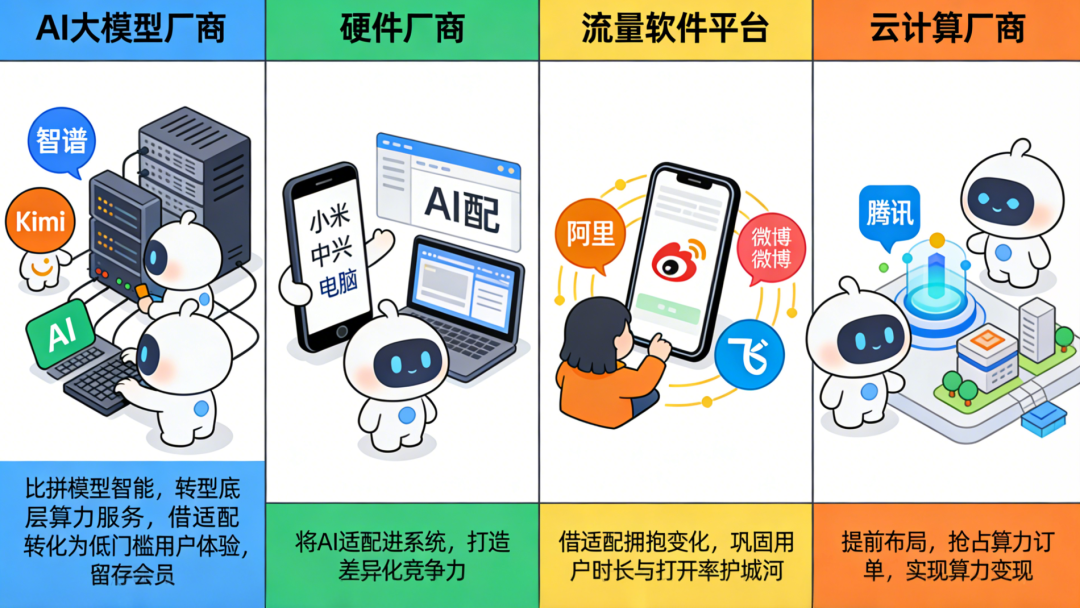
Image Source: AI Generated
Each vendor has its strengths and weaknesses; some have technology but lack traffic, while others have traffic but lack technology.
However, in the face of the technological tide, whoever seizes the opportunity can leap forward and break free from limitations.
Thus, it seems that all giants have reached a consensus in a short time: this battle must be fought, and it cannot be lost.
Winning doesn't guarantee total dominance, but losing could mean elimination.
The trend is becoming clearer.
On March 10th, NVIDIA CEO Jensen Huang published a rare long article discussing his views on the 'five-layer cake' of artificial intelligence.
He believes that the largest-scale AI infrastructure construction in history has only just begun.
The application layer at the top of AI is the core area for AI to create economic value, covering drug discovery platforms, industrial robots, legal assistants, self-driving cars, etc. The same underlying architecture can support different application outputs, and there is still vast room for innovation at the application layer.
He predicts that in the coming years, traditional software and app forms may disappear, and a new type of intelligent agent is highly likely to become mainstream.
-
![]()
Doubao Work Unveiled! Domestic AI Leaders Fully Commit to the 'Work' Sector
-
![]()
Who’s Sounding the Alarm on ‘Rushed Vehicles’?
-
![]()
Over 5.3 Billion Yuan in Losses Over Three and a Half Years! Can Yonyou Reverse Its Fortunes Through Streamlining and AI Transformation?
-
![]()
Baidu AI Adopts Free Model: A Strategic Maneuver in Traffic and Monetization
-
![]()
Silicon-Based OLED Pioneer Unveils Financial Results: H1 Shipments Outpace Entire 2025 Volume
-
![]()
AI's First "Lost Summer"
-
![]()
Zeiss Makes Another €2.2 Million Bet: Will Eye Tracking Be the Next Big Thing in the Smart Glasses Industry?
-
![]()
RUNTO Ranking | Global Top TV ODM Factories' Shipment Figures for July 2026