Behind Lin Junyang’s Exit: Alibaba’s AI Stuck in the ‘Old Guard’ Mentality
 03/13 2026
 757
757
Lin Junyang’s departure has finally been officially acknowledged by Alibaba.
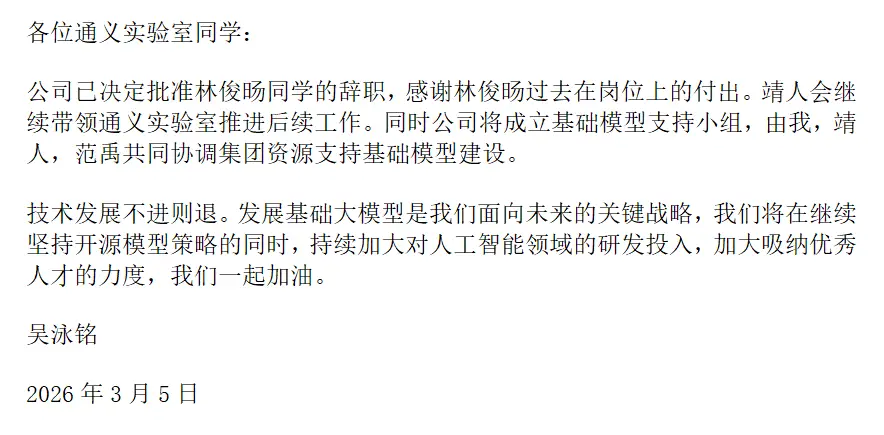
On March 5, 2026, Alibaba CEO Wu Yongming addressed Lin Junyang’s resignation in an internal memo, stating, “The company has accepted Lin Junyang’s resignation and appreciates his contributions during his tenure.”

Reports indicate that in the early hours of March 4, Lin Junyang, the technical lead of Alibaba’s Qwen team, unexpectedly announced on social media in a personal capacity: “I’ve stepped down. Farewell, my beloved Qwen.” However, during an emergency all-hands meeting of the Qwen Lab held that afternoon, Alibaba refrained from commenting on Lin’s latest move. Later that evening, Emerging Intelligence reported that Lin had submitted his resignation on March 3, though final details were still pending with Alibaba.
Lin Junyang’s exit from Qwen came as a near-complete surprise. Just three days prior, Qwen had open-sourced four compact Qwen3.5 models with parameter sizes of 0.8B, 2B, 4B, and 9B, catering to diverse needs ranging from extreme resource constraints to high-performance lightweight applications. Tesla founder and CEO Elon Musk lauded the move as “amazing intelligence,” to which Lin responded, “Thank you, Elon.”
A closer look at the circumstances surrounding Lin Junyang’s departure reveals that his split from Alibaba was far from amicable; rather, it was a unilateral resignation announcement that caught Alibaba off guard. To some extent, this reflects Lin’s growing dissatisfaction with the company.
Notably, Lin Junyang is not the only recent departure from Alibaba’s Qwen team. According to TMTPost, Li Kaixin, a key contributor to Qwen3.5 & VL & Coder; Yu Bowen, the post-training lead of Qwen; Hui Binyuan, the head of Qwen Code; and others have also resigned.
While Alibaba has not publicly addressed the sudden leadership shakeup at Qwen, recent strategic signals suggest a quiet shift in the business’s focus. Under a new power structure and business logic, the room for technical talent appears to be shrinking—a likely catalyst for the exodus of several core Qwen members.
01. Why Did Lin Junyang Suddenly Resign? At Least Three Major Factors
After piecing together the clues, Farsight identified three primary reasons behind Lin Junyang’s abrupt resignation: clashes over Qwen’s organizational structure, resource allocation, and strategic direction.
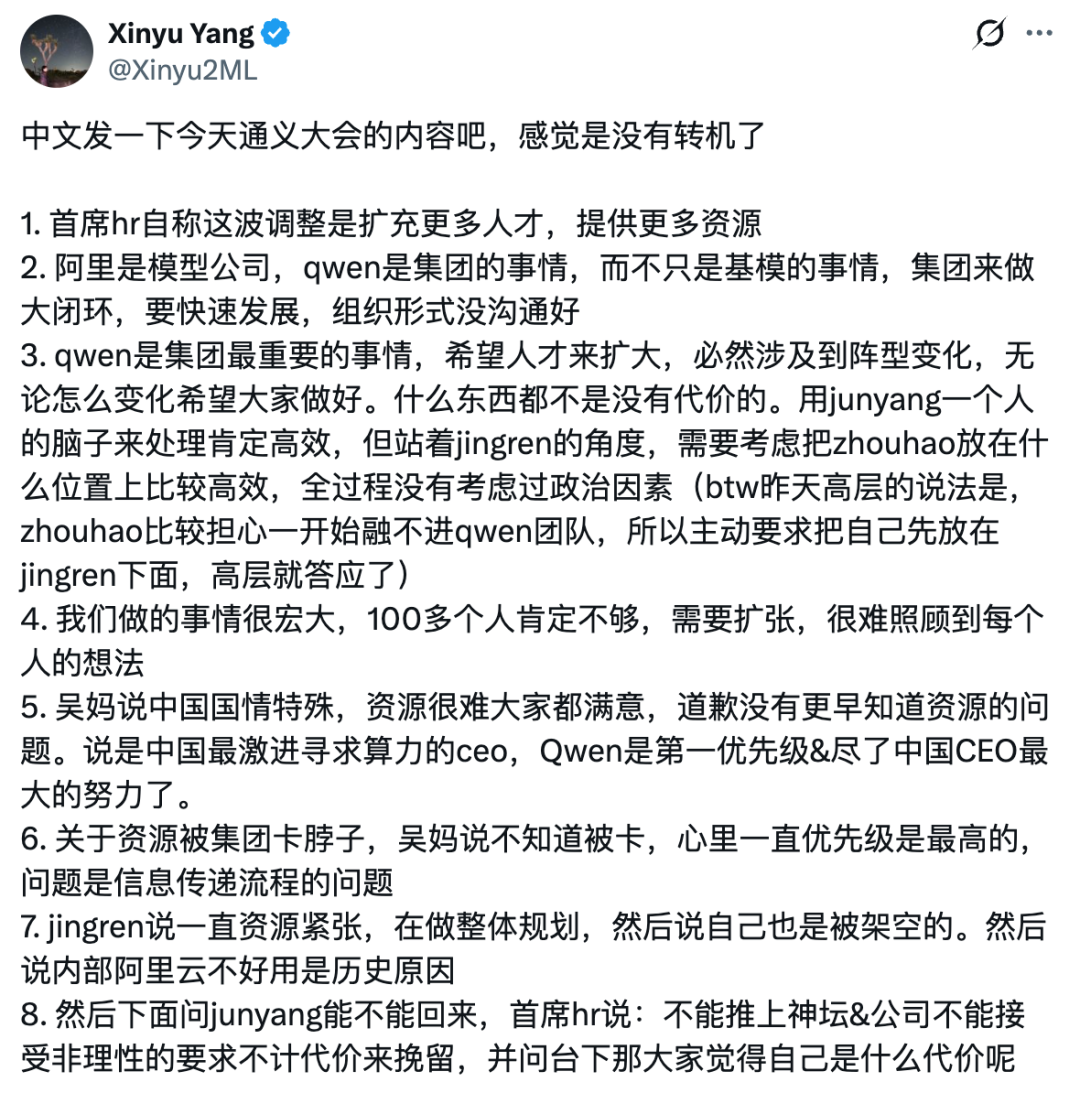
Sina Technology cited insiders as saying that amid intensifying AI competition, Alibaba aimed to expand the Qwen team by bringing in additional talent. “While relying solely on Lin Junyang’s expertise is efficient, from the perspective of Alibaba Cloud CTO and Qwen Lab head Zhou Jingren, it’s crucial to determine how to effectively integrate newly recruited talent like Zhou Hao, without letting ‘political factors’ interfere.”

Zhou Hao, a former senior researcher at Google DeepMind who worked on projects like Al Mode and Deep Research and was a core contributor to Gemini 3.0, joined Alibaba’s Qwen Lab in early 2026. He reported directly to Zhou Jingren, bypassing Lin Junyang.
According to insiders, when Lin was involved in frontline strategic planning, he felt “sidelined”—a reference, perhaps, to the impact of “air-dropped” executives like Zhou Hao on his decision-making and execution.
On another front, large-scale model training demands massive computational resources, and Alibaba reportedly fell short of meeting Lin’s needs. Insiders revealed that Lin frequently voiced concerns about resource constraints within the company.
In response, at the all-hands meeting, Wu Yongming acknowledged the scarcity of computational resources in China and apologized for “not identifying the issue sooner.” However, he insisted that Alibaba had prioritized Qwen and made every effort to secure resources, noting that the problem stemmed from cross-departmental communication barriers rather than group-level restrictions.
Interestingly, Alibaba’s internal memo stated that Wu Yongming, Zhou Jingren, and Alibaba CTO Fan Yu would “jointly coordinate group resources to support foundational model development.” The involvement of three top executives in resource allocation underscores both the previous resource shortages and Alibaba’s intent to break down silos through higher-level influence.
Furthermore, at the strategic level, significant differences emerged between Lin Junyang’s vision and Alibaba’s recent adjustments. Since 2025, Lin had advocated for “bundling” Alibaba’s large model teams—pre-training, post-training, and even Infra—to enhance model training efficiency and multimodal capabilities.
However, Qwen Lab recently proposed splitting the team into vertical systems based on training processes and modalities, merging them with similar teams within the lab to boost operational efficiency. Under this restructuring, Lin’s authority would have been significantly diminished.
Clearly, Lin’s resignation was not triggered by a single issue but by the cumulative effect of multiple factors. As a technical expert, Lin prioritized technology’s impact and foresight. Alibaba, as a commercial entity, pursues not only technological edge but also profitability.
As Qwen’s business entered an expansion phase and shifted toward scalability and monetization, differences in pace, resource allocation, and values between Lin and Alibaba widened. These disparities evolved from philosophical gaps into structural conflicts, ultimately leading to his resignation.
02. Intensifying Industry Competition: ‘AI Leadership’ Adjustments Become the Norm
The sudden leadership shakeup at Qwen reflects Alibaba’s broader strategic pivot: beyond foundational model capabilities, the company is now vying for market influence in consumer (C-end) AI applications.
Since launching its personal AI assistant Qwen—built on the Qwen large model—in November 2025, Alibaba’s AI strategy has shifted from serving B-end enterprises to targeting the C-end market.
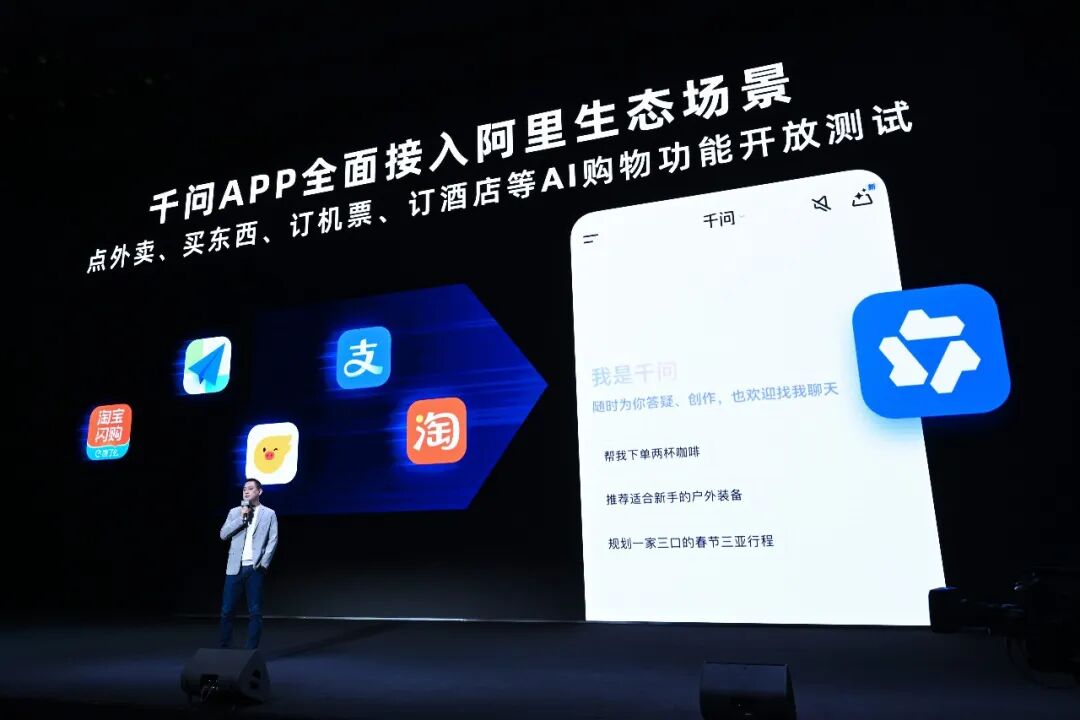
To expand Qwen’s C-end reach, Alibaba first integrated it into its ecosystem of services, including Taobao, Alipay, and Fliggy, then launched a ¥3 billion “hospitality plan” during the Spring Festival to heavily subsidize the market. To boost brand recognition, in early March 2026, Alibaba unified its AI offerings under the “Qwen” banner.
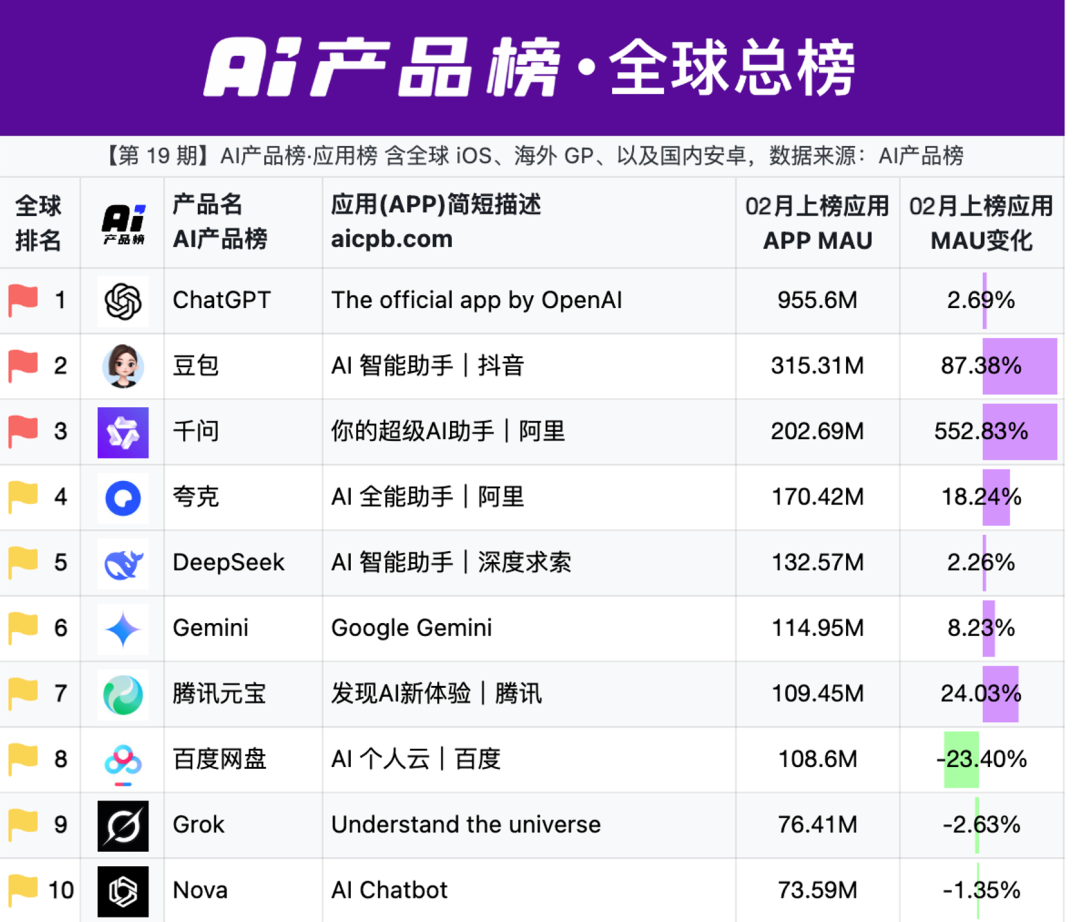
The high-profile strategy paid off: Qwen App secured 203 million monthly active users globally in February 2026, ranking third behind ChatGPT and Doubao, with a staggering 552.83% month-over-month increase—the highest globally.
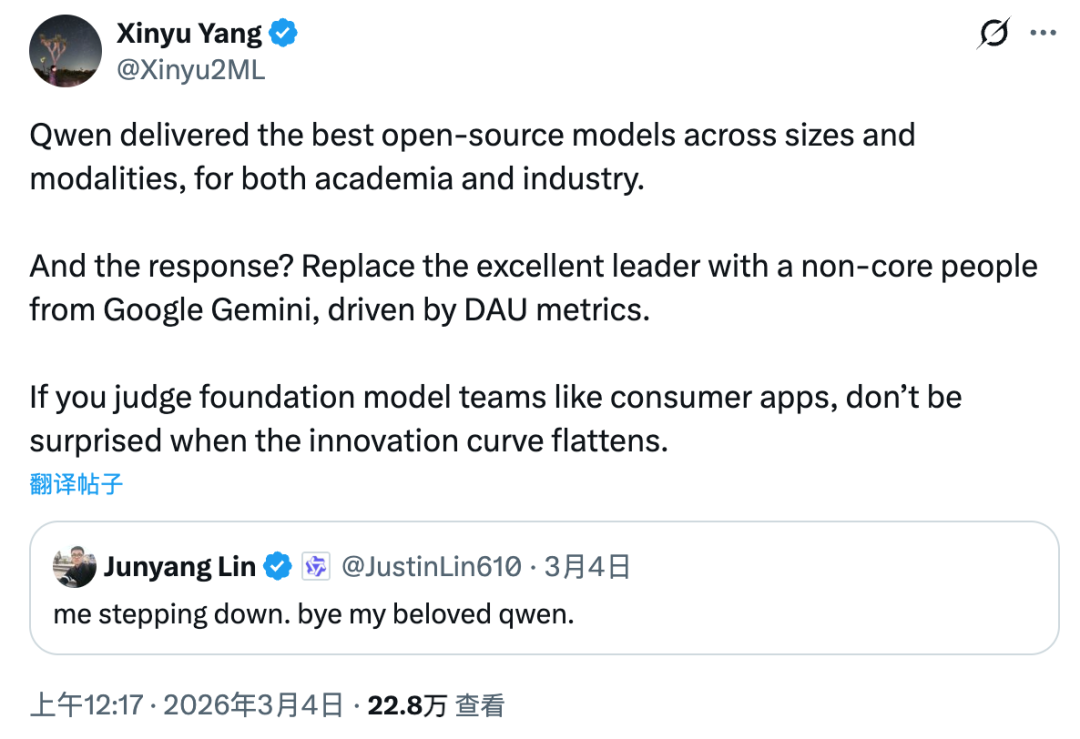
Against this backdrop, Alibaba imposed new demands on the model team. Xinyu Yang, a blogger certified on X as the founder of the “FM-Wild Workshop and ASAP Series Seminars,” revealed that Alibaba now evaluates foundational model teams using consumer-grade metrics like daily active users (DAUs). “If you judge foundational large model teams by consumer app metrics, don’t blame the innovation curve for flattening.”
Indeed, in the fierce AI race, Alibaba’s market-driven adjustments are understandable for a commercial entity with clear performance goals.
Previously, the Qwen team focused solely on technological research, cementing its global dominance in open-source models. However, as Alibaba’s AI focus shifted to the C-end market, maintaining a “product-model separation”—keeping the model team insulated from commercial pressures—would severely constrain the product team’s commercialization efforts.
Thus, Alibaba opted to expand the Qwen team, impose concrete KPIs, and vertically divide the team by training processes and modalities to enhance efficiency.
At the all-hands meeting, Jiang Fang, Alibaba’s Chief Talent Officer, stated, “We’re growing rapidly, and this adjustment aims to broaden our talent pool and provide more resources.” She acknowledged communication gaps, noting that introducing new talent inevitably alters team structures during expansion. “We may not have handled it well.”
In fact, AI’s rapid evolution is forcing companies to rethink strategic and organizational frameworks. Over the past few years, restructuring power dynamics and decision-making mechanisms around AI—and replacing top leaders—has become a “rite of passage” for Chinese internet firms.
For example, in February 2025, Wu Yonghui, former Vice President of Research at Google DeepMind, joined ByteDance as head of foundational research for the large model team Seed. That December, Yao Shunyu, a former OpenAI researcher, became Tencent’s Chief Research Scientist for Hunyuan, reporting to President Martin Lau.
03. AI Assistants Fall into the ‘Scale Trap’: Is Qwen on the Wrong Path?
While Alibaba’s proactive organizational adjustments align with AI trends, its internal evaluation logic seems stuck in the mobile internet era, prioritizing user scale as a core metric.
This “traffic-first” mindset risks leading Alibaba astray.
In January 2025, Yan Junjie, founder and CEO of MiniMax, criticized the AI field’s obsession with user scale in an interview with LatePost: “From a mobile internet perspective, Doubao is impressive. But assuming technology will evolve to support diverse products and business lines, this may not be beneficial.”
His reasoning is twofold: first, serving more users strains AI companies financially, slowing R&D; second, models often outsmart users, whose “queries” rarely enhance model capabilities.
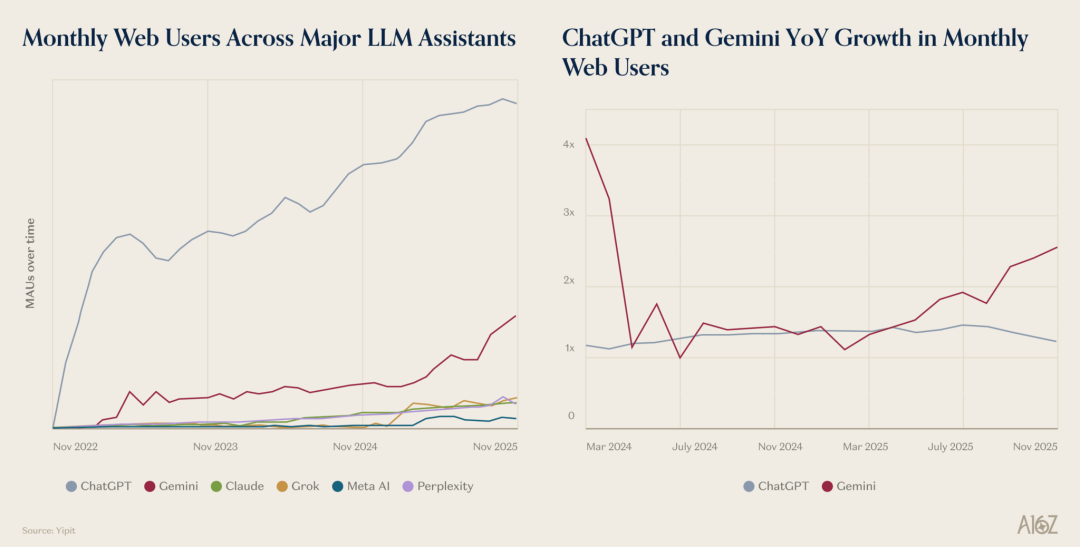
Yan offered a striking example: ChatGPT’s DAU is 50–100 times that of Claude, yet their model capabilities are roughly comparable. “This shows intelligence gains don’t heavily depend on user numbers.”
In short, AI assistants have shattered the mobile internet’s “scale effect” myth. Mobile apps once leveraged massive user bases to dilute costs and refine interactions through feedback loops, building strong commercial moats. Today, AI assistants chasing user scale risk falling into a “scale trap”—where user growth fails to boost model capabilities and may even hinder evolution.
Leading AI firms now prioritize defining next-gen model capabilities, clarifying required algorithms, data, and reasoning processes, and using technical means to meet those benchmarks. To prevent commercialization goals from stifling innovation, they separate tech and product development: tech pushes boundaries; products meet user needs.
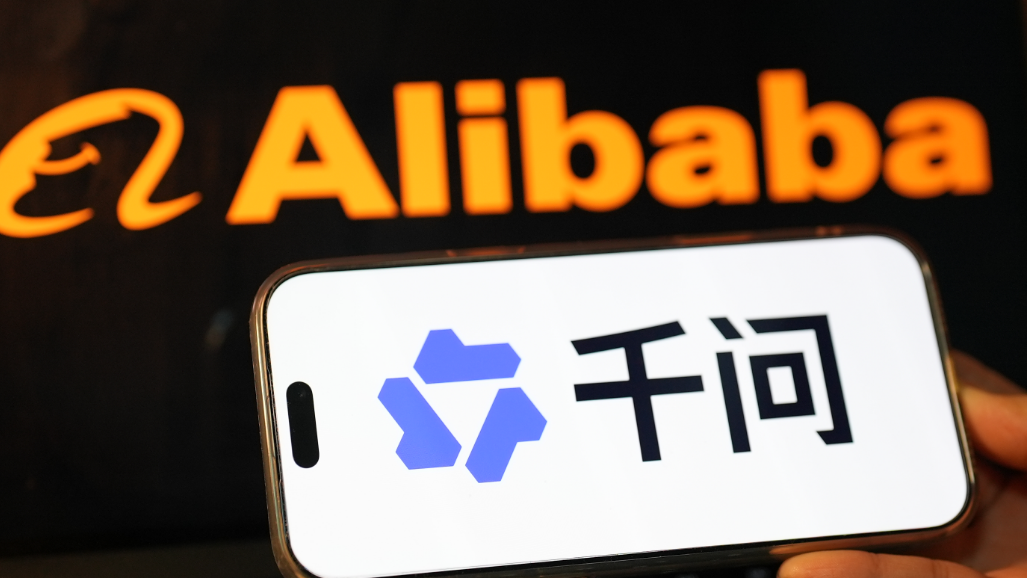
In contrast, Alibaba seems to be moving against AI trends. To turn Qwen App into a traffic-driving mobile product, it’s investing heavily in marketing while pressuring technical talents like Lin Junyang to align with commercial goals.
As management expert Jim Collins noted in Built to Last, great companies “pursue a purpose beyond profit.” Alibaba’s AI strategy, with its KPI-driven focus on user scale, deviates sharply from its vision of becoming a “102-year-old good company.”
During the mobile internet era, Alibaba succeeded not by chasing metrics but by creating exceptional shopping experiences for consumers and sellers. In the AI era, its blind pursuit of short-term KPIs will not only demoralize technical talent but also struggle to deliver sustainable user value or navigate industry cycles.
In an internal email, Wu Yongming articulated, "The development of fundamental large-scale models represents our core strategic direction for the future. We are committed to maintaining our open-source model strategy, while simultaneously ramping up investment in artificial intelligence research and development, as well as intensifying our efforts to recruit top-tier talent."
Merely 'increasing investment' is not sufficient; Alibaba needs to engage in a more profound introspection regarding its business philosophy. If the underlying 'traffic-first' mentality persists unchanged, Lin Junyang may not be the last AI expert to sever ties with Alibaba.
-
![]()
Doubao Work Unveiled! Domestic AI Leaders Fully Commit to the 'Work' Sector
-
![]()
Who’s Sounding the Alarm on ‘Rushed Vehicles’?
-
![]()
Over 5.3 Billion Yuan in Losses Over Three and a Half Years! Can Yonyou Reverse Its Fortunes Through Streamlining and AI Transformation?
-
![]()
Baidu AI Adopts Free Model: A Strategic Maneuver in Traffic and Monetization
-
![]()
Silicon-Based OLED Pioneer Unveils Financial Results: H1 Shipments Outpace Entire 2025 Volume
-
![]()
AI's First "Lost Summer"
-
![]()
Zeiss Makes Another €2.2 Million Bet: Will Eye Tracking Be the Next Big Thing in the Smart Glasses Industry?
-
![]()
RUNTO Ranking | Global Top TV ODM Factories' Shipment Figures for July 2026