Domestic AI Breakthrough: Energy Costs, MoE Architecture, and Comprehensive Industrial Applications
 03/16 2026
 516
516
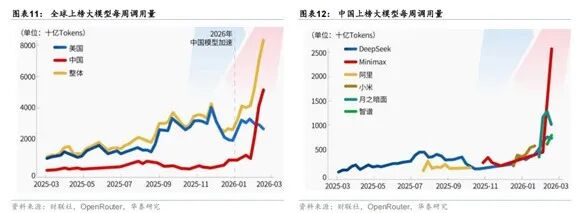
In February 2026, the global AI landscape witnessed a significant turning point. Data from OpenRouter, the world's foremost API aggregation platform for large models, revealed that domestic AI models surpassed their U.S. counterparts in monthly Token invocation volume for the first time, accounting for over half and contributing a staggering 14.69 trillion Tokens. This achievement signifies that Chinese AI models are gaining international recognition, validated by the rigorous standard of global developers' "code votes," and leveraging their unique competitive strengths.
01. Domestic Models Outpace Overseas Counterparts in Invocation Volume
According to OpenRouter data, by February 28, the total Token consumption of the top ten models on the platform had exceeded 28.7 trillion, with domestic models contributing over 14.69 trillion. This marked a historic milestone where, for the first time, a single month's Token invocation volume exceeded half and outstripped U.S.-produced models.
Among the leading domestic models, MiniMax M2.5, Yuezhian's Kimi K2.5, and DeepSeek V3.2 ranked first, second, and fourth, respectively, with invocation volumes of 5.44 trillion, 4.27 trillion, and 3.09 trillion Tokens. Zhipu's GLM 5 also featured prominently, ranking eighth with 1.89 trillion Tokens.
In the realm of artificial intelligence, Tokens represent the smallest semantic units processed by large models and serve as the cornerstone for computing power consumption and service billing. Each conversation, code snippet, or content piece is dissected into Tokens by the model for computation and subsequent billing.
Notably, American developers constitute 47.17% of OpenRouter's user base. This indicates that the primary impetus behind the ascent of Chinese models stems from overseas developers, particularly those from Silicon Valley and Europe.
This underscores the distinct competitive advantages of Chinese AI models compared to their overseas counterparts.
02. Energy Costs, Structural Innovations, and Model Architecture Drive Commercial Resilience and Cost-Effectiveness
To comprehend the differentiated strengths of China's AI development, energy emerges as a pivotal factor. The rationale is straightforward: AI is an energy-intensive domain. Those who can feed it sufficiently, efficiently, and affordably will ultimately prevail.
Firstly, consider costs. The AI competition, particularly in training and inference for large models, is essentially a contest for computing power duration, with electricity being the ultimate consumption endpoint. China's electricity prices are highly competitive among major economies, thanks to our extensive and efficient power grid infrastructure and the world's leading installed capacity in wind, solar, hydro, and nuclear power.
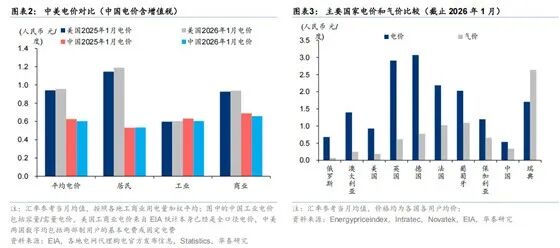
According to the National Energy Administration's January 2026 statistics, China's total electricity consumption in 2025 reached approximately 10.37 trillion kilowatt-hours, a year-on-year increase of 5.0%. The China Electricity Council's "2025-2026 National Power Supply and Demand Analysis and Forecast Report" highlighted that this consumption scale is more than double that of the United States for the entire year and surpasses the combined total of the EU, Russia, India, and Japan, cementing China's status as the world's largest power consumer.
For AI clusters necessitating parallel computation across millions of cards and servers, even a marginal difference in electricity prices per kilowatt-hour can result in astronomical annual operating costs. This cost advantage endows Chinese enterprises with inherent commercial resilience in delivering computing power services and applications.
Now, let's delve into structure. China's energy structure boasts two unique characteristics.
Firstly, the proportion of green energy, exemplified by wind and solar power, continues to rise. During the 14th Five-Year Plan period, China's installed capacity of non-fossil fuel power generation witnessed rapid growth. By the end of 2025, China's installed capacity for hydropower, nuclear power, wind power, and solar power had reached 450 million, 62 million, 640 million, and 1.2 billion kilowatts, respectively. Notably, the growth in wind and solar power installation was most pronounced, with their combined share of total installed capacity rising to 47.3%, an increase of 23.1 percentage points from the end of the 13th Five-Year Plan.
Secondly, China can transcend geographical limitations. The formidable ultra-high-voltage transmission network and the West-to-East Power Transmission project have alleviated the physical constraints on computing power center布局 (layout). Eastern China exhibits strong data demand but limited land and energy resources, while western China is abundant in clean energy but faces consumption challenges. China's AI infrastructure can strategically locate the most power-hungry computing centers in the west, directly utilizing inexpensive wind and solar power for "green computing," and then transmitting the results back to the east. This "Compute East, Data West" model represents a pioneering global solution, addressing not only cost concerns but also energy security and sustainable development.
Thus, the advantages in energy costs and structure furnish China's AI with a unique "underlying operating system." It transcends mere technical catch-up, fostering a more cost-effective and resilient AI industrial ecosystem grounded in national strategic-level infrastructure.
Additionally, the architectural innovation of the "Mixture of Experts" (MoE) constitutes another significant advantage of domestic models. Traditional dense models necessitate activating all parameters for every request, whereas the MoE architecture introduces a "gating network" that divides the model into multiple "expert sub-networks" specializing in diverse domains. Only the most pertinent experts are activated for each inference, compressing the actual computational load to a fraction of the original while preserving a vast knowledge reserve.
With the support of energy and model innovations, domestic models offer unparalleled cost-effectiveness. Taking prices disclosed on the OpenRouter platform as an example, MiniMax's M2.5 model costs $0.3 per million Tokens for input and $1.1 per million Tokens for output. In contrast, Claude Opus 4.6 costs $5 for input and $25 for output. Simply put, the cost of utilizing Chinese models is one-tenth or even lower than that of U.S. competitors.
Notably, a recent Goldman Sachs report highlights that, from a global perspective, dominance in the AI field is shifting from semiconductors to electricity and infrastructure, reflecting a market focus shift from computing power development to supply chain bottlenecks. In China, the infrastructure sector has demonstrated robust performance in both the ChatGPT and DeepSeek cycles, underscoring China's competitive edge in technology hardware manufacturing.
03. The Real Economy, Particularly Comprehensive Industrial Scenarios, Fosters a Positive Cycle
From an application standpoint, the unique strengths of China's AI development are deeply entrenched in its globally most complete and intricate industrial chain system. This seamless integration of scenario-driven development and technological implementation engenders a highly dynamic positive cycle.
Simply put, China's vast industrial system provides the world's most fertile "training ground" for AI. From precision electronics manufacturing to heavy machinery, from complex supply chain management to stringent quality inspection, every link (process) harbors real, urgent, and high-value demands for cost reduction and efficiency enhancement.
These demands are not simulated scenarios in laboratories but hard indicators for corporate survival. When AI technologies are deployed in these real-world environments, they must confront challenges such as data noise, extreme operating conditions, and cost control. This refinement process propels rapid technological iteration and practical application. For instance, in the consumer electronics sector, AI visual inspection has achieved global leadership in accuracy and speed. In specific scenarios like ports and mines, autonomous driving and intelligent scheduling technologies have matured significantly due to prolonged exposure to complex environments.
More importantly, this deep coupling provides China's AI development with robust data foundations and rapid feedback loops. The massive, multidimensional, and high-quality data generated by industrial scenarios serves as invaluable fuel for training and optimizing AI models, while real-time feedback from industrial production swiftly validates the practical effectiveness of AI solutions.
This path, which originates from demand and culminates in application, renders China's AI development more resilient and sustainable, eschewing mere technological showmanship and truly taking root in the fertile soil of the real economy. This constructs a formidable and difficult-to-replicate barrier in the global AI competition.
04. Conclusion
In summary, China's AI breakthrough is no mere accident but stems from structural advantages in energy costs, the computing power revolution ushered in by MoE architecture, and the vast application scenarios provided by the real economy.
This represents a systematic breakthrough spanning from underlying infrastructure to top-tier application ecosystems.
When U.S. developers opt for Chinese models through their Token consumption, they are not merely selecting a one-tenth usage cost but also an innovation ecosystem capable of rapidly implementing technologies and refining them through real-world scenarios.
The initial ascent of domestic models may just be the prologue. In this long-distance race propelled by energy, algorithms, and industry, China's AI is forging its own path and setting its own rules.
- End -
-
![]()
Doubao Work Unveiled! Domestic AI Leaders Fully Commit to the 'Work' Sector
-
![]()
Who’s Sounding the Alarm on ‘Rushed Vehicles’?
-
![]()
Over 5.3 Billion Yuan in Losses Over Three and a Half Years! Can Yonyou Reverse Its Fortunes Through Streamlining and AI Transformation?
-
![]()
Baidu AI Adopts Free Model: A Strategic Maneuver in Traffic and Monetization
-
![]()
Silicon-Based OLED Pioneer Unveils Financial Results: H1 Shipments Outpace Entire 2025 Volume
-
![]()
AI's First "Lost Summer"
-
![]()
Zeiss Makes Another €2.2 Million Bet: Will Eye Tracking Be the Next Big Thing in the Smart Glasses Industry?
-
![]()
RUNTO Ranking | Global Top TV ODM Factories' Shipment Figures for July 2026