AWE 2026: Home Appliance Giants Shift Focus from 'Large Models' to 'Chip Development'—Is This the Future?
 03/16 2026
 629
629
AI is the essence of intelligence, while computing power serves as its backbone.

As we marvel at the wave of smart home appliances sweeping through the AWE exhibition halls, have we paused to consider what powers this intelligence? From a software perspective, it's algorithms and large AI models; from a hardware standpoint, it's chips.
At this year's AWE, Leitech observed that many manufacturers are now emphasizing chips as a key selling point. These companies are moving beyond superficial functional upgrades and innovations. Instead, they are delving deep into hardware potential, building more suitable platforms for their products from the ground up.
As Leitech's AWE reporting team discussed in a pre-departure internal meeting, the chief editor posed a thought-provoking question: "The future of home appliance intelligence lies in AI, but where does the future of AI lie?"
Could the ultimate goal for smart home appliances be self-developed chips?
If we were to ask which brand boasts the most comprehensive and extensive lineup of self-developed chips this year, the answer would undoubtedly be Dreame. As one of the most talked-about brands, Dreame showcased its 'Human-Vehicle-Home Ecosystem' hexagonal ecosystem at AWE. And at the heart of this ecosystem lies chips, which are particularly crucial.
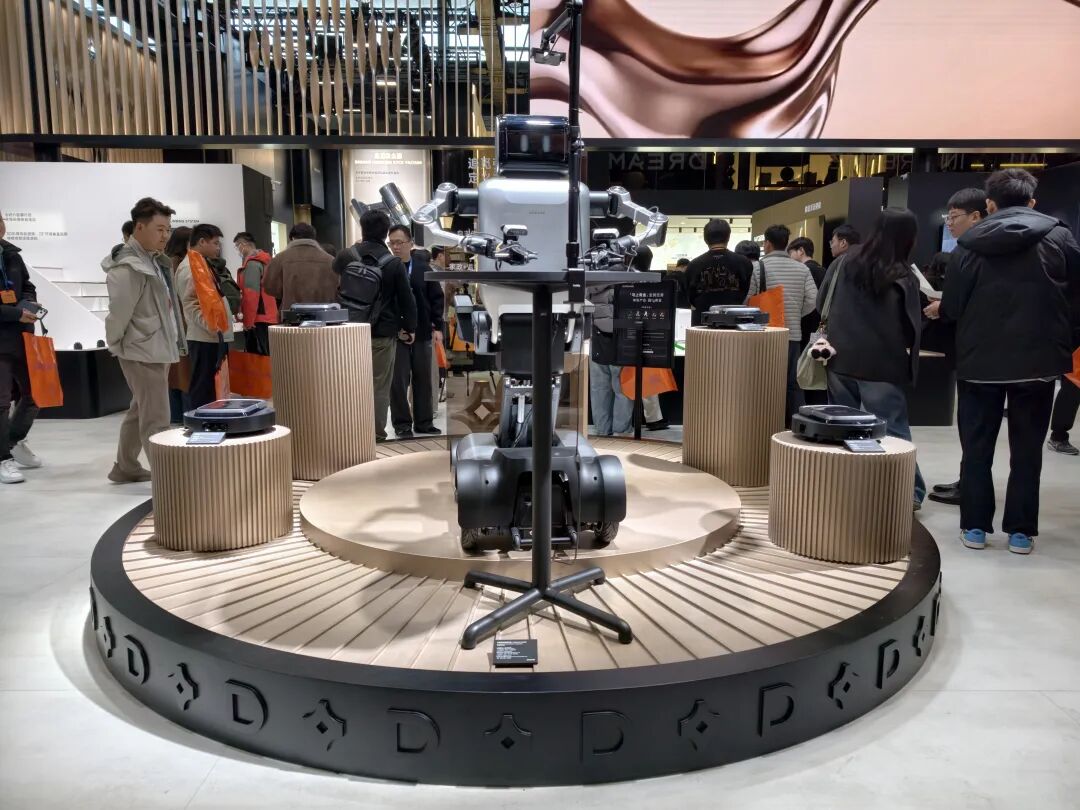
Image Source: Leitech Photography. Note: Dreame Embodied Intelligence Product Exhibition.
At the forefront is the 'Chixiao 01,' released by Dreame's subsidiary, Chip Crossing. Positioned as the core processor for Dreame's high-end AI products, this processor adopts Dreame's self-developed AI computing architecture, boasting an AI equivalent computing power of up to 200TOPS. It enables more complex local large models to run on the device side, facilitating multi-round, highly perceptive semantic interactions.
Currently, the first product to feature the Chixiao 01 appears to be the Dreame AUROR smartphone. The unique aspects of this chip make Dreame's intentions clear: they do not intend to make the AUROR smartphone a traditional phone. Instead, they aim to use the phone to connect home appliances, robots, and cars, transforming it into a comprehensive personal mobile hub and ultimately achieving seamless computing power flow across terminals.
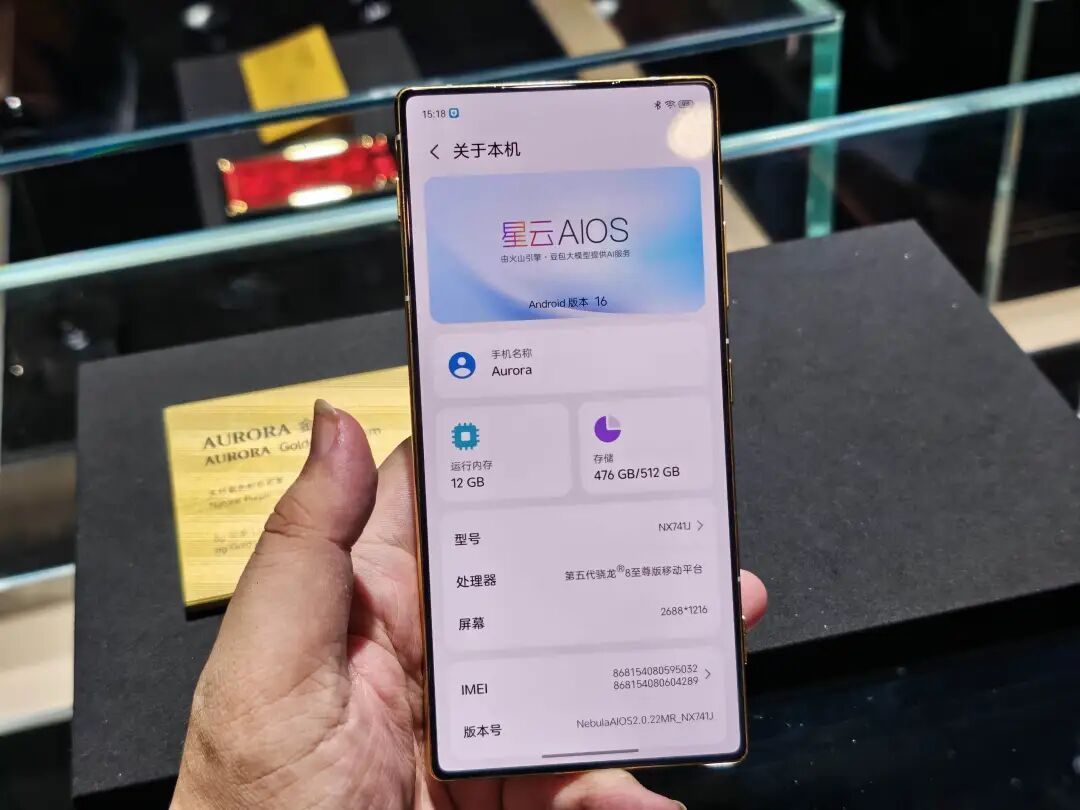
Image Source: Leitech Photography. Note: Dreame Smartphone.
Besides the Chixiao 01, we also saw Dreame's Tianqiong series, primarily designed for various embodied intelligence products under Dreame (such as robotic vacuums). The uniqueness of the Tianqiong series lies in its highly integrated CPU+NPU+MCU heterogeneous design, which directly supports on-device computing for LiDAR and AI models. This enables Dreame's robotic vacuums to achieve faster response times and more on-device AI functions.
From these two chip systems by Dreame, it is evident that they are building a proprietary software-hardware integration platform centered around 'AI.' This platform not only achieves synergy at the software level but also synchronizes at the hardware level. The advantage is that the entire platform remains in Dreame's control, making subsequent upgrades, compatibility, and improvements more convenient. The challenge, however, lies in the high research and development costs, requiring sufficient determination and funding to drive forward.
Additionally, there is another highly anticipated chip—the cockpit-driving integrated chip that will be used in future Dreame vehicles. It adopts an aggressive two-nanometer process and, according to introductions, boasts a single-chip computing power of up to 2000TOPS, directly on par with Tesla's current most powerful AI 5 in-vehicle chip.
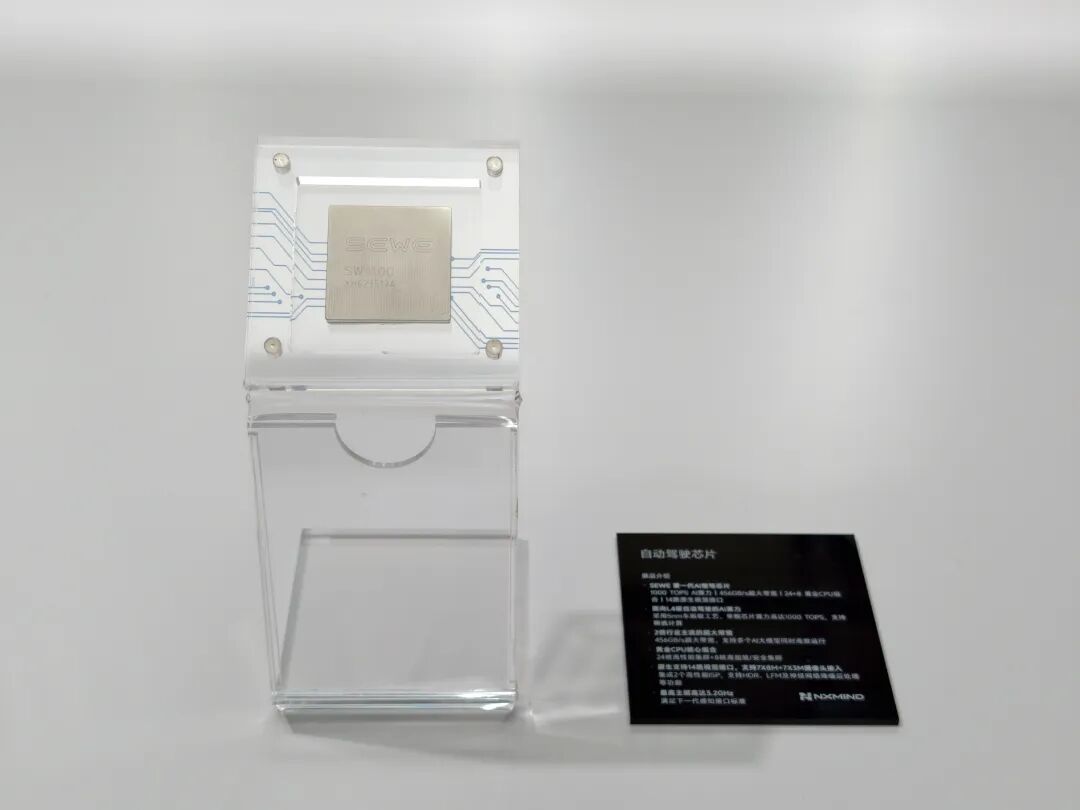
Image Source: Leitech Photography. Note: Dreame Cockpit-Driving Integrated Chip.
However, Dreame has not yet officially named this chip, and it is still in the tape-out testing phase. The earliest expected market release is still a year or two away. Nevertheless, from robotic vacuums to smartphones and now to vehicles, this 'Human-Vehicle-Home' chip ecosystem has once again showcased Dreame's formidable technical reserves to Leitech.
Another manufacturer that stands out for its chips is Hisense. However, unlike Dreame's aggressive cross-industry approach, Hisense focuses on the display sector. Its self-developed Xinchip AI Light-Color Synchronized Control Chip and RGB Trichromatic Light-Emitting Chip have achieved a technological leap from traditional 'light-color separation' to 'pixel-level light-color fusion.'
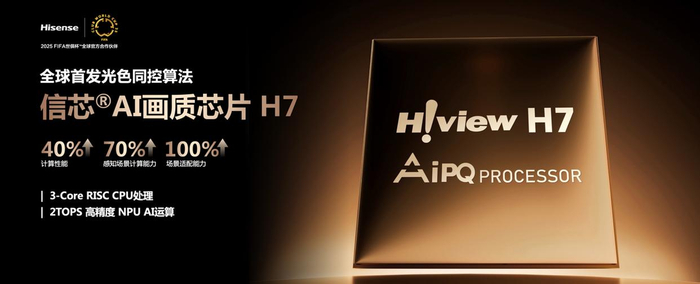
Image Source: Hisense
Through the combination of these two chips, Hisense has achieved the world's first 134-bit high-bit-depth control technology, enabling ultra-precise synchronous scheduling of red, green, blue, and cyan light sources. This thoroughly solves (physically) the industry pain points of color distortion and dark field halos in Mini LED displays under high-light scenarios.
It can be said that the birth of the Xinchip AI Light-Color Synchronized Control Chip and RGB Trichromatic Light-Emitting Chip marks the transition of domestic TV chips from mere algorithmic enhancements to hardware-level architectural innovations. This is also a microcosm of the entire Chinese home appliance industry: by strengthening technological leadership through self-developed chips and combining it with the cost-effectiveness brought by large-scale production, they are delivering a significant blow to overseas brands.
From Leitech's perspective, as the domestic chip R&D industry becomes increasingly developed and mature, more home appliance companies will join the ranks of self-development. This is because self-developed technology is the core competitiveness that determines market competition status.
Edge-Side Computing: The Core of Smart Home Adoption?
Besides being the foundation of parameters, chips are also the foundation of AI. At this year's AWE, we also saw many home appliances adding AI functions, including some complex applications such as food identification and expiration date screening. However, from an actual user experience standpoint, it is still difficult to say that these functions are mature: achieving high accuracy requires tapping into cloud computing power, resulting in second-level delays; while on-device recognition with low latency raises concerns about accuracy.
In fact, it's not just refrigerators that face the issue of insufficient on-device computing power. Air conditioners, robotic vacuums, washing machines—all home appliances that rely on real-time AI recognition functions have high computing power requirements. This is why we mentioned earlier that Dreame's self-developed Tianqiong series chips will serve as the computing power core for flagship embodied intelligence products. But then the question arises: What about non-flagship products?
From a chip cost perspective, a high-computing-power chip costs at least a thousand yuan. It is unrealistic to popularize high-computing-power chips across all home appliances. However, the demand for AI computing power is very real. How can this issue be resolved?
At AWE, Chinese companies provided two answers. One is the 'Smart Home Unified Interconnection Standard' released by the GIIC Global Smart IoT Alliance and several core units, aiming to address the challenges of network configuration difficulties, incompatibility, and lack of unified control faced by smart homes by breaking down 'ecosystem silos.'
The other is the AI Agent hub. At Linkthink Technology's booth, Leitech saw their proposed HomeClaw Whole-House Smart Computing Power Center solution. In this solution, all smart home appliances only need to be equipped with a basic computing power chip, which is solely used to support the invocation of basic smart functions of the devices. High-computing-power AI functions are uniformly handled by the computing power center.
For example, when you open the refrigerator and place a fish inside, the computing power center, detecting the door opening action, will immediately initiate interconnection with the refrigerator. It reads the images captured by the camera in real-time via WiFi, completes inference using the hub's computing power, and feeds the answer back to the refrigerator.
In this solution, the refrigerator itself does not need to possess high computing power or performance; it only needs to meet the requirements of 'taking photos' and 'transmitting' data. This not only simplifies the entire AI inference process into an internal loop of 'refrigerator—computing power hub—refrigerator,' ensuring that data remains within the home, but also reduces latency while avoiding potential cloud data leakage risks.
In response to this solution, Linkthink Technology also released the ARCS series chips. These are their first multimodal integrated chips, capable of completing multiple functions such as AI computing power, main control, multimedia processing, audio codec, memory, and wireless connectivity with just a single chip, perfectly meeting the interconnection needs of smart devices.
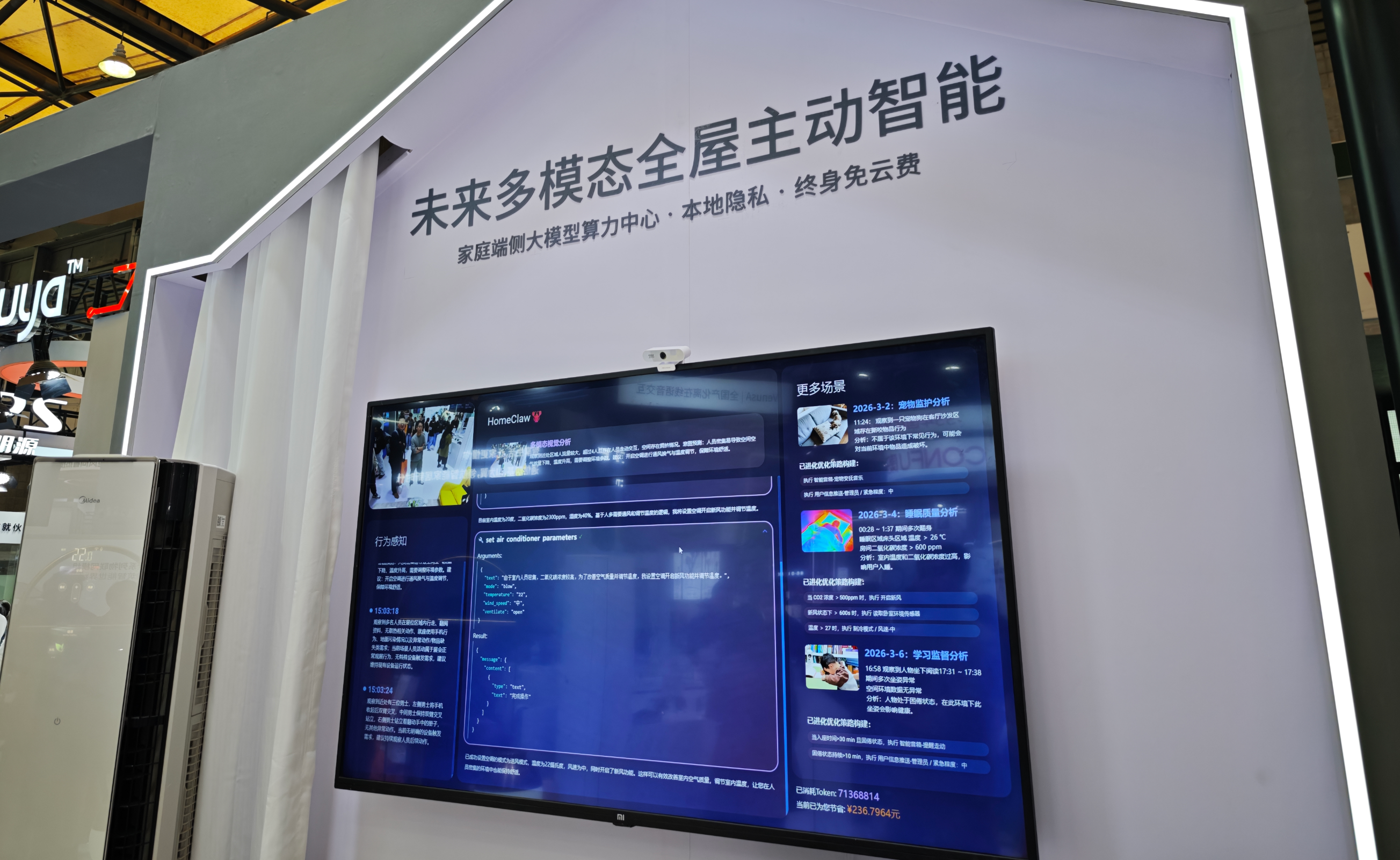
Image Source: Leitech Photography. Note: Linkthink Technology Whole-House Smart Solution.
By leveraging the 'Smart Home Unified Interconnection Standard' and the whole-house smart computing power center solution, we can build a low-cost whole-house smart system (edge-side computing). The core of this system can be your smartphone, a high-computing-power computer, or a dedicated smart home hub, responsible for handling all tasks with high computing power requirements.
With the widespread adoption of whole-house smart systems, combined with AIoT one-stop solution providers like Biemicro, Leitech can confidently say that the entire smart home ecosystem will witness a complete outbreak in the next two years.
This is because the deployment cost of AI functions is further decreasing, shifting from the cloud to the device side. The cost-effectiveness brought about by this shift is significant, as cloud computing power essentially represents ongoing operational costs for manufacturers, while device-side computing power only consumes the user's electricity.
With this solution, traditional manufacturers can quickly label their products as 'smart' and complete initial upgrade layouts in lower-tier markets, significantly reducing resistance to the promotion of smart home appliances.
A Dual-Pronged Approach to Solving On-Device AI Computing Power Challenges
However, at this point, some may wonder: 'If computing power is the same across the board, how can we ensure differentiated experiences between products?'
Firstly, this premise itself is flawed. While refrigerators priced at a thousand yuan and ten thousand yuan can both preserve food, they differ significantly in terms of design, capacity, freshness preservation effects, and other aspects. The edge computing solution only lowers the entry barrier and cost of AI-driven intelligence; it does not directly eliminate differences in the core experiences of refrigerators.
Secondly, not all home appliances can rely on a smart home hub to solve computing power issues. For example, the embodied intelligence robots showcased by Dreame require extremely fast reaction speeds and agile movements akin to humans, necessitating sufficiently robust on-device computing power.
In short, for home appliances that need to move, operate in complex environments, and possess real-time responsiveness, on-device computing power remains their core. For devices like refrigerators and air conditioners that do not require mobility and have less stringent latency requirements, the edge computing solution offers significant advantages.
Returning to the question posed by Leitech's AWE reporting team before departure regarding 'where the future of chips lies,' this year's exhibition has provided a clear answer: The future chip ecosystem will no longer be a single-dimensional accumulation of computing power but will move toward a dual-track parallel state of 'heavy terminals with on-device independent decision-making' and 'light terminals with strong edge computing hubs.'
The self-developed high-computing-power route, represented by Dreame's Chixiao 01 and cockpit-driving integrated chips, can empower smartphones, vehicles, and embodied intelligence robots with millisecond-level 'physical intuition' and advanced on-device decision-making capabilities. This is also the only solution for future embodied intelligence devices to handle complex three-dimensional spatial interactions.
On the other hand, the distributed computing power hub solution, represented by Linkthink Technology's HomeClaw and ARCS series, can address the dilemma faced by traditional white goods in balancing cost control with AI large model deployment. Through convenient computing power flow and whole-house collaboration, it enables static devices like refrigerators, washing machines, and air conditioners to achieve AI evolution at extremely low hardware costs.
This wave of intelligence, triggered by AI but ultimately returning to computing power, may completely transform our smart home ecosystem in the coming years.
Dreame, Hisense, Linkthink
Source: Leitech
All images in this article are from the 123RF Authentic Library (123RF Royalty-Free Image Library)
-
![]()
Hardware is the skeleton, AI is the soul, and data integrates the two
-
![]()
China’s AI Industry: A Unified Pivot Towards Monetization?
-
![]()
New Progress! Infineon Completes Acquisition of ams OSRAM's Non-Optical Sensor Business
-
![]()
35 Million Bet on an Optical Future! Tengjing Technology Makes a Move in AR
-
![]()
Why World Models Get Stuck on Construction Roads in Autonomous Driving Applications
-
Alibaba Initiates Cultural Transformation: Is Jack Ma Making a Strategic Comeback?
-
Tianfeng Heads to Hong Kong for IPO with RMB 3.8 Billion in Funds: Xingyu's Cross-Border Foray into Embodied AI Faces Uncertain Future
-
![]()
Mengshi Auto’s High-End Aspirations Dashed: Huawei Partnership Fails to Revive Sales, New Model’s Entry Price Dips Below 300,000 Yuan