120 Billion Yuan: Kimi’s Valuation Quadruples, Yet Market Comprehension Lags
 03/16 2026
 597
597
This weekend, the AI sector in China is abuzz with news of Kimi’s latest funding round. The large model company secured three rounds of financing in less than three months, with its valuation soaring from $4.3 billion to $18 billion (approximately 120 billion yuan). This marks a new benchmark for consecutive funding amounts in China’s large model sector in recent years.
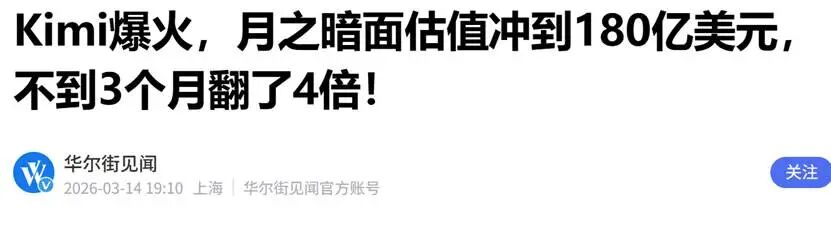
Behind this rapid ascent lies a wealth of untold stories. Among China’s mainstream large model companies, Moonshot AI’s Kimi has long remained an enigmatic “dark horse” due to its unlisted status and limited public disclosures. While peers like Zhipu and MiniMax are under the spotlight due to their listing processes, Kimi’s strategic moves rely heavily on industry word-of-mouth and expert evaluations.
This lack of transparency makes the intense funding spree worthy of deeper analysis. Understanding the rationale behind “three rounds in three months” not only clarifies Kimi’s growth trajectory but also unveils the true competitive dynamics of large models in China and globally.
01
Cognitive Edge Drives Technical Leadership: From Agent Cluster Vision to Capitalizing on OpenClaw
China’s AI landscape is crowded with large model companies, but those with genuine cognitive leadership are rare. Kimi’s uniqueness stems from its strategic foresight.
In September 2025, Kimi initiated grayscale testing for a new product called “OK Computer” (later renamed Agent). Inspired by Radiohead’s iconic album, the name blends artistic flair with strategic vision: while competitors focused on context length and benchmark scores in the chatbot race, Moonshot AI was already charting a different course—enabling AI to perform real-world tasks for humans.
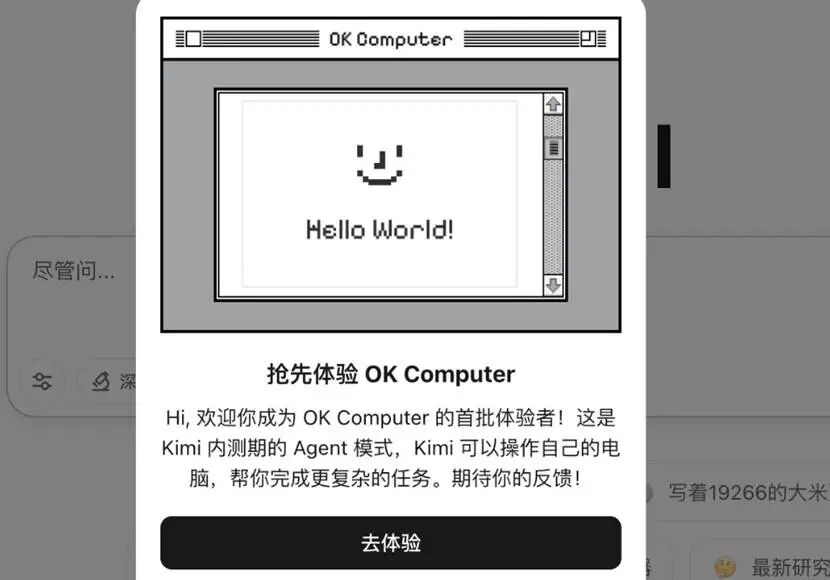
This product evolution reflects a fundamentally different strategic judgment. While the industry debated whether large models could understand complex instructions, Kimi recognized that language models are merely interfaces; true value lies in transitioning from “conversation” to “execution.” This insight centers on early recognition of the “Computer Use” and Agent trends.
Kimi president Zhang Yutong elaborated on this strategy during a Tsinghua University talk: “Our goal is to make Kimi everyone’s full-stack assistant.” This vision has guided Kimi’s development since inception: focusing on logical and Agent layers for high-value tasks requiring long-term planning and complex tool integration.
This cognitive edge translates into technical choices. Kimi incorporated massive real-world Agent scenario data during pre-training, including tool usage and multi-round planning trajectories. Post-launch, real user experiences continuously optimize the model. This means Kimi’s Agent capabilities are “endogenous”—developed organically from the model’s foundation rather than grafted later.
This cognitive advantage has materialized into concrete technical achievements. On the SWE-Bench Verified benchmark measuring software engineering capabilities, Kimi K2 scored 71.3%, surpassing most open-source and closed-source models. In November 2025, the Kimi K2 Thinking model was released, trained on the “model-as-Agent” concept with native “think-while-acting” capabilities. It scored 44.9% on “Humanity’s Last Exam” and achieved SOTA in multiple benchmarks, including autonomous web browsing (BrowseComp).
By January 2026, when Kimi K2.5 launched, Agent capabilities had evolved to “cluster” level. The K2.5 Agent cluster can dynamically deploy up to 100 instances for parallel processing of 1,500 steps, with the primary Agent overseeing role allocation and task decomposition.
Yang Zhilin explained this technical direction: “High-quality data growth can’t keep pace with computing power expansion. Traditional internet data-based token prediction yields diminishing returns. But we can scale through other means like Agent clusters—the number of parallel subtasks is infinitely expandable.”
This foresight received strong validation in early 2026. With the OpenClaw open-source agent project’s explosion, the industry suddenly realized users crave “practical” AI. During this “Agent craze,” Kimi became one of the most sought-after models globally.
Meanwhile, Kimi was the first to launch a cloud-based OpenClaw product, with “Kimi Claw” validating its market potential. In February, Kimi Claw ranked #2 globally on AI’s “Lobster Chart” with the highest domestic traffic.
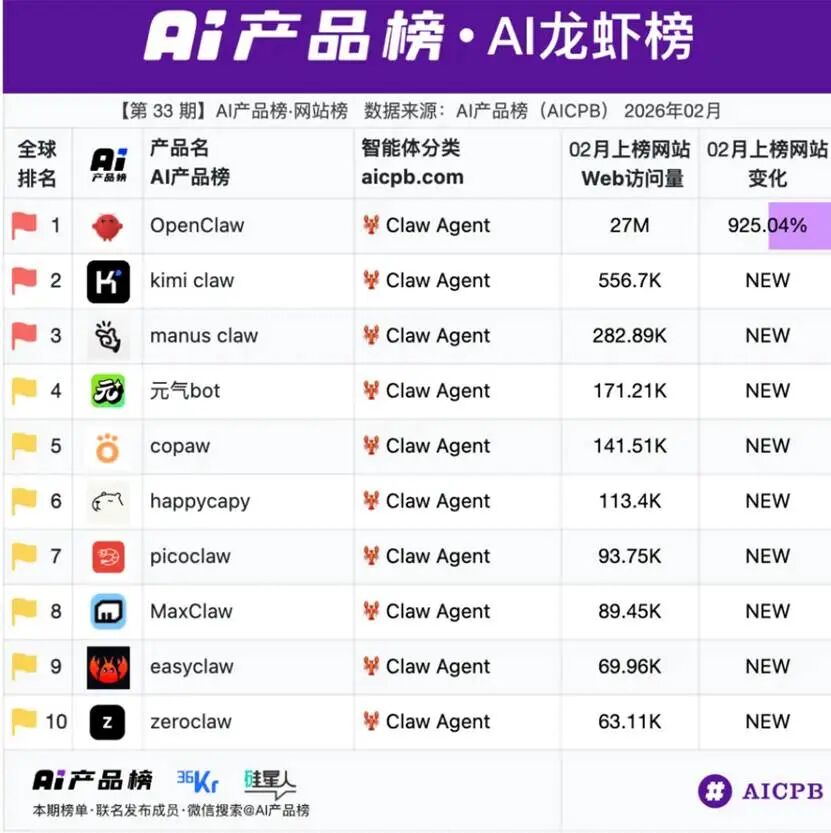
This success is no accident but a natural outcome of cognitive leadership. When the tide shifts toward Agent capabilities, only those who built the right infrastructure in advance can seize the opportunity.
02
Valuation Surge Logic: “Cost-Effectiveness” Emerges and Primary Market Awakens
While the “Agent craze” validated Kimi’s technical direction, capital inflow confirmed its business model viability. The three funding rounds in three months represent the primary market’s collective reevaluation and urgent position-building on Kimi.
Previously, market attention focused on listing candidates like Zhipu and MiniMax, which received high valuations due to listing expectations. Kimi’s unlisted status led to undervaluation or simplistic comparisons.
However, Zhipu and MiniMax’s listing processes established new valuation benchmarks. In Hong Kong, their recent trading valuations range between $34-45 billion.
This cost-effectiveness perception was ignited by compelling business data. After Kimi Claw’s launch, its personal subscriber base grew exponentially. Global payment giant Stripe’s data revealed explosive growth: payment orders surged 8,280% MoM in January and another 123.8% in February, breaking into Stripe’s global top 10.
More remarkably, Kimi’s 20-day revenue in late January exceeded its 2025 full-year total. Notably, its revenue structure shifted: after K2.5’s release, overseas revenue surpassed domestic, indicating global commercialization.
Similarweb data showed Kimi’s overseas API platform traffic surged 10-20x daily after K2.5’s release. In February, kimi.com hit record traffic with 120 million visits over three months.
From a valuation perspective, these metrics justify the valuation jump. The consensus is that AI large model companies require new valuation frameworks based on ARR growth and token call volume rather than traditional internet metrics.
Take Kimi: 20-day revenue exceeding full-year 2025 suggests at least 18x annual revenue growth. OpenRouter data shows Kimi 2.5 ranks top 3 in monthly call volume with 67% MoM growth—one of China’s fastest. Even conservative estimates suggest full-year revenue and token call growth far exceed 4x, making the three-month 4x valuation surge reasonable.
Comparatively, Hong Kong-listed Zhipu and MiniMax command $34-45 billion valuations, making Kimi’s $18 billion appear conservative.
For capital, this presents a perfect investment thesis: technical leadership validated by industry trends, a validated business model with data support, proven overseas growth, and valuation headroom versus listed/pre-listed peers. This convergence made Kimi a “must-have” from a “nice-to-have” investment.
Three rounds in three months pushing valuation to $18 billion appears aggressive but represents efficient market pricing as information transparency improves. When technical paths, business data, and comparative valuations align, capital consensus forms rapidly.
03
The War Footing: Why Such Urgent Capital is Needed
From Kimi’s perspective, accepting intense financing in such short order—with the founder describing it in an internal letter as “raising more capital than most IPOs or private placements, believing we can secure greater sums from the primary market”—reveals a hidden driver: the 2026 competition will be far more brutal than imagined.
While Agent business model validation benefits the entire industry, it triggers the fiercest arms race for individual companies. Everyone sees the same future: Agents are the battleground.
Using OpenClaw as reference, Agent evolution now occurs daily rather than monthly. This progress depends on sustained investment in core capabilities: coding (the Agent’s hands must be dexterous), multimodality (its eyes must be sharp), and infrastructure (its circulatory system must be robust).
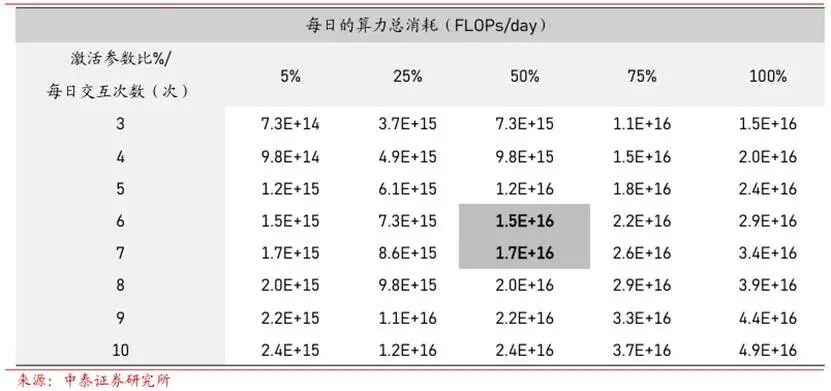
As Agent applications enter productivity scenarios, token consumption scales rapidly. Zhongtai Securities’ model, based on assumptions like 60% user interaction token coverage, links token consumption to computing demand (measured in H100 GPUs). Their calculation shows: a DAU 100M+ AI app may consume equivalent to 141,500 H100 GPUs daily.
Latest data shows China’s daily token consumption surged from ~100B in early 2024 to >30T by mid-2025, reaching 180T in February 2026.
This means once Agents dominate, model computing costs will rise exponentially rather than linearly. Any company wanting to stay in the game must prepare massive capital to pay this “computing tax.”
Yang Zhilin’s internal letter outlined 2026 goals: through technical improvements and model scaling, achieve at least 10x equivalent computing power for next-gen K3, matching global frontiers in pre-training; vertically integrate model training and product experience for differentiated K3 capabilities; ultimately focus on Agent productization/commercialization, prioritizing intelligence ceilings over user counts to create greater productivity value and achieve revenue scale growth.
Kimi’s decision to raise $1B at $18 billion valuation isn’t about maintaining status quo but surviving fiercer competition ahead. This is existential preparation, not just developmental funding.
04
The Dawn of AI OS: From Agents to Windows, Toward a $10T Market
Viewing Kimi’s financing pace through broader industry history reveals deeper patterns.
Today’s OpenClaw/Agent craze resembles DOS in the PC era. Next, the industry will enter the “Windows” competition phase. During DOS, users needed commands and scripts; Windows made computing graphical and intuitive, bringing it to households.
In AI, current Agent forms resemble command-line DOS—proving machines can execute tasks. The next battleground is AI OS: not just understanding user instructions but orchestrating underlying computing resources, managing multimodal I/O, and even becoming future AI hardware’s core.
Viewed through this lens, Kimi’s financing acceleration and valuation surge make sense. Capital frenzy isn’t just chasing a star startup’s equity but reflecting intensifying industry competition and staking claims on future super-interfaces.
For Kimi, the $18 billion valuation and three funding rounds merely secure an entrance ticket to the next arena—far from guaranteeing victory. On the AI OS track, rivals include not just aggressive startups but cloud/ecosystem giants. Tencent and ByteDance’s rapid OpenClaw ecosystem building aims to lock users into their app ecosystems.
This is a war for next-gen human-computer interfaces. While Kimi leads in models, it faces enormous challenges in platforms, ecosystems, and hardware. These three months’ three funding rounds merely prepare the first batch of ammunition for this prolonged war.
This weekend, as we marvel at Kimi’s valuation jump, we should see the accelerating AI world behind it. Technical leadership made it stand out in the “Agent craze,” business data explosions forced capital to reprice, and foresight about the Agent war compelled unprecedented speed in capital stockpiling.
DOS has arrived; Windows is coming. This super-war has just warmed up.
“I recognize the storm and thrill like the sea”—this applies to Kimi, large models, investors, and all of us.
-
![]()
Doubao Work Unveiled! Domestic AI Leaders Fully Commit to the 'Work' Sector
-
![]()
Who’s Sounding the Alarm on ‘Rushed Vehicles’?
-
![]()
Over 5.3 Billion Yuan in Losses Over Three and a Half Years! Can Yonyou Reverse Its Fortunes Through Streamlining and AI Transformation?
-
![]()
Baidu AI Adopts Free Model: A Strategic Maneuver in Traffic and Monetization
-
![]()
Silicon-Based OLED Pioneer Unveils Financial Results: H1 Shipments Outpace Entire 2025 Volume
-
![]()
AI's First "Lost Summer"
-
![]()
Zeiss Makes Another €2.2 Million Bet: Will Eye Tracking Be the Next Big Thing in the Smart Glasses Industry?
-
![]()
RUNTO Ranking | Global Top TV ODM Factories' Shipment Figures for July 2026