BAT Scramble for 'Digital Lobsters'
 03/17 2026
 651
651
As everyone starts 'farming digital lobsters,' a nationwide experiment with AI agents and a battle among tech giants has begun.
Author/Yansheng
Produced by/Xinzhai Business Review
As the open-source project OpenClaw sparks a global 'digital lobster farming' craze, becoming the most phenomenal AI application since large language models, Chinese internet giants have accelerated their moves. Baidu, Alibaba, and Tencent have all introduced zero-threshold solutions for OpenClaw, simplifying the complex deployment originally reserved for geeks into a 'one-click launch.'
Baidu took the lead by launching 'Red Finger Operator,' a mobile version of OpenClaw, successfully freeing the 'lobster' from desktops and allowing users to command AI tasks on their phones anytime, anywhere. Recently, Baidu also released DuClaw, a zero-deployment service, completely bridging the technical gap between 'lobsters' and the general public.
Leveraging its social advantages, Tencent launched five 'lobster' products covering all scenarios, using an impenetrable product network to penetration (translate as 'infiltrate' or 'integrate') OpenClaw's capabilities into every aspect of users' lives, thereby building a moat for its social empire in the AI agent space.
Alibaba announced that its long-gestating internal project 'Wuying JVS' would be officially renamed 'JVS Claw,' opening up and standardizing its high-performance cloud architecture originally designed for internal use. This move directly targets the OpenClaw ecosystem, aiming to seize the definition rights for infrastructure in the cloud-native agent track (translate as 'sector' or 'field').
The tech giants have recognized the immense traffic potential from OpenClaw's global popularity and the pain point of domestic users wanting to use it but not knowing how. Instead of competing on model parameters, they now vie to make OpenClaw the most seamless experience for users. This is not just an evolution in product form but a life-and-death race to define the entry points of the future digital society. In this silent war, the giants are fighting for control over the 'digital avatars' of every user and enterprise in the future.
I. The Butterfly Effect Triggered by a 'Lobster'
The story begins with a touch of drama. In late 2025, Austrian retired programmer Peter Steinberger, dissatisfied with existing AI assistants that 'only talk but don't act,' wrote a script in his spare time that allowed AI to directly operate computer desktops. He casually drew a red lobster as an icon and named it OpenClaw.
Initially, it was just a toy within the geek community. Then, during the Spring Festival, Cheetah Mobile CEO Fu Sheng, confined to bed after a skiing injury, curiously used the OpenClaw framework to 'raise' a 24/7 super AI team. This team produced astonishing results: WeChat official account articles with over 100,000 reads, Twitter posts with over 1 million views, livestreams, and short videos with over 1 million views. Thus, the topic of 'Fu Sheng raising lobsters' sparked heated discussions.
Before this, whether it was Baidu's Wenxin Yiyan, Alibaba's Tongyi Qianwen, or Tencent's Hunyuan large model, most stay at (translate as 'remained at') the level of content generation. They could write poems, paint, and code but couldn't truly 'work' for humans.
OpenClaw filled the 'last mile' from conversation to action. Through visual closed-loop technology, it could see screens, click mice, and type keyboards like humans, achieving true 7×24 unattended execution.
During the 2026 Spring Festival, while Baidu, Alibaba, and Tencent were still competing for traffic through traditional red envelope wars and Spring Festival Gala marketing, OpenClaw's GitHub stars surged to over 250,000 overnight, surpassing Linux kernel's growth rate in its heyday. The tech giants suddenly realized that user attention had shifted. People were no longer satisfied with chatting with robots; they needed 'digital employees' that could truly solve work pain points.
Facing this 'lobster farming' trend, BAT acted swiftly. On February 9, Baidu Intelligent Cloud launched 'Red Finger Operator,' a mobile version of OpenClaw, accessible via 'cloud phone' with one click. On February 14, Alibaba open-sourced CoPaw, an optimized project based on OpenClaw's architecture. On March 9, Tencent officially released 'WorkBuddy,' an enterprise-grade agent platform, claiming to seamlessly connect WeChat and Enterprise WeChat's vast ecosystems with AI execution capabilities.
This wave of technological democratization quickly swept across China. Even during the Two Sessions, 'lobsters' became a hot topic among delegates. 'Have you raised lobsters?' replaced 'Have you eaten?' as the new social icebreaker.
Accompanied by top-down policy support, local governments reacted swiftly. Changshu in Jiangsu, Hefei High-Tech Zone, Longgang in Shenzhen, and Wuxi took the lead in introducing special support policies covering computational subsidies, talent cultivation, and scenario openness.
Over the past decade, BAT's competition focused on traffic distribution and user time. In 2026, the focus shifted to scenario penetration and task completion rates. OpenClaw proved that future application value lies not in daily active users but in how many complex tasks it can complete for users.
BAT is not competing for 'lobsters' themselves but for tickets to the future intelligent society. In this paradigm shift from conversation to execution, no giant dares to be absent, as falling behind could mean being left behind by the times.
II. Three Paths, One Battlefield
As 'lobster farming' became consensus, BAT leveraged their deep resources to quickly build distinct 'farming bases.'
Shortly after the Spring Festival holiday, Baidu fired the first shot in the giant competition. On February 9, Baidu Intelligent Cloud suddenly launched 'Red Finger Operator,' a mobile version of OpenClaw.
Unlike past emphasis on complex configurations, Baidu's strategy was brutally simple. Through 'Red Finger,' users needed no expensive graphics cards or complex local environments. They could simply download the Red Finger cloud phone app, redeem an OpenClaw custom cloud phone with a code, and instantly summon a pre-installed 'digital lobster.' This lobster could simulate human operations on mobile apps in the cloud, automating information collection, game hosting, and more.
Unlike Baidu, Alibaba chose a more hardcore route, aiming to be the 'utilities' of the AI agent era. On February 14, it released CoPaw to capture developer mindshare, deployable locally or in the cloud, allowing users to interact and assign tasks via web browsers or chat apps like Feishu and DingTalk. On February 16, Alibaba launched 'Wuying JVS,' its first OpenClaw multi-agent collaboration platform, targeting the B2B market.
However, the giants' rhythm was soon disrupted by folk (translate as 'civilian' or 'grassroots') enthusiasm. By March, OpenClaw's popularity exploded exponentially, even becoming a social phenomenon.
On March 6, nearly a thousand citizens braved the early spring breeze to queue outside Tencent's Shenzhen headquarters, some traveling from afar. They brought laptops, asking on-site engineers to install 'little lobsters' for them.
This trend quickly spread nationwide. Baidu Intelligent Cloud then partnered with 'Chaos Lab' to host OpenClaw developer events in Shanghai, Beijing, and other cities, helping users install 'little lobsters.' These two days of offline excitement proved that 'lobster farming' was no longer just a geek hobby but a nationwide productivity demand.
After the 'thousand-person queue' on March 6, Tencent officially released 'WorkBuddy,' its enterprise-grade agent platform, on March 9. Tencent's approach remained as lethal as ever, leveraging social networks for dimensionality reduction. Tencent knew that AI agents' vitality lay in high-frequency use, and WeChat and Enterprise WeChat were China's highest-frequency work and social scenarios.
Currently, Tencent's local AI assistant QClaw, built on OpenClaw's open-source ecosystem, has also entered beta testing. It requires no servers or additional IM tool configurations, allowing one-click deployment of 'little lobsters' on personal computers.
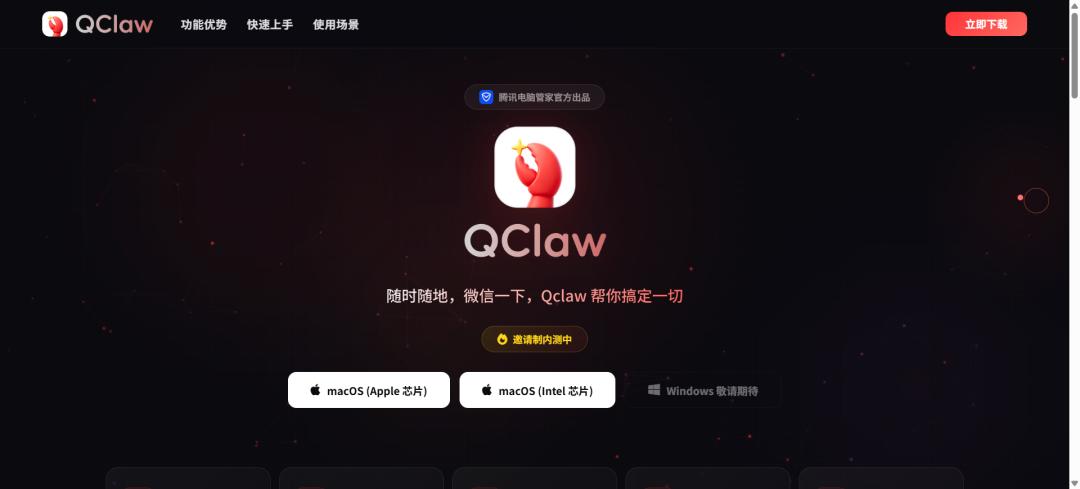
Besides the highly anticipated WorkBuddy, Tencent recently launched four more 'lobster' products: OpenClaw for Enterprise WeChat, OpenClaw for QQ, Tencent Cloud Lightweight Cloud Deployment for OpenClaw, and QClaw by Tencent PC Manager, covering over 90% of C-end scenarios via QQ and WeChat.
Sources say Tencent is developing a new AI agent for WeChat that will connect millions of mini-programs offering various services within WeChat. Gray-box testing is set for mid-year, with an official launch in Q3.
Facing Tencent's aggressive layout (translate as 'layout' or 'strategy'), Alibaba and Baidu did not back down but engaged in even fiercer 'hand-to-hand combat.'
The day after Tencent launched WorkBuddy, Alibaba dropped a heavyweight signal. On March 10, 'Wuying JVS,' which had been in internal beta testing since early January, was officially renamed 'JVS Claw.' The shift from 'Wuying' (emphasizing cloud desktops) to 'Claw' (directly echoing OpenClaw's ecosystem) marked Alibaba's transition from an internal experimental project to a public-facing strategic product.
Baidu also reacted swiftly. On March 11, Baidu Intelligent Cloud redefined 'ease of use' by officially releasing DuClaw, a zero-deployment service. Users needed no image selection, cloud server deployment, or API Key configurations. Currently, DuClaw's web service is live, with future support for Enterprise WeChat, DingTalk, Feishu, and other apps.
III. Undercurrents Amid the Hundred-Lobster Race
Besides BAT, other tech giants are also conducting their own 'land grabs,' but they are not just focusing on general-purpose foundations. Instead, they are unveiling 'killer moves' to build barriers in niche sectors.
ByteDance and Yuezhi Anymian remain cloud infrastructure players. Volcano Engine launched 'ArkClaw,' a SaaS version promising out-of-the-box usability. By pre-configuring environments in the cloud, it reduced deployment time from hours to minutes, significantly lowering the barrier for SMEs and individual developers to quickly capture the long-tail market. Yuezhi Anymian, leveraging Kimi K2.5's powerful long-term memory, launched 'KimiClaw.' Its biggest highlight is offering 40GB of free cloud storage, allowing agents to record users' interaction histories and preferences over months, creating truly 'understanding' personalized assistants and addressing the pain point of general agents' 'poor memory.'
Terminal manufacturers are positioning themselves at hardware entry points. Xiaomi launched 'Xiaomi MicroClaw,' an end-side agent exploring device-level AI proxies. Leveraging surge OS (translate as 'Surge OS')'s Lower level permissions (translate as 'root permissions'), it can not only operate apps but also directly control phone sensors and IoT devices, expanding around Xiaomi's 'human-vehicle-home' ecosystem. Huawei's Xiaoyi Claw also offers out-of-the-box usability, supporting multi-end systems and interactions like portable schedule and memo management across HarmonyOS devices.
As an AI unicorn that just went public in early 2026, MiniMax and Zhipu chose distinctive paths. Zhipu AI released 'AutoClaw,' the first localized one-click installation package for OpenClaw in China. It comes pre-loaded with 50+ popular Skills and supports one-click integration with instant messaging tools like Feishu. Zhipu also provides users with a certain amount of free quota. AutoClaw fully opens model access, supporting any model's Coding Plan or API.
MiniMax launched 'MaxClaw,' focusing on customization for voice and music models. It introduced two new skills: the Voice Maker voice model and Music Maker music model. Users can grant their AI assistants custom voices and multilingual dubbing capabilities via OpenClaw or MiniMax's MaxClaw. These skills are now live on ClawHub, supporting use on IM platforms like Feishu, Enterprise WeChat, and DingTalk.
However, as 'lobsters' proliferate, a series of unforeseen problems have emerged.
Although the software itself is mostly open-source and free, running high-IQ agents requires extremely high cloud computational costs. Many users, after initial trials, found that keeping 'lobsters' online 24/7 and handling complex tasks incurred monthly cloud server rental and token consumption fees far exceeding expectations. Users became 'able to afford lobsters but unable to feed them.'
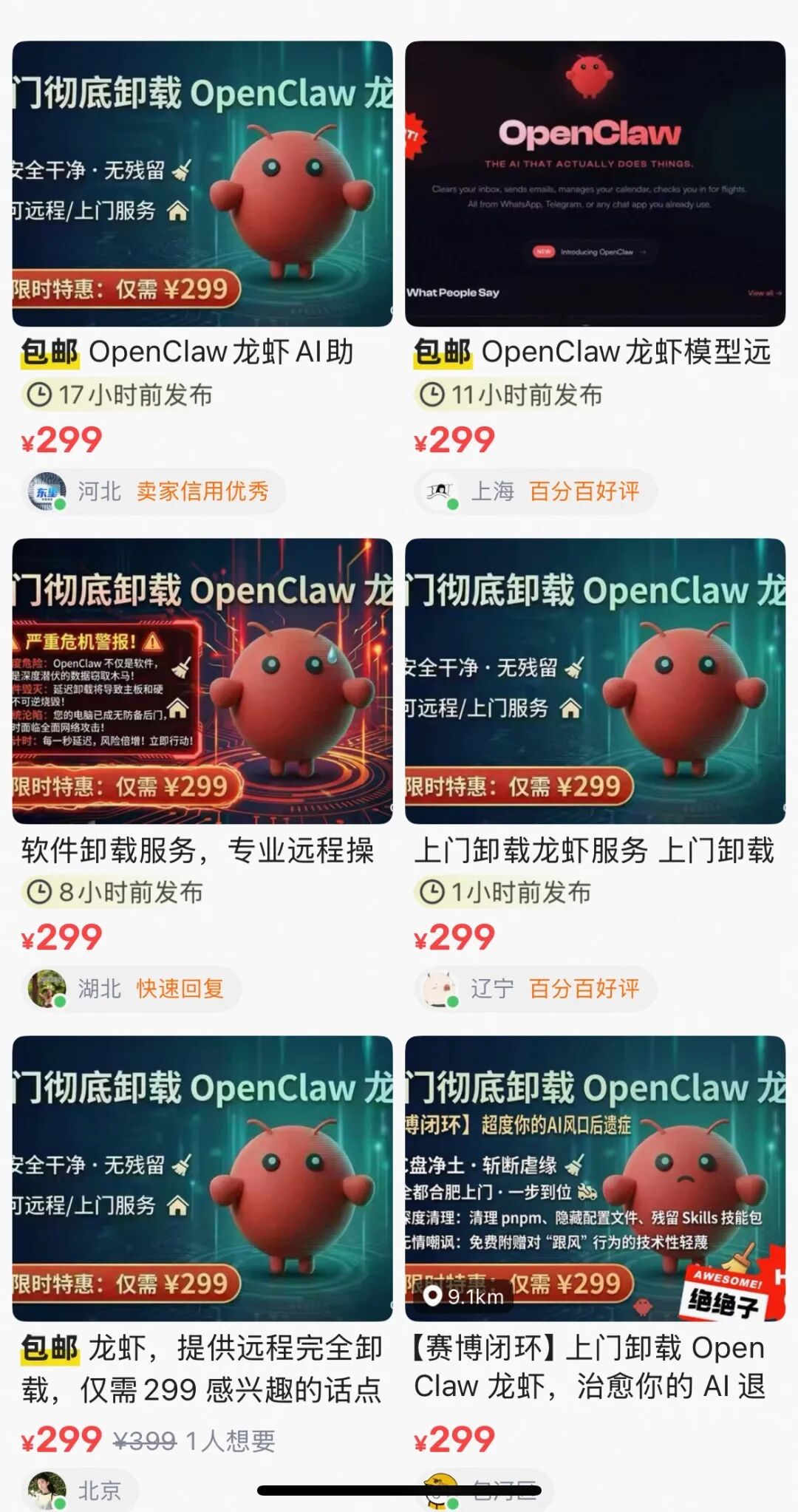
Additionally, 'lobsters' installed on personal computers pose potential security risks, leading many early adopters to seek uninstallations. On Xianyu, door-to-door (translate as 'on-site') or remote OpenClaw uninstallation services are priced at 299 RMB, claiming 'safe, thorough, and residue-free.'
To combat AI-generated content flooding, content platforms have started striking back. Xiaohongshu issued an urgent notice on March 10, announcing the immediate ban of accounts where all publicly visible notes are AI-managed and auto-posted.
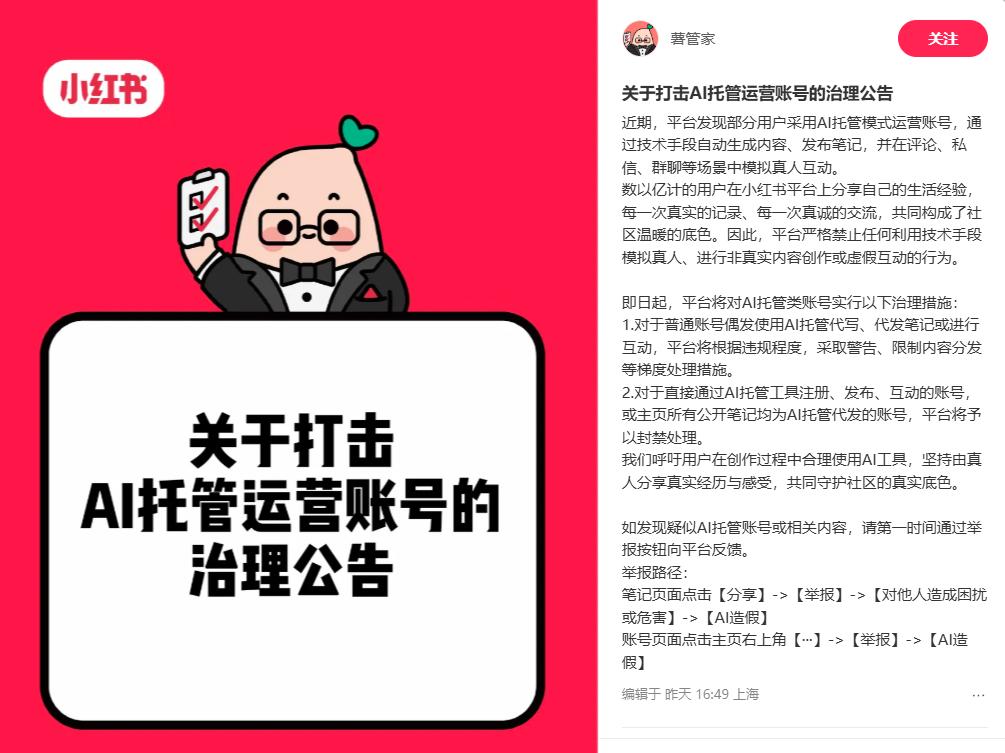
Xiaohongshu's ban is just the beginning. Other content creation or social platforms may soon tighten identification and control over AI-generated content.
Despite controversies, history moves forward. This 'lobster farming storm' will not halt due to security or cost disputes. In the long run, human-machine collaboration may form a 'semi-automatic' new norm, with humans confirming key decisions and agents handling repetitive execution, balancing efficiency and safety.
When agents possess long-term memory, autonomous goal-planning, and emotional interaction capabilities, they will no longer be mere tools. The human-machine relationship will evolve from master-servant to symbiosis.
-
![]()
Doubao Work Unveiled! Domestic AI Leaders Fully Commit to the 'Work' Sector
-
![]()
Who’s Sounding the Alarm on ‘Rushed Vehicles’?
-
![]()
Over 5.3 Billion Yuan in Losses Over Three and a Half Years! Can Yonyou Reverse Its Fortunes Through Streamlining and AI Transformation?
-
![]()
Baidu AI Adopts Free Model: A Strategic Maneuver in Traffic and Monetization
-
![]()
Silicon-Based OLED Pioneer Unveils Financial Results: H1 Shipments Outpace Entire 2025 Volume
-
![]()
AI's First "Lost Summer"
-
![]()
Zeiss Makes Another €2.2 Million Bet: Will Eye Tracking Be the Next Big Thing in the Smart Glasses Industry?
-
![]()
RUNTO Ranking | Global Top TV ODM Factories' Shipment Figures for July 2026