Samsung's Massive Strike: The Real Bottleneck for AI
 03/20 2026
 521
521
Source: Duke Internet News (ID: wlyxs888)
On March 18, two scenes half a world apart laid bare the most absurd truth in today's AI industry.
On one side, in Silicon Valley, NVIDIA CEO Jensen Huang confidently assured capital at the Morgan Stanley conference: global memory chip manufacturers should expand production as much as possible, and NVIDIA will take whatever capacity they can offer. The gap in AI computing power is far larger than anyone imagines.
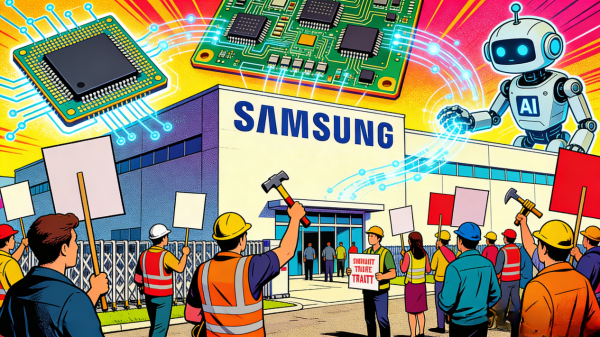
On the other side, in Pyeongtaek, South Korea—home to the world's largest memory chip production base—Samsung Electronics' three major labor unions jointly announced strike vote results: among 90,000 union members, 73.5% voted, with a staggering 93.1% approving the strike. Without a breakthrough agreement, Samsung will face its largest-ever strike from May 21 to June 7, with 18 days of work stoppages directly halting half of the core production capacity at the Pyeongtaek campus.
On one side, the AI circle revels in computing power, with capital scrambling for it and large models competing on parameters to the extreme; on the other side, the workers supporting the entire computing infrastructure have handed the industry a "death ultimatum" with a high-vote strike resolution.
Everyone talks about AI's "bottlenecks"—fearing lithography machine bans, GPU shortages, or advanced process blockades. But no one realizes that the true Achilles' heel of global AI computing power lies not in ASML's lithography machines but in the hands of the 24-hour shift workers in South Korean factories. If they stop working, even the most powerful large models won't run a single character.
【History's Largest Strike: Not a Tantrum, but Unequal Distribution of AI Dividends】
This strike is not a sudden emotional outburst but the culmination of two years of escalating labor disputes at Samsung during the AI supercycle.
The union's demands couldn't be clearer: a 7% base salary increase, abolition of the "performance bonus capped at 50% of annual salary" limit, and replacement of the opaque OPI bonus calculation system with a transparent operating profit-sharing mechanism. Samsung management's concession: just a 6.2% salary hike, refusing to budge on bonus caps or profit-sharing. After eight months of negotiations, talks collapsed completely.
The trigger was SK Hynix's "reverse play." In September 2025, SK Hynix accepted the union's compensation reform demands, sharply raising frontline employees' performance bonuses and profit-sharing ratios. Within three months, over 100 Samsung semiconductor core technicians jumped ship to SK Hynix.
Union survey data hit harder: at the same semiconductor production line level, SK Hynix employees earn over 30% more annually than Samsung's. Ironically, these two companies are the biggest winners in the AI storage boom.
What workers find unacceptable is the complete disconnect between corporate performance and employee income. In 2025, Samsung's semiconductor division achieved record results: annual operating profit surpassed 43 trillion won, memory chip business profit soared over 400% year-on-year, and AI-core HBM high-bandwidth memory revenue jumped 157%. In Q4 2025 alone, Samsung's total operating profit hit 20.1 trillion won, up 209% year-on-year, with the semiconductor division contributing 80% of profits.
Yet while profits surged, frontline workers' base salaries failed to keep pace with South Korean inflation for three consecutive years, performance bonuses faced layered restrictions, and AI boom excess profits flooded into shareholders' and executives' pockets without a ripple reaching factory workers.
This isn't Samsung's first strike. In July 2024, the company saw its first-ever unlimited general strike involving about 6,500 employees, lasting nearly a month. This strike's scale is over ten times larger, covering over 70% of South Korean employees and directly targeting the semiconductor division generating most group profits.
The two strikes, less than two years apart, trace a clear escalation curve: as AI transformed memory chips from "ordinary industrial products" to "AI hard currency," and corporate profits doubled with computing demand, workers' demands for "fair distribution" reached a breaking point.
As Choi Seung-ho, representative of Samsung Union's Joint Struggle Headquarters, said: "The chip industry is booming like never before, but these gains have never reached frontline producers. That's why we fight."
【Every GPU You Snatch Depends on South Korean Factory Workers】
Most people's understanding of AI stops at large model launches, NVIDIA's new GPUs, and trillion-parameter breakthroughs. Few grasp the fundamental logic: all AI computing power relies on memory chips. Without fast, large-capacity memory, even the most powerful GPUs can't run large models.
AI's memory demand is exponential. A regular server typically has 32-64GB RAM; an AI server for large model training needs 8-10 times that, with 8-16 HBM high-bandwidth memory modules per server and enterprise-grade SSDs in the dozens of terabytes.
Gartner data shows: global AI server shipments will exceed 1.5 million units in 2026, up over 180% year-on-year, corresponding to over 12 million AI memory chips needed. Yet global production capacity in 2025 was only 8 million units, creating a supply-demand gap exceeding 30%.
In this seller's market, Samsung holds absolute dominance. TrendForce data shows: in Q4 2025, Samsung reclaimed the global DRAM market lead with 36% share; NAND flash memory at 28% (also No.1); and in AI-critical HBM, Samsung's 2026 market share is projected at 27%, with SK Hynix combining for 85% global HBM capacity.
Critically, 100% of Samsung's DRAM production and two-thirds of NAND capacity are concentrated in South Korea, centered at the strike's epicenter—the Pyeongtaek semiconductor campus.
A common misconception: semiconductor factories are fully automated, so a few missing workers won't matter. The reality is the opposite: a 12-inch wafer production line running 24/7 requires numerous technicians for equipment maintenance, parameter calibration, and yield control. Even a few hours' absence of core operators can render entire wafer batches scrap; even if production resumes immediately, restoring normal yield levels takes 1-2 months.
Among the striking union members are many core engineers responsible for production line maintenance and yield management at Pyeongtaek. The union has vowed to precisely target semiconductor production capacity, estimated directly impacting half of the Pyeongtaek campus's output.
Meanwhile, storage industry inventory levels hover at a cliff's edge. SK Hynix disclosed overall inventory at just 4 weeks, with Samsung similarly at historic lows—far below the 8-12 week industry safety line. With no inventory buffer, a Samsung production halt means a cliff-like drop in global memory chip supply.
The AI industry will bear the brunt. Samsung has already started mass-producing HBM4 memory for NVIDIA's next-gen Vera Rubin AI computing platform, while Pyeongtaek also handles premium DRAM/NAND orders for Google, Microsoft, and Amazon. An 18-day strike will delay existing orders and disrupt global AI data center construction, worsening the already fierce computing power shortage.
We constantly discuss AI's "bottlenecks" but fail to realize: global AI computing power's lifeline rests in these production line workers' hands. Their collective work stoppage could instantly strand Silicon Valley's AI arms race in a "no rice to cook" dilemma.
【We Guarded Against Countless 'Bottlenecks' but Never Against 'People'】
Samsung's strike exposes the most hidden, lethal wound in global AI supply chains: we've spent fortunes building a "never-fail" globalized computing power system while blind to its foundational fragility.
For years, semiconductor industry risk warnings focused on geopolitics—U.S. tech blockades against China, Japan-South Korea material trade frictions, Middle East conflict impacts on raw materials. These were the industry's recurring "black swans." But Samsung's strike reveals: compared to geopolitical uncertainties, labor relations pose a more direct, uncontrollable, and overlooked supply chain risk.
The global memory chip market is an extreme oligopoly. Samsung, SK Hynix, and Micron control over 90% of global DRAM market share; the HBM market is even more concentrated, with Samsung and SK Hynix monopolizing 85% of capacity. This highly centralized production means global AI supply security hinges entirely on these few companies' stable operations—making South Korean labor relations the global AI supply chain's "Achilles' heel."
More alarmingly, this "people bottleneck" risk isn't isolated but pervasive across the AI boom. Over the past three years, to meet AI demand, global top memory manufacturers have Crazy expansion of production ( Crazy expansion of production = crazy expanded production), pouring nearly all funds into advanced process R&D and production line construction while stingily cutting frontline workers' compensation and working conditions.
Korea Semiconductor Industry Association data shows: in 2025, South Korean semiconductor employees' average overtime hours increased 27% year-on-year, but salary growth was just 4.2%—far below industry profit growth rates.
This imbalance fuels escalating conflicts. From Samsung's first strike in 2024 to SK Hynix's 2025 labor negotiations and now Samsung's largest-ever strike, South Korean semiconductor industry labor disputes are rapidly intensifying. Once Korean semiconductor production halts, no country or company can fill the supply gap.
Unlike supply chain disruptions from natural disasters like earthquakes or pandemics, labor conflict-induced "human disasters" are harder to resolve. Natural disasters allow resumption after repairs, but labor disputes stem from long-term distribution imbalances and workers' demands for fairness—not solvable with short-term subsidies or temporary compromises. Even if Samsung and the union reconcile this time, as long as AI dividend distribution mechanisms remain unchanged, future strike risks will always loom over the industry.
The global AI industry is trapped in an absurd cycle: we've built a "never-fail" computing power system with cutting-edge technology while basing its stability on squeezing bottom-level producers' interests. We constantly calculate computing power availability, redundancy, and disaster recovery capabilities but never assess the labor relations supporting this system's safety margins.
【The Cost of Revelry: Ordinary People Always Pay】
The strike's butterfly effect has begun. After vote results were announced, global memory chip spot prices surged—DRAM spot prices jumped over 15% in a single day, with multiple agencies raising 2026 memory chip price hike forecasts. Goldman Sachs even warned: if the strike proceeds, DRAM annual price gains could exceed 250%.
These cost increases will cascade through the supply chain, sparing no one.
First impacted are AI chipmakers like NVIDIA and AMD—HBM and DRAM price hikes directly raise GPU production costs, pushing AI server prices higher. Next, cloud giants like Microsoft, Google, and Amazon will pass server cost increases onto cloud services and AI computing rental prices. Ultimately, all businesses using AI services and ordinary consumers buying smart devices will foot the bill.
Ironically, regardless of the strike's outcome, ordinary people—not AI boom's biggest winners—will pay.
If Samsung management stands firm and the strike proceeds, supply chain disruptions will pass costs downstream to consumers. If Samsung compromises and meets union wage demands, increased labor costs will still transfer to the entire supply chain via chip price hikes. Meanwhile, shareholders and executives reaping massive AI storage boom profits will bear virtually no losses.
This reflects global tech industry's most urgent reflection ( reflection = reflection): we claim AI changes the world and makes life better, but technological progress's dividends flow only to a tiny minority. Frontline AI infrastructure producers gain nothing from industry growth while enduring high-intensity work, mismatched salaries, and industry cycle risks. Meanwhile, office-bound management and Wall Street capital easily pocket most AI boom profits.
As we marvel at Sora's lifelike videos, cheer for large model parameter breakthroughs, and scramble for scarce AI computing power, few consider that behind this power are Pyeongtaek campus workers maintaining production lines 24/7. We calculate large models' training and inference costs but never tally how much truly reaches frontline producers.
This strike sounds the alarm for the frenetic AI industry: a computing power system built on distribution imbalances and labor conflicts is inherently fragile, regardless of technological sophistication or scale. Technological progress should serve capital appreciation and uplift everyone supporting the system.
After all, when the hands producing HBM chips choose to down tools, even the most advanced large models won't run a single character.
The real question is: while the industry obsesses over AI being technologically bottlenecked, has anyone considered that what could instantly halt this computing power revelry isn't cutting-edge technology but the people we ignore yet support the entire AI edifice?
Note: Some data in this article comes from publicly available online sources
-
![]()
A Computing Power Titan Unveils a Revolutionary Product: Performance-to-Power Ratio Skyrockets by 450 Times!
-
![]()
Doubao Work Unveiled! Domestic AI Leaders Fully Commit to the 'Work' Sector
-
![]()
Who’s Sounding the Alarm on ‘Rushed Vehicles’?
-
![]()
Over 5.3 Billion Yuan in Losses Over Three and a Half Years! Can Yonyou Reverse Its Fortunes Through Streamlining and AI Transformation?
-
![]()
Baidu AI Adopts Free Model: A Strategic Maneuver in Traffic and Monetization
-
![]()
Silicon-Based OLED Pioneer Unveils Financial Results: H1 Shipments Outpace Entire 2025 Volume
-
![]()
AI's First "Lost Summer"
-
![]()
Zeiss Makes Another €2.2 Million Bet: Will Eye Tracking Be the Next Big Thing in the Smart Glasses Industry?