Half Salary in Tokens: Chinese Companies First to Implement Jensen Huang's Bold AI Vision
 03/20 2026
 588
588
Tokens serve as a catalyst to enhance employees' capabilities and competitive edge.
At the ongoing NVIDIA GTC 2026 conference, Jensen Huang made a groundbreaking announcement:
"In the future, every engineer at our company will need an annual token budget. In addition to their base salary, I may allocate a token quota equivalent to half their salary to boost their productivity tenfold."
As the prime beneficiary of the AI computing power boom, NVIDIA is flourishing. Having overcome real-world implementation hurdles, it's now feasible to provide employees with a 'token quota' amounting to half their salary.
Will small, medium, and large enterprises across the board embrace new expense items like 'token quotas'?
'Token Quotas': The New 'Workstations' for Enterprises
At NVIDIA GTC 2026, Jensen Huang also proclaimed, "OpenClaw is undoubtedly the next ChatGPT."
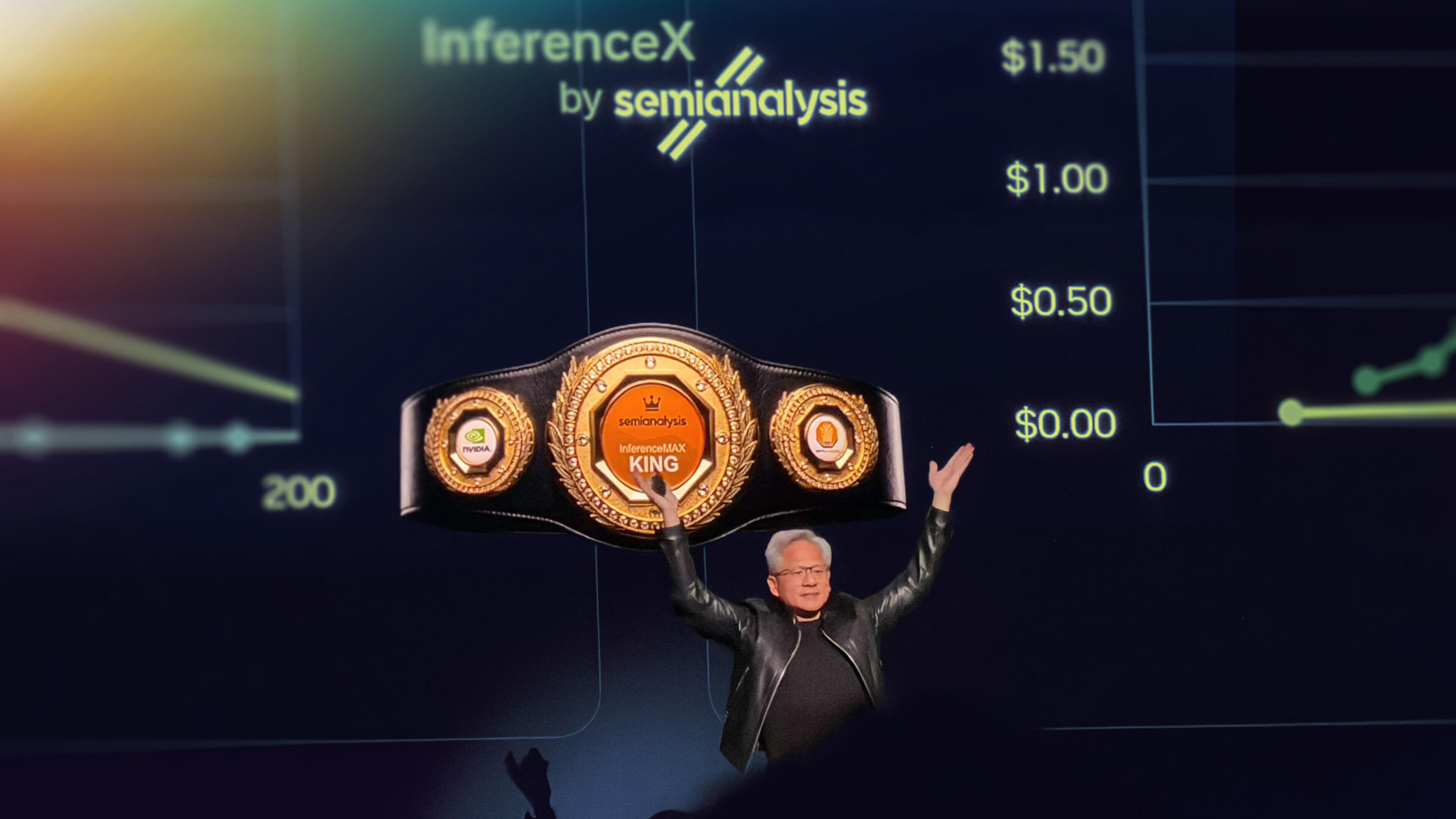
Image Source: CNET
AI agent frameworks, exemplified by OpenClaw, are seamlessly integrating AI technology into human office and work environments, with skills that are 'constantly evolving'.
However, compared to traditional chat-based interactions, AI assistants consume significantly more tokens per task in work scenarios.
An AI assistant answering a simple question in a chatbox may use a few hundred or thousand tokens per interaction. Yet, when functioning as an agent in a work scenario, the basic workflow entails 'perception, reasoning, decision-making, execution, and feedback.' Executing a relatively complex task can easily consume hundreds of thousands to millions of tokens. The more capable the AI assistant and the more complex the work environment, the more 'astronomical' the token consumption per task becomes.
Enterprise clients' token consumption is skyrocketing exponentially. Data from the National Data Bureau reveals that China's daily token consumption has surged from 100 billion in early 2024 to over 30 trillion by mid-2025, a more than 300-fold increase in just 1.5 years. IDC data projects that the annual token consumption by globally active AI agents will soar from 0.0005 Peta Tokens in 2025 to 152,000 Peta Tokens by 2030, a growth of over 300 million times.
On the flip side, AI large model platforms, such as Zhipu in China, have continuously raised API prices, with cumulative increases nearly doubling this year. Cloud platforms, including Alibaba Cloud and Baidu Cloud in China, are also set to hike service prices for AI computing power products.
With surging user and market demand on one side and token costs that are challenging to significantly reduce in the short term on the other, Leikeji believes that new expenditure plans like 'token quotas' are increasingly facing enterprises, especially tech companies. Given the trend of AI technology application development, 'it's better to allocate late than never,' and a herd effect is emerging.
Image Source: ByteDance Miaoda AI
More importantly, the 'token quota' system will revolutionize traditional corporate work paradigms, workstation configuration standards, and talent recruitment criteria.
In terms of corporate work paradigms, after providing a super digital assistant with an 'unlimited' token quota (often dubbed a gold-medal intern), human employees will gradually be liberated from simple, mechanical 'low-skill' tasks. They will transition to 'supervisory' or 'project leader' roles, moving into high-skill jobs or offline scenarios involving deep human interaction. During workdays, human employees may not need to stay in the office; digital assistants will continue working on weekends and holidays.
Regarding workstation configuration standards, white-collar workers who joined companies as knowledge workers in the past only needed a computer with basic office capabilities to leverage their skills. Now, all office personnel must gradually be equipped with devices featuring stronger AI computing power, along with a certain 'token quota.' The 'token quota' will not only become employees' 'new workstations' but also gradually evolve into a fundamental work infrastructure highly valued by both enterprises and employees.
In terms of talent recruitment criteria, Jensen Huang noted that in Silicon Valley today, 'How many tokens will this position be allocated?' has become a condition for recruiting talent. This requirement is also bidirectional: when hiring, companies will place greater emphasis on human employees who 'know how to efficiently collaborate with super digital assistants.' Conversely, when applying for jobs, employees will pay more attention to how much 'token quota' a company provides for a given position.
Token Quota Practices at Chinese Startups
Regarding the series of issues surrounding 'token quotas,' Leikeji interviewed the founder of a startup that, as early as late last year, set daily 'token consumption' KPIs for its technical development team.
As early as late 2025, the Coding Agent capabilities of various model vendors had significantly improved. Coupled with advancements in Agent Harness (agent constraint frameworks), various agentic tools had also evolved rapidly.

Image Source: ByteDance Miaoda AI
The startup founder told Leikeji that at the time, the team was equipped with Tencent CodeBuddy (Tencent Cloud's coding assistant), Cursor (an AI programming assistant developed by Anysphere), and had purchased the team version of Zhipu GLM's large model platform Coding Plan membership service.
The company founder believed that when team members were free from token anxiety, their work efficiency and creativity would significantly improve because 'it was immediately apparent that AI is an effective lever to enhance work efficiency. If a technical employee consumes very few tokens, it indicates they are not leveraging this lever effectively.'
So, after setting daily 'token consumption' KPIs, how can companies ensure employees use tokens reasonably rather than 'consuming them for the sake of consumption?'
After practical implementation, the company founder stated that they only needed to monitor employees' overall work efficiency and whether it significantly improved after extensive use of AI tools and token consumption, including the quality of corresponding outputs.
From the current interim results, the company's development team has indeed achieved a significant boost in work efficiency, along with welcome changes:
First, the delivery speed of related features has accelerated. Second, tasks that employees were previously reluctant to undertake, such as 'dirty work' in Code Review/documentation/end-to-end testing, now have higher execution rates and delivery quality after AI introduction. Finally, the entire technical team's work methods and skills have transformed, becoming more AI-native.
However, the company founder also stated directly that currently, only the technical R&D team has 'token consumption' KPIs, aiming to first streamline the 'AI-native' evolution process for this department and job hierarchy. For non-technical departments, the focus may still be on task automation rates, SOP skillification (degree of skillification), and whether business value has been created.
In the near term, AI can fully handle work domains characterized by high certainty and high digitization levels, involving low-end and basic skills. More 'tool-like' roles and occupations will be more susceptible and the first to be replaced by AI.
Leikeji also interviewed more internet technicians. Currently, the hottest skill for AI agents is in 'web design and development.' For 'coders,' particularly front-end developers, their 'AI anxiety' is most pronounced.
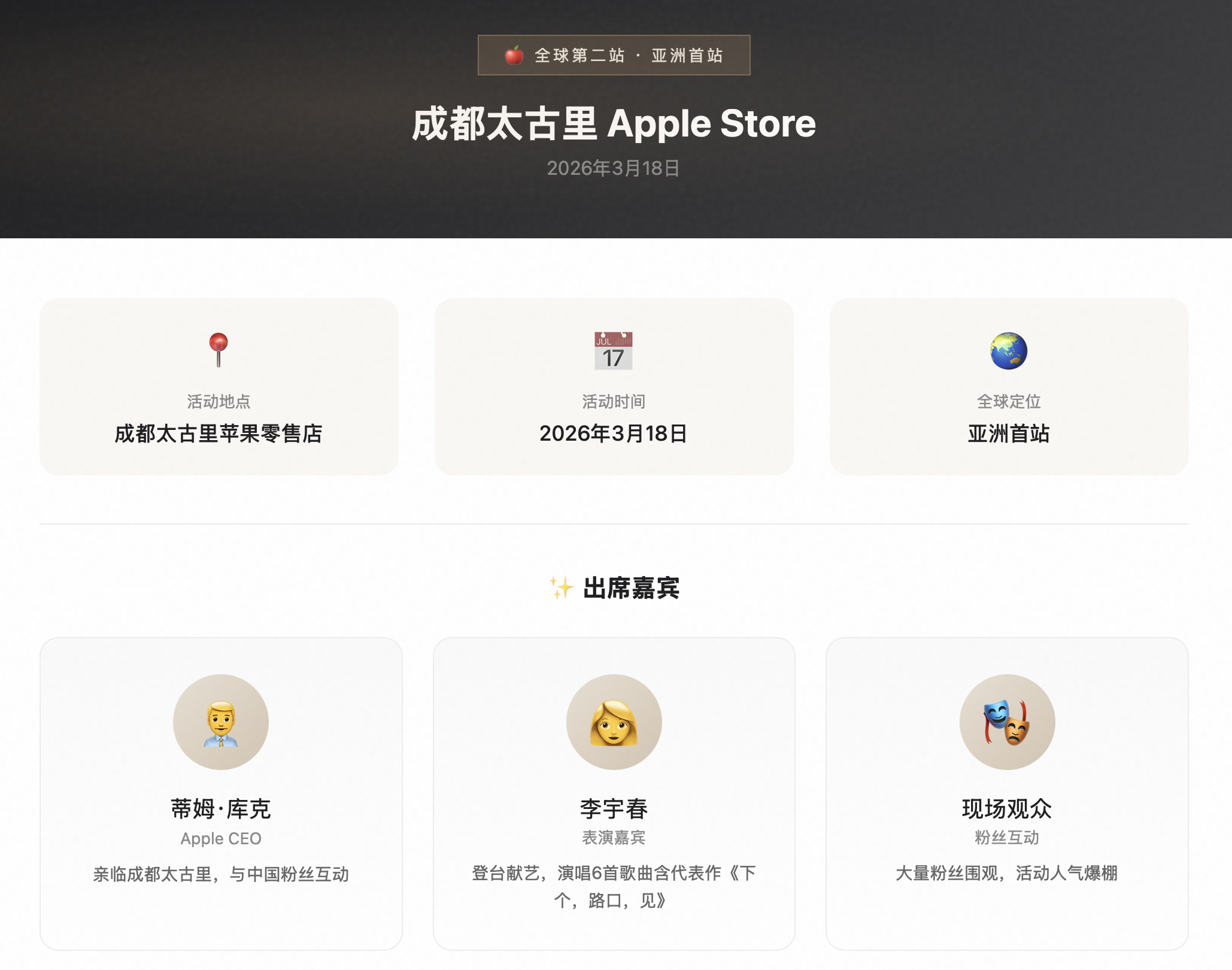
An AI agent-generated overview page for the 'Cook's Chengdu Visit' event, based on real-time information acquisition and immediate output (Source: Leikeji, excerpt)
How should traditional development role personnel respond? They revealed two points to Leikeji:
1. At the senior employee level, such as front-end developers, they are incorporating back-end development into their skill sets, transitioning to 'full-stack engineers' with integrated front-end and back-end development capabilities, mutual learning, and company training. Companies are also no longer hiring separate front-end and back-end roles; new technical hires must possess full-stack development skills.
2. Until now, technicians in relevant roles at many companies still serve as the final 'gatekeepers.' For example, AI-generated code still requires programmers to conduct final manual reviews before delivery or deployment.
In the AI era, both enterprises and individuals are striving to transform and adapt, with the technical development field being the first to face these changes head-on.
Tokens: A Lever to Amplify Employees' Capabilities
Providing employees with a 'token quota' equivalent to half their salary is just the first part of Jensen Huang's statement; the second part is 'to amplify their productivity tenfold.'
After AI capabilities fully shift towards work assistance and even collaboration scenarios, many individuals have emerged who leverage AI technology applications to 'generate revenue.'
Since last year, the concept of 'one-person companies' has rapidly gained traction nationwide, with various regions providing financial support and subsidies. Recently, public attention to this new entrepreneurial form has reached a peak.

Image Source: CCTV News
A one-person company (OPC, One Person Company) refers to a new entrepreneurial form where an individual, supported and partnered by AI, independently completes the entire product design, development, and market launch process.
The primary operator of a company is just one person, who, with the collaboration of multiple AI agent assistants or 'avatars,' achieves a workload that previously required several to ten people. Isn't this 'amplifying one person's productivity tenfold?'
This is true in the entrepreneurial realm and also applies to corporate employees. After front-end developers transition to 'full-stack engineers,' they assume the workload of two previous roles. For highly skilled developers who fully utilize and even push the limits of AI's super assistant capabilities, working alone on tasks that previously required multiple people is becoming the new norm for experts.
Notably, the 'capability gap' between bosses or employees who truly understand and comprehensively apply AI agent 'playbooks' in work and learning scenarios and those who do not is widening.
The capability ceiling of AI agents is 'immeasurable,' and over time, it may even expand human cognition and capability ceilings to 'near-infinite' levels. Those who skillfully use AI super assistants, especially those who already possess strong work and leadership abilities, will undoubtedly become 'even stronger': in plain terms, 'making smart people smarter and capable people even more capable.'
For individuals and enterprises, effectively using AI assistants will 'infinitely amplify' their ideas, creativity, work efficiency (including proactive initiative), and even personal advantages or corporate styles, such as flexibility or composure.
Tokens have become the 'ammunition' in the competition among top skilled talent and tech companies. Those who recognize their importance and allocate them generously earlier will become the trendsetters in the AI era.
NVIDIA, Token Computing Power, AI Agents
Source: Leikeji
Images in this article are from the 123RF licensed image library.
-
![]()
A Computing Power Titan Unveils a Revolutionary Product: Performance-to-Power Ratio Skyrockets by 450 Times!
-
![]()
Doubao Work Unveiled! Domestic AI Leaders Fully Commit to the 'Work' Sector
-
![]()
Who’s Sounding the Alarm on ‘Rushed Vehicles’?
-
![]()
Over 5.3 Billion Yuan in Losses Over Three and a Half Years! Can Yonyou Reverse Its Fortunes Through Streamlining and AI Transformation?
-
![]()
Baidu AI Adopts Free Model: A Strategic Maneuver in Traffic and Monetization
-
![]()
Silicon-Based OLED Pioneer Unveils Financial Results: H1 Shipments Outpace Entire 2025 Volume
-
![]()
AI's First "Lost Summer"
-
![]()
Zeiss Makes Another €2.2 Million Bet: Will Eye Tracking Be the Next Big Thing in the Smart Glasses Industry?