Top Scientists Lead the Charge: Ullqi Secures a Critical Edge in Embodied AI
 03/23 2026
 655
655
Author | Xiang Xin
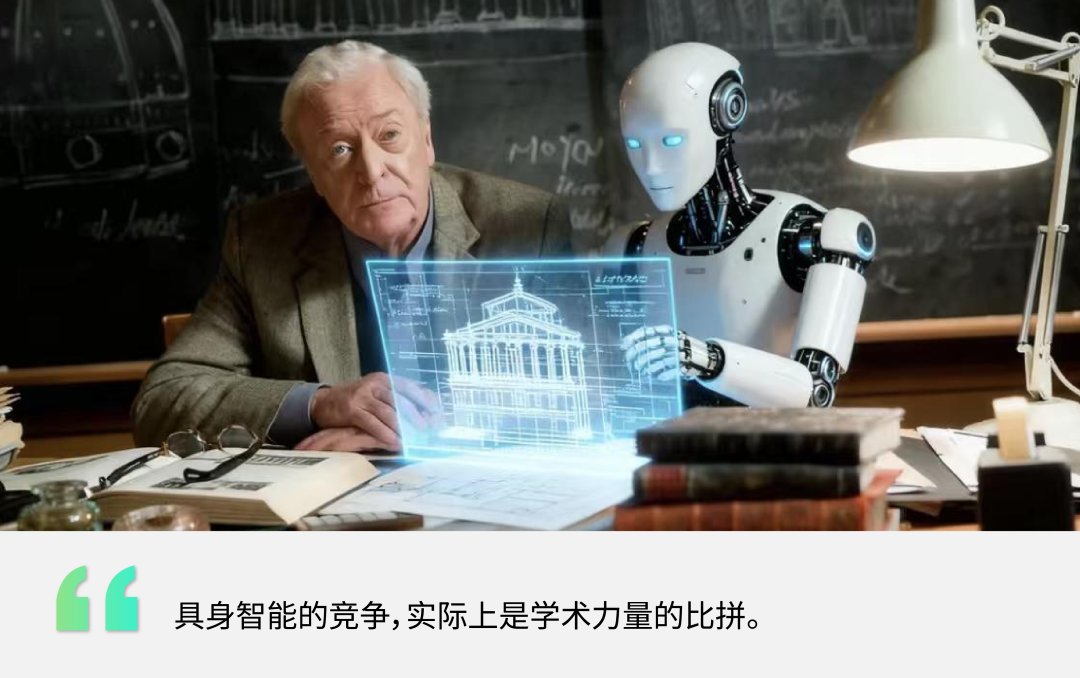
Many compare embodied AI to autonomous driving a decade ago, but this analogy may not be entirely accurate.
A decade ago, autonomous driving primarily advanced intelligence within mature technological frameworks. In contrast, embodied AI operates in a field that relies more heavily on foundational research, involves longer development cycles, and spans a broader technical spectrum.
The most challenging aspects of this industry remain centered on cutting-edge technologies themselves: how robots perceive their environment, execute precise operations, and maintain stable performance in complex scenarios.
At this stage, academic strength from universities and laboratories often becomes one of the most critical drivers in the industry's early development.
Ullqi's decision to bring in Professor Wang Hesheng from Shanghai Jiao Tong University as Chief Scientist reflects the talent strategy of embodied AI companies during this phase.

Founder Structure Shapes a Robot Company's Technological Identity
The founder structure of a robotics company typically determines its technological direction, influences product development pace, and shapes its corporate identity.
In the embodied AI industry, these differences are particularly pronounced.
From a founder structure perspective, companies can be broadly categorized into two types:
One type is led by university professors, young scholars, or laboratory teams, representing the academic camp;
The other type is driven by teams with industrial engineering backgrounds, belonging to the industry camp.
These two paths exhibit significant differences in technological choices and development approaches.
Academic-oriented companies prioritize foundational capabilities, investing in core issues such as embodied large models, multimodal understanding, dexterous manipulation, generalization capabilities, and data systems. They favor universal, cutting-edge, end-to-end technological routes.
For these teams, entrepreneurship often stems from extensions of laboratory research, aiming to push technological boundaries while establishing long-term influence. Consequently, they tend to have more flexible requirements regarding commercialization timelines.
Typical representatives of the academic camp include companies like StarHippo, Galaxy General, StarEra, and TransWit. These firms commonly involve deep participation from research systems at Tsinghua University, Peking University, Shanghai Jiao Tong University, Westlake University, and other institutions.
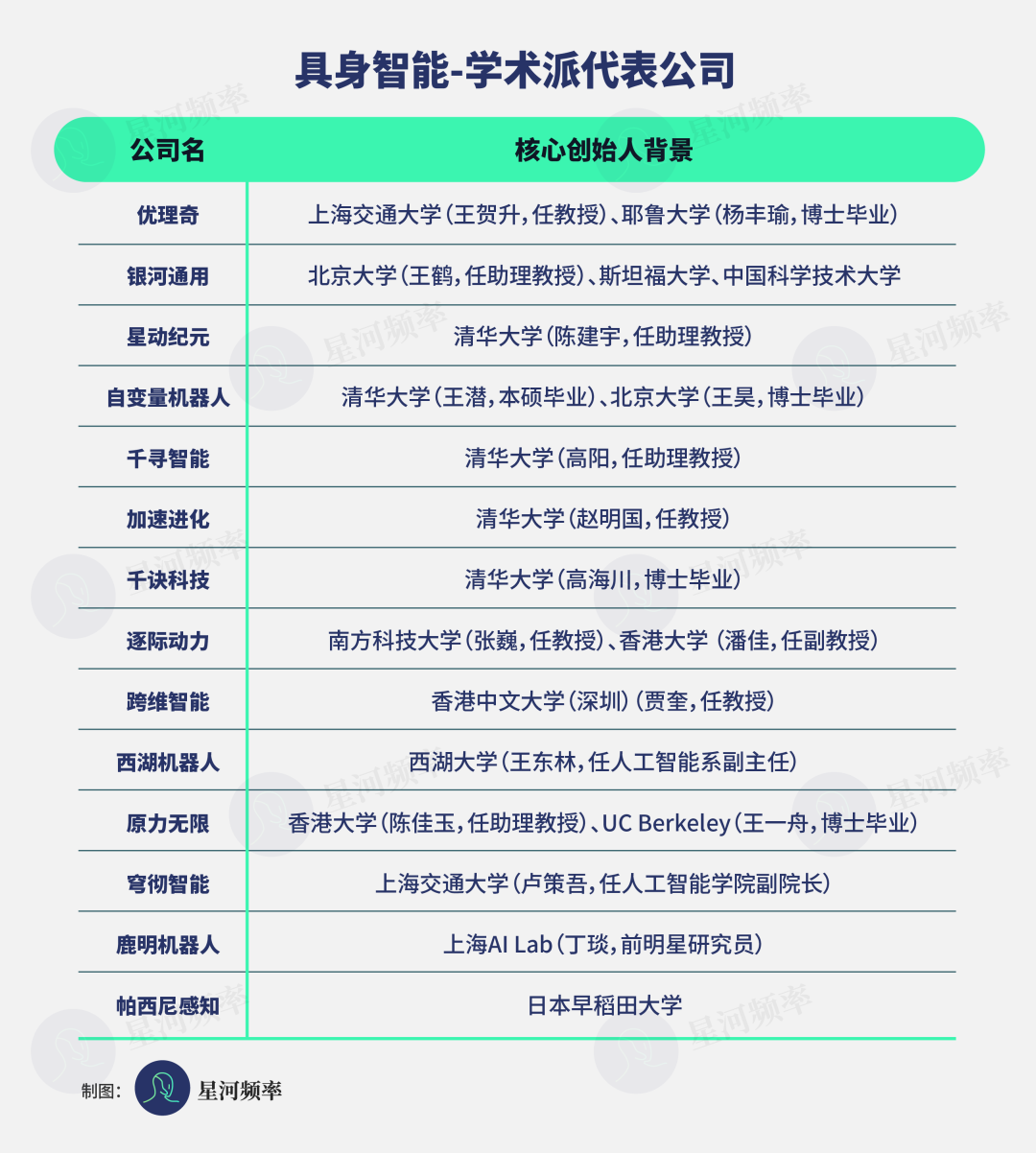
In terms of technological choices, these companies align more closely with cutting-edge research. StarHippo bets on VLA embodied large models, while Galaxy General builds training systems around synthetic data and end-to-end models—both routes carrying strong academic research orientations.
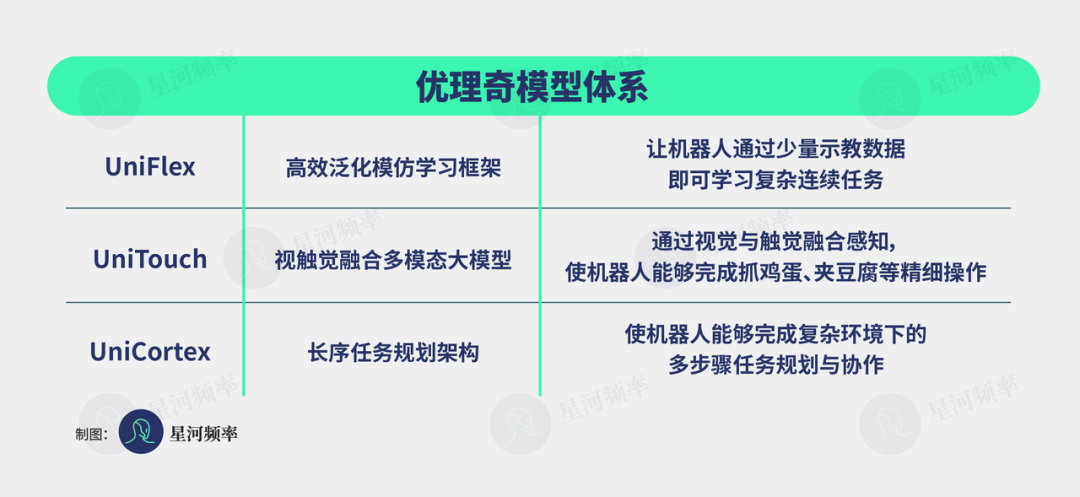
Ullqi also falls into this category. The company has established a relatively complete model system centered on foundational capabilities of embodied AI.
In contrast, industry-oriented companies place greater emphasis on deployment speed, product stability, cost control, and supply chain maturity.
They typically prioritize solving issues related to mechanical structures, motor drives, complete machine integration, and supply chains. These firms tend to adopt mature solutions and modular designs, aiming to rapidly develop deployable and deliverable robot products.
This category can be further divided into two origins: one stemming from the robotics industry itself, and the other from AI, internet, or autonomous driving systems.
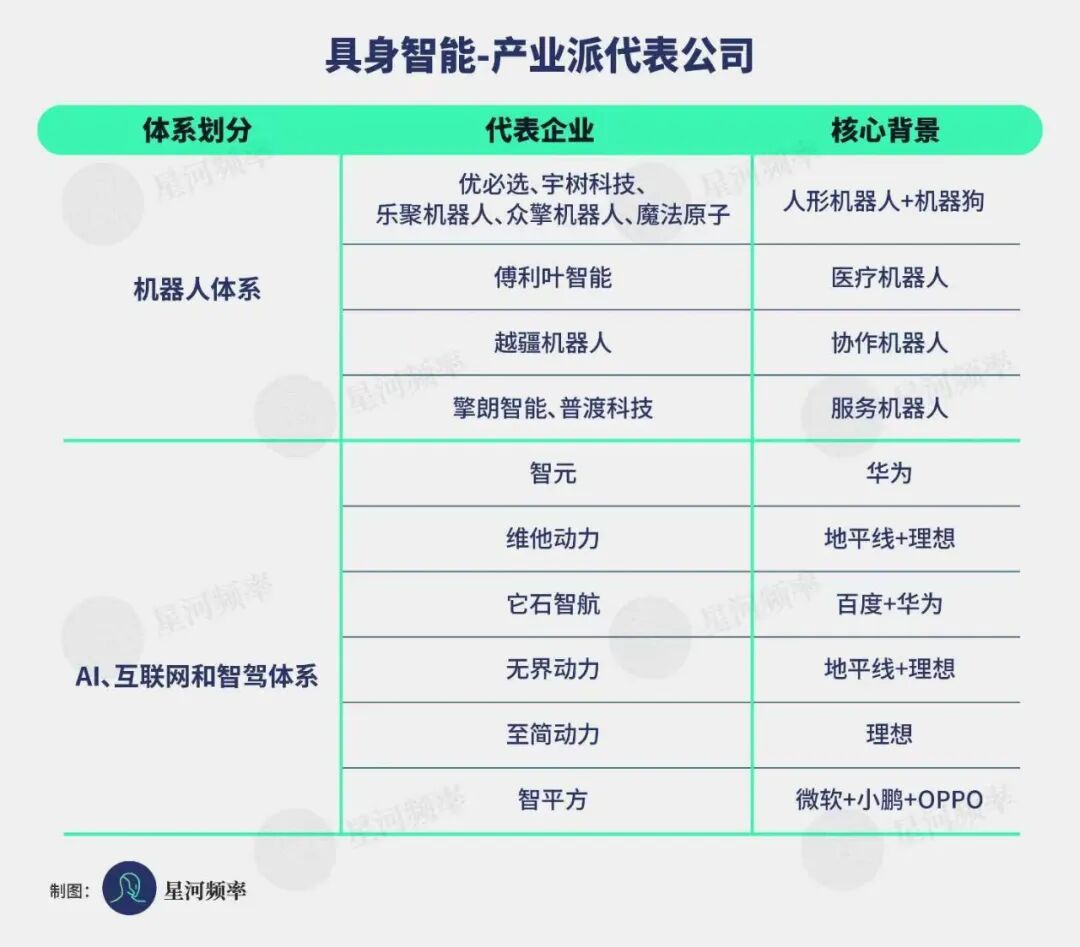
Their founding teams often possess management experience at large corporations, hardware mass production expertise, or systems engineering backgrounds. This makes them more adept at rapidly organizing complex technologies into products and advancing commercial deployment.
For instance, companies like Zhiyuan Robotics and Unitree Technology achieved mass production and delivery of over 5,000 humanoid robots last year, significantly outpacing most other embodied AI enterprises in the industry.
In the early stages of the industry, both paths remain valid and serve different roles. The academic camp excels at pushing technological boundaries forward, while the industry camp specializes in transforming capabilities into real products.
Embodied AI clearly relies more deeply on academic strength, as the industry still operates in a phase where foundational problems remain unresolved.
Core capabilities such as how robots stably perceive real environments, achieve reliable multimodal perception, and perform high-precision operations still require long-term research accumulation. These cannot be rapidly advanced through engineering experience alone.
Therefore, in this track (referring to the competitive field), the value brought by top scientists manifests not only in papers or titles but also in technological route judgment, defining key challenges, and helping companies establish higher capability ceilings.
Ullqi's decision to bring in Professor Wang Hesheng from Shanghai Jiao Tong University as Chief Scientist after its founding aligns with this industry logic.

Ullqi's Choice: Technological Complementarity Between a Young Team and Top Professors
Among current embodied AI companies, founding teams tend to be relatively young. Ullqi has formed a more complete talent combination: young entrepreneurs drive strategic direction, while top professors guide technological routes.
Although Ullqi's founder, Yang Fengyu, belongs to Generation Z, he boasts strong academic credentials. As a Yale Ph.D. with extensive research in robotic visuo-tactile perception, he served as the first author of UniTouch, a visuo-tactile fusion multimodal large model, and has published multiple top-tier conference papers in robotic visuo-tactile perception.
The company's early technological routes also revolved around multimodal perception, imitation learning, and embodied models.
Young teams excel in their high receptiveness to new technologies, rapid decision-making, and willingness to explore unproven routes.
However, as companies progress toward productization and real-world deployment, stable judgment of technological routes, control over complex systems, and selection of long-term R&D directions become increasingly critical.
Wang Hesheng's joining complements the team precisely at this stage.
Wang Hesheng, a professor at Shanghai Jiao Tong University, recipient of the National Science Fund for Distinguished Young Scholars, and General Chair of IROS 2025, has long focused on robot control and visual servoing.
Compared to mainstream professors in the current embodied AI field, his research emphasizes the integration of perception and control, as well as high-precision execution in real environments—accumulations that become particularly valuable when robots enter practical application stages.
From a core research direction perspective, academic routes among current embodied AI companies can be broadly categorized into three types:
One focuses on foundational motion control, addressing how robots achieve stable movement;
Another emphasizes visual perception and dexterous manipulation, addressing how robots understand the world and learn to interact physically;
The third centers on world models and long-sequence planning, addressing how robots comprehend tasks, preview scenarios in advance, and complete complex decisions.
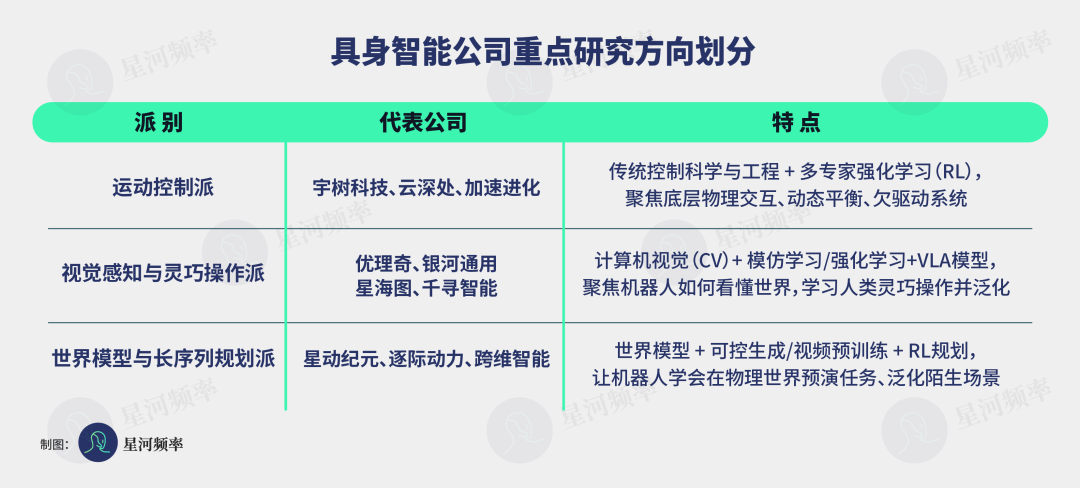
Ullqi aligns more closely with the direction of visual perception and fine manipulation. Wang Hesheng's long-term research core lies in visual servo control.
Simply put, visual servoing enables robots to continuously adjust their actions based on real-time visual feedback, essentially equipping them with a closed-loop eye-hand coordination system. This directly impacts robots' precision, stability, and continuous operational capabilities in real environments.
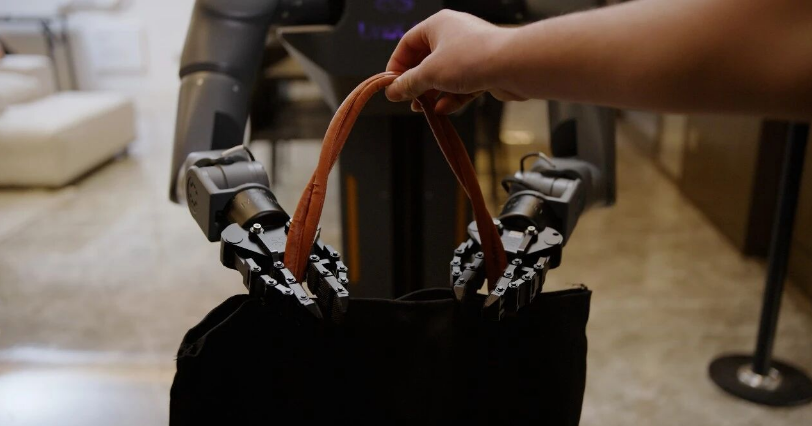
The value of this direction becomes especially prominent after embodied AI enters deployment stages.
In laboratory settings, robots typically rely on fixed calibrations and standard poses to complete tasks. However, in real-world scenarios, lighting variations, object position shifts, spatial errors, and prolonged operation all affect execution precision.
For example, when robots operate long-term in unstructured service scenarios like hotels, retail, security, and elderly care, lighting conditions in hotel environments constantly change, item placements on shelves remain inconsistent, and delivery, grasping, and organization tasks face continuous disturbances—all factors that amplify control errors.
Wang Hesheng has long researched visual servoing in uncalibrated environments, adaptive control, and high-precision robot control in complex dynamic scenes, proposing methods such as the "depth-independent interaction matrix."
Applied to Ullqi's products, this enables robots like Wanda and Panther to rely less on repeated recalibrations when performing grasping, delivery, organization, and service tasks. They can better adapt to lighting changes, object pose variations, and spatial disturbances, ensuring more stable operation.
Moreover, Wang Hesheng's expertise naturally complements Yang Fengyu's technical accumulations.
Yang Fengyu specializes in visuo-tactile fusion, multimodal perception, and embodied models, addressing how robots better understand objects, materials, and contact information.
Wang Hesheng excels in visual servoing and high-precision control, addressing how robots translate perception into stable actions.
One focuses more on perception and understanding, the other on control and execution. When combined, these two technological paths form a more complete closed loop between environmental understanding and action execution in robots.
Wang Hesheng's joining provides Ullqi with a more solid foundation for technological judgment while maintaining exploration speed.
For companies aiming to truly deploy robots in real-world scenarios, this "young team + top professor" structure offers an organizational model better suited to the current industry phase.

Embodied AI Enters a Phase of Deep Industry-Research Coupling
Beyond companies' need for scientists, another noteworthy development is that top scholars increasingly rely on industrial platforms to advance their research.
Traditionally, academia and industry had relatively clear divisions of labor. Universities focused on cutting-edge theory, while companies handled engineering implementation, with connections formed through collaborative projects or technology transfer.
However, in fields like embodied AI, such loose collaboration increasingly struggles to support technological progress.
Robot systems involve physical structures, control algorithms, environmental perception, model training, and real-world deployment. Many critical issues only emerge after long-term operation of complete systems, and technological routes must continuously refine in real environments to stabilize.
In Wang Hesheng's view, embodied AI development is entering a phase where many research directions cannot advance significantly without data cycles from real-world scenarios.
Having long engaged in visual servoing and robot control in complex environments, he understands that such technologies heavily depend on real systems. Robots must operate continuously in real deployment environments to uncover true bottlenecks, thereby driving co-evolution of algorithms and systems.
An important reason Ullqi attracted Wang Hesheng lies in the company's approach of advancing R&D within real application scenarios from the outset.
Its wheeled dual-arm robots, the Wanda series and Panther series, have achieved normalized operation in hotels, retail, security, and service scenarios, facing long-term operational conditions such as complex lighting, dynamic pedestrian flows, and object position changes.
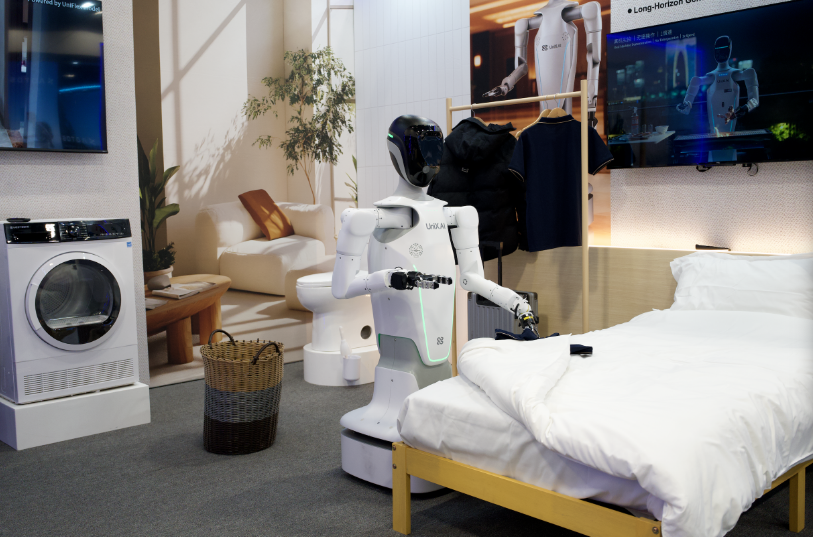
The data and challenges generated by such continuous operation constitute the most valuable research resources, providing real validation platforms for visual servoing, multimodal perception, and fine manipulation.
On the other hand, embodied AI is entering a systematized phase, imposing increasingly high demands on R&D platforms.
Robots involve far more variables than autonomous driving. Different physical structures, sensor configurations, and control methods all influence final performance.
No single laboratory can sustain long-term system-level research across multiple physical platforms, scenarios, and models. Companies, however, can provide stable teams, continuous hardware iteration, and long-term operational environments, enabling research to accumulate and amplify results progressively.
Suzhou, where Ullqi is based, also provides a realistic foundation for such industry-research integration.
Wuzhong District has formed a complete industrial chain covering core components, physical manufacturing, and system integration. Critical links such as servos, motors, reducers, and sensors can be rapidly sourced locally, creating a highly efficient collaborative system.
Meanwhile, the region hosts multiple university research institutes and robotics laboratories with long-term accumulations in motion control, visual servoing, reinforcement learning, and dexterous manipulation.
At the governmental level, Suzhou has designated embodied AI as a key future industry, promoting deep cooperation between enterprises and universities through special funds and industrial policies.
Wang Hesheng's choice of Ullqi reflects recognition of the company's technological direction and real-scenario capabilities, as well as judgment of Suzhou's industry-research ecosystem.
Looking back at this wave of entrepreneurship in embodied AI, changes in founder structures reflect the industry's unique developmental phase.
Currently, technology remains at a stage where foundational capabilities have not fully converged. Academic research, engineering systems, and real-world scenarios must advance simultaneously. No single party can drive system-level breakthroughs alone.
Cutting-edge research requires validation in real systems, while engineering deployment cannot proceed without long-term understanding of foundational issues.
Ullqi's founder structure epitomizes this industry phase.
As robots begin to enter real and complex environments, technological advancements are no longer confined to laboratories or factories, but are gradually maturing through repeated iterations between the two.
-
![]()
1.6 Billion Big Order Secured! SeeYA Technology's Revenue Soars by 287.87% in the First Half of the Year
-
![]()
Baidu's Profits Plunge by 68%: Unraveling the Mystery Behind the Numbers
-
![]()
Baidu’s Profits Tumble by 68%! Where Has All the Money Gone?
-
![]()
Hynix’s Taobao Store Shuts Down Abruptly: What Should Customers Do About Warranty Services for Memory Modules?
-
![]()
A Computing Power Titan Unveils a Revolutionary Product: Performance-to-Power Ratio Skyrockets by 450 Times!
-
![]()
Doubao Work Unveiled! Domestic AI Leaders Fully Commit to the 'Work' Sector
-
![]()
Who’s Sounding the Alarm on ‘Rushed Vehicles’?
-
![]()
Over 5.3 Billion Yuan in Losses Over Three and a Half Years! Can Yonyou Reverse Its Fortunes Through Streamlining and AI Transformation?