Transforming Tokens into Gold: Is China Poised to Lead?
 03/23 2026
 642
642
In the era dominated by tokens, China's capacity for token production has emerged as a significant lever for the growth of the AI industry. However, leveraging these comparative advantages demands pragmatism, not the blind exuberance fueled by a "winner-takes-all" mentality.
By She Zongming
"Who is leading in AI—China or America?" Last September, The Economist posed this critical question to both the AI and political spheres.
Just a few years ago, the answer seemed clear:
In September 2023, Huang Qifan remarked that the gap between Chinese and U.S. AI large models was at least two years wide and rapidly expanding.
In March 2024, during a discussion with the head of Norway's sovereign wealth fund, Joe Tsai was asked whether China was trailing the U.S. in AI by "one, three, or five years." He responded, "Probably about two years behind America's top LLMs (Large Language Models)."
In July 2024, Liang Wenfeng noted in an interview that while China's AI might appear to lag the U.S. by only one or two years technologically, the true gap lay in originality versus imitation.
However, the narrative took a sudden turn last year.
In November, several mainstream media outlets, including the Financial Times, reported on Jensen Huang's comments at a closed-door meeting: China would win the AI race due to its lower energy costs, more relaxed regulatory environment, and a vast pool of AI engineers.
Although Huang later denied asserting that China would win the Sino-U.S. AI competition, he emphasized that the world's most popular open-source AI models now originate from China, urging the U.S. to "speed up."
In January, Elon Musk stated in an interview, "People severely underestimate the difficulty of increasing power supply. In the next two years, whoever solves electricity and cooling issues will win the AI war." He underscored China's massive advantage in power generation, predicting that "by 2026, China's electricity output will triple that of the U.S."
Shortly after, he added, "The fundamental limiting factor for AI deployment is power supply. Clearly, we'll soon—perhaps even later this year—be producing more chips than we can activate due to power shortages. Globally, except in China, electricity output has stagnated while chip capacity grows exponentially," highlighting China as the exception to global AI power bottlenecks.
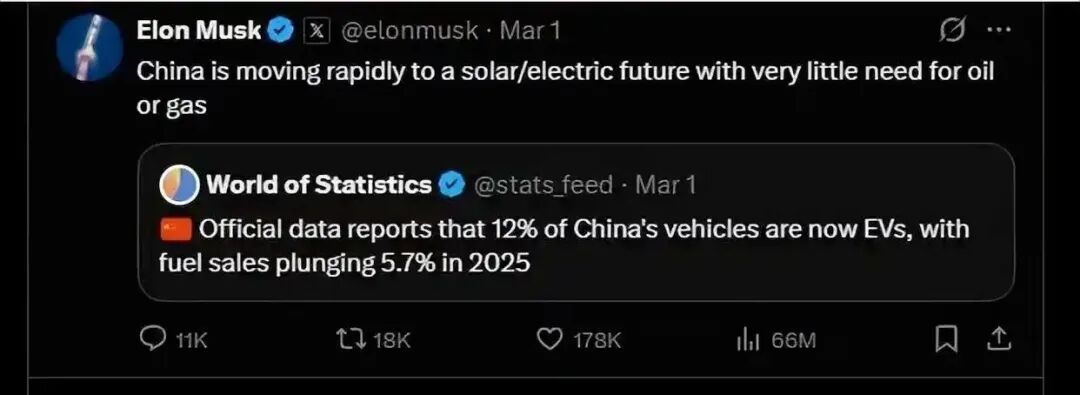
▲ Elon Musk, also known as the "Overseas Top Advocate for China's Power."
Today, the token-dominated era seems to validate Huang and Musk's assessments of China's competitive edge.
Data from OpenRouter, the world's largest AI model API aggregation platform, reveals that in February this year, China secured four of the top five spots in global token usage, with MiniMax M2.5, Kimi K2.5, Zhipu GLM 5, and DeepSeek V3.2 leading the rankings. Chinese AI models surpassed their U.S. counterparts in token usage for the first time.
The question arises: Is it time to declare "China wins"?
My perspective: It's premature to claim victory, but China indeed holds multiple advantages. Leveraging these wisely will accumulate more leverage for dominating future AI competition.
01 /
All signs point to 2026 as a pivotal year for AI development. The early "red-packet wars" were just preludes; the current full-chain competition over token production, distribution, consumption, and monetization is the main event.
Recent landmark events include:
1. China's "Lobster Craze," with Tencent, Alibaba, ByteDance, and Baidu launching one-click "Lobster Packages."
2. Domestic "Lobster Triumvirate" stocks—Xunce Technology, Minimax, and Zhipu—doubling in value and reaching new market caps.
3. On March 16, Alibaba established the Alibaba Token Hub (ATH) business group, led personally by CEO Wu Yongming.
4. On March 18, during the 2025 earnings call, Pony Ma discussed "Lobster" apps for the first time, noting their creation of new decentralized entry points that inspire WeChat's AI development.
5. On March 18, Alibaba Cloud and Baidu Intelligent Cloud raised AI computing and storage prices due to surging token demand.
These developments annotate Jensen Huang's bold claim at GTC2026:
AI has transitioned from the training era to an industrialized phase of reasoning + agents + physical AI, with tokens becoming the digital commodity and hard currency of the AI execution era.
Future data centers will be giant factories continuously producing tokens, which serve as the basic tradable units of AI-generated intelligence.
In short: The token-dominated era has arrived.
AI competition has evolved from model iteration and chip races to a battle for computing power value measured in tokens.
As tokens become the key leverage in AI industrial competition and the core anchor for reshaping global computing power orders, they generally benefit China's AI assets.
In model competition, domestic large models still lag behind OpenAI's GPT, Anthropic's Claude, and Google's Gemini.
Though a 2025 report from Stanford's AI Institute showed the performance gap between top Chinese and U.S. AI models narrowing to 0.3% (from 20% in 2023), acknowledging the persistent gap is unavoidable without resorting to hyperbolic claims.
In chip competition, China's "AI Chip Triumvirate"—Cambricon, Moore Threads, and MetaX—can only vie for the title of "China's NVIDIA."
The gap resembles a comparison between the author and Daniel Wu in terms of looks.
But in token production... many Chinese AI firms likely think: "Now you're speaking our language!"
The "Lobster Craze" drove Minimax and Zhipu's market caps to double this year and Kimi's parent company, Yuezhi Anmian, to quadruple in valuation within three months, giving Alibaba Cloud pricing power. This speaks volumes.
Had China's tech stocks avoided "Nasdaq envy with Nasdaq ailments," a broader AI boom might have been achievable.
Credit goes to Peter Steinberger, the father of Lobster (OpenClaw). Its viral success and the AI agent explosion unlocked the "last mile" of AI application deployment, geometrically increasing token consumption and creating a "money-printing effect."
At the "Lobster Triumvirate" celebration, while pointing the fish head at Steinberger might be politically incorrect, his absence should at least warrant a ceremonial pause before digging in.
02 /
The token-dominated era transforms strategies.
Why did Alibaba establish ATH, integrating model R&D, computing power orchestration, MaaS platforms, and scenario applications?
Think of tokens as dumpling filling: ATH consolidates AI business lines into a "token stronghold"—labs handle filling (token creation), Alibaba Cloud supplies wrappers (token transport), and Qianwen and Wukong cook and sell dumplings (token utilization). This creates a full-industry chain system: "Create Tokens → Deliver Tokens → Apply Tokens," transitioning from a model vendor to a token supplier and infrastructure operator.
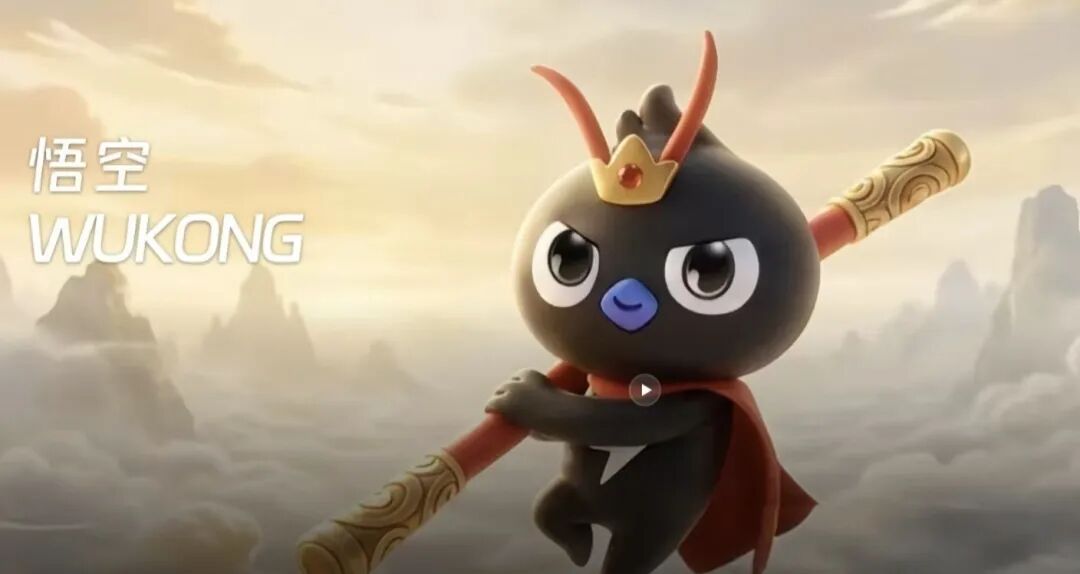
▲ The launch of the enterprise-grade AI-native work platform Wukong marked ATH's debut.
Alibaba's rationale is simple: Tokens' dual attributes—energy and currency—have been unlocked by "Lobster." On one side, tokens are the "oil" of the AI world; whoever produces high-quality tokens at the lowest cost holds industrial pricing power. On the other, tokens serve as universal "currency" within ecosystems, connecting model vendors, cloud providers, developers, and end-users to support subscription, pay-as-you-go, and revenue-sharing models.
This shifts digital economy logic:
In the pre-AI era, traffic was king: user growth, DAU/MAU, usage duration, and ad inventory determined success. Marginal costs approached zero, favoring scale. The focus was on monopolistic entry points, total national time, and traffic monetization.
In the AI era, tokens reign: daily token consumption, per-user token spending, paid conversion rates, and task closure rates become core metrics. Industry evaluation shifts from DAU/MAU to TPD (Tokens Per Day), from model parameters to cost per token, token output per watt, and intelligence density.
Thus, BAT's strategic pivots are clear: ByteDance, leading in AI-to-C with Doubao, aims to transition from a content distribution empire to a full-scenario token consumption hub. Alibaba, achieving full-chain closure with Qianwen for shopping, ride-hailing, food delivery, and hotels, aims to shift from an e-commerce giant to a token industrialization and transaction operator. Tencent, launching a "Lobster Family Package," aims to evolve from a social connectivity leader to a social-chain token fission and agent control platform.
The approach: embrace, master, and transcend Lobster.
Caption needed: "If MiniMax, Kimi, and Zhipu can feast on Lobster's dividends, why not our giants?"
Google, Microsoft, and Meta might say, "We want a bite," but OpenRouter's token usage statistics muffle them: No, you can't.
The API pricing of GPT, Claude, and Gemini alone deters many.
Multiple factors ensure Lobster remains a "domestic delight."
At minimum, the cloud monopoly and premium pricing of foreign top models clash with local agent development trends.
03 /
In the token-dominated era, whoever produces tokens at lower costs and builds more efficient token circulation ecosystems gains greater initiative in global AI competition.
Currently, China stands as the global "superfactory" for token production. Its token capacity advantages partially offset chip and model disadvantages in the Sino-U.S. AI race.
Jensen Huang divides the AI industry chain into a "five-layer cake" model: energy, chips, infrastructure (data centers, computing networks), models, and applications. Here, "energy" primarily refers to electricity. As Huang stated, "Real-time intelligence requires real-time power. Every generated token results from electron flow, heat management, and energy conversion into computing."
Musk repeatedly emphasizes that "energy equals intelligence" and "watts will become the new currency," meaning AI's endpoint is computing power, and computing power's endpoint is electricity.
In essence, computing power is energy conversion, with electricity as the core driver for AI computing. For large-scale computing clusters, electricity costs dominate operational expenses, especially in inference. Thus, electricity prices directly set the cost floor for token production.
China boasts unique electricity supply conditions: affordability and stability.
Regarding affordability, green power costs in China's western renewable-rich regions drop to 0.2–0.3 RMB/kWh, merely 1/3 or even 1/5 of industrial electricity prices in the U.S. and Europe. MiniMax M2.5's input price for one million tokens on OpenRoute is just $0.3, 1/20th of overseas peers like Claude Opus. DeepSeek V3.2 reduces per-million-token costs to nearly 1% of GPT-5.4's through technical optimization—all thanks to cheap electricity.
Regarding stability, one needn't grasp ultra-high-voltage transmission networks, "source-grid-load-storage" integration, or 80–100% grid redundancy. Yet Musk, the "Overseas Top Advocate for China's Power," calls China an exception to global AI power bottlenecks, not merely out of flattery.
If China's "West-to-East Electricity Transmission" supports its current "West-to-East Data Calculation" token export dominance, Western nations lose at the starting line—"West-to-East Electricity Transmission"? Impossible, given "America's unique national conditions."
Notably, China's rise as a token "superfactory" stems not only from cost advantages but also ecological strengths. Cheap electricity supplies cost advantages, while a full-chain computing base delivers ecological strengths.
China has replicated its industrial-era script of being the "sole nation with a complete industrial category capability" to construct a closed-loop AI industrial chain spanning hardware, software, data, and applications. It is now the only nation with a complete computing power industry chain.
In hardware, while the gap with NVIDIA in high-end GPUs remains, market enthusiasm for domestic substitutes—reflected in Cambricon and Moore Threads' valuations—shows capital's high hopes. Domestic chips are advancing, partly thanks to Trump's "indirect assistance."
In software, algorithm optimizations like MoE architectures and heterogeneous computing scheduling, along with token distribution improvements, leverage China's traditional strength of "more savings from more purchases."
Data and applications need no elaboration. The "Lobster Craze"-driven extension of tokens from production to circulation and consumption relies on full-scenario application support.
Through cost and ecological advantages, China has become the "one superpower" in the global token market's "one superpower, multiple players" landscape.
Today, the U.S. retains core technologies in high-end chips and foundational algorithms but lacks advantages in token scale production and cost control. Europe and Japan, constrained by inadequate computing infrastructure and high energy costs, struggle to scale. In contrast, China leads as the largest token producer and exporter—with such cost-effectiveness, tokens may soon become China's "digital export icon" after the "New Three."
04 /
After all, in the era where tokens reign supreme, China's advantage in token production capacity has become a strong fulcrum for the development of the AI industry.
The widespread adoption of tokens will completely transform the logic of measuring and distributing the value of computing power.
Prior to this, the value of computing power was difficult to standardize and trade, only being priced based on hardware costs. At this time, the pricing power for computing power was in the hands of NVIDIA, AWS, Azure, and others.
In the Agent era, tokens can transform abstract computing power into precisely billable and cross-border tradable 'digital commodities,' shifting from hardware-based pricing to scenario-based value pricing. Data centers evolve from server clusters into 'token factories,' computing networks into 'token pipelines,' and user interactions into 'token consumption'—this becomes the comfort zone for Chinese AI companies.
When it comes to model development, we still lag behind the likes of GPT, Claude, and Gemini. Similarly, in the realm of chip manufacturing, we have yet to catch up with NVIDIA, AMD, and other industry leaders. However, when it comes to Token production capacity... let's just say it's reminiscent of Elon Musk's famous quotes on exponential growth.
It is predictable that with the advent of the application deployment phase, typified by Agents, Token consumption will inevitably continue its exponential ascent. The Token economy is poised for a significant surge, acting as a crucial catalyst for Chinese AI to assert its global dominance in the intelligent ecosystem and cultivate enduring core competitiveness.
The 'lobster craze' phenomenon is transforming Tokens into a veritable goldmine, while China's strengths in AI application deployment are being fully harnessed.

▲ China's prowess in Token production capacity stands as a pivotal advantage in the Sino-US AI rivalry.
Nevertheless, if we approach this scenario with a 'winning mentality,' assuming that 'China will emerge as the ultimate victor' implies comprehensive superiority and generational leadership, we might be overestimating our position. In reality, such exaggerated viewpoints are prevalent among enthusiasts of the 'China's-the-best' narrative.
The edge in Token production capacity has indeed fortified China's defensive stance in the computing power race, but this remains a partial advantage. There is still a considerable journey ahead before it can be translated into an overall generational lead.
While the advantage in Token production capacity may alleviate concerns about 'China's AI lagging further behind America's AI,' it is insufficient to justify the claim that 'China's AI has already surpassed America's AI in every aspect.'
At least for now, as long as GPT, Claude, and Gemini continue to set the standard for domestic large models, as long as Cambricon is still referred to as 'China's NVIDIA' instead of NVIDIA being dubbed 'China's little Cambricon,' and until the notion of 'Our Chinese outperform theirs' is reversed, we must acknowledge the gaps in foundational frameworks, core algorithm patents, and the deficiencies in high-end GPU chips.
It is conceivable that for the foreseeable future, the differentiated landscape of 'America excels in foundational innovation, China excels in engineering applications' will likely endure, with both nations coexisting as twin peaks. The final outcome in this competitive and cooperative landscape will not be immediately apparent.
However, while victory is undoubtedly significant, what truly matters is maximizing our comparative advantages.
And to capitalize on these advantages, we require more pragmatic efforts, opting for self-reflection and self-confidence over feelings of inferiority or arrogance. When evaluating our own strengths and those of others, we should choose a balanced perspective over the mindless exuberance of a 'winning mentality.'
-
![]()
1.6 Billion Big Order Secured! SeeYA Technology's Revenue Soars by 287.87% in the First Half of the Year
-
![]()
Baidu's Profits Plunge by 68%: Unraveling the Mystery Behind the Numbers
-
![]()
Baidu’s Profits Tumble by 68%! Where Has All the Money Gone?
-
![]()
Hynix’s Taobao Store Shuts Down Abruptly: What Should Customers Do About Warranty Services for Memory Modules?
-
![]()
A Computing Power Titan Unveils a Revolutionary Product: Performance-to-Power Ratio Skyrockets by 450 Times!
-
![]()
Doubao Work Unveiled! Domestic AI Leaders Fully Commit to the 'Work' Sector
-
![]()
Who’s Sounding the Alarm on ‘Rushed Vehicles’?
-
![]()
Over 5.3 Billion Yuan in Losses Over Three and a Half Years! Can Yonyou Reverse Its Fortunes Through Streamlining and AI Transformation?