Decoding the 'Lobster Ideology': Pioneering the AI Revolution in the Software Realm
 03/26 2026
 564
564
The TO B service value chain, epitomized by the 'SaaS-PaaS-IaaS' service paradigm, is undergoing a profound and irreversible transformation. While IaaS was the focal point of change in recent years, the advent of Lobster signals a new era where established SaaS and PaaS companies will emerge as the vanguards of this transformation.
Author | Pi Ye
Produced by | Industrial Hom
'Is Lobster truly indispensable?'
For C-end users, the answer is a resounding yes. This product, which originated overseas and gained immense popularity in China, empowers users to perform a series of intelligent and automated tasks, thereby enhancing productivity through specialized skills.
However, when posed to enterprises, the response may not be as unanimous. For enterprise-level applications of Lobster, the key lies in the 'enterprise-level' aspect, which entails a host of challenges such as permission management, B-end SOPs, and data security. Currently, the market lacks clear-cut product solutions to address these challenges.
Despite this, from cloud vendors to platforms like DingTalk and Feishu, and even WeCom, which has carved out a unique niche, all are accelerating their efforts in this Lobster-driven wave. This acceleration is reminiscent of the national fervor surrounding the emergence of DeepSeek.
Why? At a time when enterprises have yet to demonstrate clear demand, why are these B-end industry players taking such proactive stances? Or, what other signals does the 'Lobster Ideology' convey beyond automation?
From cloud vendors to collaboration platform providers to software vendors, there's a fundamental consensus that Lobster's emergence signifies a new TO B service model, or rather, a commercial form that is taking shape.
The TO B service value chain, represented by the 'SaaS-PaaS-IaaS' service model, is indeed undergoing irreversible reconstruction. If IaaS was the primary focus of change in the past two years, then post-Lobster, established SaaS and PaaS companies are poised to become the new protagonists of this transformation.
An AI TO B industry (enterprise) service model, with Tokens as its new core, is on the rise.
I. The Ecological Race Against Time
Over the past month, DingTalk, Feishu, and WeCom have unveiled new products. DingTalk introduced the world's first enterprise-level Lobster product, 'Wukong.' Feishu, leveraging its existing core products, further upgraded them to become autonomous and executable enterprise-level Agents, embodying the 'Lobster Ideology.'
WeCom's approach is even more distinctive. If its previous strategy was to amplify its connection advantages and integrate with WeChat, then in this Lobster wave, it has demonstrated unprecedented speed, becoming one of the first enterprise-level products in China to integrate Lobster.
Why the rush against time?
Looking back over the past decade, SaaS software has been the primary driver for enterprises seeking to enhance productivity through digitalization. Corresponding to this demand are leading SaaS companies like Yonyou, Kingdee, Beisen, and Weimob, which serve as front-end touchpoints for enterprise services across various domains. Platforms like DingTalk, Feishu, and WeCom act as intermediary 'routing' platforms, aiding small and medium-sized enterprises with out-of-the-box products while also building ecosystems through PaaS platforms to serve medium and large clients alongside front-end SaaS companies.
Beneath them, cloud vendors play an infrastructure role, providing servers, databases, and middleware.
This stable commercial model has endured for decades, constructing a relatively stable 'SaaS-PaaS-IaaS' service model and TO B commercial framework through repeated conflicts and resolutions.
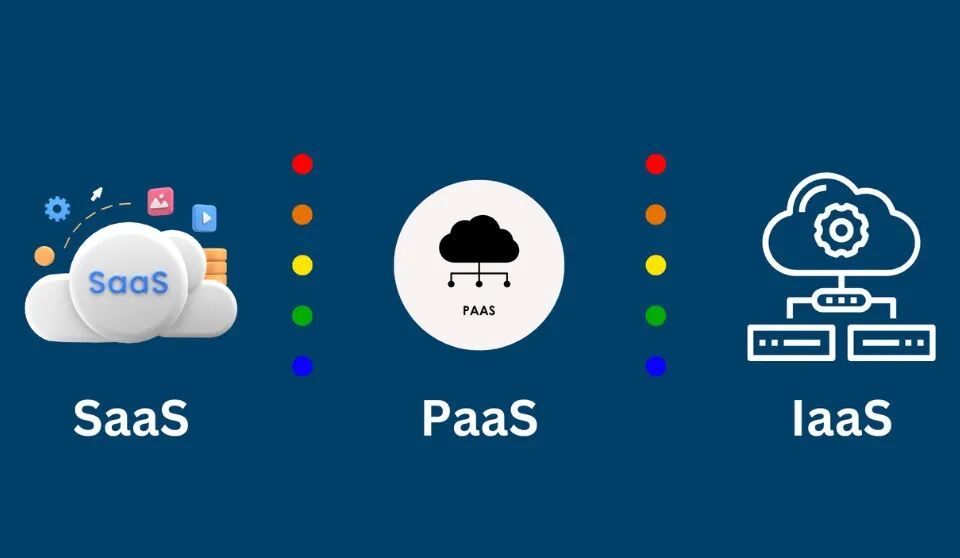
However, this service model, or rather, commercial framework, is now undergoing significant changes with the advent of Lobster. Over the past three years, whether it's copilot or Agent positioning, enterprise-level AI has primarily operated in a 'human-driven, AI-assisted' mode. In other words, it has not yet fully enabled enterprises to achieve AI automation in areas such as HR, finance, or core ERP functions.
But Lobster brings this possibility to the fore.
In DingTalk's release, a point often overlooked is that the intermediate layer of 'Wukong' is no longer based on the existing PaaS model but is designed around programming languages (CLI). In essence, DingTalk's intermediate layer was previously tailored for developers, but now Wukong's intermediate layer is designed for AI. Similar intermediate layer designs are emerging in various products domestically and internationally, such as Feishu.
This represents a proactive platform or commercial positioning. The sharp decline of Salesforce on the other side of the ocean also corroborates this model, confirming that the path of AI autonomous execution and closure in enterprise services is indeed viable.
This certainty of AI autonomous execution reflects corresponding changes in the B-end enterprise service industry structure. Whether it's front-end SaaS software, collaboration routing platforms like DingTalk, Feishu, and WeCom (B-end traffic entry points), or even the underlying infrastructure layer, all must undergo a new evolution based on the AI service model (AaaS model).
This is precisely why DingTalk, Feishu, and WeCom are racing against time. Over the past year, cloud vendors can be seen as having completed their initial AI transformation, encapsulating computing power and MaaS service models into new infrastructure capabilities. The emergence of Lobster further accelerates the transformation of intermediate-layer products (enterprise AI soil).
This acceleration can, on the one hand, leverage the MaaS services already built by front-end large model vendors and, on the other hand, provide platform support for the emergence of traditional SaaS vendors transitioning into Agent enterprises or new-style enterprise-level Agent service providers, completing the AI-era B-end traffic positioning in advance.
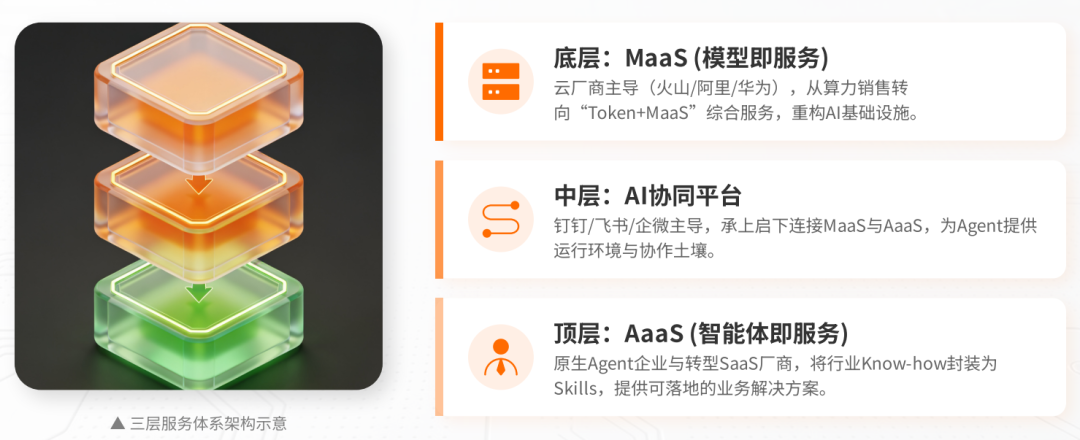
II. 'MaaS + Platform Layer + AaaS': The Emerging TO B Landscape in the AI Era
A certain fact is that with the emergence of Lobster, a new enterprise service ecosystem is taking shape.
Over the past two years, before Lobster, more service system changes occurred at the bottom layer, with cloud vendors evolving towards large model vendors. Volcano Engine, Alibaba Cloud, Huawei Cloud, and Tencent Cloud have been fiercely competing on MaaS and Agent platforms, essentially forming market-recognized AI infrastructure standards.
Broadly speaking, the transition from the traditional server pure computing power sales model to a comprehensive 'Token + MaaS' model means that AI cloud has become the latest revenue component. Narrowly speaking, the traditional database, middleware, containers, sandboxes, and other components on the infrastructure side are now all serving AI, providing a more suitable underlying environment for Agent production and value expression.
Additionally, alongside this model transition, there are also boundary extensions. Large model vendors, based on the evolution of large models combined with corresponding scenario data and know-how, are evolving into new enterprise service models, such as Baidu Intelligent Cloud Keyue's AI digital employees, Lingyang's AI marketing assistant, and Tencent Qidian's AI marketing brain.
However, large model vendors are not the only players in this arena. Before Lobster, whether it was SaaS giants like SAP and Workday on the other side of the ocean or domestic SaaS companies like Kingdee, Weimob, and Saleseasy, they were all vigorously undergoing AI transformation while also constantly pondering the answer to a question: In the AI era, do SaaS companies still hold value?
The answer is a resounding yes. From the software company routes of the past few decades, SaaS companies with cross-cycle capabilities often find it challenging to transition from SaaS to PaaS, defining the underlying atomic components of corresponding software links, thereby providing services to enterprises in a scalable, efficient, and customizable manner.
This PaaS, when viewed through an AI lens, represents the skills in different industrial scenarios. For example, how financial reimbursement works in various fields, how customer management can be most efficiently advanced in different sectors, or how production R&D product links in different enterprises can be better coordinated.
Despite this, extricating themselves from the traditional SaaS model is no easy feat. Questions such as how to define what kind of Agent enterprises need, how to change software UI pages, how to reprice based on tokens, and even how to build a corresponding AI customer success system all require exploration.
'The hardest part here is defining the effectiveness capability unit, i.e., what kind of effectiveness corresponds to what price,' a Saleseasy representative told us.
The emergence of Lobster and the further evolution of collaboration platforms have further heightened the urgency for SaaS companies to transform. They must more swiftly convert their past best understandings of enterprise scenarios, permissions, and processes into skills, encapsulating them into their Agent products to form ecological synergy with intermediate-layer platforms like DingTalk, Feishu, and WeCom as soon as possible or embedding them into the MaaS ecosystems of large model vendors to become part of the AI service system.
III. The New Software Service Ecosystem: Evolution Beyond the 'Traditional Framework'
In fact, since the beginning of the year, discussions about new service models have been stronger overseas. This discussion, triggered by the arrival of Lobster, has sparked the 'SaaS Apocalypse Theory,' leading to a more than 30% drop in the stock prices of companies like Salesforce.
Why is this happening? From actual actions, Salesforce has not failed to adopt an 'AI-first' strategy. On the contrary, its Agentforce has now become a core product for many enterprise purchases, and Salesforce is also driving a comprehensive update of its sales and R&D systems.
The answer lies not in the present but in the future. For the global SaaS industry, Salesforce is an absolute benchmark, representing the best but also the most massive software products, ecosystems, and sales systems in the global market over the past few decades. However, this system is now struggling to fully transition to the Agent era. For outsiders, the stock price drop corresponds precisely to expectations of corporate change.
This is also the consensus in the current industry. In this new enterprise AI service system, it is difficult to say that the intermediate layer will definitely be traditional SaaS players or tool-type companies. For example, over the past few years, a series of native Agent companies have frequently received large investments. Their core products are not software interfaces but a flexible Agent form, pricing products based on the leads or deterministic data obtained by enterprises, with the middle not being a single software but a combination of multiple Agent products. This model has even now successfully passed PMF product verification.
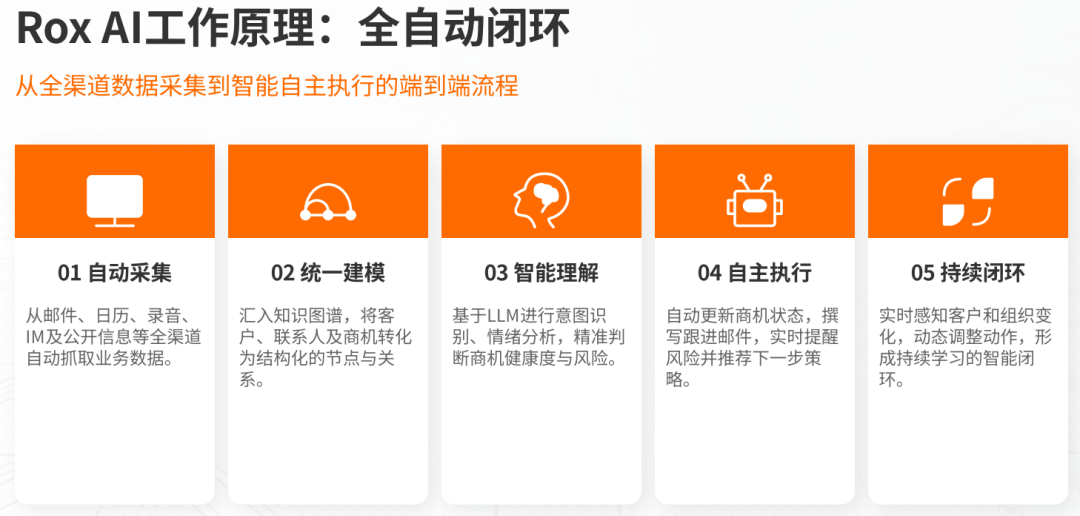
Another example is the global AI newcomer Palantir, which has completely established data models and corresponding scenario effectiveness pricing units, truly pricing the market based on effectiveness rather than token consumption. And Rox AI, which is now highly regarded overseas, is subverting the traditional CRM interface, completely helping clients achieve deterministic effectiveness through Agent-driven forms, getting rid of the ending resistance of traditional CRMs and truly boosting revenue.
Lobster can be seen as significantly accelerating this progress. If the turning point of the TO B service system in the past few years was at the resource layer, then Lobster is extending the battle forward to the platform and software layers, officially challenging the front end of the traditional TO B service system.
This is also why DingTalk, Feishu, and WeCom are quickly racing against time. Before the emergence of updated enterprise-level Agent product paradigms, whoever can earlier build platform-level atomic components and basic Agent services, such as PaaS capabilities and office systems in the SaaS era, can earlier aggregate Agent developers and capture B-end enterprise mindshare.
A visible fact is that the underlying AI cloud has already constructed a relatively complete commercial model, and with the emergence of this wave of AI education from Lobster, its AI-based revenue model is continuously solidifying. According to LatePost, with the popularity of Lobster and Seedance 2.0 models, Volcano Engine's daily call volume has exceeded 10 billion tokens, driving Volcano Engine to continuously gain an edge in the MaaS battlefield of AI clouds.
Correspondingly, Alibaba Cloud's architecture is also undergoing unified alignment adjustments this year, officially placing MaaS services on the table.
It can also be said that the stories unfolding on DingTalk, Feishu, WeCom, and SaaS software today have long been playing out at the resource layer. The process of change is not without pain, but there is no room for retreat, with the principle approaching a winner-takes-all scenario. Lobster is accelerating the forward movement of this battle.
-
![]()
The Allure of 'Acquisition Spree': Li Shufu's Left Turn, Xu Jiayin's Right
-
![]()
Strategic Transformation Yields Results: Phoenix Optics Reports 10.9% YoY Rise in Core Net Profit for H1 2026
-
![]()
Three Key Growth Trajectories Synergize! Crystal-Optech Reports 3.478 Billion Yuan in Revenue for H1 2026
-
![]()
Semi-Annual Report Sparks XPENG Motors Buzz
-
![]()
1.6 Billion Big Order Secured! SeeYA Technology's Revenue Soars by 287.87% in the First Half of the Year
-
![]()
Baidu's Profits Plunge by 68%: Unraveling the Mystery Behind the Numbers
-
![]()
Baidu’s Profits Tumble by 68%! Where Has All the Money Gone?
-
![]()
Hynix’s Taobao Store Shuts Down Abruptly: What Should Customers Do About Warranty Services for Memory Modules?