Power Surge: The New AI 'Shovel Sellers'?
 03/27 2026
 516
516
Over the past few years, the dominant narrative in the AI sector has consistently focused on the 'shovel sellers.' This logic adheres to the age-old gold rush principle: to get rich, build the roads first. For AI applications to explode, infrastructure must lead the way.
Under the 'shovel sellers' logic, shovels have become increasingly valuable. Market capitalizations of leading stocks in various AI infrastructure sectors, such as NVIDIA, TSMC, Samsung Memory, and even Foxconn Industrial Internet, have soared.
Today, the computational power logic has extended upstream to energy supply. Power stocks have hit 20CM daily limits within minutes, with consecutive limit up (limit-up) trends emerging. It seems power is showing signs of becoming the new 'shovel.'
This article holds the following viewpoints:
1. AI development has shifted from computational bottlenecks to power constraints. AI inference relies on Tokens, with power and computational hardware depreciation accounting for over 70% of the cost per Token. This not only means power will benefit from AI inference scale expansion but also indicates that low power costs can enhance model competitiveness, potentially stimulating AI-oriented power investments.
2. The spotlight on HALO assets. Goldman Sachs recently defined HALO assets: in an era where AI rapidly disrupts the digital world, capital is paying a premium for physical assets that AI cannot disrupt. The reality of the Middle East energy crisis and global power shortages has drawn more attention to power within HALO assets.
/ 01 / Power in Full Bloom
The ongoing conflicts in the Middle East keep oil prices fluctuating, constantly tugging at the nerves of global inflation and hanging like a Sword of Damocles over capital markets.
Amid this tense market environment, power has carved out an independent trajectory, with power assets exhibiting a high-explosion, wide-coverage trend.
Over the past 20 days, the A-share power sector has risen by 10%, ranking third among 103 Dongcai secondary industries. Especially in the last two days, sentiment around power investments has reached a fever pitch: Jiawei New Energy hit a 20% daily limit within one minute of opening, while assets like Huadian Liaoning Energy achieving consecutive limit-ups are not isolated cases.
The rising power assets are not confined to a specific segment but span most subdivision (sub-sectors) of the power industry chain, from traditional thermal power to wind and solar generation, power equipment, energy storage, and virtual power plants.
In the past, power was not considered a 'sexy' asset.
The logic of power generation is simple and transparent, with the product being nothing more than electricity—highly homogeneous. Company performance is highly predictable, leaving no room for surprises. Even leading stocks like Yangtze Power are viewed by many investors as 'bond-like' stocks, with reasonable market caps calculated using conservative DCF formulas.
The recent surge in power assets first stems from the arrival of a new power investment cycle.
Driven by national strategies such as the West-to-East Power Transmission and the transition from traditional power infrastructure to a new power system, State Grid announced this year that fixed asset investments during the '15th Five-Year Plan' period are expected to reach RMB 4 trillion, a 40% increase compared to the '14th Five-Year Plan.' Investments will primarily focus on three areas: ultra-high voltage transmission, distribution networks, and pumped-storage hydropower stations.
Meanwhile, the logic of rising electricity prices is strengthening. The Russia-Ukraine conflict and Middle East tensions have pushed up global coal and gas prices. China's power market reforms have opened up the transmission path from 'energy price hikes → electricity price increases,' potentially boosting the profitability of power assets.
However, if power assets rely solely on investment cycles and occasional price hikes, their value proposition remains short-term, with little qualitative change in long-term value. What could truly transform the value of power assets is their emergence as indispensable assets in both the AI and physical worlds.
/ 02 / The New AI 'Shovel Sellers'
This month, Elon Musk's xAI joined seven tech giants—including OpenAI, Microsoft, and Google—at the White House to sign a somewhat anxious 'pledge': committing to self-supply or purchase the massive electricity required for AI data centers.
In the past, the consensus among Silicon Valley elites was that computational power was key to AI investments. Today, tech giants face power constraints because the most critical physical bottleneck restricting AI technology development and commercialization has become a stable and low-cost power supply.
The underlying logic starts with Tokens.
Tokens are the smallest semantic units of large models, akin to the 'building blocks' they use to understand and generate content. This universality across AI products means AI service pricing is based on the number of Tokens consumed.
Surprisingly, power consumption and hardware depreciation account for over 70% of the production cost per Token.
This means AI competitiveness will no longer depend solely on model parameter size but also on power costs—how many Tokens each watt-hour of electricity can produce.
An example will make this clearer.
According to Cailian Press, data from OpenRouter, the world's largest AI model API aggregation platform, showed that in February, Chinese AI model usage surpassed the U.S. for the first time. Among the top five models by platform usage, four were from Chinese vendors.
The high usage is not due to superior performance but lower costs. Research by Changjiang Securities shows that for input prices, MiniMax M2.5 and Zhipu GLM-5 cost $0.3 per million Tokens, while Anthropic's Claude Opus 4.6 costs $5—16.7 times more than Chinese models.
This price gap has led U.S. users to switch from U.S. models to Chinese ones via API interfaces when using certain AI tools, as affordability trumps all.
Understanding power's pivotal role in AI competition reveals the growth logic of power assets.
First, as AI inference scales up, Token consumption increases. Tokens are the 'digital fuel' condensed by high-performance GPUs after consuming vast amounts of electricity and performing hundreds of billions of calculations. This naturally drives a surge in power demand.
More importantly, power is becoming both a driver and beneficiary of Token globalization. In AI's global expansion, users need not download or install any software; they can access Token resources output by Chinese large models via API interfaces. Power is both the foundational energy supporting Token globalization and a direct beneficiary of the revenue it generates, potentially becoming the next focus of tech giants' AI investments.
Thus, power has formed a 'Power—Token—Global Reach' business closed loop in the AI sector, with AI 'shovel sellers' extending from computational power to electricity.
/ 03 / The Premium of 'HALO' Assets
The HALO concept originates from a recent bullish report by Goldman Sachs.
HALO stands for Heavy Assets and Low Obsolescence, with the core logic being: as AI accelerates the disruption of the digital world, capital is shifting toward physical assets that AI cannot replace and is willing to pay a premium for them.
More bluntly, traditional heavy assets like power grids, energy pipelines, utilities, transportation infrastructure, high-end heavy equipment, and industrial capacity requiring long-term construction are now seeing opportunities for value reassessment amid the AI wave.
This reassessment is already reflected in capital markets.
In its report on HALO assets, Goldman Sachs used the European market as an example: light-asset portfolios, which once enjoyed valuation premiums, are now correcting, while heavy-asset portfolios, long pressured by valuations, continue to strengthen. In recent years, the valuation gap between the two has narrowed rapidly.
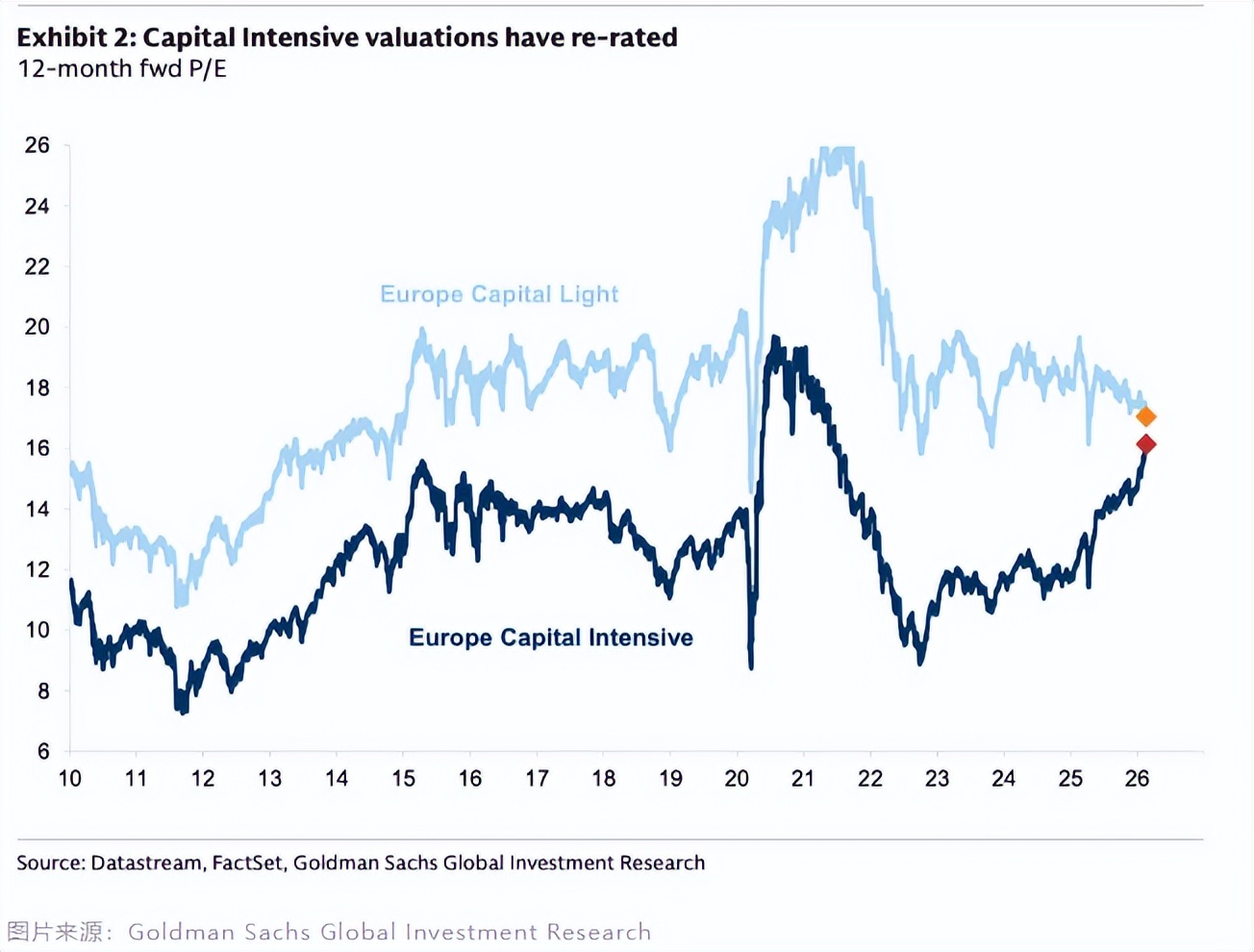
After Goldman Sachs released its report, sudden conflicts in the Middle East drew even more attention to energy within HALO assets. Rising oil prices constantly remind investors that the underlying physical constraint for manufacturing and expanding any physical asset is energy.
Power's strategic value in energy continues to rise. After humanity advances up the AI tech tree, the focus of resource competition will shift from crude oil, steel, and coal to copper, electricity, and rare earths over the long term.
Even without considering the long energy transition, power remains a globally scarce asset outside China.
The dilapidated state of overseas infrastructure has evolved into a power bottleneck: 70% of power facilities in Spain and Portugal are over 40 years old, while over 70% of transformers in the U.S. have exceeded their 25-year lifespans. Inadequate infrastructure has left major economies like the U.S., Europe, and Japan in a collective 'power crunch.' Texas's grid faced rolling blackouts in summer, while electricity prices in Pennsylvania surged by 29%. Power scarcity will likely trigger an overseas power investment cycle.
As the world once again enters a 'fight for resources' dynamic and energy becomes a bottleneck for AI, power may finally have its moment in the sun.
-
![]()
The Allure of 'Acquisition Spree': Li Shufu's Left Turn, Xu Jiayin's Right
-
![]()
Strategic Transformation Yields Results: Phoenix Optics Reports 10.9% YoY Rise in Core Net Profit for H1 2026
-
![]()
Three Key Growth Trajectories Synergize! Crystal-Optech Reports 3.478 Billion Yuan in Revenue for H1 2026
-
![]()
Semi-Annual Report Sparks XPENG Motors Buzz
-
![]()
1.6 Billion Big Order Secured! SeeYA Technology's Revenue Soars by 287.87% in the First Half of the Year
-
![]()
Baidu's Profits Plunge by 68%: Unraveling the Mystery Behind the Numbers
-
![]()
Baidu’s Profits Tumble by 68%! Where Has All the Money Gone?
-
![]()
Hynix’s Taobao Store Shuts Down Abruptly: What Should Customers Do About Warranty Services for Memory Modules?