OpenAI Shuts Down Sora: Strategic Retreat or Exposure of AI Video Commercialization as a 'False Proposition'?
 03/30 2026
 614
614

'Burning Cash and Fleeing VS Stubbornly Taking Over'
Editor | Tianyang & Yunshu
Produced by | Jixin
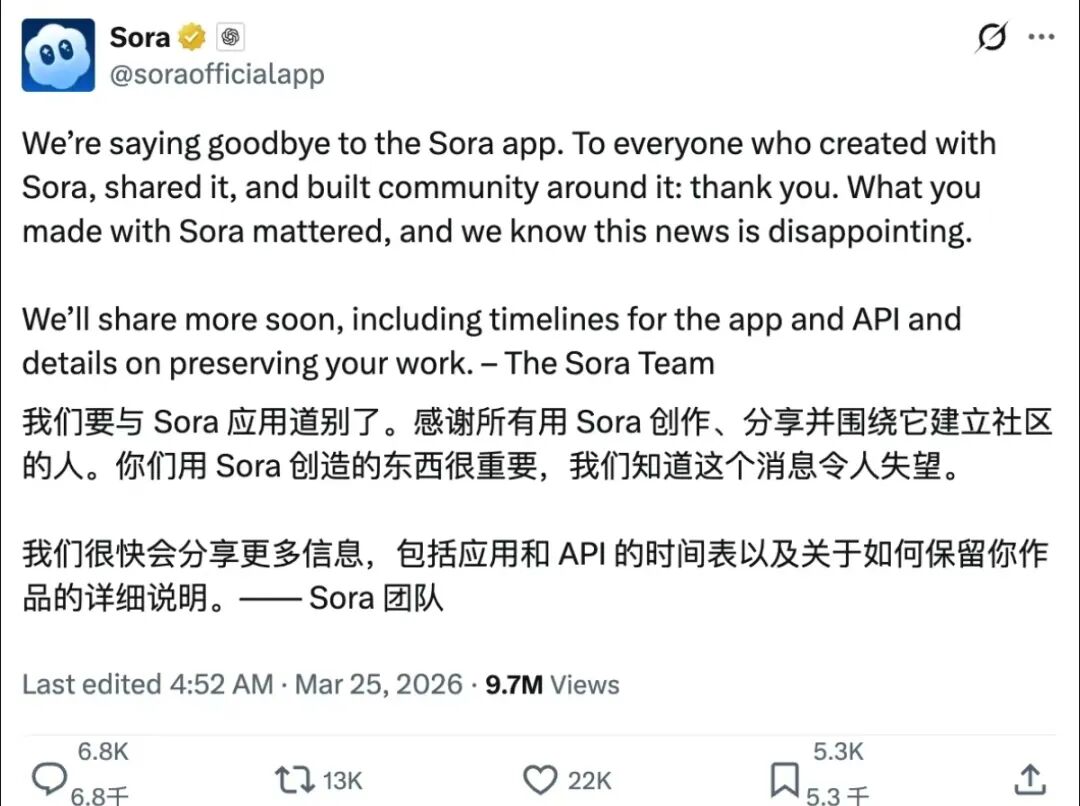
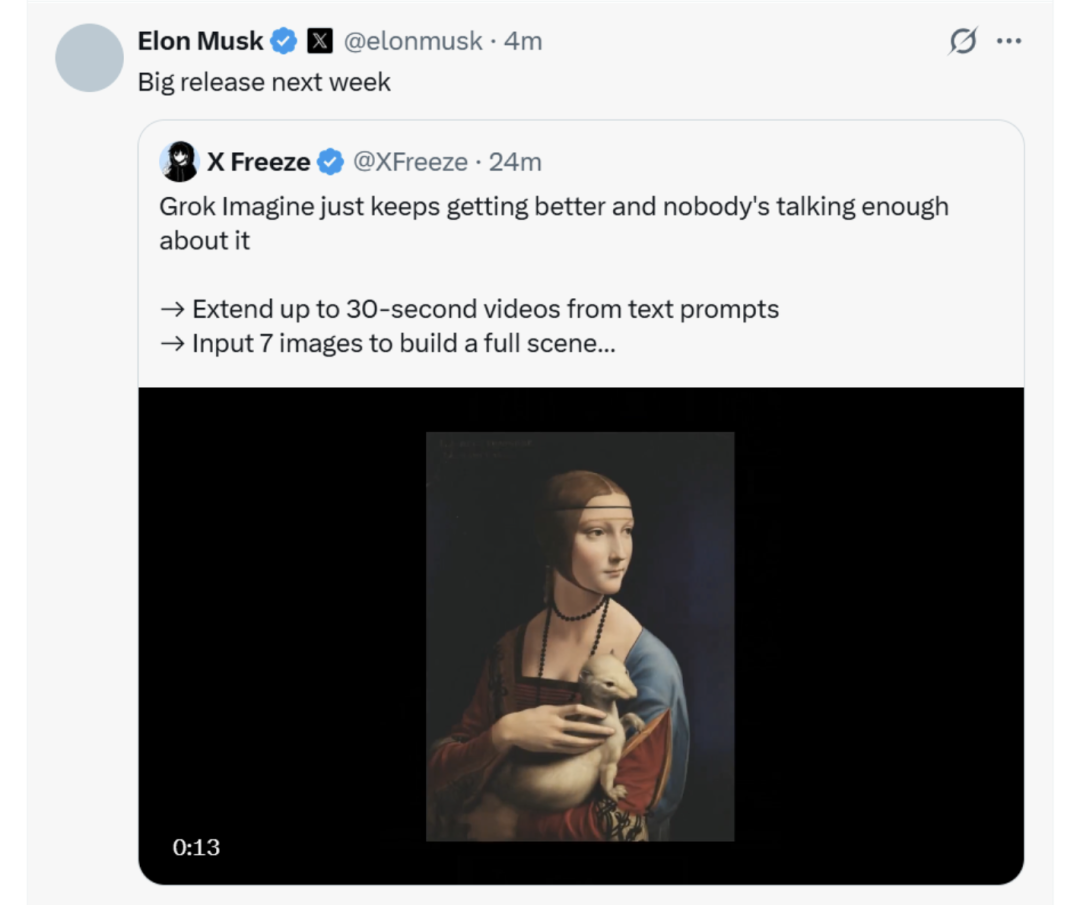
When OpenAI announced this week the shutdown of its AI video generation model Sora, which had once amazed the world, the entire tech community was shaken. Just hours later, Elon Musk took to the X platform to proclaim that xAI would be upgrading its video generation product, Grok Imagine, with an 'epic' overhaul and would be 'doubling down' on this track (translation: 'track' or 'field'). This retreat by one and advance by another not only reveals the fierce competition in the AI video realm but also raises a fundamental question: Is Sora's exit a strategic retreat by OpenAI, or is AI video commercialization itself an immature 'false proposition'?
The Sora Hype: Technological Mirage or Commercial Quagmire
Sora's debut was hailed as the 'ChatGPT moment for AI video.' Capable of generating coherent, physically plausible one-minute videos from text prompts, it showcased a stunning technological breakthrough. However, the path from tech demo to sustainable commercial product is far bumpier than imagined.
Multiple considerations may lie behind OpenAI's decision. First is the prohibitive computational cost. The resources required to generate high-quality video grow exponentially, with each inference consuming vast amounts of energy. Bloomberg's analysis cuts to the core: the chasm between soaring costs and actual returns may have exceeded OpenAI's current tolerance.
Second is the ambiguity of the commercialization path. While AI image generation has found applications in design, marketing, and other fields, the market positioning for high-quality video generation remains unclear. Should it target professional filmmaking or ordinary user creation? Both paths face enormous challenges: the former demands stringent quality, controllability, and copyright compliance that current technology struggles to fully meet; the latter grapples with insufficient user demand intensity and low willingness to pay.
Musk's Dangerous Gamble Between Vision and Reckoning
Musk's swift move to fill the market void reflects his trademark aggressiveness. Elevating Grok Imagine to one of xAI's four core businesses signals his recognition of the strategic value in the AI video track (translation: 'track'). Yet, the path is littered with cautionary tales.
xAI itself faces a talent exodus—co-founder of the Imagine business Guodong Zhang and core employee Haotian Liu have departed. Moreover, Grok's previous controversies over generating violation (translation: 'non-compliant') content have exposed the enormous safety and ethical risks of AI video, risks that multiply exponentially in the video domain.
Musk's 'doubling down' resembles a high-stakes gamble: betting on rapid market capture while rivals hesitate, and on technological progress breaking through cost and application bottlenecks in the short term. However, if the fundamental challenges of AI video commercialization remain unsolved, this aggressiveness may merely transform OpenAI's retreat into xAI's trap.

How Far Is the Gap Between AI Video's 'Ideal' and 'Reality'?
Sora's abrupt exit has doused the fervor of the entire AI video track (translation: 'track') with cold water. We must confront a stark reality: technology can leap forward, but the path to commercialization is riddled with pitfalls. Beneath the halo of AI video generation, several deep fissures have emerged:
Balancing Cost and Accessibility: How to reduce per-generation costs to a range acceptable to ordinary users or SMEs?
Matching Precision Control with Creative Demands: Current technology still struggles to achieve the fine control and consistency creators require.
Establishing Copyright and Ethical Compliance Frameworks: Issues like training data copyright and liability for generated content remain unresolved.
Validating Real Market Demand: Beyond technical demonstrations that amaze, does genuine, sustained, and scalable user demand truly exist?
An Industry Moment for Value Reassessment
OpenAI's shutdown of Sora should not be simply interpreted as a technical failure or strategic blunder but rather as a realistic strategic adjustment. It exposes the deep-seated contradiction in current AI video commercialization: the disconnect between the pace of technological breakthroughs and the maturity of business models.
Meanwhile, Musk's aggressive foray represents another logic: seizing the initiative amid uncertainty, using radical investment to force technological breakthroughs and ecosystem construction. These two starkly different choices reflect two philosophies at the crossroads of AI development.
The future of AI video generation will not dim because of Sora's exit, but this event undoubtedly sounds an alarm for the entire industry: technological marvels must withstand the scrutiny of commercial laws. True breakthroughs may no longer stem solely from increases in model parameters but from systemic solutions to cost, application scenarios, and sustainable ecosystems.
On this field defined by expensive computational power, ethical minefields, and fierce competition, the road to the future is far from smooth. The disruptor who first breaks through the thick wall between technological ideals and commercial realities may push open (translation: 'push open') the 'narrow gate' that defines the next generation of narrative language.
-
![]()
The Allure of 'Acquisition Spree': Li Shufu's Left Turn, Xu Jiayin's Right
-
![]()
Strategic Transformation Yields Results: Phoenix Optics Reports 10.9% YoY Rise in Core Net Profit for H1 2026
-
![]()
Three Key Growth Trajectories Synergize! Crystal-Optech Reports 3.478 Billion Yuan in Revenue for H1 2026
-
![]()
Semi-Annual Report Sparks XPENG Motors Buzz
-
![]()
1.6 Billion Big Order Secured! SeeYA Technology's Revenue Soars by 287.87% in the First Half of the Year
-
![]()
Baidu's Profits Plunge by 68%: Unraveling the Mystery Behind the Numbers
-
![]()
Baidu’s Profits Tumble by 68%! Where Has All the Money Gone?
-
![]()
Hynix’s Taobao Store Shuts Down Abruptly: What Should Customers Do About Warranty Services for Memory Modules?