Biren Technology Achieves 1 Billion Yuan in Annual Revenue but Reports a 'Loss' of 16.5 Billion Yuan: How Long Can Financing Sustain Operations?
 04/15 2026
 716
716
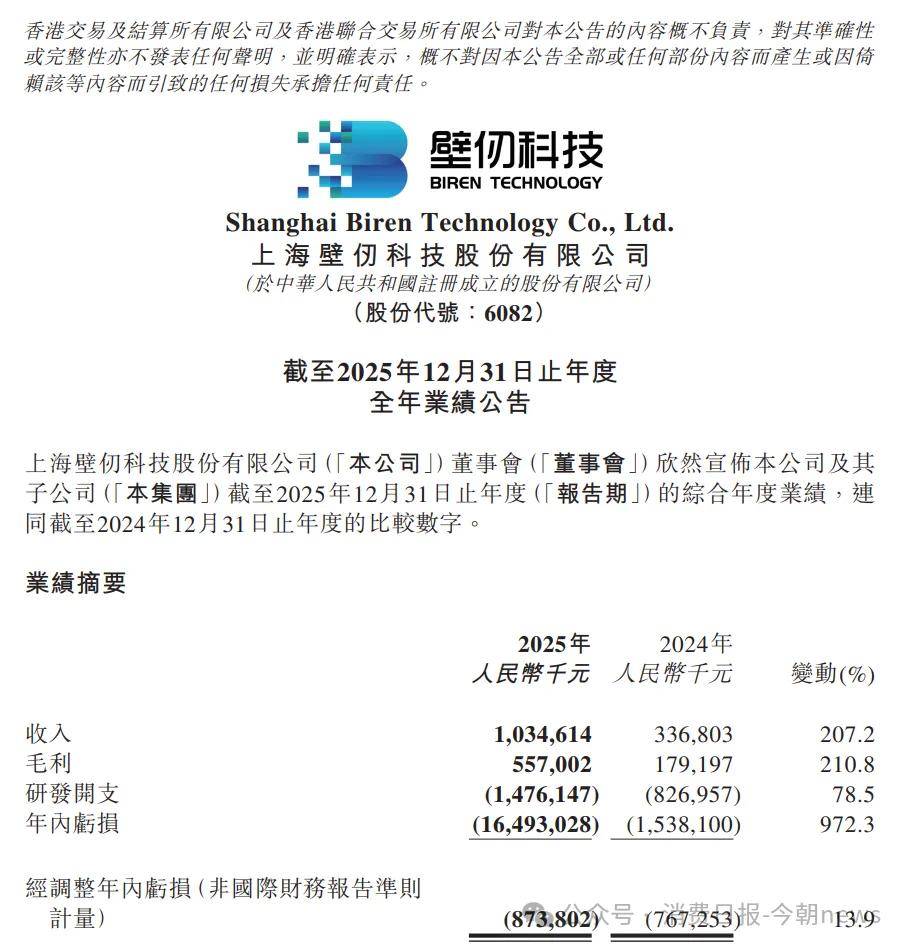
Image Source/Financial Report
On March 30, Biren Technology released its full-year 2025 performance announcement, marking its first complete annual financial report since listing on the Hong Kong Stock Exchange. The results reflect a dual trend of high growth and intense pressure.
The financial report shows that Biren Technology's 2025 revenue reached 1.035 billion yuan, surging by 207.2% year-on-year, while the reported net loss hit 16.493 billion yuan, primarily due to non-operating accounting adjustments related to changes in the book value of redeemable preferred shares. After adjustments, the net loss stood at 874 million yuan, with significant increases in R&D investment and inventory scale.
Tracing its listing journey, Biren Technology, founded in Shanghai in September 2019, rapidly rose to prominence with a focus on high-end general-purpose GPU development. Between 2020 and 2022, it completed multiple funding rounds, attracting investors such as Qiming Venture Partners, Hillhouse Capital, and state-backed entities.
Biren Technology formally submitted its prospectus to the Hong Kong Stock Exchange in August 2025, passed the hearing in December of the same year, and listed on the main board on January 2, 2026, with an issue price of 19.6 HKD, becoming the "first domestic GPU stock on the Hong Kong Stock Exchange."
Initially, Biren Technology's stock price surged, opening 82.14% higher on its debut, peaking at 42.88 HKD during the session—a gain exceeding 118%—and reaching a market capitalization of 100 billion HKD at one point.
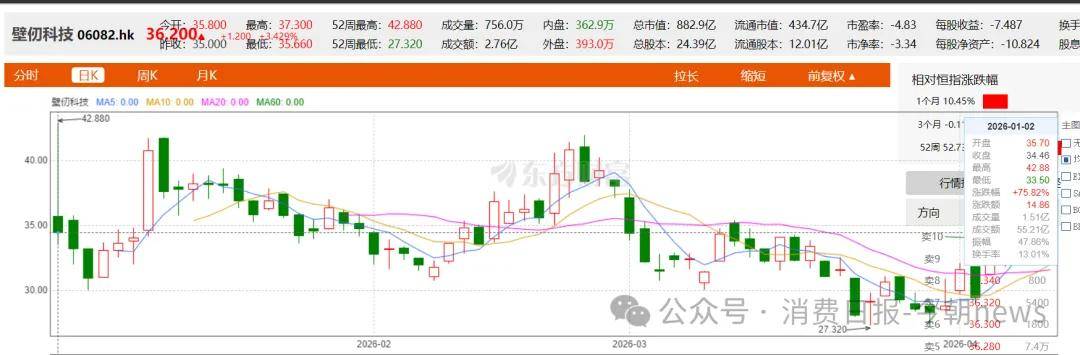
Image Source/East Money
However, after the initial excitement, the stock price entered a volatile downward trend, hitting a low of 28 HKD on March 23—a new post-listing low and a decline of over 30% from the debut peak. Market divergence over its business model gradually emerged. As of April 14, Biren Technology opened at 36.18 HKD.
Behind Biren Technology's 2025 financial report and post-listing stock price fluctuations lie the opportunities and challenges faced by domestic GPU companies in breaking through, as well as the market's stringent demands for hard-tech firms transitioning from financing-driven expansion to profit realization.
1
High Growth, High Investment, and the Growing Pains Behind Substantial Book Losses
Biren Technology's 2025 financial report reveals a mix of high growth, massive book losses, high R&D investment, and soaring inventory levels. While showcasing the explosive potential of the domestic GPU sector, it also exposes the typical pressures faced by hard-tech firms in their early scaling stages.
The financial report shows that Biren Technology's 2025 revenue reached 1.035 billion yuan, surging by 207.2% year-on-year—a leap from 337 million yuan in 2024—with a gross profit of 557 million yuan and a gross margin of 53.8%, up 63 basis points year-on-year. Intelligent computing solutions contributed the core revenue, driven by mass production and delivery of the BR106 and BR166 series chips.
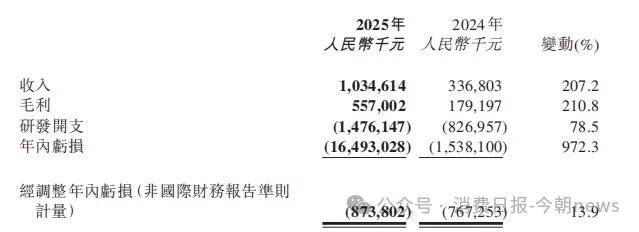
Image Source/Financial Report
While revenue soared, Biren Technology's 2025 net loss reached 16.493 billion yuan, expanding by 972.3% year-on-year, primarily due to a 15.471 billion yuan adjustment in the book value of redeemable preferred shares—a non-cash, non-operating accounting treatment that does not reflect actual operating cash outflows.
After adjustments to exclude redemption liabilities, share-based compensation, and listing expenses, Biren Technology's 2025 net loss stood at 874 million yuan, up just 13.9% year-on-year, providing a closer reflection of its true operating performance. With the termination of preferred share redemption rights upon listing in January 2026, subsequent reported losses are expected to narrow significantly, gradually dispelling earlier market question over financial packaging.
The financial report indicates that Biren Technology maintains relatively sufficient capital reserves. As of the report's end, it held cash and cash equivalents, bank deposits, restricted cash, and current financial assets measured at fair value through profit or loss totaling 2.896 billion yuan. Combined with the 5.631 billion yuan raised through its IPO, the company holds a total of 8.5 billion yuan in cash and various financial assets.
In R&D, Biren Technology continued its high investment, with R&D expenses reaching 1.476 billion yuan in 2025, up 78.5% year-on-year, and an R&D-to-revenue ratio of 142.6%. The financial report notes that the increase in R&D investment was primarily due to rising costs for technical services, equipment depreciation, and expanded R&D team size and compensation to support product and technology iterations. As of the end of 2025, Biren Technology employed 842 people.
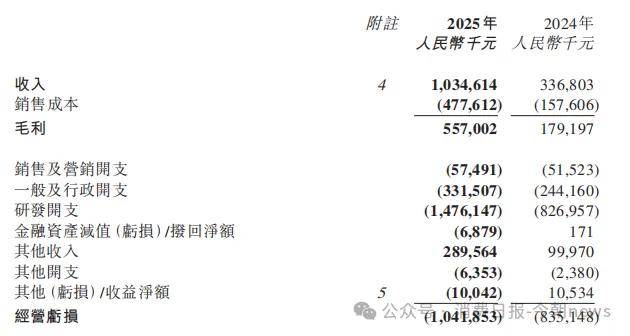
Image Source/Financial Report
Meanwhile, Biren Technology's inventory scale surged to 949 million yuan in 2025, up 520.4% year-on-year, nearing its annual revenue level. The company attributed this to meeting explosive demand for computing power and ensuring supply chain resilience.
However, high investment also brings multiple uncertainties. Risks persist in R&D efficiency and technology conversion cycles, making it difficult to form a profitable closed loop in the short term, with the market remaining cautious about the timeline for profitability. On the inventory front, if AI computing demand slows, it could trigger inventory overhang and impairment risks, while large inventory holdings directly impact profits and cash flow.
Additionally, operating cash flow remained negative, with the company heavily reliant on primary and secondary market financing. Customer payments, inventory holdings, and R&D expenditures create pressure. Trade receivables surged by 508.3% year-on-year to 532 million yuan, and while the collection ratio reached 56.8%, it still tests capital turnover. Overall, while abundant financing reserves support expansion, cash flow resilience remains weak, with multiple potential pressure points ahead.
2
Single-Business Focus, Concentrated Client Base, and Uncertainties in Commercialization Quality
Biren Technology centers its business on general-purpose GPU chips and intelligent computing clusters, with a product matrix featuring mass-produced BR106 and BR166 series chips targeting large-scale model training and inference scenarios. It also offers system solutions such as 2048-card optically interconnected intelligent computing supernodes and thousand-card-scale intelligent computing centers, serving national-level computing platforms, telecom operators, commercial AIDC providers, AI/large-scale model companies, and enterprise clients.
In vertical domains, the company has developed solutions for AI Agents/AI Coding, generative AI (AIGC), fintech, smart manufacturing, intelligent education, and smart governance, establishing end-to-end delivery capabilities spanning "chips + systems + vertical scenarios" to enrich terminal application scenarios.
At the software level, Biren Technology advances ecosystem compatibility through its BIRENSUPA software stack, though software ecosystem maturity and developer tool completeness require further improvement.
In 2025, Biren Technology's revenue structure remained highly concentrated, with intelligent computing solutions generating 1.028 billion yuan in revenue, accounting for 99.3% of total revenue and surging by 205.1% year-on-year. This represents the sole core revenue stream, with extreme business concentration and no secondary growth curve formed, relying entirely on GPU chip and intelligent computing cluster deliveries for growth.
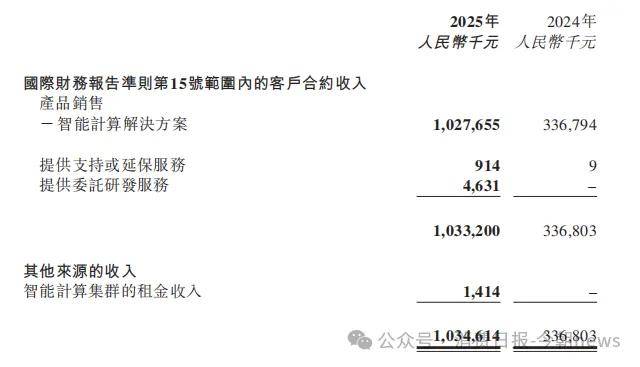
Image Source/Financial Report
Client concentration remained high, with the top five clients contributing over 90% of revenue in 2023, 2024, and the first half of 2025. In 2024, the single largest client accounted for 54.5% of revenue, and while 2025 saw some optimization, the top five clients still contributed over 70%. Clients primarily include leading internet giants, national-level computing platforms, operators, and AI large-scale model companies, with a small client base, weak bargaining power, and significant order fluctuation risks.
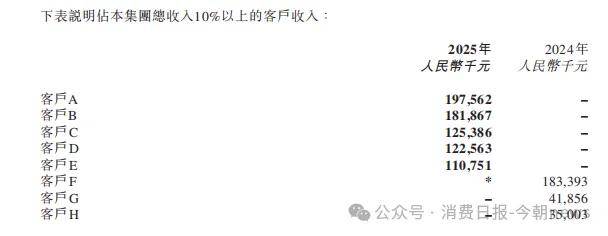
Image Source/Financial Report
This model of heavy reliance on a few large clients poses risks. If core clients reduce orders, press for price cuts, or switch to competitors, the company's revenue could plummet. High growth is primarily driven by a handful of large orders rather than broad market penetration, raising questions about income sustainability, repurchase rates, and client loyalty. Expansion into small and medium-sized clients, vertical industry scenarios, and overseas markets remains slow, with a clear commercialization ceiling.
Key question also arise on the business side. The company's BR100 series chips lag significantly in software compatibility, cluster stability, power control, and ecosystem synergy, with domestic substitution relying more on policy and supply chain support than comprehensive performance replacement. Supply chain dependence on external wafer foundries introduces risks in advanced processes, capacity, and yield fluctuations.
Software ecosystems continue to constrain long-term competitiveness, with BIRENSUPA's compatibility, developer tool completeness, and application ecosystem richness falling short. High client migration costs hinder the formation of a robust ecological barrier.
3
From Financing to Listing: What Comes Next for Biren?
Since its founding in Shanghai in September 2019, Biren Technology's founder, Zhang Wen, assembled a core team with backgrounds at AMD and Huawei. Zhang holds a Harvard Law School J.D. and a Columbia MBA, previously served as SenseTime's president, and has experience in Wall Street private equity and legal practice, excelling in strategic planning, financing, and commercialization.
CTO Hong Zhou brings over 30 years of GPU R&D experience as the technical cornerstone; COO Zhang Linglan, formerly an AMD GPU SoC architect and Samsung U.S. R&D executive, oversees engineering, supply chain, and mass production; and co-CEO Li Xinrong, a former AMD global vice president, handles organizational management and product design.
Since its inception, Biren Technology has focused on high-end general-purpose GPU development, completing multiple funding rounds between 2020 and 2022 with participation from Qiming Venture Partners, IDG, Hillhouse Capital, and state-backed investors. In 2022, it launched its flagship BR100 chip, setting a computing power record.
In 2024, some products entered scaling shipment, with annual revenue surpassing 300 million yuan. In 2025, it submitted its Hong Kong Stock Exchange prospectus, reported annual revenue exceeding 1 billion yuan, and officially listed on the main board on January 2, 2026, at an issue price of 19.6 HKD, becoming the "first domestic GPU stock on the Hong Kong Stock Exchange."
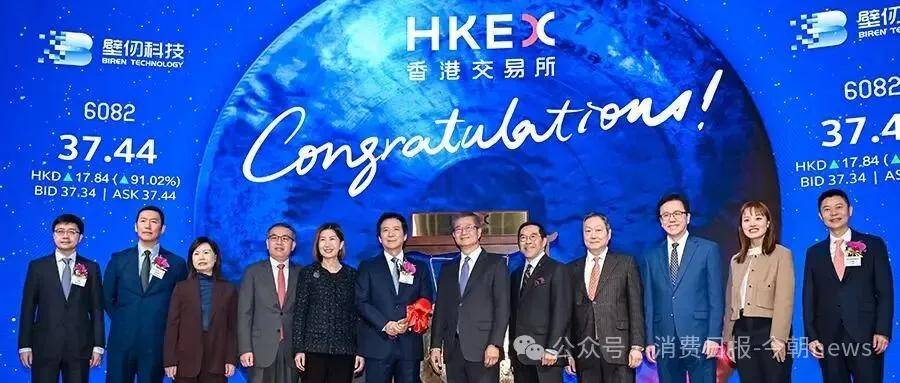
Image Source/Biren Technology
In just a few years, Biren Technology achieved a rapid transition from startup to Hong Kong Stock Exchange listing.
From a equity structure perspective, its pre-IPO equity structure was relatively dispersed, with Zhang Wen controlling approximately 17.73% as the single largest shareholder. Institutional investors include Qiming Venture Partners, Walden International, Hillhouse Capital, Country Garden Venture Capital, and state-backed entities from Shanghai and Guangzhou.
However, amid rapid growth, the company has faced long-standing controversy . Zhang Wen, lacking a chip technology background, has been labeled a "capital-driven entrepreneur," with market concerns over a focus on financing over technology and potential risks in R&D decision-making.
Since its founding, the company has operated at a loss, entirely reliant on primary and secondary market financing for R&D and operations. If financing conditions tighten, survival and expansion will face direct pressure.
Technologically, it faces international patent and ecosystem barriers, with long-term IP and compliance risks. While no substantive penalties have been imposed, compliance pressures persist.
In 2025, Biren Technology delivered a "five-high" performance: high revenue growth, high R&D investment, high book losses, high inventory, and high client dependency. This reflects both commercialization breakthroughs amid the domestic substitution trend and the common dilemmas faced by hard-tech startups.
Currently, Biren Technology stands at a critical juncture of technological breakthroughs and commercial scaling. As a typical case of domestic GPU advancement, its 2026 milestones are clear: successful mass production of the BR20X series, orderly inventory digestion, improved client structure, and narrowed adjusted losses. Its future depends on building a self-controlled software and hardware full-stack ecosystem, breaking through supply chain bottlenecks, and ultimately achieving scalable profitability.",
-
![]()
Tesla Restructures Its Balance Sheet
-
![]()
Accelerating the High-Speed Interconnection Upgrade of AI Computing Clusters! JONHON Releases ELSFP External Light Source Optical Connectors
-
![]()
Breaking the overseas blockade of volumetric holographic materials, this optical enterprise secures nearly 100 million yuan in financing!
-
![]()
Why Does Jensen Huang So Openly Praise China’s AI?
-
![]()
"Wudang" Unveiled: Arm China's Next-Gen AI VPU Redefines Video Encoding
-
![]()
From Energy Conservation and Carbon Reduction to AI Decision-Making: GECON East Intelligence and Chery Group Explore a New Green and Smart Paradigm for Automobile Manufacturing
-
![]()
WAIC 2026 Observation | AI Accelerates Towards the Core of Industries, Industrial AI Enters a Critical Phase
-
![]()
Volkswagen China Fires the First Shot in Foreign-Funded 'White Box Delivery'!