The Call to Oust Sam Altman!
 04/15 2026
 481
481

Across the ocean, the seeds of revolution have finally been planted.
Author: He Jian
Editor: Jiang Jiao
Cover: Generated by AI
Sam Altman, the preeminent leader in the global AI landscape and a trailblazer of the large language model era, now finds himself the most reviled, scrutinized, and targeted individual. Over the past year, OpenAI has not only been consistently outperformed by newcomers in terms of model capabilities and commercialization, but now even its founder has become a focal point of controversy—perhaps the most significant one yet.
Dissatisfaction with him has escalated to the point where his personal safety is at risk. A few days ago, Sam Altman's residence in San Francisco was subjected to two human-initiated attacks within 48 hours—one involving a Molotov cocktail and the other a shooting. Fortunately, there were no casualties in either incident. The suspects in both attacks were subsequently apprehended by local police, with one arrested near OpenAI's headquarters, allegedly threatening to burn down OpenAI.
Following the first attack, Sam Altman posted a lengthy blog urging calm. He rarely shared photos of his family, including his partner and children, stating, "Here is a photo of my family; I love them more than anything." He believes in the power of imagery and hopes it will dissuade further attacks on his home.
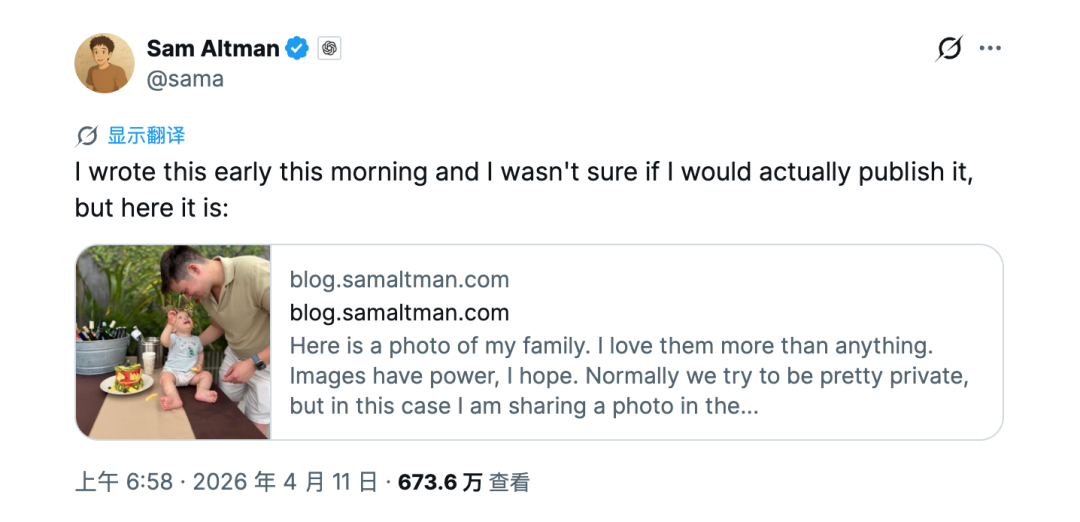
Sam Altman releases a lengthy blog post in response to the assaults.
Prior to these attacks, Sam Altman was already embroiled in a fresh wave of public controversy. The New Yorker published an extensive article titled "Sam Altman May Control Our Future, Can He Be Trusted?", reigniting long-standing debates about his ambitions for power, control issues, and credibility.
The article's author, Ronan Farrow, stated that he and his colleagues spent nearly a year and a half interviewing over a hundred sources and obtaining over 200 pages of confidential documents in an attempt to assess whether the founder of the world's largest AI company could be trusted.
However, multiple sources interviewed for the article accused Sam Altman of being a habitual liar, with more than one using extreme terms like "sociopathic" to describe him, believing he has an intense ambition for power and acts recklessly. The New Yorker also featured a dynamic cover with multiple faces of varying expressions stacked on Sam Altman, hinting at his multifaceted nature.
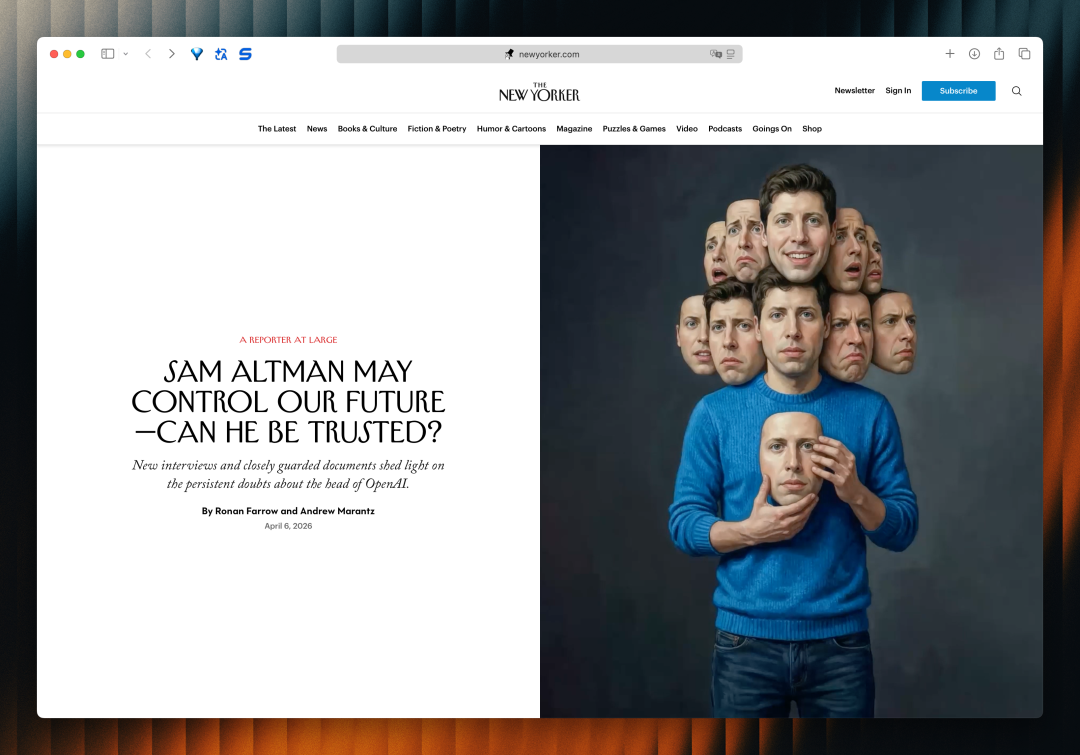
The New Yorker magazine's official website.
In addition to the lengthy article in The New Yorker, various negative allegations about Sam Altman's personal life have circulated, such as his sister suing him for allegedly sexually assaulting her when she was a child—though Altman is openly gay, and The New Yorker also stated there is no evidence to support claims that Altman sexually harassed a minor. Another rumor involved a former OpenAI employee committing suicide, but since the employee had publicly exposed OpenAI's violations before his death, there were rumors he was murdered.
Half a century later, the seeds of revolution may have finally been sown across the ocean. The American bourgeoisie have united, vowing to expose the duplicitous individuals hidden among the populace and overthrow the obstacle hindering the American people's AI endeavors.
OpenAI previously responded by stating that the report heavily revisited previously documented events, relying on anonymous accounts and selective anecdotes from individuals with clear biases, implying that the report was not objective.
After the extreme assaults, Sam Altman attempted to link the attacks to The New Yorker's negative coverage. In his lengthy blog post, he called it an incendiary article targeting him personally. He had been warned that the report, published during a period of heightened anxiety about artificial intelligence, might put him in greater danger. Initially dismissive, he now believes he underestimated the power of language and narrative.
Sam Altman did not respond to each controversial event mentioned in the report but broadly acknowledged making many mistakes during OpenAI's development, stating, "I am a flawed person at the center of a complex situation," while emphasizing his consistent efforts toward his mission.
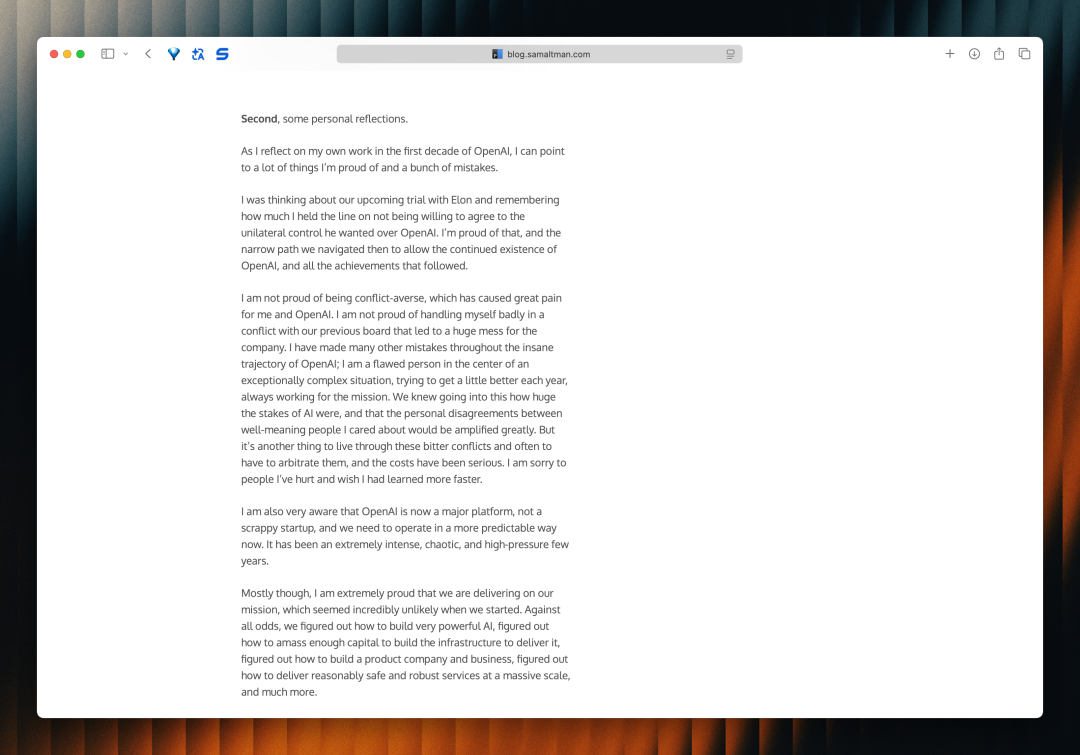
Sam Altman's blog post.
He stated he is not proud of his behavior during the conflict with the former board—previously, OpenAI's former board dismissed him on the grounds that Altman was untrustworthy, but he later returned to the company with support from Microsoft and other employees, quickly reorganizing the board. He apologized to those he harmed and expressed a desire to grow faster.
Technology figures are often accompanied by controversy, and Sam Altman is not the first tech leader to be deified only to fall heavily later.
The visionary Bill Gates pioneered the personal PC era but seemed to have little regard for his personal life, having had an affair with a female employee in his early years and now being implicated with Epstein. Steve Jobs was revered as a tech icon after his death but was known for being irritable, paranoid, and unsympathetic during his lifetime. Elon Musk, the current tech maverick, has never seemed to learn how to collaborate with others, with Tesla's executives changing repeatedly and xAI suffering even more turnover, with nearly all of its core founding members having left.
A single report may not possess such immense mobilizing power, even inciting extreme assaults. Whether Sam Altman is indeed a habitual liar and power-hungry may not be enough to provoke ordinary people to the point of committing crimes. Not to mention that The New Yorker has never been particularly fond of tech figures, and OpenAI is not yet powerful enough to dominate humanity's future.
But one thing is certain: Sam Altman is currently the most recognizable leader in the AI field. To some extent, his name almost represents the entire AI era, much like how people associate Jobs with the mobile internet and Musk with electric vehicles. All the admiration for AI is concentrated on Altman, but at the same time, all the hatred for AI may also be focused on him.
Later, someone uncovered the personal blog and social media accounts of the Molotov cocktail attack suspect, whose past statements revealed a consistent hostility toward artificial intelligence, even believing that the AI race could very likely lead to human extinction. The suspect's Discord account showed he was an active member of PauseAI—a global organization calling for a pause in the development of general artificial intelligence.
Over the past two years, tech leaders have continuously promoted the future of artificial intelligence at various events, envisioning how AI will reshape modern society and revolutionize productivity. However, at the same time, people's anxiety about being replaced by AI has gradually increased, much like how British textile workers in the early 19th century banded together to destroy textile machines and factories, stubbornly believing that only by destroying AI can they keep their jobs.
The unemployment wave triggered by AI has already spread through Silicon Valley. From late March to early April this year, Oracle initiated its largest-ever round of layoffs, with external estimates suggesting the scale could reach 20,000 to 30,000 employees, directly attributed to increased investment in AI infrastructure. After already laying off nearly 30,000 employees, Amazon launched another round of global layoffs in May this year, with reports indicating the scale could reach as many as 14,000. Reuters recently reported that Meta is planning another large-scale layoff after multiple rounds, potentially affecting 20% of its workforce, with Meta currently employing nearly 80,000 people.
According to commercial data platform RationalFX, nearly 80,000 people were laid off in the global tech industry in the first quarter of this year, with about three-quarters occurring in the United States and nearly half attributed to the impact of artificial intelligence and work automation. The database Layoffs.fyi, which tracks tech layoffs, reports that over 70,000 tech workers have been laid off in 2026, involving 80 companies.
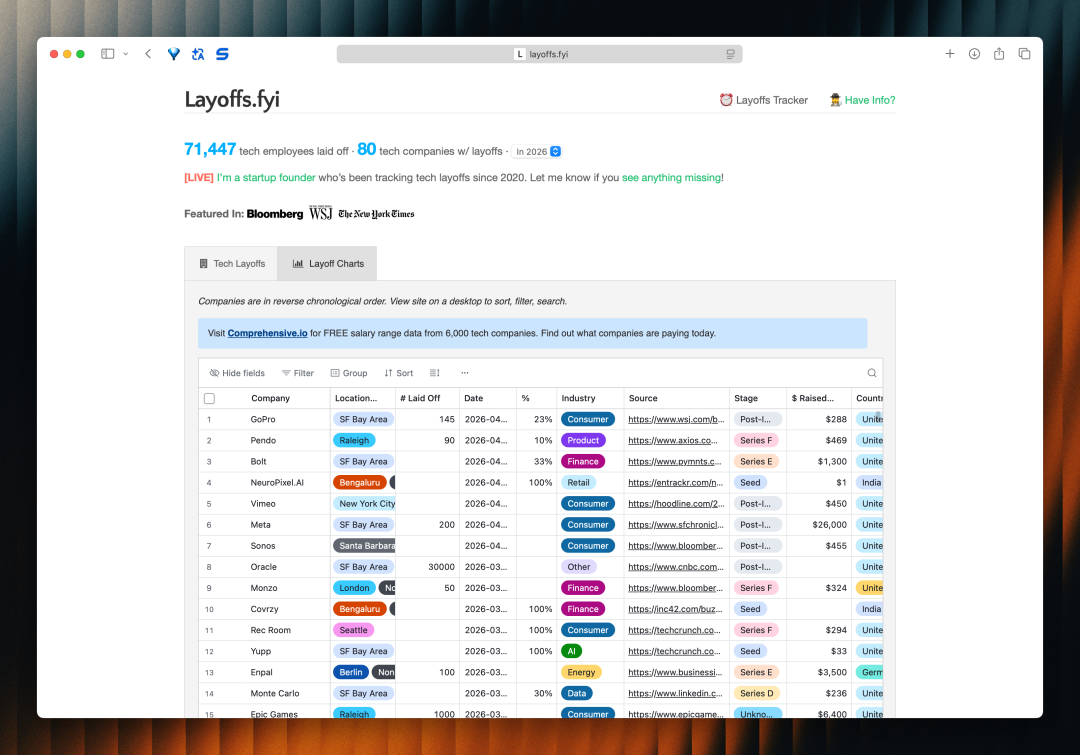
Layoffs.fyi statistics page.
Panic continues to spread, and negative sentiment towards AI among the American public is surging. NBC conducted a national survey some time ago, showing that only 26% of voters hold a positive attitude toward AI, while a staggering 46% hold a negative view. In NBC's survey, AI ranked third from the bottom in terms of favorability among the American public, only slightly higher than the Democratic Party and Iran.
It's also that American tech companies don't know better, constantly promoting dangerous rhetoric about AI replacing humans, which has naturally sparked backlash from the American public. They should learn from Alibaba and Tencent—regardless of how much AI improves efficiency, it should ultimately return to the traditional folk custom of giving red envelopes to the general public. The more money they give away, the more the public approves.
Sam Altman has always seen himself as an Oppenheimer-like figure, claiming that OpenAI is similar to the Manhattan Project, where the United States secretly developed the atomic bomb. He has also enjoyed this leader-like aura, moving between governments worldwide and acting as a prophet for AI's future.
He may have forgotten that after the war, Oppenheimer was under U.S. government surveillance and scrutiny for a long time until 2022, when the U.S. announced the revocation of its decision to revoke Oppenheimer's security clearance. In familiar terms, he was finally vindicated.
Sam Altman is not the type of tech genius people are familiar with; he may not be as great as Oppenheimer, possessing perhaps only Oppenheimer's most insignificant ability—persuading others. But he may not be as despicable and hypocritical as some claim. If you take the time to read his early blog posts, you might also agree with his genuine concerns about the future of technology.
But regardless, Altman has now become the most prominent target in the AI era. Even after he has faced two assaults, social media remains filled with mockery and attacks against him, with some even openly declaring the attackers as heroes.
The Call to Oust Sam Altman!
© All rights reserved by Shanshang. Unauthorized reproduction is prohibited.
-
![]()
Wang Huiwen, Former Meituan Executive, Achieves 20-Fold ROI, Supports 24 AI Startups
-
![]()
Another AI Computing Power Unicorn Launches IPO! Founded by a Changjiang Scholar
-
![]()
OFILM Holdings Secures Zhongke Daojing, Marking a Significant Leap in the Optical Communication Industry!
-
What Will Be the Next Key Battleground for Large Models After AI Coding?
-
![]()
Leapmotor's Sales Soar, Yet Hidden Concerns Loom
-
![]()
China’s Action Camera Market Soars: 3.12 Million Units Sold in Six Months, DJI Secures 74% Dominance
-
![]()
Zhang Yiming: Strategic Retreat as a Path Forward
-
![]()
Exploring Charging for Some Features of QianWen App: Can It Follow the Path of Doubao?