14 Years of Fluctuations, 9 Near-Death Experiences, Valuations Plummeting from Billions to Zero: Have AR Glasses Finally Found Salvation in AI?
 04/20 2026
 541
541
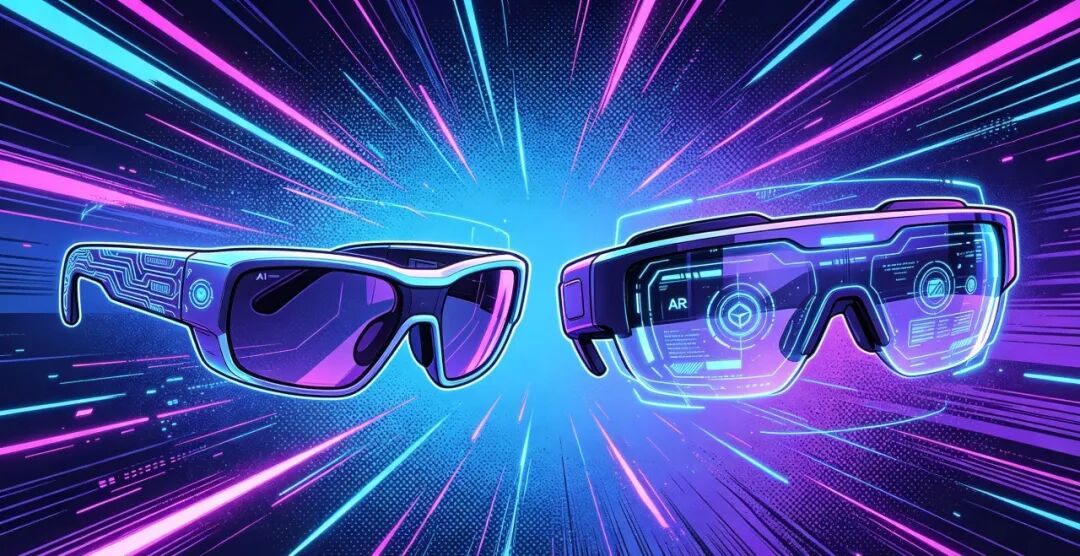
AI Revitalizes Another Industry.
Source | Silicon-Based Quadrant
Fourteen years ago, Google Glass made its grand entrance, sparking widespread excitement about the concept of "wearing a computer on one's face."
However, less than a year after its release, the product was discontinued due to its high price, privacy concerns, and impracticality, becoming a textbook example of a tech failure.
Yet, the vision of transforming glasses into smart devices persisted.
Since then, a wave of augmented reality (AR) glasses companies have emerged.
In 2014, Rokid was founded; in 2017, XREAL came into existence; in 2020, BeeBest was established; and in 2021, Thunderbird Innovation was launched and introduced its first AR glasses.
But for a decade, AR glasses have struggled to win over consumers. During the initial AR/VR frenzy, industry valuations soared to hundreds of billions, only to crash as demand fell short, products failed to sell, capital dried up, and a slew of once-promising companies collapsed, laid off staff, sold off assets, and watched their valuations nosedive repeatedly.
According to LoTu data, AR glasses sales in China reached only 267,000 units in 2024 and 489,000 units in 2025, less than one-tenth of smartwatch sales (50 million units in 2025).
Entering 2024, with the maturation of AI large models, AR glasses have found new life, evolving into AI glasses.
The transformation began with major players: in 2024, Baidu and Alibaba unveiled Xiaodu AI Glasses and Kuake AI Glasses, respectively. In 2025, Xiaomi released its first AI glasses, followed by Rokid's collaboration with BOLON to launch the BOLON AI Glasses, and XREAL's partnership with Google to release the AI glasses Project Aura...
The sector that once "teetered on the brink of extinction" is now being revitalized by AI large models.
On one hand, independent startups are regaining the attention of investors. On April 1, XREAL filed its IPO application with the Hong Kong Stock Exchange. Thunderbird Innovation secured 1 billion yuan in new financing in January this year, and Rokid received 180 million yuan in subscription financing in March.
On the other hand, major tech giants are re-entering the fray. Google plans to revive its AI glasses project, and Apple has officially announced its entry, aiming to launch AI glasses in 2027.
Is this time truly different?
01
The Unsellable AR/VR Dream
Smart glasses are not a novel idea.
In 2012, Google Glass was introduced, capable of taking photos and making video calls via voice control or blinking, identifying directions, browsing the internet, processing text messages and emails, and supporting functions like music playback and photography.
On April 15, 2014, Google Glass officially opened for online orders, priced at $1,500.
However, less than a year into its sales, issues such as high prices and privacy risks surfaced. On January 19, 2015, Google discontinued the project.
Since then, AR/VR manufacturers have continued to innovate, focusing on functions like large-screen audio-visual experiences, immersive gaming, and virtual large-screen office work through AR lenses.
But AR/VR glasses have faced numerous challenges in commercialization.
For instance, issues like heavy weight and overheating. Prolonged wear is uncomfortable; currently, the lightest glasses weigh over 70 grams, causing dizziness and nasal discomfort after extended use. Battery life is short, with some models lasting only 2 hours without external power, and prices reaching nearly 4,000 yuan.
Recall Meta's (formerly Facebook's) metaverse gamble in 2021?
In 2021, Facebook rebranded as Meta, announcing its ambition to "become a metaverse company within five years." However, from 2021 to the end of 2025, Reality Labs (its metaverse division) incurred losses of $19.193 billion (about 133.5 billion yuan) in a single year. Its Horizon Worlds (virtual social) community saw daily active users plummet from 3 million to less than 150,000. In January 2026, Reality Labs laid off 10% of its staff, closed three VR game studios, and redirected its metaverse budget towards AI and AI glasses.
The domestic market has fared no better. XREAL, the global leader in the AR market, has undergone nine rounds of financing totaling 2 billion yuan but has struggled to stay afloat. Its prospectus reveals cumulative losses exceeding 2 billion yuan between 2023-2025, with net current liabilities as high as 3.084 billion yuan.
For years, AR glasses have been dismissed as niche products, toys, or "beautiful waste."
02
AI Rescues AR Glasses
In 2024, with the gradual maturation of large AI models, AI glasses emerged.
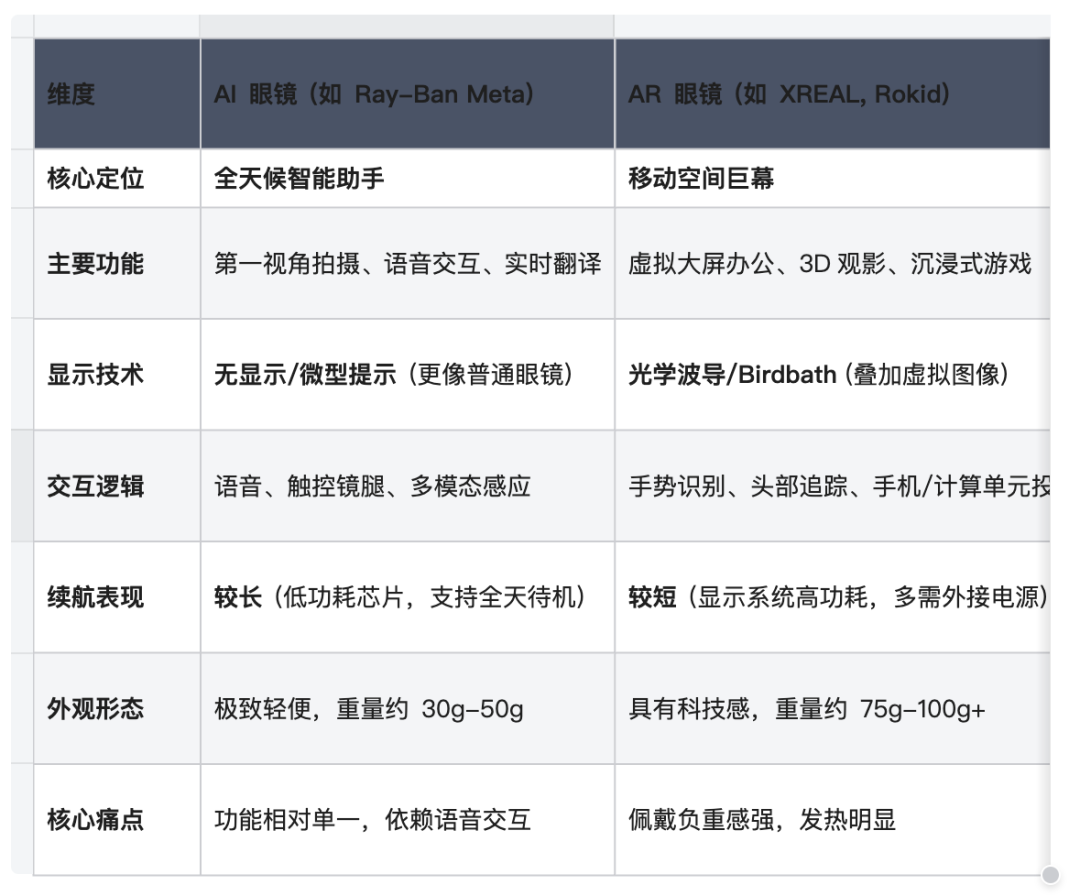
AI glasses priced around 1,000 yuan, such as Xiaomi AI Glasses and Qianwen AI Glasses, weigh about 40 grams without lenses, abandoning video functions to focus solely on voice assistants, real-time translation for cross-language communication, first-person photography/video recording, music playback, navigation, and phone/SMS notifications.
When users wear the glasses, they can simply say, "Take a photo/video," "Translate this," "What building is this?" or "Summarize the meeting just now."
Targeting scenarios like vlogging, travel navigation, and office work, these glasses are not intended to replace smartphones/computers but to serve as intelligent assistants connected to phones.
The resurgence of AI glasses can be attributed to three core reasons: First, AI capabilities have matured, enabling glasses to understand, interact, and execute tasks. Second, use cases have become clear; past questions like "What's the point of wearing them?" now have concrete answers: office work, translation, navigation, photography.
However, AI glasses also have limitations: limited functionality, relying solely on voice recognition. The emergence of AI glasses has provided a new entry point for AR glasses.
AI+AR glasses have become a new product direction, still equipped with lenses for immersive audio-visual and gaming experiences while adding AI dialogue and voice recognition. For example, Google and Xreal's jointly released Project Aura device uses a waveguide optical solution to combine virtual imagery with real-time scenes, equipped with cameras for real-time simultaneous translation, navigation, and AI assistant functions via bone conduction.
03
Can They Truly Replace Smartphones?
In 2026, riding the wave of AI glasses, traditional AR glasses companies are being rediscovered by capital markets.
XREAL, with a global market share of about 24.8%, has submitted its IPO application. Rokid has completed a 180 million yuan Pre-IPO round, and Thunderbird Innovation secured 1 billion yuan in financing this year. Rokid and XREAL are essentially "veterans" of the AR era.
However, AI+AR glasses are not poised to become "replacements" but rather "new entry points" that gradually gain prominence.
Currently, AI glasses have limitations in input efficiency; typing remains more precise than voice, and privacy scenarios are unsuitable for voice. Display capabilities are insufficient, with screen experiences still inferior to smartphones. Battery life is limited, and AI operations consume significant power.
Additionally, at CES 2026, Meta's first AR+AI glasses, Ray-Bann Display, still faced issues like only 3 hours of battery life, frequent AI errors, and blinding white light from the lenses during recording.
In the short term, AI glasses are more like supplementary devices to smartphones, similar to earbuds or watches. In the medium term, some smartphone functions (voice, navigation, simple interactions) may migrate to them. In the long term, when AI is mature enough, operating systems will become less dominant, app forms will evolve, and the importance of smartphones will diminish.
Because AI glasses offer advantages that smartphones lack: "hands-free + seamless interaction."
When AI is powerful enough, users won't need to open apps, enter keywords, or operate interfaces. They'll simply say, "Book a ticket, send an email, summarize this."
From PCs to smartphones, every technological shift has fundamentally altered human-computer interaction.
When AI becomes the primary interface, apps will be replaced, and interfaces will dissolve. Smartphones will no longer be the center, screens will no longer be the core, and the world you see will become the interface itself.
-
![]()
Wang Huiwen, Former Meituan Executive, Achieves 20-Fold ROI, Supports 24 AI Startups
-
![]()
Another AI Computing Power Unicorn Launches IPO! Founded by a Changjiang Scholar
-
![]()
OFILM Holdings Secures Zhongke Daojing, Marking a Significant Leap in the Optical Communication Industry!
-
What Will Be the Next Key Battleground for Large Models After AI Coding?
-
![]()
Leapmotor's Sales Soar, Yet Hidden Concerns Loom
-
![]()
China’s Action Camera Market Soars: 3.12 Million Units Sold in Six Months, DJI Secures 74% Dominance
-
![]()
Zhang Yiming: Strategic Retreat as a Path Forward
-
![]()
Exploring Charging for Some Features of QianWen App: Can It Follow the Path of Doubao?