From iQIYI to AIQIYI: A 'Cost-Reducing Marvel' or a 'Crisis of Trust'?
 04/24 2026
 549
549

Author|Zhang Qian
Editor|Hu Zhanjia
Operations|Chen Jiahui
Produced by|LingTai LT (ID: LingTai_LT)
Header Image|Publicly available image from the internet
April 20, 2026, iQIYI World Conference.
CEO Gong Yu took the stage and made two bold statements. The first: Live-action filming may become intangible cultural heritage. The second: Over 100 artists have signed up for the AI Artist Library, with AI commercial blockbusters set to release this summer.
Two hours later, #iQIYIHasGoneMad trended at the top of Weibo's hot search list.
Zhang Ruoyun's studio issued an emergency refutation at 13:30: "No AI authorization (AI authorization) has been signed; legal affairs are already involved." Yu Hewei's studio followed up at 14:38: "No AI-related authorization has been signed." Wang Churan's fan club stated at 14:03: "No AI-related authorization has been signed."
The top-rated comment in the netizens' discussion section read: "From now on, don't call it iQIYI; call it AIQIYI."
This was not a marketing stunt. Viewed within a broader context, these were two depth charges launched by iQIYI into the market, but no one could have predicted the resounding backlash they would provoke.
 AI Digital Actors Trend on Hot Search—Has iQIYI Really Gone Mad?
Gong Yu couldn't sit still.
On April 21, he posted on social media, explaining that technology is people-oriented and should always serve humanity. Technology should never aim to replace people...
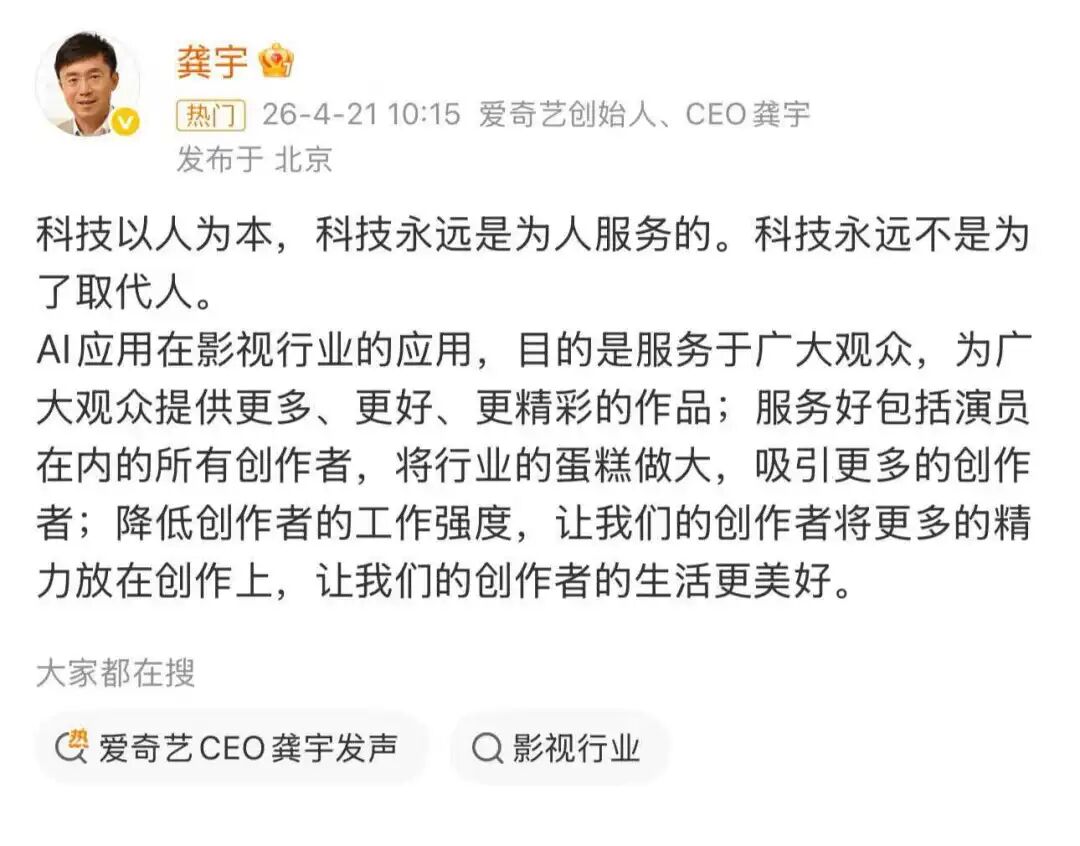
This was a further explanation of his remarks at the conference. After all, actors trending on hot search is not uncommon. However, AI digital actors trending on hot search made the scene seem somewhat eerie.
On-site videos showed that Ma Su, Chen Zheyuan, Zeng Shunxi, Cheng Lei, Fang Zhuren, and Jiang Long had already joined the AI Artist Library. Gong Yu's original words were even more provocative: "Actors often work very hard, spending three to four months filming without having their own lives. AI can enable actors to go from starring in four dramas a year to 14, giving them more time to rest."
Netizens translated this as: "Low emotional intelligence: actors lose their jobs. High emotional intelligence: more rest."
Amid the surge (raging) public opinion, iQIYI issued a clarification on Weibo that afternoon: "The Nado Pro Artist Library aims to provide a standardized platform for AIGC creators, facilitating the selection of artists and efficient communication and collaboration." This was followed by another post in the early hours of the 21st: "Joining merely represents an intention to explore collaboration on AI film and television projects. Whether to participate and in what form will require separate negotiations based on specific projects."
However, the public's resistance and skepticism recall the 2017 "Digital Actor" controversy.
That year, Liu Tao publicly revealed that while filming, she encountered actors who substituted their lines with numbers, mouthing numbers while relying entirely on post-production dubbing. "Digital actors" became the focus of ridicule—hollowing out the essence of roles, leaving behind empty forms, and destroying the truth of performance.
In the same year, "Lonely Aromatic Flower" was exposed for having extremely few scenes featuring both the male and female leads together. In two episodes totaling two hours, they appeared together in only about eight shots, totaling 10 minutes. Green screen backgrounds, blurred edges around characters, disproportionate sizing, and inconsistent lighting led netizens to derisively call it "studio photo cutouts." Its Douban rating plummeted from 8.2 to 3.1, with over 75% of viewers giving it one star.

At their core, "digital actors" and "AI artists" are the same: they represent "dehumanization."
The connotations of lines encompass human creativity in text, and memorizing lines is a labor-intensive method that technology cannot yet replace. These layers of meaning attached to an actor's initiative disappear, along with the effort to "become" a character.
Gong Yu said, "to reduce actors' workloads," but in the public's perception, over the past six years, extremely high incomes and relatively low personal labor intensity have become the consensus about the acting profession. All celebrities claiming to be overworked and impoverished are at a disadvantage in moral and public opinion.
The rough and difficult realities of life pulse beneath the feet of every ordinary person. If even the performers in fictional worlds become fake, the spiritual nourishment attached to abstract truth will ultimately vanish under digital monopoly.
What lies behind iQIYI's "madness"?
According to comprehensive media information from Tianyancha and iQIYI's financial reports, revenue in 2025 was 27.3 billion, a 14% decline. Membership revenue was 16.8 billion, a drop of 3.5 billion. Advertising also shrank simultaneously. The annual net loss was 206 million, reversing two years of profitability.
The capital market reacted faster than the financial reports. Stock prices, which had briefly rebounded after "The Knockout," continued to decline. Investors asked blunt questions: Can you continue to make money?
iQIYI couldn't provide a clear answer.
The long-form video model is essentially a "content gamble." Money is spent on buying dramas, hoping they become hits. If they do, membership numbers rise; if not, the investment is lost. "The Knockout" succeeded in 2023, but iQIYI had no follow-up hit in 2024 or 2025.
 Eroded User Trust
The collapse of membership revenue cannot be entirely blamed on content.
One must examine how iQIYI has been "pushing away" users.
Price hikes. Over five years, prices rose three times, from 15 yuan per month for the basic VIP to 30 yuan for Gold VIP, 40 yuan for Platinum, and 60 yuan for Star Diamond. Prices doubled, but benefits did not.
Tiered membership. The same membership was split into three tiers: what Gold members could watch, Platinum members could screen-cast; what Platinum members had, Star Diamond members could fully enjoy. Simple things were made complex, forcing users to buy the more expensive tiers.
Restrictions. How many devices could one account log into? Rules were changed, tightened, and tightened further. Family users were forced to purchase multiple subscriptions. Friends borrowing accounts? Frequent switching led to account suspension.
Advertising. Even with a membership, there were exclusive member ads at the beginning, mid-roll ads during dramas, and pause ads. Users joked: "I bought a membership to watch more expensive ads?"
Advanced screening. Members had to pay extra to watch the finale early. After public outcry, it was renamed "screening ceremony," but the essence remained the same. Trust was repeatedly eroded until users stopped bothering to "negotiate"—they simply didn't renew.
Comprehensive media reports from Tianyancha show that from 2023 to 2025, membership revenue dropped by 3.5 billion. It's not that users lack money; they feel it's "not worth it."
More conceal (covert) harm came from advertisers. Member attrition meant declining traffic quality, making return on investment (ROI) unappealing. Advertisers cut budgets, shifting to short videos and live-stream e-commerce. iQIYI's advertising revenue shrank alongside its membership numbers.
A vicious cycle ensued: users leave → advertising drops → revenue falls → content is cut → more users leave.
 The Massive Impact of 275 Million Monthly Active Users from Short Dramas like Hongguo
In 2024, short dramas exploded in popularity.
ByteDance's Hongguo short drama platform reached 275 million monthly active users. Each episode lasted a few minutes, featuring clichéd but addictive plots, free to watch, and monetized through ads and paid unlocks. User time was heavily fragmented, and long-form video usage plummeted.
iQIYI did respond quickly, launching micro-short dramas and revising revenue-sharing models. However, long-form video platforms venturing into short dramas is like a five-star hotel opening a fast-food window—their organizational DNA doesn't align. Long dramas emphasize high production quality, long cycles, and IP accumulation; short dramas prioritize rapid iteration, algorithm-driven content, and instant emotional gratification.
These are two conflicting logics operated by the same team, leading to internal friction.
A deeper issue lies at the strategic level. While Gong Yu verbally committed to "fully embracing AI-simulated dramas," with plans to release 25,000 vertical short dramas and 35,000 comic-based dramas in 2026, over 50% using AI, the lineup revealed that long dramas remain the "pinnacle," with short dramas as "supplements."
How can a "supplementary" mindset compete against opponents going "all in"?
Behind Hongguo is ByteDance, with its unlimited ammunition of algorithms, traffic, and capital. What does iQIYI have to counter it?
 Why the AI Artist Plan Triggered a Public Opinion Explosion
Returning to the conference on April 20.
Gong Yu dropped two bombs: the first, "live-action filming may become intangible cultural heritage," and the second, the "AI Artist Library." Public opinion erupted, artists refuted the claims, and netizens mocked relentlessly.
Why was the reaction so fierce?
On the surface, it was a dispute over authorization; at a deeper level, it was a collapse of trust. Viewers spend money and invest genuine emotions in dramas. The platform's suggestion that faces on screen might soon be AI-generated was met with: "If you try to fool me with fake stuff, I won't buy it."
Even deeper lies the essence of performing arts.
Stanislavski wrote in *An Actor Prepares*: "You cannot create what you yourself do not believe in or consider untrue."
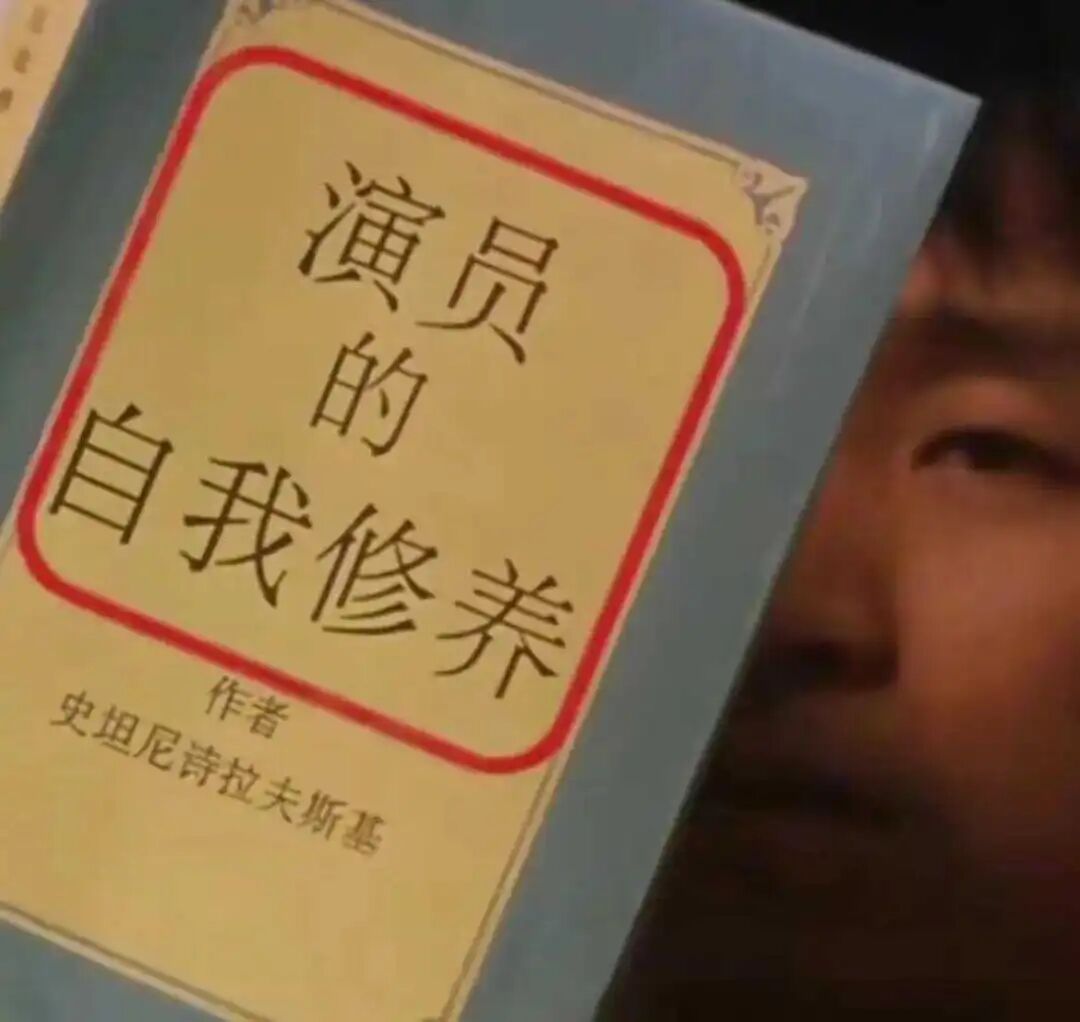
The artistry of performance does not lie in accurately completing actions or delivering lines but in actors drawing from their own life experiences to produce genuine "here and now" reactions in their roles. Directors may obsessively film a scene dozens of times, each take containing subtle differences—this reflects the creator's unique vision and includes the actor's accidental breakthroughs under unexpected circumstances. Human struggles and limitations become the nourishment for performance.
Such reactions are spontaneous, irreplicable, and full of human flaws. For example, in *Comrades: Almost a Love Story*, Maggie Cheung's uncontrollable laughter upon seeing a Mickey Mouse tattoo while identifying a body accidentally added layers of richness that the script had not intended.
AI lacks such "accidents."
It can "perform" the same scene countless times without fatigue or complaints, but the "one-time" and "irreversible" nature of human performance disappears. Its ultimate effect still depends on how human creators define and guide it.
Over 2,300 years ago, Aristotle said, "Drama is the imitation of an action." Using a living being to imitate the traces of another's existence is, at its core, using one life to enlighten and awaken another.
AI artists represent the opposite of this "biological" logic—using lifeless forms and symbols to assemble representations of living beings.
Gong Yu calculates costs: unit content costs drop by an order of magnitude, while output increases by two orders of magnitude. But he fails to calculate another cost: when viewers realize they're being fooled by AI faces, they will vote with their feet.
AI is not unusable; the question is how to use it.
Youku positions itself as "democratizing creation," Tencent emphasizes "higher thresholds for quality content," Enlight invests 320 million in IP development, using AI as an assistant but not a replacement for humans. iQIYI's approach, however, is to replace actors, filming, and even creation itself.
 This Controversy Demands iQIYI's Serious Attention
Tencent has a video ecosystem, gaming, and WeChat; Youku is backed by Alibaba; Mango TV has broadcasting resources; Bilibili has a unique community. What does iQIYI have? Baidu.
Once, iQIYI was Baidu's most successful investment outside of search. Founded in 2010 and listed in 2018, Gong Yu was personally chosen as CEO by Robin Li. At the time, Baidu was thriving, with money, patience, and traffic to direct.
But Baidu's current focus does not lie with iQIYI, which seeks a secondary listing in Hong Kong to raise funds. Capital markets ask: What's your story? Where's the growth? How will you generate profits?

Regardless, the growth story for iQIYI does not lie in AI artists.
In the internet industry, user trust is more valuable than traffic, content quality outweighs quantity, and strategic resolve matters more than chasing trends.
Gong Yu said, "The essence of good content will always be story, character, and emotion." But when "characters" become code, "emotion" becomes an algorithm, and "story" becomes data, why should viewers pay for "electronic tears"?
It might be better to focus on making one good drama at a time.
-
![]()
Proposed to Raise 955 Million Yuan through Private Placement! Huicheng Vacuum Boosts Localization of Ultra-Precision Optical Coating Equipment
-
![]()
Cash Flow Soars 13-Fold! What Major Strategic Move is Wuhan Five Square Optoelectronics Planning?
-
![]()
Leaked Design of vivo X500: Reverts to Circular Camera Module in Top-Left Corner, Pays Homage to Classic X90 Aesthetic
-
![]()
DeepSeek Shows Signs of Foraying into Code Agents, Launches WeChat Official Account Focused on Harness
-
![]()
Auto Companies Deny Claims That ‘Cooperation with Huawei Is Non-Essential’, as Huawei Transforms into a ‘Public Platform’
-
![]()
Starship to Independently 'Return to the Launch Tower': SpaceX's Ambitions Extend Beyond Rocket Building to Dominating Space Transportation
-
![]()
Starship Set to Independently 'Return to the Launch Tower': SpaceX is Revolutionizing Space Transportation, Not Just Building Rockets
-
![]()
Anthropic and OpenAI Face Off Against Deepseek